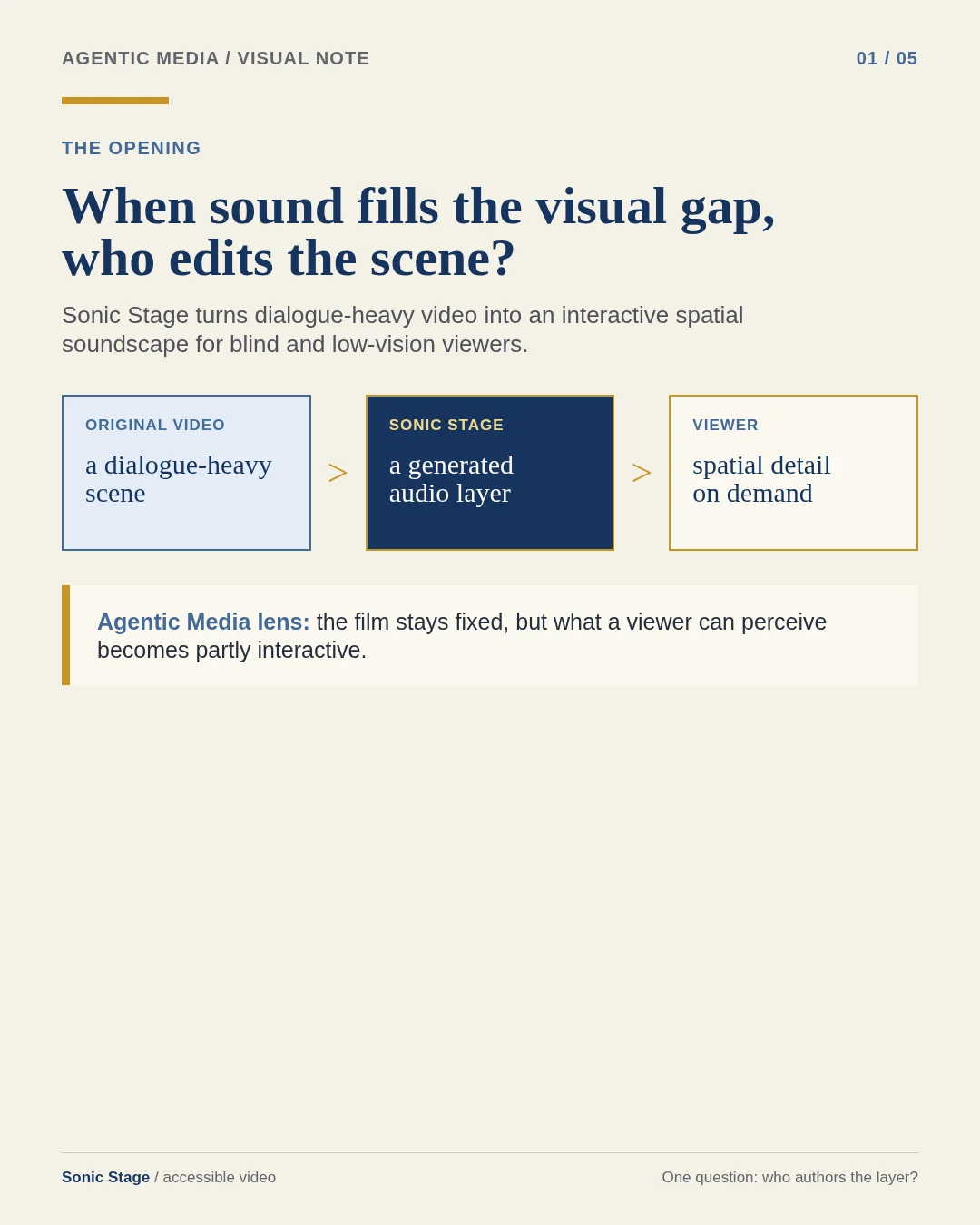

Sonic Stage is a research system from HKUST, Columbia University, and the University of Rochester that turns dialogue-heavy video into an interactive spatial soundscape for blind and low-vision viewers. Its arXiv version was revised on July 30, 2026, and the project page lists UIST 2026. 12
The design has three layers: spatialized dialogue to place voices, diegetic sound to cue actions, and interactive descriptions for on-demand visual detail. The system reconstructs a shared 3D scene so those cues stay coherent across camera changes. 1
In a 12-person BLV user study across 16 dialogue clips, position, movement, action, and visual-detail understanding improved against a baseline, along with spatial presence and narrative engagement. Objective dialogue recall did not differ significantly. I read this as a bounded Agentic Media edge, not full autonomy: the media object responds to a viewer's tap, while the underlying film and its limits remain designed. 1
Would you want one film to offer multiple sensory versions? Who gets to decide whether an added sound is faithful accessibility design or a new editorial choice?
References
- 1
- 2Sonic Stage project page
shuchangxu.github.io
Comments