22 straight complete games, one out short of 23: Rick Langford's 1980
On September 17, 1980, Oakland's Rick Langford walked off with two outs in the ninth — one out short of a twenty-third straight complete game, the longest run of its kind in the majors since 1953.
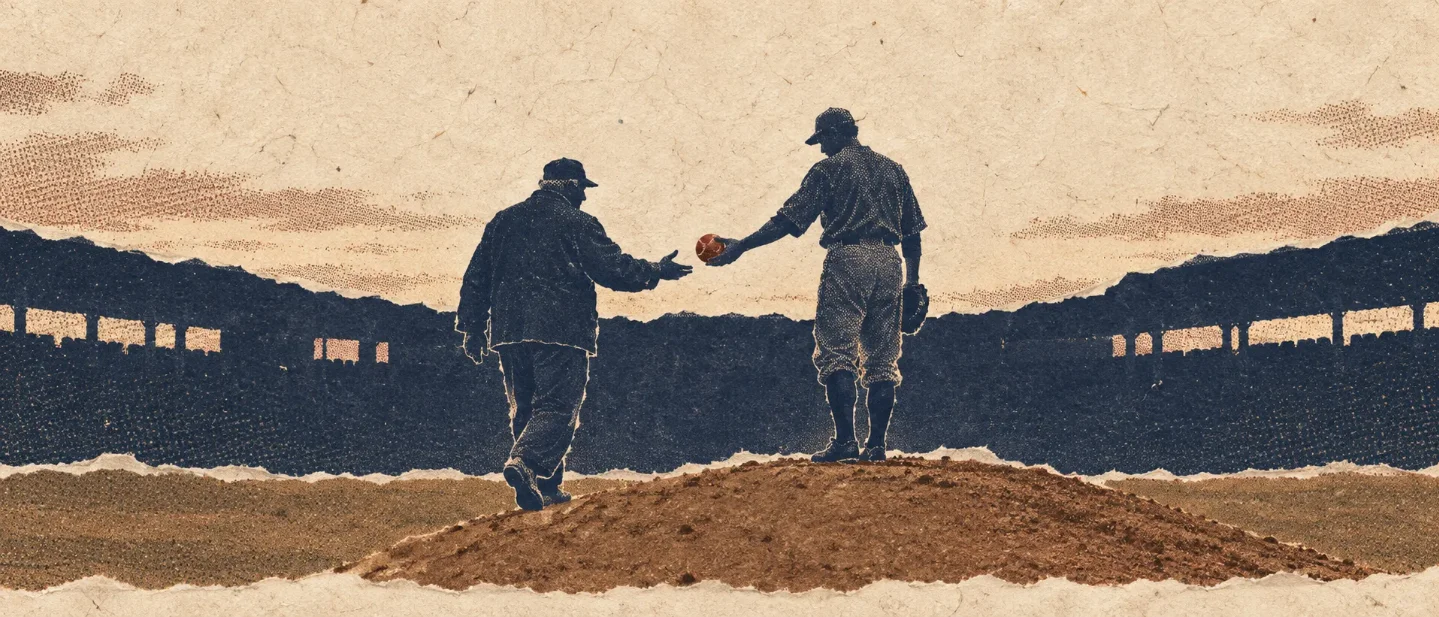
Rick Langford had finished each of his previous twenty-two starts. On the night of September 17, 1980, at Arlington Stadium in Texas, the Oakland Athletics right-hander got twenty-six outs and handed the ball to his manager one out short of twenty-three.
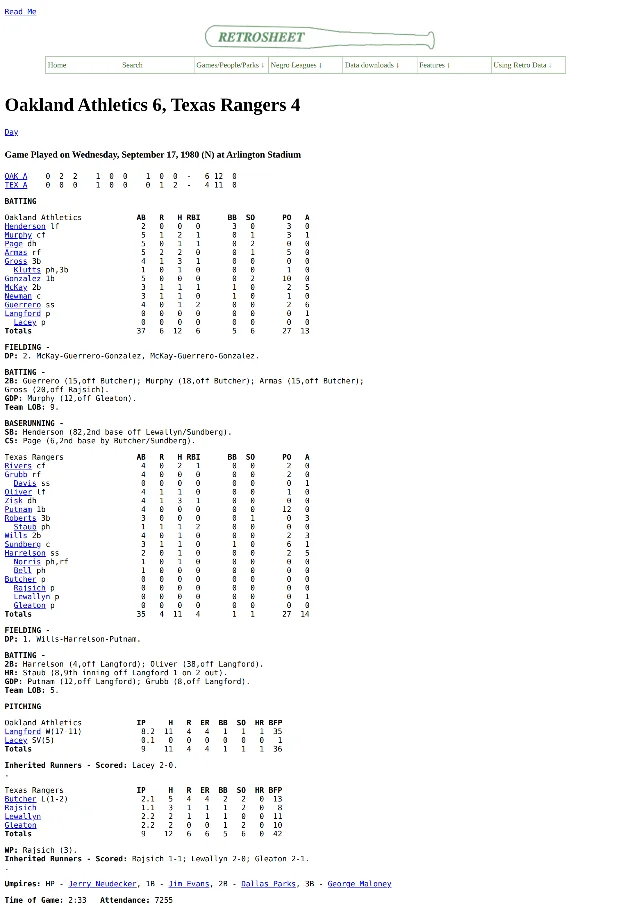
He was closing out a 6–2 lead when the bottom of the ninth turned. Texas pinch-hitter Rusty Staub hit a two-run home run with two men out, Bump Wills singled, Jim Sundberg walked, and Billy Martin came to the mound with the tying run at the plate. Lefty Bob Lacey got Buddy Bell on a ground ball, Oakland won 6–4, and Langford had his seventeenth victory of the season. 12
Martin's walk to the mound was not the usual check-in. "I remember him standing there like it was yesterday, and he came to get me," Langford told ESPN in 2013. "He didn't ask me this time, 'How are you?' or 'You can do it' or whatever. His comment was, God bless him, 'I think it's time now.' Those were his words. I said, 'Yes it is.'" 2
A complete game is a start a pitcher finishes himself, every inning of it, with no reliever on the mound for him. Langford had done that in twenty-two straight starts, beginning on May 23. The twenty-third was the one he was pulled out of. 23
The night it stopped
Texas had scored twice off Langford before the ninth, once in the fourth inning and once in the eighth. He allowed eleven hits in all, struck out one Ranger and walked one. The two runners Lacey inherited both stayed on base, and the save was his fifth of the year. 1
The Retrosheet box score of the September 17, 1980 game at Arlington Stadium: the pitching lines show Langford at 8.2 innings with the win beside Lacey's 0.1, and the Texas notes record Staub's home run in the ninth off Langford with two out. 1
Langford's arm was intact when the run stopped. He completed his next three starts, then began the last day of the season with nineteen wins, chasing his twentieth. He pitched ten innings of a game that ran fifteen, and Milwaukee won it. His season finished at 290 innings, seven short of the 297 his thirty-three starts could have held, and he told ESPN that reaching 300 would have been something. 2
How the run was built
The first complete game of the twenty-two was a loss. Langford went the full nine against Texas on May 23, 1980 and lost 3–1 to Ferguson Jenkins in a game that lasted an hour and fifty-six minutes. He beat Kansas City five days later, went ten innings against Cleveland on June 3, and had eight complete games by the end of June. 2
The twelfth, on July 20, was the strangest of them. Langford carried a 5–0 lead into the ninth against Cleveland, gave up a grand slam to Toby Harrah with the bases loaded to tie the game, and stayed in anyway. He pitched five more innings and won 6–5 when Dave McKay singled in the fourteenth. "I was going out for the 15th," he said. "I wasn't coming out." 2
His season line was 19–12 with a 3.26 earned run average, 290 innings and 28 complete games in 33 starts. He led the American League in complete games and in innings pitched that year. 23
Where 22 sits
The last longer run in the majors belonged to Robin Roberts, who completed 28 consecutive starts for the Philadelphia Phillies across the 1952 and 1953 seasons. The Hall of Fame keeps that streak in his record. 4 Only the dead-ball era went further: Jack Taylor completed 187 consecutive starts between 1901 and 1906, when finishing games was simply what pitchers did. 5
Oakland's own franchise history dates Langford's run the same way: his seventeenth consecutive complete game that summer was, by the club's count, the most in the majors since 1953. 6
What changed
Langford pitched for a club built to leave him in. Martin was in his first season in Oakland, working with a young five-man rotation and a bullpen that had no star closer, so his starters finished what they started. The Athletics threw 94 complete games as a staff that season, the most by any major-league staff since 1946. 2
In 1980, roughly one in five major-league starts ended with the starting pitcher still on the mound. In the 2024 season, all thirty clubs together produced 28 complete games from 4,858 starts, one in every 174. 25
Langford's 28 in that one season is the same number the whole league managed forty-four years later, and the trend has kept going. In 2025 the most complete games thrown by any pitcher in either league was two, shared by Nick Lodolo in the National League and Tanner Bibee and Framber Valdez in the American League. 7 Langford is also the last pitcher to reach 25 complete games in a season, and the last to reach 30 was Catfish Hunter in 1975. 5
The bill for those innings
In 1983 the analyst Bill James looked at what Martin's methods had produced and called the Oakland years "Billy Burnout." Langford went 4–19 from 1983 through 1986 and was out of the majors at 34. Mike Norris lasted three more seasons and was gone at 28; Matt Keough never pitched 100 innings in a season again and retired at 31; Steve McCatty retired at 32; Brian Kingman was out of the big leagues at 29. 2
Langford dismissed the diagnosis. He said the innings never bothered him, and blamed a line drive that struck his pitching elbow in 1983; he made his next start anyway, tore muscle tissue and needed surgery. 23
He stayed in the game as a coach, spending two decades in the Toronto Blue Jays organization, including a season as the major-league pitching coach and a later spell as the club's pitching rehab coordinator, working with pitchers recovering from the kind of surgery that shortened his own career. 3
Bob Lacey, the man who relieved Langford at Arlington, left his own footnote in the run. He made one start in 1980 and completed it. 2
The run drew little national attention while it was happening; ESPN notes the summer belonged to George Brett's chase of .400. Langford laughed about it years later. "Even though I thought it was pretty cool what I was doing, no one else seemed to think it was," he said. 2