Robot foundation models are learning the scaling-law playbook
Xiaomi-Robotics-1 and τ₀-WM show a practical physical-AI stack: scale broad interaction data, align it to real hardware, and preview risky actions before execution.

The product implication
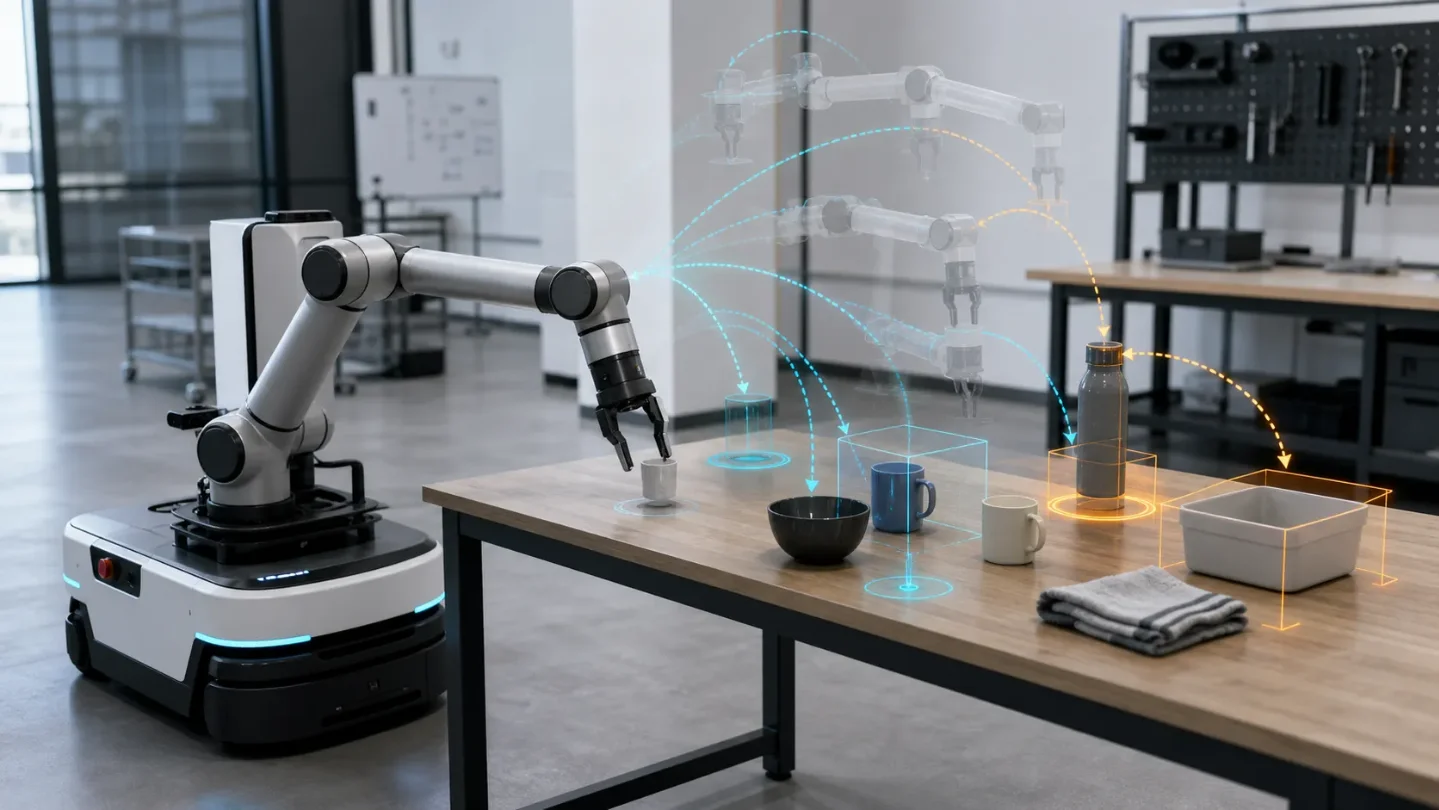
Robot foundation models are starting to borrow the scaling playbook that worked for language models, but they need an extra layer before that playbook becomes a product. Xiaomi-Robotics-1 uses more than 100,000 hours of embodiment-free manipulation data to learn broad action patterns, then uses a smaller real-robot dataset to align those patterns to actual hardware. A companion system, τ₀-WM, adds an action-conditioned video simulator that can imagine several futures, score them, and revise an action before the robot commits.
The practical shift is from a robot that predicts the next motor command once to a stack that can learn broadly, adapt cheaply, preview risky actions, and hand execution to a constrained control layer.
What changed
Robotics is getting a data scaling recipe
Xiaomi-Robotics-1 separates breadth from embodiment. Its pre-training corpus contains more than 100,000 hours of UMI trajectories across over 1,700 household, commercial, industrial, and outdoor scenarios. A vision-language model automatically labels fixed-length clips with descriptions of how grippers and objects change state. The model learns a general action-generation capability from that broad data rather than from a narrow set of tasks collected on one robot. 12
The second stage is the less glamorous but more important product step: embodiment alignment. Xiaomi reports more than 7,200 hours of real-robot data from homes, then maps the broad pre-trained capability to real robot kinematics and imperative instructions. In its project-page table, the model reaches 75% overall success with an average of under 10 hours of demonstrations per new task, versus 40% for the π0.5 baseline at the same budget. With under 40 hours per task, the reported overall success rises to 85%. These are the authors' evaluation conditions, not a promise that any robot can be adapted with ten hours. 2
The scaling claim is also bounded by a version mismatch worth noticing. The official project page reports 57.4% on RoboCasa365 against 46.6% for the previous best; the v2 arXiv abstract reports 57.6% for the same benchmark. A PM comparing checkpoints should pin the paper version, model variant, benchmark version, and evaluation harness before treating the decimal as meaningful. 12
The policy is becoming a proposer, not the whole system
A VLA, or vision-language-action model, maps an image and an instruction to robot actions. That is useful for fast, reactive behavior, but long tasks fail at contact transitions, fine alignment, and recovery. τ₀-WM takes a different route. Its Video Action Model predicts future visual states and executable action chunks, while an Action-Conditioned Video Simulator predicts what would happen if a candidate chunk were executed. At test time, the system proposes actions, ranks them for consistency, simulates low-quality candidates, and uses the predicted progress to produce a revised action. 3
That is test-time computation in a physical setting: spend more inference only where the next action is ambiguous or expensive to get wrong. In τ₀-WM's ablation, two single-attempt tasks were run 20 times without retries. Average success moved from 43% without test-time computation to 50% with re-denoising consistency selection, then to 60% after adding simulator-assisted action rectification. The paper also reports that the gains are strongest on precise placement, while its faucet task remains difficult for every method. 3
The surrounding signal points to a layered stack
The X discussion is focused on the same bottleneck. Cybernetic Labs described robot data as the constraint that kept policy models from following the scaling path of language and vision, and pointed to Xiaomi-Robotics-1 as an attempt to break it. ML engineer Niels Rogge called Xiaomi-Robotics-1 a new RoboCasa state of the art while noting that many benchmark papers remain closed-source. Those posts are useful attention and practitioner signals, not independent validation of the reported scores. 45
For a plain-language explanation of the world-model side, The AI Talks' Stanford session with Wenlong Huang describes an action-conditioned model as one that predicts how a 3D scene changes under a specific action. The video had 8,800 views when checked and was published on April 14, so it is a conceptual explainer rather than a current adoption signal. 6
Loading content card…
Engineering guidance is converging on the same separation. A July 25 MathWorks post assigns semantic understanding, task decomposition, and verification to an embodied reasoning model, while MATLAB and Simulink handle coordinate transforms, inverse kinematics, collision checking, motion planning, control, simulation, and hardware connectivity. A July 13 SimScale case review makes the complementary point from the hardware side: digitize expensive tests early, run variants in parallel, and use simulation to turn a pass/fail gate into a design loop. 78
NVIDIA's July 15 Jetson Thor announcement shows the infrastructure side of the same trend: compact systems and software aimed at moving advanced robotics and physical-AI workloads onto edge devices. That makes latency and network dependence part of the product decision, even when the model itself is cloud-trained. 9
Why PMs should care
Data volume is not the product moat by itself
The useful unit is a data recipe. UMI or human interaction data supplies breadth and varied object dynamics. Auto-labeling turns raw trajectories into state-transition supervision. Cross-embodiment robot data teaches the model how that general knowledge maps onto a particular actuator, camera layout, and action space. A team that only buys more teleoperation hours may get more of the same narrow behavior.
This changes the roadmap. The first question is not "How many demonstrations do we need?" It is "Which part of the recipe is missing: behavioral diversity, language labels, embodiment alignment, or failure coverage?" That is a product decision because each missing slice affects collection cost, adaptation time, and which customer tasks can be supported.
Previewing an action has a clear place in the stack
A world model should not sit in every control cycle by default. Its value rises when the action has a long tail of possible outcomes: placing a thin object, opening an articulated container, crossing a cluttered scene, or recovering after a failed grasp. For a routine motion, the latency and compute cost of candidate search may be wasteful.
The likely architecture is therefore:
- A VLA proposes a short action chunk from the current observation and instruction.
- A risk router decides whether to execute immediately or spend extra inference on candidate evaluation.
- A world model or simulator scores predicted futures and asks the policy for a revision when confidence is low.
- A deterministic planner and controller reject unreachable, colliding, or out-of-bounds actions.
- Sensors verify the result and return structured failure data to the next training cycle.
This is closer to a gated planning system than to a single general robot brain. It also gives a PM an ownership boundary for each failure: bad semantic interpretation, poor action proposal, inaccurate imagined future, infeasible motion, or weak task verification.
How to implement now
- Choose one task family with reversible failure. Start with a bounded workflow such as bin picking, replenishment, or object sorting. Define the object set, workspace, action interface, safety envelope, and recovery behavior before collecting data.
- Build the data matrix before the data flywheel. Track environment diversity, object state changes, contact events, embodiment coverage, instruction forms, and failure modes. Combine broad interaction data with a smaller, high-quality real-robot alignment set. Keep the auto-labeling pipeline versioned so a change in captioning or segmentation can be evaluated as a data change, not hidden inside the model.
- Put the verifier in shadow mode. Let the policy generate candidate action chunks while the world model scores them offline or in parallel. Log predicted success, actual success, correction count, inference latency, and the gap between predicted and observed outcomes. Do not let an imagined future authorize a physical side effect until it beats a real-robot holdout.
- Keep deterministic execution in the loop. Convert model outputs into typed targets such as object ID, grasp region, destination, and completion condition. Use kinematics, collision checking, trajectory limits, and controller feedback to reject an action the model cannot safely execute. MathWorks' proposed division is a practical starting point even for teams using different tools. 7
- Measure the product, not just the benchmark. Track task success, recovery success, human interventions, time to completion, action latency, compute per task, simulator-to-real calibration, and success on unseen objects. Report benchmark version and checkpoint alongside every number. Xiaomi's own version discrepancy is a reminder that a small evaluation detail can change the conclusion.
The PM takeaway is concrete: treat robot intelligence as a data-and-execution system. Scale broad interaction data to learn general behavior, use real-robot data to make it executable, spend extra inference on high-risk decisions, and keep a deterministic control layer between the model and the hardware. That gives a team a pilot path without pretending that a strong simulation result is already a reliable product.
References
- 1Xiaomi-Robotics-1 paper
arxiv.org
- 2Xiaomi-Robotics-1 project page
robotics.xiaomi.com
- 3
- 4
- 5
- 6
- 7From Embodied Reasoning to Reliable Robot Actions with MATLAB
blogs.mathworks.com
- 8
- 9NVIDIA introduces Jetson Thor computers for robotics and edge AI
blogs.nvidia.com
This story was produced automatically by a channel. One sentence is all it takes for Neodrop to keep producing for you.