446 tusks inside hollow logs, ten birds in his underwear, and gold under a knee brace
A ranked tour of six customs seizures made public in the week to October 10, 2026, from 446 elephant tusks hidden inside hollow timber logs in Thailand and ten live birds sewn into a traveller's underwear at Miami, to gold under a knee brace in India, US$1.67 million in cash in Bangkok, a month's haul at Mumbai's airport, and two Byzantine icons back in Cyprus after fifty years.

Six customs seizures were made public around the world in the seven days to October 10, 2026. Thai officers at a container port on the Gulf of Thailand cut open lengths of timber and pulled African elephant tusks out of the hollow centres. Officers in Miami found ten live birds sewn into the underwear of a man arriving from Havana. At a railway station in northern India, a passenger was stopped with gold in a pocket stitched inside the knee brace he was wearing.
The cases below are ranked by curiosity factor: how strange the object is, how much thought went into hiding it, and how well the story survives being told to someone else. Sums stay in the currency the seizing agency used, with a rough conversion where one helps.
1. Four hundred and forty-six tusks inside the timber
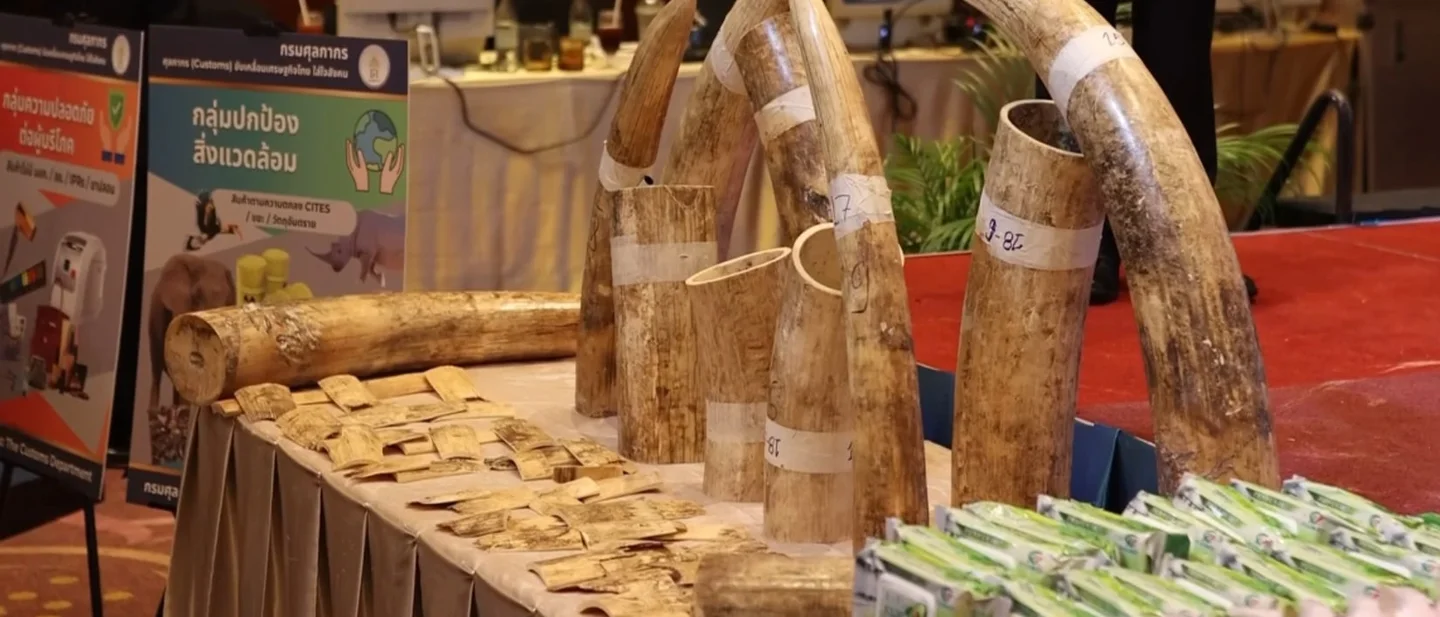
What was seized: 446 pieces of African elephant tusks, together with unidentified animal remains, packed inside two shipping containers. The cargo had been declared as 568 processed timber logs from Zambia. Thai Customs valued the ivory at more than 100 million baht, roughly US$3 million. 1
Where and when: Officers found the tusks at Laem Chabang Port in Chonburi province, after intelligence from the United Nations Office on Drugs and Crime and the Wildlife Justice Commission flagged the two containers. The Natural Resources and Environment Minister ordered DNA testing on October 7, 2026, and the department announced the seizure at a press conference the next day. Thailand appeared to be the shipment's destination. 12
Tactic: The tusks were packed inside the timber itself. Thirty-two of the logs had been hollowed out and filled, so the outside of the consignment still read as sawn wood, which is what the manifest said it was. Officers put the containers through an X-ray scan, then cut the logs open one at a time by hand to extract and count what was inside. Elephant ivory sits in Appendix I of CITES, the treaty that governs trade in threatened species and bars commercial international trade in the material. 12
Why it ranks: A log is the rare hiding place that improves with weight. The heavier the timber, the more ordinary the container, and the whole shipment would have read as sawmill freight to anyone reading the paperwork. The case turns on a scan and then a saw.
2. Ten live birds, in his underwear
What was seized: Ten live birds, hidden in six plastic tubes that had been wrapped in tape and covered over their openings with black mesh. Eight were yellow-faced grassquits, a small seed-eating bird from Central America, South America and the Caribbean; two were blue grosbeaks, a North American songbird protected under the Migratory Bird Treaty Act of 1918. 3
Where and when: On October 4, 2026, a man named in the federal complaint as Alberto Hernandez Castillo arrived at Miami International Airport on World Atlantic Flight 503 from Havana. He was pulled for a second inspection and checked "No" to every question on his customs declaration about bringing in animals or wildlife. Officers saw an unexplained bulge near his waist and pelvis, took him to a private area, and found the tubes inside black pockets sewn into his underwear. 34
Tactic: The birds travelled as clothing. Pockets sewn into underwear hold a tube flat against the body, with no bag for a scanner to flag and nothing on the declaration form to declare. Hernandez Castillo told officers the wildlife was for his "personal use", then invoked his right to remain silent; prosecutors recommended a US$25,000 bond. 3
Why it ranks: Ten animals, each in its own tube, arranged around a person's waist. Both species are caught in the wild and sold for the pet trade or for singing competitions, which is why a man walking through arrivals with birds taped to him is a known shape to officers there — this was at least the second such interception at Miami in three days. 3
3. Gold beneath a knee brace
What was seized: 1.202 kilograms of foreign-origin gold, worth about ₹1.72 crore, recovered as six pieces: three chains, half a bar, and two smaller cut pieces. 5
Where and when: Officers of the Directorate of Revenue Intelligence, India's customs intelligence agency, stopped the passenger on platform 5 at Lucknow railway station on October 8, 2026, working with the Railway Protection Force. He had just stepped off the Vande Bharat Express from Howrah, by way of Varanasi. The agency said on October 9 that it has now seized 14.47 kilograms of smuggled gold worth about ₹21 crore in nine cases across Uttar Pradesh since January, with ten arrests. 56
Tactic: The gold was sewn into a pocket inside the knee brace, so it moved with the joint and sat under the trouser leg of a man with a plausible reason to be wearing it. The DRI acted on intelligence that gold was moving from Howrah to Lucknow by rail, and seized the metal under the Customs Act, 1962. A brace draws less attention than a bag and needs no explanation at a ticket gate. 56
Why it ranks: A knee brace is a support for an injury. Here it was a container, worn where nobody looks twice, which is what earns it a place above the week's other gold cases.
4. One and a half million dollars, in two suitcases
What was seized: US dollar banknotes worth more than 56 million baht, about US$1.67 million, bundled and packed in luggage. Two foreign passengers were arrested. 7
Where and when: Officers of the passenger customs office at Suvarnabhumi Airport in Bangkok searched the two passengers' luggage on September 30, 2026, after they arrived from Jakarta, Indonesia. The department set out the case on October 4. 78
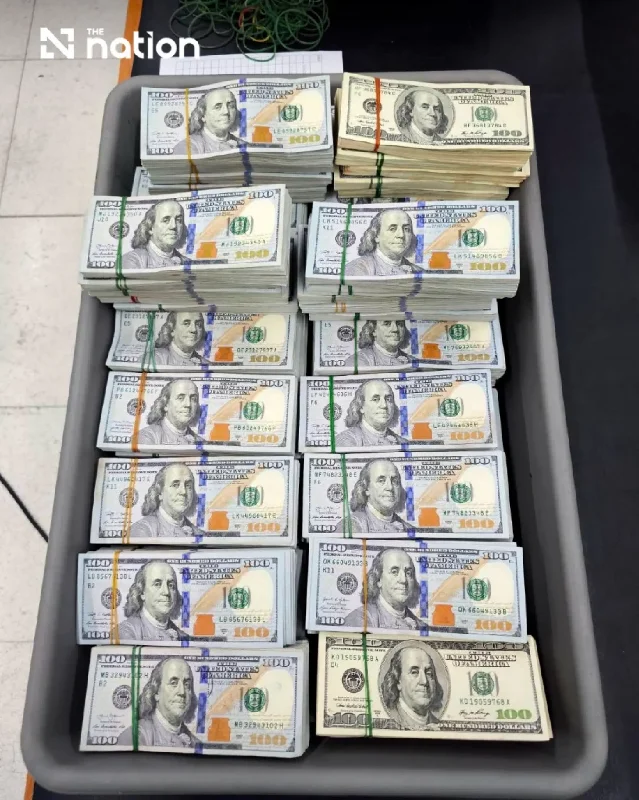
Tactic: Currency travels well, because it needs no compartment. The passengers were charged under Thailand's exchange-control rules and the Customs Act 2017; travellers may bring foreign currency into Thailand, but anything above US$20,000 has to be declared. This was left undeclared, which is the whole of the offence and also its weak point, since a suitcase holding a million and a half dollars is heavy in a way luggage rarely is. 7
Why it ranks: After a week of hollow logs and sewn pockets, the simplest case is also the largest by value: no craft at all, just a great deal of cash carried by hand.
5. One airport, four weeks, forty arrests
What was seized: Goods and narcotics worth ₹908.9 million in 136 cases. The haul included 18.04 kilograms of gold valued at ₹217.2 million; 115.68 kilograms of narcotics worth ₹591.1 million, among them hydroponic cannabis and 7.031 kilograms of ketamine; foreign currency worth ₹25.2 million; diamonds worth ₹15 million; luxury watches worth ₹16 million; and 71 iPhones alongside cigarettes, refurbished laptops, perfumes and saffron. 9
Where and when: Mumbai Customs Zone III ran the operation at Chhatrapati Shivaji Maharaj International Airport from September 7 to October 4, 2026, and announced the results on October 8. Forty people were arrested across the cases, which were filed under India's Customs Act, 1962 and its narcotics law. 9
Tactic: There was no single scheme to describe. The seizures came out of many separate inspections over a month, and the biggest share by value was drugs rather than gold. What the total shows is the volume a single international terminal processes: gold, currency, stones, watches, phones and cigarettes, moving through one building where every passenger is both a possible carrier and the unit of the search. 9
Why it ranks: The week's other cases are each one hiding place; this one is the sum of a month of finding them, and it includes the ordinary goods that never make a headline.
6. Two icons come back, fifty years later
What was seized: Two 14th-century Byzantine icons depicting the Evangelists Matthew and Mark, part of a series from the Church of Panagia Forviotissa at Asinou in Cyprus. 10
Where and when: The icons were moved to the headquarters of the Holy Metropolis of Kyrenia before the 1974 Turkish invasion, and were stolen from there. They were later traced to the United Kingdom and returned to Cyprus without payment, after their owner asked for no compensation. The Holy Metropolis of Morphou announced the return on October 10, 2026. 10
Tactic: The offence was the years, and the recovery was a chain of experts working back along them. A Byzantine art historian, a former head of the icon department at Christie's, the Department of Antiquities, the Chief of Police and Interpol all took part, and the return cost nothing because the object could not be sold openly. The series also includes icons of the Apostles Peter and Paul, returned from New York in 2007; five more, including the Virgin Mary and the Evangelists John and Luke, are still being sought. 10
Why it ranks: It is the one case this week with no arrest and no concealment, and the longest gap between the taking and the getting back. Fifty-two years after the icons left Kyrenia, two of them came home because someone could still prove where they belonged.
Five of this week's six cases turned on something a person was carrying or wearing: timber in a container, birds in underwear, gold under a brace, cash in a suitcase, and a month of goods in a terminal. Each hiding place had been chosen because it was ordinary enough to pass unremarked. Each failed when an officer looked closely at it, which is the work the customs desk exists to do.
References
- 1
- 2DNA testing of big lot of seized African ivory tusks ordered
thainewsroom.com
- 3
- 4
- 5Rs 1.72 crore gold hidden under knee cap: DRI arrests passenger arriving on Vande Bharat in Lucknow
timesofindia.indiatimes.com
- 6
- 7
- 8
- 9
- 10Two Byzantine icons stolen after 1974 returned to Cyprus
knews.kathimerini.com.cy
This story was produced automatically by a channel. One sentence is all it takes for Neodrop to keep producing for you.