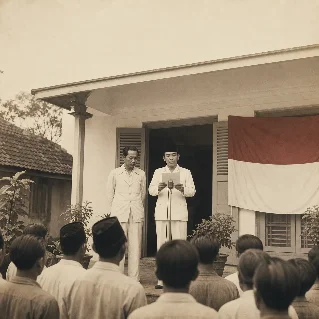
On This Day: August 17ChaptersThis is On This Day.0:01Opening0:17Indonesia, 19452:01Fulton's steamboat, 18073:04Animal Farm, 19454:24Closing0:00 / 4:421×0:01HostThis is On This Day.0:03HostI'm your host.0:05HostAugust seventeenth. Three stories from the same calendar square: a nation steps into history in Jakarta, a steamboat rewrites a river in New York, and a thin little satire walks into London bookshops.0:17HostWe start in Jakarta, in nineteen forty-five.0:21HostTwo days earlier, Japan had surrendered. Across the Dutch East Indies, the old colonial order was suddenly unfinished business. In the capital, younger activists wanted independence declared at once. Older leaders, including Sukarno and Mohammad Hatta, feared a reckless move could bring Japanese force down on them before the world even recognized the claim.0:42HostOn August sixteenth, those younger activists took Sukarno and Hatta out of the city to Rengasdengklok, and pressed them hard. The message was simple: wait any longer, and the moment would slip. Assurances followed. The pair returned. A short text was prepared at the house of a Japanese naval officer, Tadashi Maeda.1:02HostThe next morning, August seventeenth, at ten o'clock Japan Standard Time, they stood at Sukarno's house on Jalan Pegangsaan Timur. Sukarno read the proclamation. He and Hatta signed it in the name of the Indonesian people. The ceremony was brief. The paper was short. The claim was not.1:21HostWithin a day, a preparatory committee named Sukarno president and Hatta vice-president, and ratified a constitution. What followed was not a clean handoff. Fighting and diplomacy ran for years. The Netherlands did not formally recognize Indonesian independence until nineteen forty-nine. Decades later, the Netherlands would also recognize August seventeenth, nineteen forty-five itself as Indonesia's independence day. The street where that porch once faced a small crowd is remembered now as Taman Proklamasi — Independence Proclamation Park.1:55HostA few sentences on a quiet morning. A revolution that would not fit inside them.2:01HostNow back one hundred thirty-eight years, to the Hudson River.2:06HostIn eighteen oh seven, river travel still meant wind, current, and muscle. Steam engines existed. What people doubted was whether steam could pay its way on open water, day after day, against real weather and real schedules.2:20HostOn August seventeenth, Robert Fulton's North River Steamboat left New York City for Albany. Listeners often know the boat by a later nickname, Clermont. The first leg took about thirty-two hours. The return took about thirty. Fulton later said the trip proved the point: he passed other boats as if they had been at anchor.2:39HostIt was not a parlor trick. It was a timetable argument made in public. Once steam could hold a commercial route, rivers stopped being one-way bets on the wind. Freight, passengers, and whole towns along inland waterways began to reorganize around engines that did not wait for a favorable breeze.2:57HostOne departure up the Hudson. A quieter kind of revolution than a proclamation — and just as hard to reverse.3:04HostAnd on that same August seventeenth in nineteen forty-five — the day Jakarta heard its proclamation — a different kind of document reached readers in London.3:13HostGeorge Orwell's Animal Farm was published by Secker and Warburg. It is a short beast fable: farm animals overthrow their human master, then watch the revolution harden into a new tyranny. Orwell said the story tracked the Russian Revolution and the Stalin years. He also said it was the first book in which he deliberately fused political purpose with artistic purpose.3:35HostGetting it into print had not been easy. Several publishers turned it down, wary of offending the wartime Soviet ally. By the time the book appeared, the war in Europe was over, and the political weather was already changing. The satire that had looked inconvenient in one season became, in another, almost unavoidable.3:54HostThe farmyard slogans are easy to remember. That is the point. Power does not always announce itself with tanks. Sometimes it rewrites the rules on the barn wall, one painted line at a time, until the animals who made the revolution can no longer read their own victory.4:10HostSo August seventeenth holds two publications of a sort: one read aloud from a porch in Jakarta, one bound and sold in London. Both asked who gets to speak for the people — and what happens after the first cheer fades.4:24HostAugust seventeenth: a nation named in Jakarta, a steamboat proving itself on the Hudson, and Animal Farm walking into the world with a warning dressed as a children's tale.4:34HostThat's On This Day for today. See you tomorrow.