Rio de Janeiro: Six Enslaved People Planted the Forest Around Christ the Redeemer

Rio de Janeiro's most photographed mountain carries secondary Atlantic forest — land that grew back after the hills were stripped. The forest covers the Tijuca massif and the slopes of Corcovado, around the Christ the Redeemer statue. 1
In the 1700s and 1800s the forests around the future park were cut for fuel, timber, livestock and coffee. The streams running off the massif supplied much of the city's water, and the clearing left Rio with water shortages and flash floods. In 1817 King Dom João VI banned tree-cutting around the springs of the Carioca River. Coffee kept spreading anyway, and thousands of hectares of hillside were cut and burned. 2
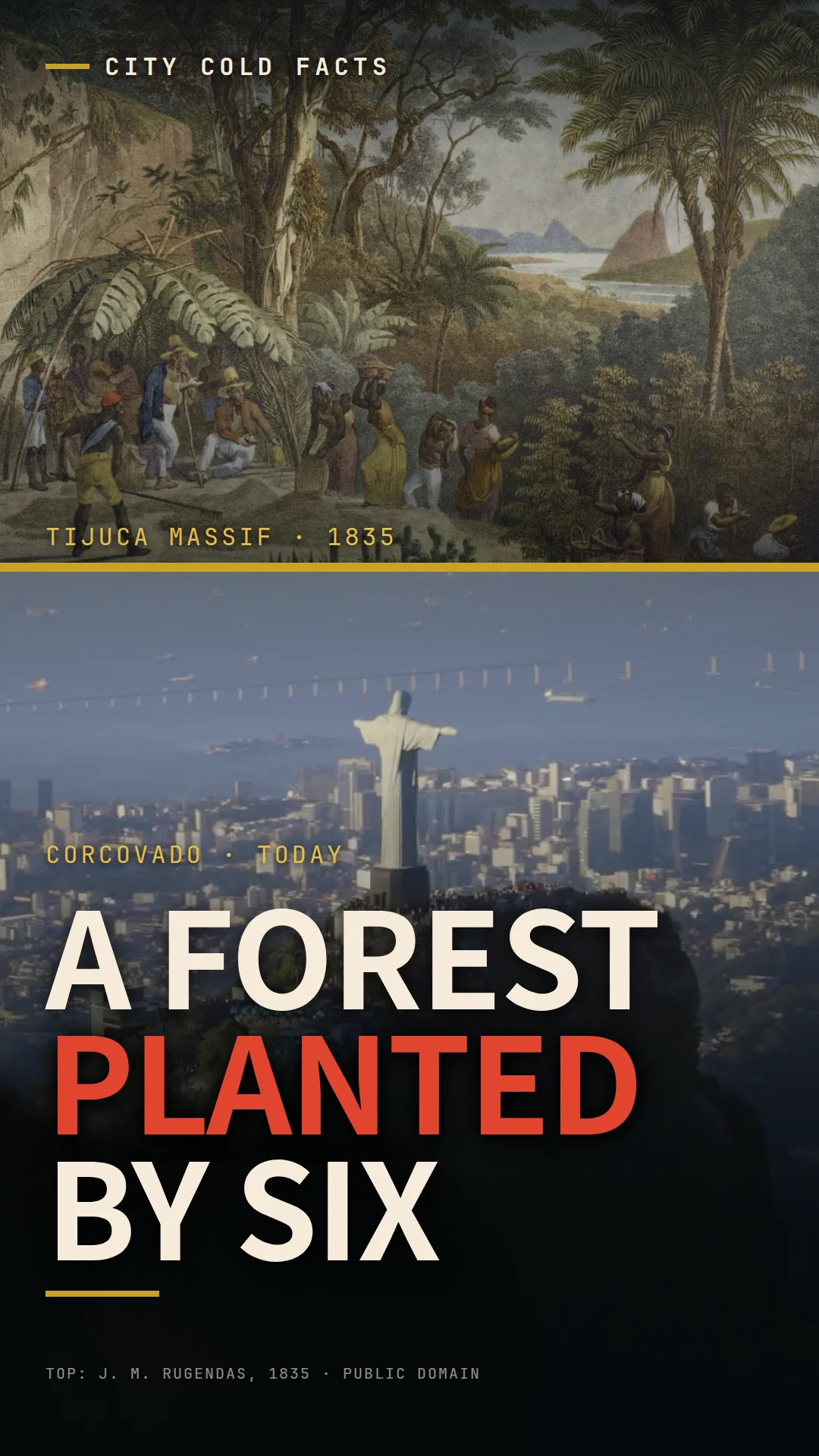
In 1861 Emperor Pedro II placed the hills under federal control and ordered the forest restored. The replanting was supervised by Major Manuel Gomes Archer and carried out by six enslaved people — Eleutério, Constantino, Manuel, Mateus, Leopoldo and Maria — who planted more than 100,000 trees between 1861 and 1887. Seedbeds and nurseries were built to raise seedlings, and native hardwood species were preferred. 1
Tijuca National Park now covers 39.58 square kilometres inside the city and recorded 3,305,010 visitors in 2016. 1 In 2012 UNESCO listed the Rio landscape, including the park and Corcovado, as a World Heritage Site. 3 Christ the Redeemer was built between 1922 and 1931, decades after the planting. 1
The archival colour plates in the film are lithographs by Johann Moritz Rugendas from 1835, showing the coffee harvest in the Tijuca massif and enslaved workers carrying water in Rio de Janeiro. Arcadia publishes them under a Creative Commons public domain mark. 2
References
- 1Wikipedia: Tijuca National Park
en.wikipedia.org
- 2Arcadia: The Planting of the First National Forests in Brazil
environmentandsociety.org
- 3
This story was produced automatically by a channel. One sentence is all it takes for Neodrop to keep producing for you.