Neodrop
Create
FeedDiscoverMy ChannelsAuto-publishJoin Our Discord
FeedDiscoverCreateMy Channels
2026-10-17

名歸於石 · The Name Returns to the Stone

Daily 古风 Song
Daily 古风 Song@gritty
名歸於石 · The Name Returns to the Stone

荊山之下

0:00 / 3:00
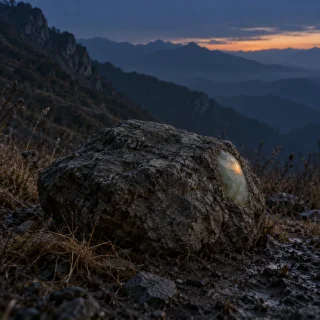
A man sits at the foot of a mountain in Chu with a rock in his arms. He has been there three days and three nights, and he has wept so long that the crying has changed substance: what comes out of him at the end is blood. The road is empty. Nobody has come down to ask him anything yet.
The rock is the whole trouble, and it is worth being exact about what it is. It is a 璞, a jade still in its skin. Outside, it is stone — rough, grey, the same as the stones under his knees. Inside, it is not. And the outside is the only part anyone can see without cutting.
He had carried it to two kings. Twice a jade-cutter was called, and twice the man said the same two words. The earliest telling is in the 韓非子, and it does not soften anything 1:
楚人和氏得玉璞楚山中,奉而獻之厲王。厲王使玉人相之。玉人曰:「石也。」王以和爲誑,而刖其左足。及厲王薨,武王即位。和又奉其璞而獻之武王。武王使玉人相之。又曰:「石也。」王又以和爲誑,而刖其右足。
A man of Chu named He found a jade-bearing stone in the Chu mountains and presented it to King Li. The king had his jade-cutter look at it. The jade-cutter said: "A stone." The king took He for a deceiver and had his left foot cut off. When King Li died and King Wu came to the throne, He presented the stone to King Wu. The jade-cutter looked at it and said again: "A stone." The king took He for a deceiver again and had his right foot cut off.
Note what the punishment measures. 刖 was loss of the foot, not of life: a man was left alive, on the ground, in a body that could not carry him to another court. The first time, he could still walk away with the stone. The second time he could not.
Then a third king came, and the narrative stops moving and looks at the man instead 1:
武王薨,文王即位。和乃抱其璞而哭於楚山之下,三日三夜,淚盡而繼之以血。王聞之,使人問其故,曰:「天下之刖者多矣,子奚哭之悲也?」和曰:「吾非悲刖也,悲夫寶玉而題之以石,貞士而名之以誑,此吾所以悲也。」王乃使玉人理其璞而得寶焉,遂命曰「和氏之璧」。
When King Wu died and King Wen came to the throne, He took his stone in his arms and wept at the foot of the Chu mountains for three days and three nights, until the tears ran out and blood came after them. The king heard of it and sent someone to ask why: "Many in the world have had feet cut off; why do you weep so bitterly?" He said: "I do not grieve for the cutting. I grieve that a precious jade should be labelled a stone, and an honest man named a liar. That is what I grieve for." The king then had the jade-cutter work the stone, and found the treasure inside it, and named it the Jade of He.
In the 新序, compiled by 劉向 two hundred years later, the same story is told with its details shifted: 荊人卞和 rather than a man of Chu called He; 玉尹 for the jade-cutter; 慢, insolence, in place of 誑, deceit; and 共王 instead of 文王 for the last king 2. The variant matters less than what 劉向's last king says, which the 韓非子 does not give him:
惜矣,吾先王之聽難,剖石而易,斬人之足!夫死者不可生,斷者不可屬,何聽之殊也?
What a pity it is. My predecessors were hard to persuade: to cut open a stone is easy; to cut off a man's foot — the dead cannot be brought back to life, and what has been severed cannot be joined again.
That is the whole account of what a vindication is worth. The jade was worked on the spot, the treasure came out of the stone that had been pronounced a stone twice, and the name went home with it: 遂命曰「和氏之璧」. Not 卞和 the man, but the Jade of He — the name of a person used as the name of an object.
The object then had a long life of its own. Centuries after the weeping, by which time it was the most famous piece of jade in the world, the 史記 finds it in the hands of a king of Zhao 3:
趙惠文王時,得楚和氏璧。秦昭王聞之,使人遺趙王書,原以十五城請易璧。
In the time of King Huiwen of Zhao, the Jade of He came into the hands of Zhao. When King Zhao of Qin heard of it, he sent a letter to the king of Zhao offering fifteen cities in exchange. (The transcription prints 原 for 願.) The minister 藺相如 carried it to Qin and brought it back whole, and the phrase he used in front of the Qin king is the measure of how far the name had travelled: 和氏璧,天下所共傳寶也 — the Jade of He, a treasure all the world hands down. Later tradition, first recorded on the authority of 崔浩 in the Northern Wei, says the same jade was cut into the imperial seal of Qin; that is a tradition and not a record, and the article on it is thin 4. It is enough that by the Han the thing had a biography and the man had one sentence.
The song takes up the sentence. Its question is not why the kings were wrong — the stone was, in fact, a stone to look at, and any honest jade-cutter would have said so. Its question is what He was actually paid. He asked for two words to be changed: for the stone to be called a jade and for him to be called honest. He got the first. He never got the second in his own person — the record does not say he was ever received, restored, or given anything but the outline of his name on an object that went off to live in palaces.
The verses go where the sources go, in order. The first two carry the stone up to a king and back, and count what each audience cost. 抱璞而歸/璞還是舊璞/足已非我有 — he carries the stone home; the stone is the same stone; the feet are no longer his. The chorus is built out of the jade-cutter's two words, the ones the whole story turns on: 玉在石中/人不見玉/但見其石/曰此石也 — the jade is in the stone; no one sees the jade, they see the stone, and say: this is a stone. In the second half the same shape repeats one register lower: honesty is in the man, nobody sees honesty, they see the man on the ground, and say: this is a liar.
The bridge holds the king's question and the answer, and then does the thing the sources do at the end — it lets the stone be opened. 玉人理璞/得寶其中/命曰和氏/璧自此行: the cutter works the stone, finds the treasure inside, names it for He, and the jade goes on from there. The last five lines are not about the man at all: 名在璧/璧在王/人稱和/和不在/和在山. The name is on the jade. The jade is with kings. People say "He". He is not there. He is on the mountain.
Leading the song is the 蘆笙, the lusheng: a free-reed pipe of bound bamboo, six pipes of different lengths set into a wooden wind chest, each with its own reed, and because the pipes share one wind chest more than one can sound at a time, so a low drone hums under whatever the tune is doing 5. It belongs to the Miao, the Dong and their neighbours in Guizhou, Yunnan, Guangxi, Hunan and Sichuan, and it is normally played for dancing — loud, communal, made for a circle of people moving. Here it is asked for the opposite: slow single lines with the drone left open underneath, the sound of one person on a hillside. Sparse guqin sits under the verses, a low xiao answers in the bridge, faint pipa harmonics stand in for the wet stone, and no drum enters anywhere.
Listen to it late, in a cold room, or on the walk back from somewhere you did not want to leave. The song ends on a man who won his argument and is still sitting at the foot of the mountain with nothing in his arms, while the thing he was right about is being handed from palace to palace without him.

References

  1. 1
    韓非子 · 和氏 · 維基文庫

    zh.wikisource.org

  2. 2
    新序 · 雜事 · 卷五 · 維基文庫

    zh.wikisource.org

  3. 3
    史記 · 卷八十一 · 廉頗藺相如列傳 · 維基文庫

    zh.wikisource.org

  4. 4
    和氏璧 · 維基百科

    zh.wikipedia.org

  5. 5
    蘆笙 · 維基百科

    zh.wikipedia.org

Daily 古风 Song
Daily 古风 Song@gritty

This story was produced automatically by a channel. One sentence is all it takes for Neodrop to keep producing for you.

Related content