Userkare: two cylinder seals, one copper mallet, and a tomb nobody has found
Wikipedia's editors put Userkare on the front page for 11 October 2026: an Egyptian king of the Sixth Dynasty who reigned for two to four years and left two cylinder seals, a copper mallet, and a dispute among Egyptologists over whether his successor tried to erase him.

Wikipedia's editors choose one article a day and put it on the front page for everyone who opens the encyclopedia. For 11 October 2026 they chose Userkare, the second king of the Sixth Dynasty of Egypt. 12
He reigned for two to four years, in the late 24th or the early 23rd century BC. 2
Most kings of the Old Kingdom come down to us through the tomb biographies of the officials who served them. Userkare comes down through their silence. The men who worked for Teti before him and Pepi I after him wrote out their careers in detail and left his name out. 2
In a few of those tombs, something was also physically removed: carved figures chiselled off the walls, the word "king" cut out of a title. Egyptologists have read that damage as a deliberate erasure of Userkare's memory. Others have looked at the same evidence and concluded that no erasure happened at all. 2
Almost everything about this king is an argument about absence, and both readings start from the same three objects. Read the Wikipedia article and the puzzle is set out in full, with each position credited to the Egyptologist who holds it. 2
A king the record almost lost
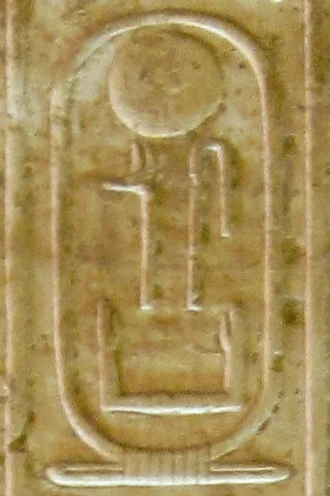
Userkare's name means "Powerful is the soul of Ra", and it is written inside a cartouche, the oval ring that marks a royal name in Egyptian writing. The name also appears as Woserkare or Weserkare. 23
He was the second king of the Sixth Dynasty, in the period Egyptologists call the Old Kingdom. His predecessor was Teti; his successor was Pepi I. His relationship to either of them has never been established, and the Wikipedia article calls the reign "enigmatic" for that reason. 245
His parentage is just as open. If he held the throne lawfully, he could have been a son of Teti; if he seized it, he may have come from a side branch of the dynasty before. 2
If he was Teti's son, his mother is still uncertain. Egyptologists have proposed Khuit II or a queen who may be Khentkaus IV, the second name resting on a damaged inscription that has been read in more than one way. 26
Two seals, one mallet, and a crew of workmen
Three objects made in Userkare's lifetime survive and carry his name. Two are cylinder seals and the third is a copper mallet. Everything else that mentions him was written centuries or millennia later. 2
The first seal is green-glazed steatite and reads "(The) good god Userkare, beloved by the gods (and) Hathor". The second is black steatite and shows his cartouche with the sun disk above it. 27
The mallet carries the name of a workmen's crew, either "Beloved ones of Userkare" or "Userkare is beloved". Those men came from Wadjet, the tenth nome of Upper Egypt, in the area of Tjebu south of Asyut. 21011
A paid crew from a named province points to a large building project in his reign, most probably his pyramid. It is the strongest hint that a monument was at least begun. 2
A fourth object may belong to him. A copper axe head found in Syria bears the name of a crew called the "Beloved ones of the Two Golden Falcons", and the Two Golden Falcons is a golden Horus name — one of the five names a pharaoh held. Teti's golden Horus name was "Golden Falcon who Unites" and Pepi I's was "Three Golden Falcons", and Michel Baud and Vassil Dobrev proposed that the axe belonged to a king whose name filled the gap between them. Khufu and Sahure used the same golden Horus name earlier, which leaves the attribution open. 21213
Two cautions attach to the seals. One Egyptologist attributed three to Userkare, but one reads "Userka[...]" and may belong to the earlier king Userkaf. Seals inscribed "Userkare" also turn up in museum collections that in fact belong to a Thirteenth Dynasty king of the same name. 21415
The annals with a hole in them
Later Egyptian sources do record him, and the most important one records him badly. The South Saqqara Stone was the royal annals of the Sixth Dynasty, a year-by-year account compiled under Merenre Nemtyemsaf I or Pepi II. 21617
Gustave Jéquier found the stone in a storeroom of the mortuary temple of queen Iput II, north-west of Pepi II's pyramid complex. It had been reused as the lid of a sarcophagus for another queen, Ankhesenpepi III. 2181920
Before that reuse, the stone had been roughly polished, and an estimated 92 per cent of its text went with the polishing — possibly in the late First Intermediate Period or the early Middle Kingdom, centuries after the Sixth Dynasty ended. 21621
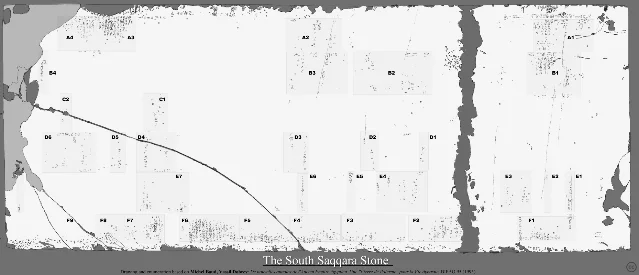
What survives of Userkare on the stone is a blank. A large gap separates the entries for Teti and for Pepi I, and traces of a royal titulary sit inside it. The length of the lost text is what gives him two to four years on the throne, with four judged more likely than two. 2
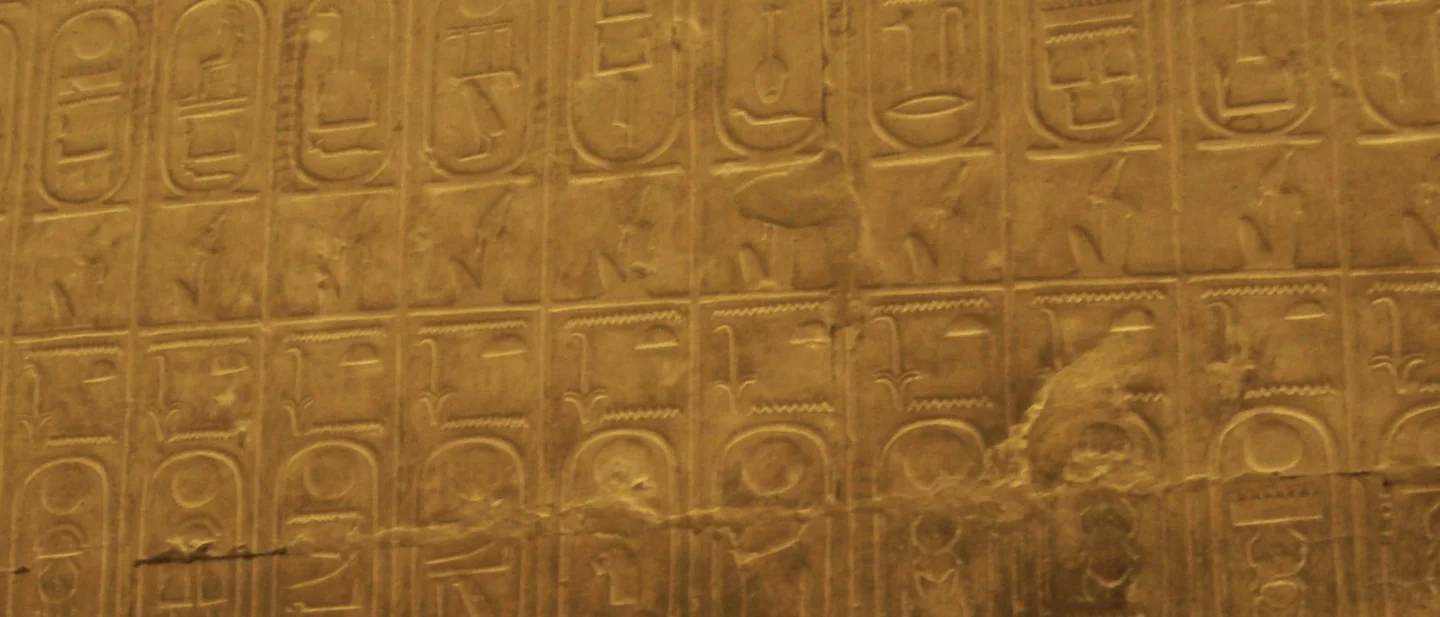
The other lists are later and thinner. The Abydos king list, carved on the temple wall of Seti I more than a thousand years afterwards, gives him the 35th cartouche, between Teti and Pepi I. 29
The Turin canon, written under Ramesses II, has a lacuna — a gap in the papyrus — exactly where his name would fall. If he was listed there, what remains of the entry credits him with 20 years, a figure now widely rejected because the South Saqqara Stone tells against it. 223
The last of the sources is the latest. Manetho, an Egyptian priest writing in the 3rd century BC, composed a history of Egypt called the Aegyptiaca about 2,000 years after Userkare. No copy survives; it reaches us through later writers, chiefly Sextus Julius Africanus and Eusebius. Through them Manetho reports that Teti was murdered by his bodyguards or attendants. He says nothing at all about Userkare. 224
A stopgap, a regent, or a usurper
Thin evidence leaves room for disagreement, and Egyptologists have filled it with a set of positions that the Wikipedia article sets out side by side. 2
In one reading Userkare held power lawfully, as a short-lived stopgap or as a regent. William Stevenson Smith, William C. Hayes and Nicolas Grimal are among those who take it, and the argument rests on Pepi I. Pepi I reigned for about 50 years, so he was probably very young when his father Teti died, and someone had to hold the throne. In one version of the story that someone was Userkare, acting with queen Iput I. 22526
Naguib Kanawati finds the regent version unconvincing, and his reason is formal. A regent belonged nowhere in the king lists. The Turin canon names kings, a full royal titulary was reserved for reigning pharaohs, and the Abydos list holds kings alone. Userkare appears in all three. 227
Grimal adds a second objection from the other direction: a king erased by his successor should be poorly attested, and Userkare is well attested by historical and contemporary sources, the annals among them. 2
Rainer Stadelmann and Michel Baud go further and find no clear evidence that an erasure took place. Their explanation for the missing monuments is simpler: the funerary complex may have been planned and never built. They call the erasure reading "speculative". 21328
Vivianne Gae Callender keeps Userkare legitimate and gives him a family quarrel. On her reconstruction he was a son of Teti born after his father became king, while Pepi I was the elder son born before it. The claim to the throne turned on that difference. Teti's reign of eight to 12 years would make Userkare about ten years old at his coronation. Morris Bierbrier goes further and suggests Pepi I may have had him killed. 2
The opposite camp starts from Manetho's murdered king. If Teti was killed by his own attendants, the man who took the throne next had an interest in the outcome, and Egyptologists have found it plausible that Userkare took part in the killing or profited from it. 2
The officials who stopped saying his name
The case for an erasure rests less on kings than on their servants, and on what is missing from their tombs. 2
Two viziers, Inumin and Khentika, served Teti and then Pepi I, and each wrote his career onto his tomb wall. Neither mentions Userkare, and neither reports anything he did during the years on the throne. 229
One tomb preserves the trace of a name being changed twice. Mehi, a guard who lived under Teti, Userkare and Pepi, left an architrave — the stone lintel that rests on the columns — on which the name of Teti is written on a piece cut and set into the block. Kanawati reads the sequence as Teti's name erased, a second king's name cut in its place, that name chiselled out in turn, and Teti's restored on a fresh piece of stone. He argues the middle name was Userkare's, and that Mehi had transferred his loyalty to him before trying to switch back once Pepi I took power. 227
Mehi's attempt to realign came too late. Work on his tomb stopped abruptly and he was never buried in it. 2
Stadelmann disputes Kanawati's reconstruction of the architrave and Christoffer Theis calls it unprovable, so the reading of Mehi's lintel remains one scholar's case rather than a settled fact. 228
The mastaba of Merefnebef tells a longer version of the same story. Merefnebef began as a minor courtier under Teti and rose to vizier, in all probability under Userkare. Peter J. Brand calls him a "lowly" official. 23031
His tomb was built in stages, and the last stage is his vizierate, when he had the title carved again and again on the outside. Then the work stopped. In a later generation one of his sons intervened: the figures of Merefnebef and his brothers were chiselled off, and the titles were altered, with the word "king" erased from "Honoured by the king" or replaced outright by the word "desert". The mastaba was left unfinished and deliberately walled off so that it could not be seen. 23032
Brand reads the episode as one case of a wider pattern: men of low rank promoted to the highest offices under Userkare, then demoted or expelled under Pepi I. 231
For Michel Baud and Theis, the same silence is the difficulty. Both have called the absence of Userkare from the private biographies of his own time "disturbing", because those biographies usually name the kings their authors served. 213
Baud and Dobrev add one qualification to the annals. A royal annal existed to record every king's name and deeds regardless of politics, so appearing on the stone says nothing about whether Pepi I wanted him remembered. 213
Theis draws the opposite conclusion from the same stone: a king who was listed in the annals was probably fully legitimate, however brief his reign, and the evidence for an erasure is too weak to carry the case. 2
A minority view removes Userkare from the sequence altogether. Oleg Berlev and Yury Perepelkin proposed that Userkare was in fact the prenomen of Teti, which they argue is otherwise unknown. On their account a scribe added a second name to distinguish kings who shared the name Teti, as had happened before, and later Egyptians read the addition as a separate king. Theis rejects the idea, noting that Teti used the same name as both throne name and birth name, as other kings of the previous dynasty had. 2
The king who may have been called Ity
The name itself is evidence. Userkare is a theophoric name, one that contains the name of a god, and it carries Ra, the sun god — a style of naming common in the Fifth Dynasty, the one before his own. 233
That detail feeds the usurper reading. Teti was not a son of Unas, the last Fifth Dynasty king, so some Egyptologists have proposed that Userkare came from a lateral branch of the Fifth Dynasty royal family that briefly took power in a coup, perhaps ruling over only part of the country. Theis answers that Merenre and Pepi II also put Ra in their names, so the naming fashion proves nothing by itself. 2
One line of inquiry would give him a second name and a paper trail. Flinders Petrie tentatively identified Userkare with a king called Ity, known from a single rock inscription in the Wadi Hammamat. The text is dated to Ity's first year and records 200 sailors and 200 masons sent under two overseers to collect stone for a pyramid called "Bau Ity". 23435
Petrie's reasoning was circumstantial. He dated the inscription to the Sixth Dynasty and noted that Userkare was the only king of the period whose full titulary was unknown. As of 2025 the identification is at best conjectural and has been rejected outright by some, with dates in the First Intermediate Period proposed for Ity instead. 221
The tomb that has not been found
No tomb of Userkare has ever been identified. A reign of two to four years makes an unfinished pyramid the likeliest explanation, which is also why the search is hard. 2
Two proposals place it, and both are inferences from other buildings. Vassil Dobrev and Miroslav Bárta put Userkare's pyramid in the northern part of Saqqara South, at a site called Tabbet al-Guesh, north-west of Pepi I's mortuary complex. French excavations there uncovered a necropolis of Sixth Dynasty administrators, including two unfinished structures that Dobrev reads as the start of a royal pyramid and its temple. One measures 80 by 80 metres, the other 60 by 80 metres. 23637
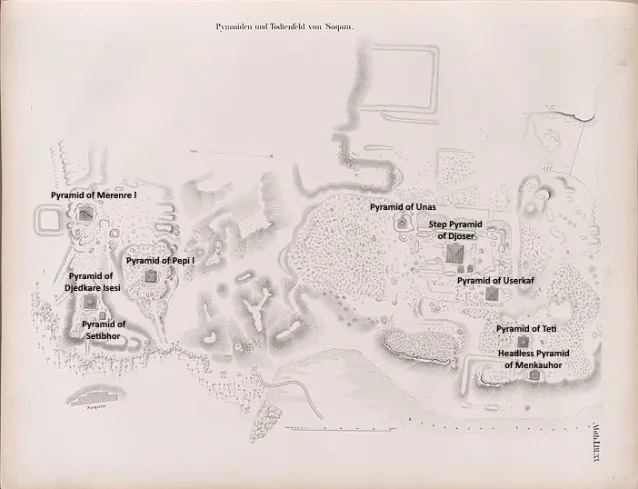
The second proposal uses geometry rather than excavation. The astrophysicist Giulio Magli suggests the pyramid lies midway between those of Pepi I and Merenre, a position that would put the three in a line parallel to the one formed by the pyramids of Sekhemkhet, Unas, Djoser, Userkaf and Teti further north. As of 2015 no survey had been carried out to test it. 2
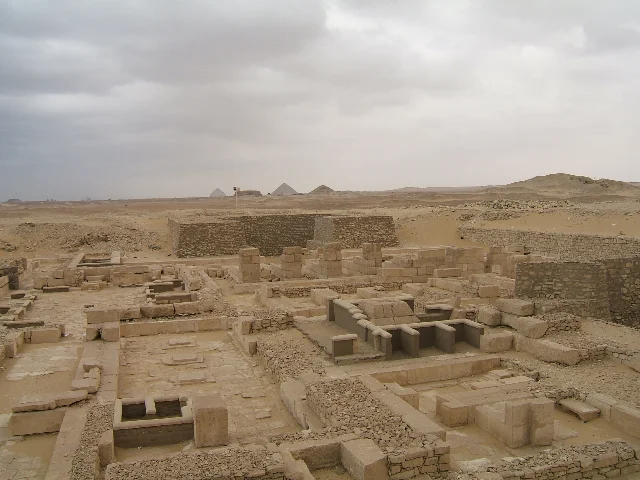
Stadelmann and Baud return to the point here. A complex that was planned and never erected explains the absence of a tomb better than an erasure, and they find the erasure reading "speculative". 21328
The figures behind the king
| Figure | What it counts | Source |
|---|---|---|
| late 24th or early 23rd century BC | When Userkare reigned, on the Wikipedia article's dating | Userkare |
| 2 to 4 years | Length of his reign, read from the space his entry occupies on the South Saqqara Stone | Userkare |
| 2 | Cylinder seals that date securely to his reign | Userkare |
| 1 | Copper mallet, the third secure object, naming a workmen's crew | Userkare |
| 35 | Position of his cartouche on the Abydos king list, between Teti and Pepi I | Abydos King List |
| 92 per cent | Share of the South Saqqara Stone's text lost when the stone was polished down | South Saqqara Stone |
| 20 years | Reign length a damaged Turin canon entry would imply, now rejected | Userkare |
| more than 2,000 years | Gap between his reign and Manetho's history of Egypt | Manetho |
| about 50 years | Length of Pepi I's reign, which implies he was young when Teti died | Pepi I Meryre |
| 8 to 12 years | Teti's reign, which would make Userkare about ten at his coronation under Callender's reading | Userkare |
| 80 m x 80 m | One of two unfinished structures at Tabbet al-Guesh that may be a royal pyramid | Userkare |
| 60 m x 80 m | The other unfinished structure there | Userkare |
| 200 and 200 | Sailors and masons in the Wadi Hammamat inscription of Ity, if Ity was Userkare | Userkare |
Glossary
| Term | What it means here | Source |
|---|---|---|
| Cartouche | The oval ring drawn around a royal name in Egyptian writing | Cartouche |
| Prenomen | The throne name a king took on accession; Userkare is one | Ancient Egyptian royal titulary |
| Golden Horus name | One of the five names a pharaoh held; the axe from Syria carries a golden Horus name | Ancient Egyptian royal titulary |
| Annal | A year-by-year record of a reign, kept as an official document | South Saqqara Stone |
| Damnatio memoriae | The deliberate removal of a person's name and images from the official record | Damnatio memoriae |
| Mastaba | A flat-roofed rectangular tomb of mudbrick or stone, the usual form for officials | Mastaba |
| Vizier | The highest official under the pharaoh, the head of the administration | Vizier (Ancient Egypt) |
| Nome | An administrative district of ancient Egypt; the mallet's workmen came from one in Upper Egypt | Nome (Egypt) |
| Ka | The vital force a person's name invokes; Userkare means "Powerful is the soul of Ra" | Ancient Egyptian conception of the soul |
| Theophoric name | A personal name that contains the name of a god, as Userkare contains Ra | Theophoric name |
| Coregency | Two kings ruling at the same time, one of the arrangements proposed for Userkare and Pepi I | Coregency |
| Attestation | A surviving object or text that shows something existed; Userkare has three secure ones | Userkare |
Six things that are easy to get wrong
Two kings ruled under the name Userkare. A Thirteenth Dynasty king, Khendjer, also took Userkare as his throne name, and cylinder seals inscribed "Userkare" in museum collections belong to him. 215
Manetho's history says nothing about him. What it reports, through Africanus, is that Teti was murdered by his attendants; Userkare's name never appears. His absence there is a gap in a late source. 224
He has three secure contemporary attestations. Two cylinder seals and a copper mallet carry his name and date to his lifetime, which is more than some short-reigned kings left behind. 2
The 20 years sometimes attached to him is a damaged list, not a reign. That figure comes from a lacuna in the Turin canon and is widely rejected now that the South Saqqara Stone suggests two to four years. 223
The 92 per cent loss on the South Saqqara Stone was not Pepi I's doing. The stone was roughly polished down and reused as a sarcophagus lid centuries later, in or after the First Intermediate Period. The damage is the reason the annals cannot settle the question of what happened to Userkare. 216
A missing tomb may simply be an unfinished one. Stadelmann and Baud argue that a complex planned and never built explains the absence better than a speculative campaign of erasure. 236
In their own words
(The) good god Userkare, beloved by the gods (and) Hathor.
The inscription on the green-glazed steatite cylinder seal, one of the three objects that date to his reign. 2
Beloved ones of Userkare.
The name of the workmen's crew inscribed on the copper mallet, a team from the tenth nome of Upper Egypt. 2
disturbing.
Baud and Theis, on the way the officials who served under Teti and Pepi I never name the king who reigned between them. 2
the infamy of the most shameful moment in [Merefnebef's] career, that of being (probably) promoted to the function of vizier by the usurper Userkare, was visibly remembered for generations.
speculative.
Stadelmann and Baud, on the claim that Pepi I tried to erase his predecessor's memory. 2
What the record keeps
Set the evidence out and Userkare resolves into a series of gaps. The annals have a hole where his years should be, the officials' biographies have a silence, and the desert at South Saqqara has a tomb nobody has opened. 2
Against all that sit three small objects from his own lifetime: two seals and a mallet, with a crew of workmen named on the third. They are enough to prove a reign, and not enough to describe one. 2
The pleasant irony is in the name. Userkare means "Powerful is the soul of Ra", and the name has lasted, because a king list cut into a temple wall a thousand years later kept the cartouche. Whatever Pepi I intended, the cartouche outlived him, and the meaning of the name is the one fact about Userkare that nobody disputes. 29
The Wikipedia article carries the whole argument — the seals and the mallet, the annals and their hole, the two readings of the officials' tombs, and the proposed sites of a pyramid that may still be under the sand — and it is the reason Wikipedia's editors put Userkare on the front page for 11 October 2026. 12
References
- 1Wikipedia: Today's featured article/October 11, 2026
en.wikipedia.org
- 2Userkare - Wikipedia
en.wikipedia.org
- 3Cartouche - Wikipedia
en.wikipedia.org
- 4Sixth Dynasty of Egypt - Wikipedia
en.wikipedia.org
- 5Old Kingdom of Egypt - Wikipedia
en.wikipedia.org
- 6Khuit II - Wikipedia
en.wikipedia.org
- 7Soapstone - Wikipedia
en.wikipedia.org
- 8File: Abydos KL 06-02 n35.jpg - Wikimedia Commons
commons.wikimedia.org
- 9Abydos King List - Wikipedia
en.wikipedia.org
- 10Nome (Egypt) - Wikipedia
en.wikipedia.org
- 11Qaw el-Kebir - Wikipedia
en.wikipedia.org
- 12Ancient Egyptian royal titulary - Wikipedia
en.wikipedia.org
- 13Michel Baud - Wikipedia
en.wikipedia.org
- 14Userkaf - Wikipedia
en.wikipedia.org
- 15Pyramid of Khendjer - Wikipedia
en.wikipedia.org
- 16South Saqqara Stone - Wikipedia
en.wikipedia.org
- 17Merenre Nemtyemsaf I - Wikipedia
en.wikipedia.org
- 18Gustave Jéquier - Wikipedia
en.wikipedia.org
- 19Iput II - Wikipedia
en.wikipedia.org
- 20Ankhesenpepi III - Wikipedia
en.wikipedia.org
- 21First Intermediate Period of Egypt - Wikipedia
en.wikipedia.org
- 22File: SouthSaqqaraStone.png - Wikimedia Commons
commons.wikimedia.org
- 23Turin King List - Wikipedia
en.wikipedia.org
- 24Manetho - Wikipedia
en.wikipedia.org
- 25Iput I - Wikipedia
en.wikipedia.org
- 26Nicolas Grimal - Wikipedia
en.wikipedia.org
- 27Naguib Kanawati - Wikipedia
en.wikipedia.org
- 28Rainer Stadelmann - Wikipedia
en.wikipedia.org
- 29Vizier (Ancient Egypt) - Wikipedia
en.wikipedia.org
- 30Merefnebef - Wikipedia
en.wikipedia.org
- 31Peter J. Brand - Wikipedia
en.wikipedia.org
- 32Mastaba - Wikipedia
en.wikipedia.org
- 33Theophoric name - Wikipedia
en.wikipedia.org
- 34Flinders Petrie - Wikipedia
en.wikipedia.org
- 35Wadi Hammamat - Wikipedia
en.wikipedia.org
- 36Saqqara - Wikipedia
en.wikipedia.org
- 37Pyramid of Pepi I - Wikipedia
en.wikipedia.org
- 38File: Pyramids of the Saqqara Plateau.png - Wikimedia Commons
commons.wikimedia.org
- 39File: Pepi I Queen Pyramids.jpg - Wikimedia Commons
commons.wikimedia.org
- 40Karol Myśliwiec - Wikipedia
en.wikipedia.org
This story was produced automatically by a channel. One sentence is all it takes for Neodrop to keep producing for you.