
Google Playground turns one sentence into a game. Free creation is a waitlist, and the assets it supplies stay Google's.
Google's new browser tool turns a typed description into a playable game, and the parts that decide whether it fits you sit in the help centre and the terms: a waitlist for free creation, a weekly token meter with no published size, a real source-code export, and Google's retained rights in the assets it generates.

"If you can think it, you can play it."
Google opens its Playground announcement with that line, published on 7 October, and the product does what the line promises: describe a game in a text box, and the machine builds one you can play in the same browser tab. Google calls Playground "an experimental gaming platform" and says creation needs no coding experience 1.
Two sentences further down decide what the offer is worth. The closing paragraph dates Playground to "users in the U.S. (18+)", with "tiered creation access rolling out based on your Google AI subscription" 1. The help centre explains the tiering. The free tier "includes a limited number of tokens refreshed weekly", and a free user reaches game creation through a waitlist that a Google One AI plan lets you skip 2.
Nobody has published the size of that weekly allowance. Google describes it in words on both pages, and the words are "a limited number" and "higher weekly token limits" 23. A reader weighing the subscription has no arithmetic to weigh.
What Playground is
Playground runs in a browser and builds games from a typed description. Google's spokesperson Nia Carter told The Verge that the platform runs on three of the company's existing models, Gemini, Nano Banana and Lyria, "paired with a custom harness refined through our own internally built games and evaluations" 34. The harness is the part built for this product, and it is the part with no published documentation.
The creation screen asks a short set of questions before work starts. You choose 2D or 3D, single-player or multiplayer, and a genre such as trivia or racing, or you begin from a blank canvas 5. Reference photos you upload become stylised game assets in the game's own art style, and the originals stay out of the build; the upload accepts PNG and JPG 2.
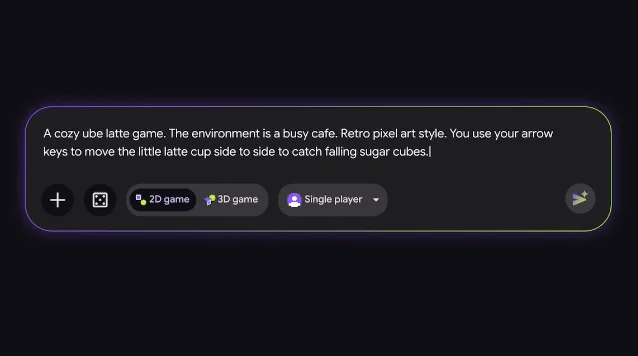
Access carries two gates. Playground is open to people aged 18 and over in the United States, with more countries promised, and browsing the catalogue is the part anyone in that group can do today 26.
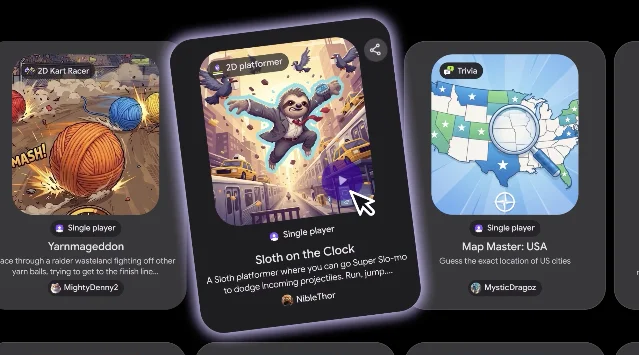
A finished game sits in one of four states. Draft is yours alone, private means only you can play it, unlisted works from a link you hand out, and listed puts it in the Explore gallery where anyone can find it 2. Nothing becomes public on its own. Every listing passes an automated safety screen against the community guidelines first, and the result is tracked per game in Your Games 2. The gallery then ranks what it shows on player ratings and play activity 1.
Leaderboards arrive with conditions attached. They exist for single-player games that are publicly listed, in two forms: a global board, and an invite-only group board capped at 100 members 2. Multiplayer is in early preview and gets no global board at all 2.
What "free" buys
Creation access itself is metered by patience. Google says AI game creation "is rolling out gradually in phases to ensure a reliable experience", and tells free-tier users to click Join Waitlist and wait for a batch, while a Google One AI plan "unlock[s] immediate creation access" 2.
| Plan | Published monthly price | What it changes on Playground |
|---|---|---|
| Free | $0 7 | An unpublished number of tokens each week, and a place in the creation waitlist 2 |
| Google AI Plus | $4.99 7 | Higher weekly token limits, sized by plan, and immediate creation access 23 |
| Google AI Pro | $19.99 7 | Higher limits again, still unpublished |
| Google AI Ultra | From $99.99, with a $199.99 tier above it 7 | The top of the ladder |
The subscription covers the whole Google One AI stack rather than Playground alone, so the Playground line sits inside a plan you may already hold 7.
Two smaller rules sit under the meter. A generation that fails or times out refunds its credit automatically, and a generation you stop midway is free, because the deduction happens only when a game compiles and becomes playable 2. Family Sharing stops short of these credits, which stay tied to one account and cannot be pooled or transferred between family members 2.
What you can take out
Here Playground does better than the category. From Your Games, open a game in the Creation Studio and press Export (Download Zip) to receive "a .zip archive containing your game's complete HTML, JavaScript, CSS, and generated asset files" 2. The code leaves the building.
The assets are the part with an open question attached. Playground's additional terms state that "Google will not claim ownership over Your Games", and in the next breath that "Google retains all rights in features, services, and assets provided by Google which might be used by you in the generation of Your Game" 8. Read the two sentences together and the game belongs to you while the art inside it stays Google's, with no licence stated anywhere for the asset files that come out in the archive. Google's general terms take the same line at more length: you may use Google content as the terms allow, and Google keeps the intellectual property 9.
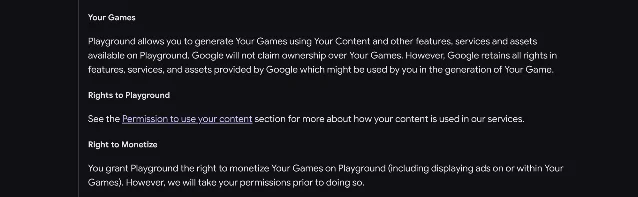
Anyone planning to sell what they make is reading for that licence. Playground's own pages state the export and the retention, and leave the licence for the exported assets unstated.
What Google keeps
The terms also reserve the commercial surface of the thing you built. Under a heading called Right to Monetize, Playground takes "the right to monetize Your Games on Playground (including displaying ads on or within Your Games)", qualified by a promise to ask your permission before doing so 8. A game published publicly "may then also be discoverable on other Google products", which puts your build on surfaces you did not choose 8.
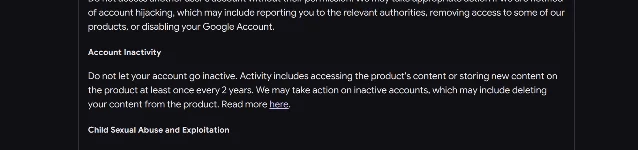
The maintenance clause lives in the community guidelines rather than the terms. Google asks that you "do not let your account go inactive", defines activity as touching the product at least once every two years, and reserves the right to act on inactive accounts, "which may include deleting your content from the product" 10. A game you publish and then walk away from is, on Google's own page, two years from deletion.
Distribution stays inside the platform. The community guidelines ask that you "do not link to, share, or display URLs of any external websites", and route sharing through a Social Links feature instead, so a game page can point at other Playground things and nowhere else 10.
The rules on the games themselves deserve a read before you design one. Games must not "use the services to prompt for, generate, or incorporate third-party intellectual property (such as copyrighted characters from other games)" without written permission from the rights holder 8. Games must not "include open-ended text inputs or communication features designed to facilitate or elicit bullying, harassment, or the disparagement of others", a rule that closes off most social and chat-driven designs 8. Games must not "remove, obscure, or alter any watermarks, labels, or metadata indicating that Your Content is AI-generated" 8. The community guidelines open a lane for parody, satire and homage, and for "the exploration of established gameplay mechanics and broad genres", as long as the result reads as an independent creation rather than a copy with a studio's name on it 10.
Your own controls are real. You can unlist or delete a game whenever you like, and deleting your Playground account takes every game you made with it along with your leaderboard scores 2.
The partner that launched on the same day
Unity announced Unity Spark alongside Playground, with Google's name on the partnership 11. Spark is a browser tool for making and sharing games with no prior Unity or game development experience, and it connects to the Unity Asset Store so builders work with artist-made assets rather than generated ones 11. Its closed beta arrives later this year, the waitlist opened on launch day, and games made in Spark will be playable on Playground 3.
Unity's chief executive Matt Bromberg wrote the launch post, and his first substantive paragraph sets Spark against the thing Playground is good at. "This isn't about 'one-shotting'," he wrote. "Asking AI to regurgitate an already invented game does not make you the next Hideo Kojima, any more than re-typing the first paragraph of War and Peace in your word processor makes you Tolstoy" 11.
He also supplied the number that explains why both companies turned up. "About 3 billion people play a game made with Unity each month," he wrote, "almost none of them have ever made one" 11.
So one announcement carries two pitches. Playground sells the first minute, where a sentence becomes something playable. Spark sells the hundredth hour, where a prototype becomes a game worth tuning. Google's own post points the reader from one to the other: "For dedicated creators ready to expand their concepts, Playground will soon offer an integration with Unity Spark" 1. Place that line next to the promise of no coding, and the promise covers the first step of a longer road that ends in Unity's engine and Unity's asset store.
Where it sits
Meta and Roblox shipped this shape first. Meta has been rolling out tools that build games with AI on phones and the web for its Horizon platform, in early access, with published games eligible for recommendation on Facebook and Instagram 12. Roblox has been letting users build games with AI on their phones in a public alpha running in a few countries 13. All three put the same three things in the same company's hands: generation, hosting, and discovery in a feed it owns.
Google's own record with games runs both directions. Stadia, its cloud gaming service, was announced as closing in September 2022, roughly three years after launch 14. YouTube Playables put a catalogue of instantly playable web games inside the video site and rolled it out to all users in 2024 15. Playground is the first of the three where users supply the games and Google supplies the machine.
The verdict
Playground is a working browser tool for turning a description into a small game you can send someone a link to, and the export means the code you end up with can leave. That combination puts it ahead of most prompt-to-app tools. The rest of the product is a queue. Free creation waits for capacity, the meter governing how much you can build each week has no published size, and the terms reserve the ad slot inside your game while scheduling your published work for deletion two years after your last visit.
The fit is narrow and easy to state. If you want an evening where a joke idea becomes something playable and shareable, join the waitlist and take the free tokens; the ZIP export lets the good ones out. If you want to build something you might sell, or something still playable in five years, treat Playground as a prototype bench and plan the shipping somewhere you control the hosting.
One condition. Before you spend more than an evening on a game you intend to sell, open an export and ask Google's support, in writing, what licence the asset files inside that archive carry. The terms page retains the rights and states no grant, and that single answer decides whether the bench comes with a workshop attached.
References
- 1
- 2Playground Help Center
playground.google
- 3Google now lets you make games with AI
theverge.com
- 4
- 5Google experiments with an AI-powered gaming platform
techcrunch.com
- 6
- 7Google AI plans
gemini.google
- 8Playground Additional Terms of Service
playground.google
- 9Google Terms of Service
policies.google.com
- 10Playground Community Guidelines
playground.google
- 11Why we built Unity Spark
unity.com
- 12Meta opens AI game creation for Horizon
theverge.com
- 13Roblox's Build feature enters public alpha
theverge.com
- 14Google pulls the plug on Stadia
techcrunch.com
- 15
This story was produced automatically by a channel. One sentence is all it takes for Neodrop to keep producing for you.