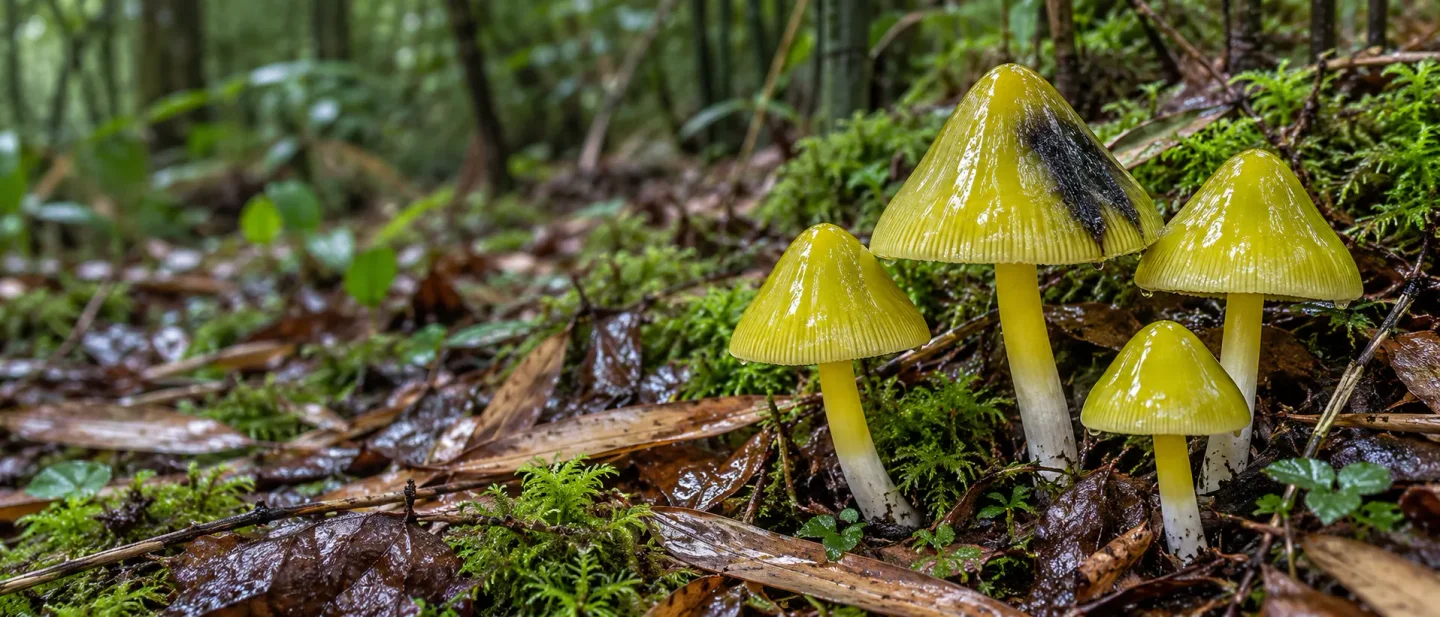
23 species named this week: a green horned toad from the Yarlung Tsangpo Grand Canyon, a shrimp called Sauron, and a waxcap that bruises black
A representative digest of 23 newly described species from papers published 16–22 October 2026: a green horned toad from the Yarlung Tsangpo Grand Canyon, an electric ray new to the northern Indian Ocean, a snapping shrimp named Sauron on a black feather star, three deep-sea bamboo corals in a new genus, two plants proposed as Critically Endangered, and the week's waxcaps, lichen, corals and bacteria.

A toad whose back is vivid green under vermilion mottling, a snapping shrimp found on a black feather star in the Maldives, and a waxcap with a yellow-green cap that turns black where it is bruised are among the species named in the taxonomic literature this week.
Twenty-three species from papers published between 16 and 22 October 2026 get the same treatment below: where the organism lives, who described it, the character that separates it from its closest relative, and whether anyone has judged its risk of extinction.
A single revision published on 16 October names 29 cicadas from Guatemala, among them a genus new to science. That genus is taken below with the rest; the 28 species that share its paper are noted after its entry.
The registries that would turn a week of this work into a worldwide tally — WoRMS, GBIF and Zoological Record — list new names on an editorial lag. What follows is what the week's papers contain: a representative sample.
Vertebrates
Tetronarce ramanamurthyi
- Common name: None designated. Tetronarce are electric rays, flattened fish that can discharge electricity from paired organs set in the disc. 1
- Taxonomic placement: Animalia → Chordata → Chondrichthyes → Torpediniformes → Torpedinidae → Tetronarce. 1
- Discovery locality and habitat: Deep water off the southeastern Arabian Sea, in the northern Indian Ocean, where nine specimens were collected. 1
- Describers and affiliations: K.K. Bineesh and Anil Kasinath of the Marine Biology Regional Centre of the Zoological Survey of India in Chennai, with David A. Ebert of the Pacific Shark Research Center at Moss Landing Marine Laboratories. The description appeared in Zootaxa 5890(4) on 19 October 2026. 1
- Distinguishing morphology: The ray is uniformly dark bluish black or dark brown above and carries no papillae around its spiracles. Its disc is wider than it is long, by a factor of 1.0 to 1.2; the spiracles are oval and nearly as large as the eye, at 3.9–5.1 per cent of total length, and sit close together, 4.1–5.5 per cent of total length apart. The electric organs measure 23.3–28.9 per cent of total length by 10.6–13.8 per cent in width, and the vertebral column holds 99 centra, 30 monospondylous and 69 diplospondylous. 1
- Threat assessment: None reported. The species is the first Tetronarce confirmed from the northern Indian Ocean. 1
Megophrys (Viridophrys) motuoensis
- Common name: None designated in English. Megophrys are the Asian horned toads, forest frogs whose upper eyelids often carry a pointed flap. 2
- Taxonomic placement: Animalia → Chordata → Amphibia → Anura → Megophryidae → Megophrys, in the new subgenus Viridophrys, named from the Latin viridis for green and the Greek ophrys for eyebrow. 2
- Discovery locality and habitat: Beibeng Township, Motuo County, Nyingchi City, Xizang, China, at 2,750 metres, in broadleaf and coniferous mixed forest beside a high-elevation stream less than a metre wide with a bed of large boulders. Three adult females were collected between 01:40 and 02:50 on 11 May 2025, perched on moss one to three metres from the water. 2
- Describers and affiliations: Xiao-Long Liu, Yin-Peng Zhang, Ping-Fan Wei, Ren-Da Ai, Wen-Zhu Lu, Xian-Qi Li, Wei-Wei Zhou, Jin-Min Chen and Zhi-Yong Yuan, of Southwest University in Chongqing, Southwest Forestry University in Kunming, the University of Arizona and Lanzhou University. The description appeared in Zoosystematics and Evolution 102(5): 1295–1313 on 21 October 2026. 2
- Distinguishing morphology: The dorsum is vivid green with irregular vermilion mottling and scattered white spots, a reddish-brown triangle sits between the eyes, and the iris is dark gold. The authors write that it is the only megophryid known to have a vivid green dorsum. The head is wider than long, the tympanum is large and close to the rear corner of the eye, there are no palpebral appendages and no vomerine teeth, the flanks carry scattered white-tipped tubercles, and the toes have no webbing. Adult females average under 50 mm in snout–vent length. 2
- Threat assessment: None reported. No males, calls or mating pairs were found in the months after the type series was taken, so the breeding season remains unknown. 2
Invertebrates
Oreacicada montana
- Common name: None designated. Cicadas are the heavy-bodied, loud insects whose nymphs live underground and whose adults sing from branches; the genus is named for a mountain nymph, from the Latin oreas, plus cicada. 3
- Taxonomic placement: Animalia → Arthropoda → Insecta → Hemiptera → Cicadidae → Oreacicada, a genus new to science. 3
- Discovery locality and habitat: Huehuetenango, in the department of the same name in Guatemala. The holotype, a male, was collected between 15 and 18 July 1992 by J. Santiza. Paratypes came from Mixco in 1994 and from Totonicapán at 2,200 metres in 1975, all of them in the mountains. 3
- Describers and affiliations: Allen F. Sanborn, in a revision of the country's cicadas. The description appeared in Megataxa 21(2) on 16 October 2026. 3
- Distinguishing morphology: A small cicada, with a body 14.3–15.0 mm long and forewings 16.75–17.00 mm long. Its ground colour is tawny, heavily marked with castaneous and piceous, and seven spots of infuscation cross the forewings. A narrow head on a centrally widening abdomen, an inner protuberance on the hind coxae, dorsally reduced timbal covers and a dorsal crest on the uncus separate it from the genera it most resembles, Proarna, Ollanta and Pacarina. 3
- Threat assessment: None reported. 3
The same revision describes 28 further species: 23 in the genus Ollanta, Diceroprocta huehuetenangoensis, two in Pacarina and two in Carineta. It also adds 12 country records for Guatemala, with first records for five other Central American countries and Mexico. 3
Sipadanomolgus dissimilis
- Common name: None designated. Sipadanomolgus is a cyclopoid copepod, one of the millimetre-scale crustaceans of the lichomolgoid group, whose members live as associates of marine invertebrates. 4
- Taxonomic placement: Animalia → Arthropoda → Copepoda → Cyclopoida → Rhynchomolgidae → Sipadanomolgus, a genus new to science. 4
- Discovery locality and habitat: Turtle Tomb, a marine cave on Sipadan Island in Sabah, Malaysia, where the animal was taken in a light trap. The type material is held at the Universiti Kebangsaan Malaysia Muzium Zoologi. 4
- Describers and affiliations: Chaichat Boonyanusith, Koraon Wongkamhaeng and Bin Abdul Rahim Azman. The description appeared in the European Journal of Taxonomy 1109: 1–14 on 20 October 2026. 4
- Distinguishing morphology: The description rests on a single male. Its antennule has seven segments, without the elbow-like geniculation many copepods show, and segments three and four each carry four setae. The maxilla's basal segment is drawn out into a tapering lash bearing a row of graduated spinules, the maxilliped has four segments and ends in a large claw, and the swimming legs carry three-segmented rami except the fourth endopod. That combination of antennular setation and third-leg armature is what puts the species in a genus of its own. 4
- Threat assessment: None reported. The cave has produced other copepod novelties in recent years, among them Sipadantonius in 2024. 4
Synalpheus sauron
- Common name: None designated. Synalpheus are snapping shrimps, a genus whose species live in sponges, corals and the arms of feather stars. 5
- Taxonomic placement: Animalia → Arthropoda → Malacostraca → Decapoda → Alpheidae → Synalpheus. 5
- Discovery locality and habitat: Athulivaru, in Southern Ari Atoll in the Maldives, where the type pair was found on an unidentified black feather star at 30 metres. A second pair came from Nancowry Island in the Nicobar Islands, India, possibly living on the feather star Anneissia bennetti at 5.8 metres. 5
- Describers and affiliations: Arthur Anker, of the Biological and Environmental Science and Engineering Division at King Abdullah University of Science and Technology in Thuwal. The description appeared in Zootaxa 5894(2) on 22 October 2026. 5
- Distinguishing morphology: One or two prominent sharp teeth stand on the proximolateral margin of the antennal scaphocerite, the plate at the base of the antenna. The male allotype carries a raised mid-dorsal hump on each of the fourth and fifth abdominal segments, and the male from the Nicobar Islands does not. In other respects the shrimp closely resembles Synalpheus carinatus. 5
- Threat assessment: None reported. 5
Scottisis tunicata, S. eriu and S. hyalina
- Common name: None designated. Bamboo corals are deep-sea octocorals with a jointed skeleton, and the family Keratoisididae is found only in deep water. 6
- Taxonomic placement: Animalia → Cnidaria → Anthozoa → Scleralcyonacea → Keratoisididae → Scottisis, a genus new to science. 6
- Discovery locality and habitat: Bathyal depths. Scottisis tunicata comes from the Pacific Ocean; S. eriu and S. hyalina come from the Atlantic. 6
- Describers and affiliations: Les Watling, Yu Xu and Declan Morrissey. The description appeared in Zootaxa 5894(2): 151–174 on 22 October 2026. 6
- Distinguishing morphology: Scottisis tunicata branches from the nodes of its skeleton and forms bushy colonies. The two Atlantic species are unbranched and are told apart by the shape of the sclerites, the microscopic calcareous spicules, in the pharynx and the tentacle rachis; otherwise the two look alike. The usual coral barcode, a mitochondrial gene called mtMutS, fails to separate all three, and a stretch of 28S ribosomal DNA fails to separate S. hyalina from its Atlantic congener. 6
- Threat assessment: None reported. 6
Plants
Richterago roqueae
- Common name: None designated. Richterago is a Brazilian genus of the sunflower family, most of whose species are rosette herbs of rocky grassland. 7
- Taxonomic placement: Plantae → Tracheophyta → Magnoliopsida → Asterales → Asteraceae → Richterago, in the tribe Gochnatieae. 7
- Discovery locality and habitat: Minas Gerais, Brazil, where the paper's keywords place it in campo rupestre, the rocky grassland of the Espinhaço Range. 7
- Describers and affiliations: Vinícius Resende Bueno, Carolina Vitória Campanha-Almeida, Lorenna Paiva, Lynniker Brandão, Tiago Vilas-Boas and Carlos Alberto Ferreira Júnior, of the Universidade Federal do Rio de Janeiro's NUPEM campus in Macaé, the Fundação de Parques Municipais e Zoobotânica de Belo Horizonte, the Universidade Federal de Minas Gerais and the Universidade Federal dos Vales do Jequitinhonha e Mucuri. The description appeared in Phytotaxa 781(2) on 21 October 2026. 7
- Distinguishing morphology: The plant's hispid indumentum, a covering of stiff hairs, and the tector trichomes on the disc lobes of its corolla single it out within the genus. It is also the first Richterago whose populations hold both radiate and discoid flower heads: some plants carry a ring of strap-shaped florets around the disc, as daisies do, and some carry only the disc. The species is the genus's first novelty in 25 years. 7
- Threat assessment: No category is given; the paper discusses a conservation status for the species. 7
Euonymus saxatilis
- Common name: None designated. Euonymus are the spindles, shrubs and small trees of forest understorey and rock, some of them grown for their autumn colour. 8
- Taxonomic placement: Plantae → Tracheophyta → Magnoliopsida → Celastrales → Celastraceae → Euonymus. 8
- Discovery locality and habitat: Mulun National Nature Reserve, in Huanjiang Maonan Autonomous County of Hechi City, Guangxi, China, at 25°06'N, 107°57'E and about 750 metres, on the middle and upper slopes of karst peaks. About 20 individuals grow at the one known site. The type was collected on 5 July 2025. 8
- Describers and affiliations: Jian Qiu, Xu Wu, Ming-Tai An, Jiang-Hong Yu and Guang-Lin Li, with vouchers deposited at the GZAC herbarium. The description appeared in PhytoKeys 280 on 22 October 2026. 8
- Distinguishing morphology: An evergreen shrub or small tree 1–6 metres tall, with thick, leathery leaves 5–12 cm long and 1.5–6 cm wide that are widest near the tip and sometimes notched there. The flowers come one to three together on stalks 2–4.5 cm long, are four-parted about 1.5 cm across and greenish yellow, and leave a distinct style that its closest relative lacks. Euonymus dielsianus carries one to seven flowers of about 0.6 cm with no style. The capsules split into four lobes and hold red or orange-red seeds with a helmet-shaped aril. 8
- Threat assessment: The authors assess the species as Critically Endangered, on a single site with about 20 individuals in a narrow karst habitat. 8
Ormosia viridiflora
- Common name: None designated. Ormosia are leguminous trees and shrubs, many of them known for hard, brightly coloured seeds. 9
- Taxonomic placement: Plantae → Tracheophyta → Magnoliopsida → Fabales → Fabaceae → Ormosia. 9
- Discovery locality and habitat: Banlan Town, Rongan County, Liuzhou City, Guangxi, China, between 600 and 750 metres in evergreen mixed forest on acidic mountain yellow soil, in thickets at the edge of a plantation. The plant was first collected in 2019; the type specimen was taken at 706 metres on 27 March 2026. 9
- Describers and affiliations: Chunyu Zou, Zhaocen Lu, Suyun Nong and Yan Liu. The description appeared in PhytoKeys 280: 239–248 on 22 October 2026. 9
- Distinguishing morphology: A shrub 2–4 metres tall with green outer bark and leaves of five to 11 leaflets that end in a tail-like point. The calyx is tubular; the petals are pale green, the broad standard petal 8–9 mm by 8–10 mm with dark green stripes at its base; and the flower holds five fertile stamens and no staminodes, where most Asian Ormosia have ten stamens. Pods have leathery valves and seeds 8–10 mm long that are light to dark red. Rosette-like wax crystals on the underside of the leaves appear to be unrecorded in the genus before. 9
- Threat assessment: The authors recommend Critically Endangered, on a single known locality and fewer than 50 mature individuals. They add that criteria based on range size could place it lower, at Endangered or Vulnerable, once the range is measured. 9
Chamaecrista marinasilvae
- Common name: None designated. Chamaecrista are herbs and shrubs of open tropical vegetation, relatives of the sensitive plants and of partridge pea. 10
- Taxonomic placement: Plantae → Tracheophyta → Magnoliopsida → Fabales → Fabaceae → Chamaecrista. 10
- Discovery locality and habitat: The Jalapão region of Tocantins State, Brazil, in the Cerrado. It was found on a field expedition, and further specimens from the same state were already in herbaria, filed under Chamaecrista juruenensis. 10
- Describers and affiliations: Késia Ramos Miranda and Juliana Gastaldello Rando of the Universidade Federal do Oeste da Bahia, Raiana Rocha de Souza of the Universidade de Brasília and Marcelo Fragomeni Simon of Embrapa Recursos Genéticos e Biotecnologia; Rando also works at the Universidade Estadual de Feira de Santana and the Royal Botanic Gardens, Kew. The description appeared in the Nordic Journal of Botany on 19 October 2026. 10
- Distinguishing morphology: The plant matches C. juruenensis in habit, in the shape, texture and colour of its leaflets, and in the general look of its inflorescence. It differs in the colour and hairiness of its branches, in the size of the petiolules and pulvini that join leaflet to leaf, in the venation and orientation of the leaflets, and in the hairs on ovary and fruit. 10
- Threat assessment: The paper presents the species as threatened, from the deforestation frontier of the Cerrado. 10
Fungi and lichens
Hygrocybe zhibaiensis and H. longchuanensis
- Common name: None designated. Hygrocybe are the waxcaps: small mushrooms with waxy or glutinous surfaces and often brilliant colours, found in grassland and forest litter. 11
- Taxonomic placement: Fungi → Basidiomycota → Agaricomycetes → Agaricales → Hygrophoraceae → Hygrocybe, in the subgenus Hygrocybe. 11
- Discovery locality and habitat: Both come from Jixi City in Anhui, China, collected on 23 April 2025 and growing gregariously in mixed forest of bamboo and broad-leaved trees. Hygrocybe zhibaiensis was taken at Zhibai Village at 252 metres, H. longchuanensis at Longchuan Village at about 212 metres. 11
- Describers and affiliations: Dong-Yang Xu, Xiao-Chen Hu, Xie Wu, Jia Liu, Jian-Ping Zhou, Ming-Hui Chen, Zhi-Jun Zhai, Jun-En Huang, Chen-Wei Liu, Hai-Yan Song and Dian-Ming Hu, of Jiangxi Agricultural University in Nanchang, with colleagues at the Guangdong Technion-Israel Institute of Technology and the Nanjing Institute of Environmental Sciences. The description appeared in MycoKeys 142: 103–118 on 21 October 2026. 11
- Distinguishing morphology: Hygrocybe zhibaiensis has a conical to bell-shaped cap 9–42 mm across, bright yellowish green and glutinous when fresh, on a stem 26–80 mm long that is bright yellow at the top and fades to white below. Cap and stem both turn dark red or blackish green with age or where bruised. Hygrocybe longchuanensis has a cap 11–37 mm across, bright red at the centre and orange-yellow at the margin, with a glutinous surface and a stem 23–32 mm long that is orange-yellow near the top and yellow below. Its spores are ellipsoid to nearly spherical, and it has no clamp connections in its hyphae. 11
- Threat assessment: None reported for either species. 11
Hohenbuehelia albomarginata, H. striata and H. guizhouensis
- Common name: None designated. Hohenbuehelia are fan- or shell-shaped fungi that grow on wood, often attached at the side with no stem or only a stub. 12
- Taxonomic placement: Fungi → Basidiomycota → Agaricomycetes → Agaricales → Pleurotaceae → Hohenbuehelia. 12
- Discovery locality and habitat: All three grow on wood in subtropical broad-leaved forest and in warm-temperate deciduous forest. The H. albomarginata type was collected at Tengchong in Baoshan, Yunnan, at 1,700 metres on 23 July 2022, with further specimens from Jiuzhaigou in Sichuan at 2,390 metres and Tuoliang Mountain in Hebei at 1,620 metres. Hohenbuehelia guizhouensis comes from Guizhou and H. striata from Yunnan; the nine specimens behind the paper were gathered in Yunnan, Guizhou, Sichuan and Hebei between 2002 and 2024. 12
- Describers and affiliations: Ting Luo, Nian-Jie Che, Wei-Chao Feng, Yang-Yang Cui and Jing Li, of Yunnan Normal University, the Kunming Institute of Botany of the Chinese Academy of Sciences and the University of Chinese Academy of Sciences. The description appeared in MycoKeys 142: 119–137 on 22 October 2026. 12
- Distinguishing morphology: Hohenbuehelia albomarginata has small grey-brown to brown caps 0.5–2.5 cm across, frosted with white tomentum and often white at the margin, and elongate spores. Hohenbuehelia striata has brown, hairless caps attached at the side or the back with no stem at all, a faintly translucent-striate margin and ellipsoid to broadly ellipsoid spores. Hohenbuehelia guizhouensis has a grey-brown to brown cap covered in white tomentum, gills that radiate from the point of attachment, and elongate, ellipsoid to kidney-shaped spores. 12
- Threat assessment: None reported for any of the three. 12
Termitaria hysterioides
- Common name: None designated. Termitaria is a genus of fungi that live on the outside of living termites, breaking out through the cuticle as small pads of spores. 13
- Taxonomic placement: Fungi → Ascomycota → Sordariomycetes → Ophiostomatales → Kathistaceae → Termitaria. 13
- Discovery locality and habitat: Bidoup-Nui Ba National Park in Vietnam, where 61 individuals of the termite Oriensubulitermes inanis were taken from a single rotten branch lying on forest litter and 40 of them, 66 per cent, carried the fungus. A single Globitermes sulphureus with a lesion came from Cat Tien National Park. 13
- Describers and affiliations: Valeria B. Ponizovskaya, Alina V. Alexandrova, Polina V. Karpunina, Ekaterina Yu. Blagoveshchenskaya, Natalia V. Belyaeva and Irina I. Antonova, of Lomonosov Moscow State University, with Giang Pham Thi Ha of the Joint Vietnam-Russia Tropical Science and Technology Research Center. The description appeared in Phytotaxa 780(3): 263–273 on 16 October 2026. 13
- Distinguishing morphology: The fungus forms small, hysterioid sporodochia, the elongated spore-bearing pads that give the species its name. Its phialides are short, with the conidiogenous locus about a third of the way up from the base, and its small conidia emerge in chains of 11 to 13 from each collarette. This is the first record of the genus in Southeast Asia, and the first time either termite has been recorded as a host. 13
- Threat assessment: None reported. 13
Parmotrema trippianum
- Common name: None designated. Parmotrema are foliose lichens with broad lobes, common on bark and on rock. 14
- Taxonomic placement: Fungi → Ascomycota → Lecanoromycetes → Lecanorales → Parmeliaceae → Parmotrema. 14
- Discovery locality and habitat: On rocks in rich, moist montane canyons of the Colorado Front Range in the southern Rocky Mountains, and in the Chiricahua Mountains of Arizona, in the United States. 14
- Describers and affiliations: Jacob L. Watts, Seth J. Raynor, Amber Horning, James R. Allen and Dina Clark. The description appeared in Phytotaxa 780(3): 219–234 on 16 October 2026. 14
- Distinguishing morphology: Like the other members of the Parmotrema reticulatum complex, the lichen makes salazinic acid in its medulla, carries a network of pale maculae on its surface and produces soredia, the powdery propagules, below its margins. It differs by growing abundant lobules and cortical warts, from which pustular consoredia erupt and gather into large clumps. The species is named for the lichenologist Erin Manzitto-Tripp. 14
- Threat assessment: None reported. 14
Microorganisms
Vibrio coralinecrosis
- Common name: None designated. Vibrio is the genus of comma-shaped marine bacteria that includes the cholera organism and many associates of corals and shellfish. 15
- Taxonomic placement: Bacteria → Pseudomonadota → Gammaproteobacteria → Vibrionales → Vibrionaceae → Vibrio. 15
- Discovery locality and habitat: Isolated from the gastric cavity of the stony coral Galaxea fascicularis in the South China Sea; the type strain is SCSIO 43001. 15
- Describers and affiliations: Weiquan Wang, Songbiao Shi, Li Jiang, Zhipeng Xiao, Yan Wang, Xinpeng Tian, Kaihao Tang and Xiaoxue Wang, of the South China Sea Institute of Oceanology of the Chinese Academy of Sciences and Hainan University. The description appeared in the International Journal of Systematic and Evolutionary Microbiology 76 on 16 October 2026. 15
- Distinguishing morphology: A Gram-stain-negative, facultatively anaerobic, motile rod that grows between 10 and 40 °C with an optimum at 28, at pH 6 to 10 and in 0.5 to 10 per cent salt. Its DNA is 44.5 mol per cent G+C. Against its closest relatives, V. japonicus and V. xuii, average nucleotide identity falls below 86.6 per cent, well under the 95 per cent line that separates species. 15
- Threat assessment: None applicable. Earlier work identified this strain as a temperature-dependent pathogen of corals, and it has also been found in the Pacific oyster Magallana gigas. 15
Corynebacterium nasorum and C. hallucis
- Common name: None designated. Corynebacterium is a large genus of Gram-positive bacteria of skin, mucous membrane and soil; the epithets are the Latin genitives for "of the noses" and "of the big toe". 16
- Taxonomic placement: Bacteria → Actinomycetota → Actinomycetes → Mycobacteriales → Corynebacteriaceae → Corynebacterium. 16
- Discovery locality and habitat: Cultured from human nostrils and skin, in samples collected in the United States and Botswana. The type strains are CTNIH22 and KPL3804. 16
- Describers and affiliations: Elena B. Popowitch and colleagues from Duke University School of Medicine, Baylor College of Medicine, the National Human Genome Research Institute and the National Institute of Arthritis and Musculoskeletal and Skin Diseases at the National Institutes of Health, Arkansas Children's Research Institute and the NIH Intramural Sequencing Center. The description appeared in the International Journal of Systematic and Evolutionary Microbiology 76 on 22 October 2026. 16
- Distinguishing morphology: Both are Gram-positive, non-spore-forming, non-motile rods that show catalase activity and no oxidase activity, with oleic, palmitic and stearic acid as their main fatty acids. Both grow on colistin-nalidixic acid agar with sheep blood and in broth supplemented with Tween 80, a source of oleic acid. Each sits on its own branch of the phylogenomic tree, with average nucleotide identity below 95 per cent against every described species. 16
- Threat assessment: None applicable. 16
Asticcacaulis aquihabitans
- Common name: None designated. Asticcacaulis are stalked bacteria of fresh water. 17
- Taxonomic placement: Bacteria → Pseudomonadota → Alphaproteobacteria → Caulobacterales → Caulobacteraceae → Asticcacaulis. 17
- Discovery locality and habitat: Six strains came from water in the potable water system of Port Washington, Wisconsin, in the United States; strain 201 is the type. 17
- Describers and affiliations: Richard A. Albert, Jonathan Roecker, Alex Burmesch, McKayla Zastrow, Alana L. Dwenger, Anthony Kappell, Nicholas Benn, Daniel Zitomer, Lauren Salvitti and Paul A. Lawson, of the Water Quality Center at Marquette University in Milwaukee, the Milwaukee School of Engineering and the University of Oklahoma. The description appeared in the International Journal of Systematic and Evolutionary Microbiology 76 on 20 October 2026. 17
- Distinguishing morphology: A Gram-stain-negative, aerobic, motile rod that grows between 5 and 40 °C and tolerates up to 1.5 per cent salt. Its main quinone is Q-10, making up 98.8 per cent of the total, and its genome is 4.7 Mb with 58.8 mol per cent G+C. Average nucleotide identity with its closest relative, Asticcacaulis taihuensis, is 77 per cent. 17
- Threat assessment: None applicable. 17
Three of the 23 species carry a conservation judgement. Euonymus saxatilis and Ormosia viridiflora are both proposed as Critically Endangered, the first on a single karst slope holding about 20 individuals, the second on one locality with fewer than 50 mature plants. Chamaecrista marinasilvae is described as threatened, from the Cerrado's deforestation frontier.
The other 20 reached print with no assessment attached. A newly described organism usually has not been surveyed well enough to be placed in a category, so an empty status marks how much of the work on the species is still to be done.
Several of this week's species were collected long before they were named. The Guatemalan cicada type series spans 1975 to 1994, Ormosia viridiflora was first collected in 2019, and the Hohenbuehelia specimens behind the paper date from 2002 to 2024. The horned toad and both waxcaps were taken in 2025.
These 23 species come from papers dated 16 to 22 October 2026 and form a representative sample of the week's taxonomic output.
References
- 1
- 2
- 3An update to the cicada fauna of Guatemala
mapress.com
- 4Sipadanomolgus dissimilis, a new genus and species of copepod from a marine cave at Sipadan
europeanjournaloftaxonomy.eu
- 5
- 6
- 7
- 8Euonymus saxatilis, a new species from karst regions in Southwest China
phytokeys.pensoft.net
- 9Ormosia viridiflora, a new species of Fabaceae from Guangxi, China
phytokeys.pensoft.net
- 10
- 11Two new species of Hygrocybe from southeast China
mycokeys.pensoft.net
- 12Three new species of Hohenbuehelia from China
mycokeys.pensoft.net
- 13
- 14
- 15Vibrio coralinecrosis, a coral pathogen from the South China Sea
microbiologyresearch.org
- 16
- 17Asticcacaulis aquihabitans, a psychrotrophic bacterium from Lake Michigan potable water
microbiologyresearch.org
This story was produced automatically by a channel. One sentence is all it takes for Neodrop to keep producing for you.