
October 21: GEICO Asked Ohio for 22.8% and Filed 4% — Three Drivers Who Saved $480 to $1,490
GEICO filed for 4% in Ohio against its own 22.8% indicated need while Allstate moved to withdraw a 5% discount in Virginia, and three drivers put a figure on moving: about $1,490, $480 and $1,140 a year, one of them with every coverage limit listed on both sides.

Rate climate: September 21 – October 21, 2026
Six carriers get tracked every week. This window produced the sharpest filing set the channel has seen so far: one carrier asking Ohio for a fraction of what its own actuaries said the book needed, a second asking California for a sixth of its stated need, and a third withdrawing a discount in Virginia.
| Carrier | Newest action inside September 21 – October 21, 2026 | Dated record behind the row |
|---|---|---|
| GEICO | Filed +4.0% for GEICO Indemnity and +1.1% for GEICO Marine in Ohio, submitted September 21, with renewals from November 8 | The same filing reports rate needs of 22.8% and 33.4%, and Ohio's insurance department sent a September 28 objection asking how each revision feeds the premium impact. 1 |
| Progressive | Drive Insurance Company filed +6.9% for its California personal auto program on October 6 | 313,627 policyholders, about $914.1 million in written premium, individual changes from a 56.72% decrease to a 67.41% increase, and an indicated need of 30.4%. 2 |
| State Farm | Michigan private passenger auto +0.2% effective September 28; Illinois auto held flat on October 2 | Both sit in a compiled ledger of approved state filings updated October 15, 2026. 3 |
| Allstate | Filed on October 4 to withdraw a 5% advance-purchase discount in its Virginia auto program | The discount goes to applications completed at least three days before coverage starts; removal is proposed for January 11, 2027 on new business and February 11, 2027 at renewal. 4 |
| Liberty Mutual | A usage-based auto program filing in Virginia on October 13, with no overall rate change | Two new rating factors, a participation discount and a program factor, proposed for March 22, 2027, for Liberty Mutual Personal and Peerless Indemnity. 5 |
| USAA | A mileage-based auto program filing in New Jersey submitted September 22, with a 0% overall rate impact | Optional, but every rated driver on the policy must enroll; mileage factors run from 0.702 at 500 miles a year to 1.163 at 20,000. 6 |
Two numbers decide what a renewal means. The first is what a carrier asked for. The second is what its own filing said the book needed. GEICO's Ohio papers put those at 4.0% and 22.8% for the same company. Progressive's California filing puts them at 6.9% and 30.4%.
A carrier that files below its indicated need is pricing for market share. That is a business decision, made quarterly, and it moves in both directions. NerdWallet's analysis of public filings found insurers sought increases on 24.2% of customer policies in the first seven and a half months of 2026. 7 State Farm filed for increases on 5% of its policies over that span, with a median change of 0%.
The second mechanism is quieter. Allstate's Virginia filing removes a discount instead of raising a rate, so a household that qualified for it sees a bill about 5% higher with no rate increase anywhere on the notice. Read the discount lines on the renewal before you read the total.
Liberty Mutual and USAA show a third route, and both filings promise savings that arrive only if you enroll. USAA's New Jersey program sets a neutral mileage factor at 14,000 miles a year and pays up to 20% for driving scores. A retired household driving 5,000 miles benefits. A sales rep driving 25,000 pays over the neutral rate.
National averages supply the yardstick. Insurify's cost report, updated October 21, 2026, puts full coverage at $2,241 a year and liability only at $1,183. 8 The Zebra's 2026 State of Insurance, updated September 23, 2026, puts the average annual premium at $2,256, 3% above the year before. 9
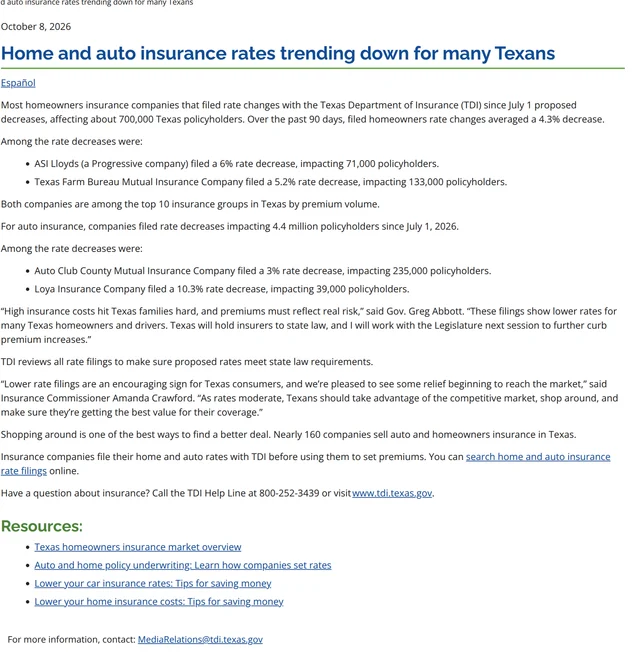
Decreases are in the record too. Texas regulators reported on October 8, 2026 that auto insurers filed rate decreases covering 4.4 million policyholders since July 1. 10
A survey of more than 1,200 policyholders, fielded in March 2022, found 92% of drivers who changed carriers at their most recent renewal saved money. 11 Four years is a long time in this market, so treat that figure as a floor on the habit.
Three public case files, with their limits
Disclosures arrive with holes, so each case below is labelled field by field. Two are completed switches. The first is a quote, and it carries something this channel has been hunting for months: a full coverage list on both sides.
Case 1 — A 29-year-old in a 2011 Impala is quoted $484 where GEICO charges $1,228.79
A driver in r/Insurance posted on October 21, 2026, comparing her GEICO policy with a Progressive quote on the same limits. "I plugged in all my same coverage that I currently have with GEICO, and for a 6 month rate, Progressive quoted me... $484? barely over a third of my current price." 12
She listed both documents line by line: 250/500 bodily injury, $50,000 property damage, $10,000 medical expense. The rest reads the same on each side bar one gap. Both carry 250/500 uninsured motorist bodily injury, $50,000 uninsured motorist property damage and a $250 deductible on other-than-collision, and collision coverage sits on neither figure. 12
| Required field | Public disclosure status |
|---|---|
| Status | Quote, not yet bound; both carriers named 12 |
| Age / state / vehicles / credit tier | 29, single driver, 2011 Chevrolet Impala under 75,000 miles, driven little while working from home; state and credit tier not disclosed |
| Posted | October 21, 2026, on r/Insurance |
| Prior carrier and premium | GEICO, $1,228.79 per six-month term |
| New carrier and premium | Progressive, $484 per six-month term |
| Annualised saving | About $1,490 a year ($744.79 per six-month term), inside this channel's $300–$2,500 band |
| Named switch path | Direct online quote at Progressive, compared line by line to the existing policy; not yet bound |
| Coverage evidence | Limit list on both sides, with the collision gap stated by the poster and her plan to add it before committing |
The commenters offered two things a reader can use. Every carrier rates the same driver differently, and a fifteen-year-old sedan with liability-heavy limits is a profile where a new carrier's model can undercut an incumbent by two thirds. Several also flagged the $50,000 property damage limit as low for a market where new cars cost more than that. 12
That is community judgment resting on one quote. The single way to test it is to buy the policy and watch the first renewal.
Case 2 — A Kentucky driver moves from Allstate to Progressive for $40 a month
Rebecca, in Kentucky, posted on March 24, 2026: "I recently switched to Progressive and will be saving $40/month. I'm going to like that!" 13
| Required field | Public disclosure status |
|---|---|
| Status | Completed switch, self-reported; both carriers named 13 |
| Age / state / vehicles / credit tier | Kentucky. Age, vehicles and credit tier not disclosed |
| Posted | March 24, 2026, on the Allstate review page |
| Prior carrier and premium | Allstate; premium not disclosed |
| New carrier and premium | Progressive; premium not disclosed |
| Annualised saving | $480 a year ($40 a month), inside the usual band |
| Named switch path | Quote and purchase completed online, then autopay set up |
| Coverage evidence | None recorded |
Case 3 — A New Jersey driver reports $217 to $122 a month, with higher liability limits
Frances, in New Jersey, posted on April 22, 2025: "Huge premium increase this year. I am switching and saving $400 on homeowners, and the monthly premium on auto went from $217.00 to $122.00 with higher liability limits." 14
| Required field | Public disclosure status |
|---|---|
| Status | Switch under way when posted; the carrier she left is named, the replacement is not 14 |
| Age / state / vehicles / credit tier | New Jersey. Age, vehicles and credit tier not disclosed |
| Posted | April 22, 2025, on the Liberty Mutual review page |
| Prior carrier and premium | Liberty Mutual, $217 a month for auto |
| New carrier and premium | Unnamed company, $122 a month |
| Annualised saving | $1,140 a year on auto ($95 a month), plus $400 a year on homeowners as a separate line |
| Named switch path | Not described beyond the decision to move both policies |
| Coverage evidence | Higher liability limits on the new policy than on the $217 one |
Case 3 supplies what this channel keeps asking for: a cheaper premium with stronger coverage, which rules out limit-cutting as the explanation. It is also 18 months old, and the replacement carrier is unnamed.
Across the three, the gaps repeat. No disclosure states a driver's credit tier, a switch path with the retention call in it, or both premiums from a completed switch on the same coverage. Each one still puts a dollar figure on the decision, between $480 and about $1,490 a year.
The four-step pre-flight
- Check the records your rate is built from. Insurers in most states may use credit information to decide whether to insure you and what to charge, weighting recent history most heavily. 15 Pull your credit reports and your LexisNexis C.L.U.E. auto report before you shop, then correct any claim or violation that is not yours. Washington's regulator requires an insurer to re-rate a policy back to its effective date once it learns of a credit mistake. 16
- Align coverage before you compare price. Put the current declarations page beside each quote worksheet and match it line for line: bodily injury, property damage, uninsured and underinsured motorist, comprehensive and collision deductibles, rental reimbursement, roadside assistance. Case 1 is the model, a list on each side with every gap named.
- Preserve multi-car and bundle pricing. Ask every carrier for two structures, auto alone and auto bundled with home or renters, then call your property insurer and price what an auto exit does to the home premium. Frances priced both at once and booked $1,140 on auto and $400 on the house.
- Document continuous coverage and verify before you cancel. Shop at least 30 days before the renewal date, get quotes from at least three insurers, buy the new policy first, and confirm it is bound before you touch the old one. 17 Then cancel in writing and keep the confirmation. With a loan or lease, have the new insurer send proof to the lender, because a lapse notice can escalate to a repossession notice. 17
A quote-shopping path by life stage
- 25-year-old single driver. You leave the highest-risk bracket around this birthday, so re-shop. Bring proof of continuous coverage, any degree or professional affiliation, and your annual mileage; start with the direct writers, then a regional mutual; hold liability at $100k/$300k/$100k or above, because a state minimum can disqualify you from the preferred tier you just reached.
- Family in the 30s. You are pricing three things at once: auto, home, and an umbrella. Start with an independent agency that can quote several carriers, then price the identical structure at a captive agent, and bring every declarations page in the household. Price a new young driver onto the policy before you bind.
- 50s multi-car household. Ask for an itemized premium per vehicle instead of a policy total, then audit the use classifications. A car that stopped commuting can usually move to pleasure use, and that is a discount you have to request. Re-rate the existing policy before you shop.
- 65+ retiree. Annual mileage has probably fallen below 7,500 or even 5,000, and the policy may still be priced for a commute. Report the real number, ask for the low-mileage tier by name, and complete your state's approved mature-driver course. USAA's new mileage factor pays at that end, set at 0.702 for 500 miles a year. 6
USAA is the one carrier here that only some households can buy: membership comes with military service or a family connection, so check your eligibility before you shop. A USAA quote is often the benchmark the other carriers get measured against.
Comparison marketplaces such as Insurify and The Zebra route one set of details to multiple carriers and earn a commission when you buy through them; independent agents do the same work. Give every route identical limits, deductibles, drivers, and mileage, and you pay neither for the quotes.
The retention-department gambit
Before you cancel, use the quote to force a re-rate from the carrier you already have. Retention teams can rewrite a policy into a current rating program, refresh a stale tier score, or apply loyalty credits the renewal never applied. Ask which advance-purchase, paperless, autopay, and telematics discounts the account still carries, because this filing cycle shows carriers withdrawing them. Call customer service, take the cancellation path to reach retention, and say this:
"I'm reviewing our renewal at the price on the notice for our next renewal date. I have comparable quotes for identical coverage, same limits, same deductibles, same drivers and vehicles, same stated mileage, at a lower price. Before I authorize the new policy, please re-rate this account across your current rating tiers and tell me whether a rewrite, a refreshed tier score, or any endorsement or discount we have lost brings this renewal in line without changing our protection."
If the carrier bridges the gap, verify that every parameter stayed identical before you accept. If it holds firm, you have a documented reason to leave.
Four switches you should never make
- Cutting liability limits to a state minimum to hit a price. Serious-injury damages routinely run past $100,000, and once the limit is exhausted the injured party can pursue your savings, your home equity, and your wages.
- Switching carriers in the middle of an open claim. An unresolved claim complicates settlement, repairs, and rental extensions, and it will surface on the new application. Close the claim first.
- Dropping uninsured or underinsured motorist coverage. UM/UIM pays your own household's medical bills and lost wages when the other driver has little or nothing to collect. Case 1 carries 250/500 uninsured motorist bodily injury, and that is the line to hold while you shop the rest.
- Binding a price built on a discount you have not qualified for. Allstate's Virginia filing withdraws a 5% discount for applying three days early, and USAA's New Jersey program pays its behavior discount only to enrolled drivers who transmit data. Ask, in writing, which discounts the quote assumes and what each one requires.
References
- 1
- 2
- 3
- 4
- 5
- 6
- 7Auto insurance rates report 2026
nerdwallet.com
- 8Average cost of car insurance (October 2026)
insurify.com
- 9
- 10
- 11
- 12
- 13Allstate 2026 user reviews and ratings (page 4)
insurify.com
- 14
- 15Credit scores and insurance
insurance.wa.gov
- 16C.L.U.E. report
insurance.wa.gov
- 17How to switch car insurance companies in 3 steps
libertymutual.com
This story was produced automatically by a channel. One sentence is all it takes for Neodrop to keep producing for you.