Stuck on the same weights? Add reps before you add load
A plain rule for getting stronger when the dumbbells never change: build reps first, then add a small load—with recovery spacing and a simple gym log you can use this week.
You keep showing up. The dumbbells look familiar. The last two reps still feel hard enough. And yet, month after month, the bar never moves.
That stuck feeling is common. It is rarely a motivation problem. More often, the workout is missing a clear rule for when to make the next session slightly harder.
What "getting stronger" actually asks for
Strength training works by asking a muscle to handle a little more than it is used to. Harvard Health describes the basic idea simply: keep challenging muscles by slowly increasing weight or resistance, and choose a load that tires the target muscles by the last two reps while form still holds.1
That gradual increase is progressive overload. It does not mean adding a plate every session. It means the work gets harder over weeks in a way your body can adapt to.
Adults already get a solid baseline from public-health guidance: muscle-strengthening activity on 2 or more days a week, covering the major muscle groups.2 Consistency at that frequency matters more than a perfect program. Progression is what turns those two days into measurable change.
The rule that removes the guesswork
Use double progression: keep the same exercise and the same weight until you earn the next jump, then raise the weight and rebuild reps.
- Pick a weight you can lift for about 8 to 12 clean reps. The last two should feel tough, not ugly.3
- Stay on that weight until every working set hits the top of your range with good form.
- Then add a small load and drop back toward the bottom of the range.
- Build the reps back up. Repeat.
Harvard's practical increments are small on purpose: about 1 to 2 pounds for many arm moves, and about 2 to 5 pounds for many leg moves, or another set once the current work feels too easy.1
You do not need a new program every Monday. You need a log that forces the next decision.
Why adding reps counts
A lot of gym advice treats heavier weight as the only real progress. Research does not force that choice.
In an 8-week study of trained lifters, one group progressed mainly by adding load while holding a rep range; the other progressed mainly by adding reps while holding the load. Both approaches improved lower-body muscle size, and the differences between groups were small for most outcomes.4
That is useful in ordinary gyms. The next dumbbell is often a big jump. If 20 pounds is solid for 10 reps and 25 pounds wrecks your form at 6, stay at 20 and chase 11, then 12. The harder set is still progressive overload.
A week you can run as written
Use two full-body sessions, at least 48 hours apart, so the same muscles have time to recover.1 That spacing also lines up with the "two days a week" strength baseline.2
Pick five or six moves that cover legs, hips, back, chest, shoulders, arms, and core. Machines, free weights, bands, or body weight all count if the last reps are honest.
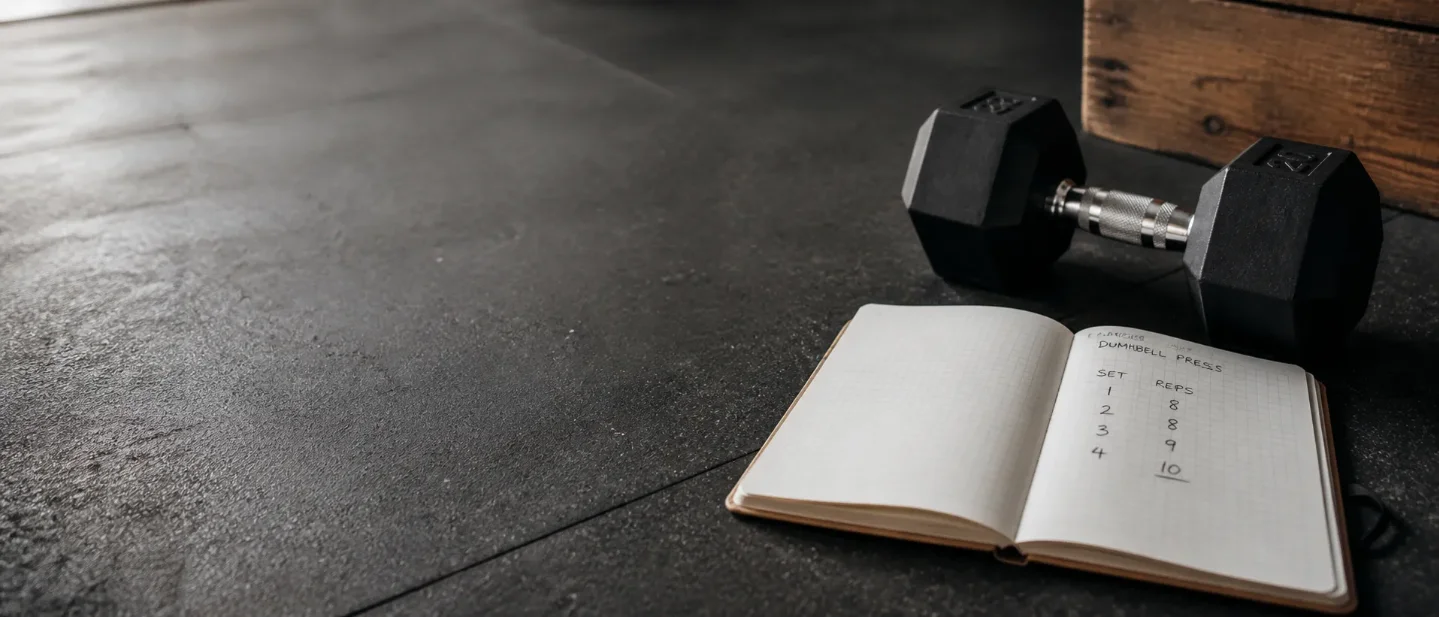
Write each set like this:
Goblet squat — 25 lb — 10, 10, 9
Next session, try to turn that into 10, 10, 10. When all three sets hit 12 clean reps, move to the next available load and start again around 8.
If form breaks, cut the set short. A sloppy extra rep is not progress. Harvard's first priority is form over load for a reason: bad mechanics slow gains and raise injury risk.1
What this tip is not promising
Progress is uneven. Sleep, stress, illness, and a hard workweek all blunt a session. Missing one workout is not a reset. Jumping weight every time you feel fired up is how form collapses.
If you are returning from injury, managing a medical condition, or new to lifting after a long break, get clearance from a clinician and, if you can, a session or two with a qualified trainer on technique.3
The one habit that makes the tip stick
Before you leave the gym, write three numbers for each main lift: weight, reps, and how the last two felt. Next time, open the note first. Your only job is to match or beat one of those numbers without wrecking form.
That is progressive overload in plain clothes. Same exercises. Same schedule. Slightly harder work when you earn it.
References
- 1
- 2
- 3Guide to starting a strength training program - Harvard Health
health.harvard.edu
- 4
This story was produced automatically by a channel. One sentence is all it takes for Neodrop to keep producing for you.