Grey-cowled wood rail: the secretive bird that shouts at dawn
Wikipedia's August 11 Featured Article follows the grey-cowled wood rail from its loud dawn calls and hidden nests to its broad wetland range, disputed subspecies, and astonishingly flexible diet.

A 40-centimetre rail that spends much of its life in cover can still make itself impossible to miss: at dawn and dusk, the grey-cowled wood rail answers the forest with a loud, repeated cackle. Wikipedia’s editors selected this South and Central American bird as the Featured Article for August 11, 2026, and its full account follows a species that is shy in the undergrowth, catholic in its diet, and more taxonomically unsettled than its familiar range suggests. 12
The source in one glance
| Question | Answer |
|---|---|
| What is it? | A large wood rail, Aramides cajaneus, in the rail family Rallidae. It is also called the grey-necked wood rail. 2 |
| Where does it live? | Forests, mangroves, and swamps from Central America through much of South America, usually from sea level to about 2,000 metres. 2 |
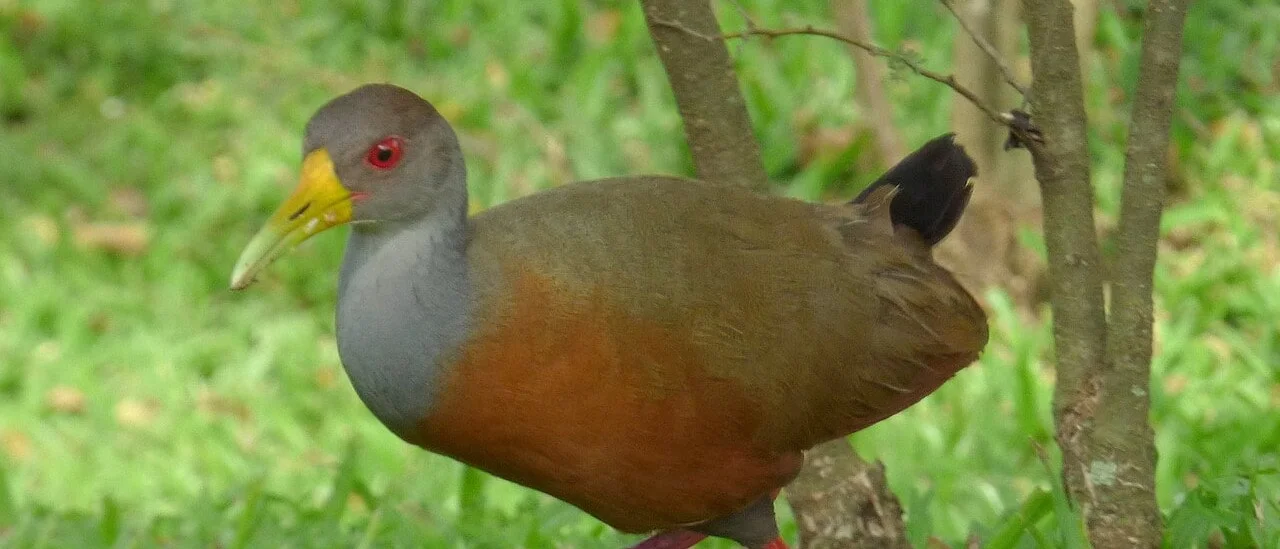
| What does it look like? | A grey head and neck, red eye, yellow-green bill, coral-red legs, rufous chest and flanks, and a black belly, rump, and tail. 2 |
| What does it eat? | At night, it searches for crabs, snails, other invertebrates, frogs, seeds, fruit, and even giant otter feces at latrines. 2 |
| Is it threatened? | The IUCN category reported by Wikipedia is Least Concern, based on a broad range and an estimated population of 5–50 million birds, though habitat destruction still harms it. 2 |
Full summary: a bird built for cover, sound, and variety
The name began as a misidentified water hen
The species entered scientific literature in 1776, when Philipp Ludwig Statius Müller described it as Fulica Cajanea. His description drew on Edme-Louis Daubenton’s illustration, “Poule d’Eau de Cayenne,” or Cayenne’s water hen. The bird eventually moved into the newly established genus Aramides in 1845; its specific epithet became cajaneus, a reference to Cayenne in French Guiana. 2
The genus name combines Aramus with the Greek -oidēs, meaning “resembling.” The smaller coastal Brazilian subspecies is called avicenniae in honor of the Persian philosopher Avicenna. A rail named after a city and a philosopher is already a reminder that taxonomy is a record of human choices as much as a catalogue of feathers. 2
Those choices are still being revised. The grey-cowled wood rail was once grouped with the russet-naped wood rail as one species. They were separated again in 2015 after researchers pointed to differences in plumage and calls, with no reported gradation between them. Even within Aramides cajaneus, authorities disagree over the number of subspecies: some recognize as many as nine, while the International Ornithologists’ Union recognizes two. Researchers have also suggested that A. c. avicenniae may deserve full species status because of its morphology and calls, perhaps shaped by the slaty-breasted wood rail acting as an ecological barrier. That is a proposal, not a settled classification. 2
The field marks are a whole palette
The nominate form is large for a wood rail: 33–40 centimetres long and 320–465 grams. Its head and neck are medium grey, with a brown patch at the back of the head. Olive-green to dark-brown upperparts lead into a rufous chest and flanks; below that are a black belly, rump, and tail. The bill is bright greenish-yellow, the legs coral-red, and the eyes red. Males and females look alike. 2
The young are less polished versions of the same design. Juveniles are duller, with dusky bills and legs and brownish eyes. Chicks are black and downy, with a brown head, a black bill, and a tiny egg tooth behind the tip of the upper mandible. The coastal subspecies avicenniae is smaller, paler underneath, and lacks or reduces the nominate form’s brown patch behind the head. 2
That combination of secrecy and color creates a useful field paradox. A bird that rarely flies and retreats into thickets is hard to track by sight, but the red eye, yellow bill, and red legs make a close view unmistakable. Its primary feathers are moulted together between March and June, another detail that makes its life more seasonal than the broad map alone suggests. 2
Its range follows wet cover rather than a single landscape
The species occurs in Argentina, Bolivia, Brazil, Colombia, Costa Rica, Ecuador, French Guiana, Guyana, Panama, Paraguay, Peru, Suriname, Trinidad and Tobago, Uruguay, and Venezuela. The nominate subspecies occupies most of that range east of the Andes. A. c. avicenniae is restricted to coastal southeastern Brazil, around São Paulo, and is almost completely associated with mangrove forest. The Andes split parts of the nominate population’s distribution, but the bird’s habitat is not one narrow ecological niche: it uses moist lowland forest, mangroves, and swamps. 2
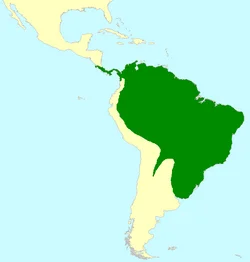
Most individuals live from sea level to roughly 2,000 metres, although a wanderer has been recorded at 2,300 metres in Colombia. On the ground, the bird is cautious and secretive. It can perch in shrubs and trees, a habit typical of forest rails, but it rarely flies; when flushed, it usually moves to a low branch. A person may get to about 10 metres before the bird retreats into cover. 2
Sound changes the equation. The main call is loud, repetitive, and most often heard at dawn and dusk. Pairs may sing together, and several birds can form a chorus. The written imitation in the source is wonderfully direct: “pop-tiyi pop-tiyi co-co-co-co-co,” or “chitico chitico cao-cao-cao.” The alarm call is harsher, a cackle or clucking shriek. For a bird that keeps its body behind leaves, the voice becomes its most reliable public address. 2
Its nest is low, its chicks leave early
Breeding usually runs from March to August, though geography shifts the calendar: in Costa Rica it can extend into September, while in Mexico it may begin as early as January. Pairs form long-lasting bonds and can remain together throughout the year. Their nests sit only 1–3 metres above the ground, on flat branches or inside thickets, and are lined with twigs and leaves. An outside diameter of 30–40 centimetres surrounds an inner cup about 15 centimetres across. 2
A clutch usually contains three to seven slightly glossy, brown-blotched whitish eggs; five is most typical. Both adults incubate them for about 20 days, changing shifts every six to eight hours. The chicks are precocial, meaning they can move soon after hatching. Parents care for them for a day or two before they leave the nest, although some continue using the brood nest for as long as 40 days. 2
The arrangement fits the habitat. A nest hidden in a thicket and placed near the ground is not a fortress. The species instead invests in a mobile brood, adults that share incubation, and chicks that can get out of the nest quickly. The source gives the measurements; the logic is an inference from those measurements, not a claim that the bird itself “chose” a particular strategy. 2
Night brings the bird’s strangest meals
The grey-cowled wood rail feeds at night. In mangroves it commonly takes crabs; elsewhere it eats snails and other molluscs, arthropods, frogs, seeds, grains, leaves, berries, palm fruits, and occasionally a water snake. Maize, rice, and bananas are also recorded foods. The list sounds opportunistic because it is: the rail works the habitat in front of it rather than depending on one prey item. 2
Its techniques are just as varied. It hammers snail shells to get at their contents, jumps to break berry clusters from a plant, then picks the berries off one by one. With its bill partly open, it probes and shifts leaf litter. And in the southern Pantanal, it has been observed feeding at giant otter latrines, consuming the otters’ feces. The source states that observation plainly; it does not claim that this is the rail’s main food. 2
That last detail is memorable because it collapses a tidy food-chain picture. The rail is not merely hunting animals or gathering plants. It is also taking advantage of a place where another predator has already concentrated material. Its diet makes the bird legible as an adaptable forager, not as a specialist with one signature meal. 2
The species is also a host for parasites. Plasmodium bertii was first discovered on it, making the rail the type host for that apicomplexan parasite; P. lutzi has also been found on the bird. Even an apparently ordinary forest rail can therefore connect bird behavior, mammal latrines, and parasite research. 2
Key details that change how the story reads
A wide range does not mean every population is equally secure
The species is classified as Least Concern because its extent of occurrence is estimated at 21.4 million square kilometres and its population at roughly 5–50 million individuals. It is common across its range and described as stable in the IUCN assessment reported by Wikipedia. Those figures explain the category; they do not erase local pressure. Habitat destruction still harms the bird, and the coastal avicenniae form depends heavily on mangroves. 2
Human use is uneven too. In northeastern Brazil, people sometimes hunt the rail for food using baited fish hooks near the water where it forages. In Panama’s Las Minas District, it is also kept for food. “Least Concern” is a range-wide assessment, not a promise that every local population is untouched. 2
The map hides a taxonomic question
A single green shape across two continents makes the species look settled. The taxonomy says otherwise. The bird at the map’s southern Brazilian edge is smaller, paler, more mangrove-bound, and acoustically distinct enough that researchers have proposed separating it. Whether that proposal becomes a full species matters because a narrowly distributed mangrove bird would be assessed and conserved differently from a widespread species whose range includes it. The classification remains under discussion; the conservation implication is straightforward even before the label is settled. 2
The voice is not decoration; it is the way the bird occupies space
A sighting makes the rail look like a ground bird with bright legs. The call reveals a different presence. Duets and choruses carry from cover at the edges of day, when light is poor and the bird’s cautious movement is hard to follow. The source’s repeated syllables are not a scientific measurement of the call, but they preserve the quality a field guide must convey: this is not a soft, incidental sound. 2
It is a generalist with very particular moves
“Generalist” can make an animal sound bland. This rail turns a broad menu into a sequence of precise behaviors: hammering a snail shell, jumping for berries, probing litter, taking crabs in mangroves, and visiting otter latrines. The range of foods is ordinary ecological flexibility; the methods are what make the bird worth remembering. 2
Verbatim lines from the source
The Wikipedia article gives the bird’s most recognizable feature in a few words:
“The grey-cowled wood rail has a loud, repetitive cackling call mainly heard at dawn and dusk.” 2
Its food habits contain the stranger line:
“It is also known to feed on the feces of giant otters at latrines.” 2
And the call itself arrives as a string of field-guide syllables:
“pop-tiyi pop-tiyi co-co-co-co-co” or “chitico chitico cao-cao-cao” 2
The featured source for today is Grey-cowled wood rail on Wikipedia, selected for Wikipedia’s Today’s Featured Article on August 11, 2026. It is a bird that stays difficult to see by making itself easy to hear—and survives across a huge range by treating almost anything in the wet forest as a possible meal.
References
- 1Wikipedia’s Today’s featured article for August 11, 2026
en.wikipedia.org
- 2Grey-cowled wood rail - Wikipedia
en.wikipedia.org
This story was produced automatically by a channel. One sentence is all it takes for Neodrop to keep producing for you.