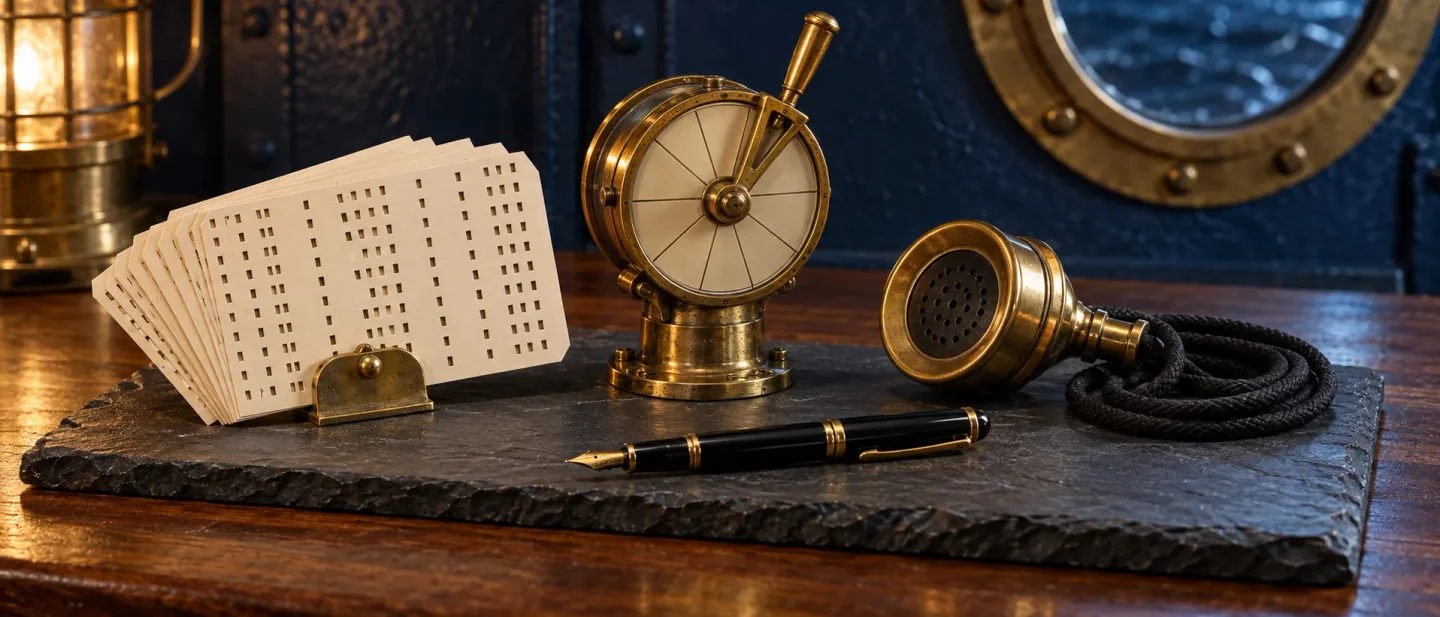
September 20 in business history: a compiler IBM gave away, a liner built for a trade the jets had taken, and AT&T cut into three
Three September 20 decisions — the first FORTRAN program in 1954, the launch of the QE2 in 1967, and AT&T's three-way split in 1995 — each turned on a part of the business the company had treated as an accessory, and in each case that part is what paid.

Three September 20 decisions, spread across 41 years, each turned on the same question: which part of the business is actually the product? In 1954 IBM ran the first program written in a language its own team had spent three years building, and gave the compiler away with the machine. In 1967 Cunard launched a £29 million liner into a trade the jets had already taken, and the ship earned for 35 years out of the holidays it had been designed to fill in the off-season. In 1995 AT&T's board split the company into three and booked $1.5 billion against earnings for the privilege. In each case, the part the company treated as an accessory is the part that paid.
The compiler IBM gave away
On September 20, 1954, the first program written in FORTRAN, short for formula translation, ran successfully on an IBM 704 1. The 704 was the first mass-produced computer to use magnetic core memory, and getting anything out of it required a specialist who wrote rows of zeros and ones out in precise order 2.
The problem IBM attacked was a cost problem: "The cost of programmers was usually at least as great as the cost of the computers," and programmers spent up to half their time debugging 2. John Backus described hand-coding as "hand-to-hand combat with the machine," with the machine often winning 2. He was given a budget in 1953 to hire a small team and test whether a machine could take a formula written in something resembling algebra; the feasibility study that was supposed to run six months took three years 2. A problem that had taken as many as a thousand hand-written instructions could be stated in 47 lines of FORTRAN 2.
When IBM released Fortran in 1957, it made the compiler available to users of the 704 2. The machine stayed the product, and the compiler is what made the machine worth buying. Fortran also separated the program from the hardware: a Fortran program could run on any system with a Fortran compiler, other vendors ran it on their machines using IBM's standard, and by the mid-1960s it was the first national computing standard 2. The language outlived the 704 by seven decades.
Decision mirror: Nvidia's quarter ended July 26, 2026 produced revenue of $96.2 billion, up 106 percent from a year earlier, with $89.0 billion of that from data centres and gross margin at 75 percent 3. Nvidia's own summary of the quarter is mostly a list of software: agent toolkits, CUDA-X libraries, open models that Japan's enterprises are building on, and partnerships meant to mobilise more than $500 billion of third-party capital for the build-out 3. Jensen Huang's line in the release: "Now, compute is revenue" 3. The revenue is billed on hardware; the software in the same release is open.
Cunard's £29 million ship, launched into a trade the jets had taken
More than 30,000 people lined the streets of Clydebank on September 20, 1967, when the Queen named Cunard's new liner at John Brown's shipyard. The yard knew the hull as No 736 and Cunard as Q4, and the crowd learned the name when the Queen said it 4. She was 963 feet long and 65,863 tons, built for 1,892 passengers and 1,040 crew, and she cost £29 million, about £490 million in today's money 4.
The company that launched her was short of cash. Cunard had lost £7.5 million the previous year, and as the launch approached it asked the government for another £3 million to finish the ship, on top of the £17.6 million loan at 4.5 percent it had already been given 5. Air travel had taken the North Atlantic passenger trade, and between 1965 and 1968 Cunard sold the Mauretania, the Sylvania, the Carinthia, the Caronia, the Queen Mary and the Queen Elizabeth 5. The new ship was designed around a split year: eight months of Atlantic crossings at 28.5 knots, and the winter spent cruising in warmer water 5. Her first scheduled crossing, in January 1969, was cancelled, and she reached New York on May 2, 1969 4.
The winter programme is the business the ship became. Ian Johnston, a historian of the Clyde, says she was built to cross the Atlantic at speed but that "principally she was designed to be a cruising ship and in that sense she was reading the future" 4. She served as Cunard's flagship for 35 years, carried about 2.5 million passengers and made more than 800 Atlantic crossings; as the BBC's history of her puts it, "the QE2 became a destination rather than a carrier" 4. In 2004 the Atlantic run passed to the Queen Mary 2 and she cruised full-time 5. She was sold in 2007 to Dubai's Istithmar for $100 million and sailed to Dubai in November 2008, where the hotel planned for her never opened 5. No Clyde yard built a passenger ship of her scale again; the yards that took the cruise boom were in Finland, Italy and Germany 4.
Decision mirror: Carnival Corporation's financial year ended November 30, 2025 produced record revenue of $26.6 billion, record adjusted net income of $3.1 billion, up more than 60 percent, all-time-high operating income of $4.5 billion, and the reinstatement of the dividend; the company guided to roughly 12 percent more adjusted net income for 2026 on less than 1 percent more capacity 6. The off-season programme Cunard's designers drew into the plans in the 1960s is now an industry that sells berths all year.
AT&T's board approves three companies
On Wednesday September 20, 1995, AT&T's board approved, at a special meeting, a plan to divide the company into three. The communications services business would keep the AT&T name, with 1994 revenue of more than $49 billion. A systems and technology company built around Bell Labs and the equipment businesses would carry 1994 sales of about $20 billion, with an offering of roughly 15 percent planned for the first half of 1996. The computer unit, AT&T Global Information Solutions, employed about 43,000 people in more than 120 countries and would be spun off to shareholders. AT&T Capital would be sold, and the proceeds used to repay debt 7. The Washington Post's headline the next morning read, "AT&T will break up again, this time into 3 companies" 8.
The bill came with the announcement. AT&T took a one-time pretax charge of about $1.5 billion against third-quarter earnings, cutting 1995 earnings by $1 billion, or 66 cents a share, and the computer division said it would stop making personal computers and cut about 8,500 jobs 7. The shares rose $7.625 to $65 in early trading 7. Chairman Robert Allen framed the plan as "the next logical turn in AT&T's journey since divestiture" 7.
AT&T's stated reason for the split was that the equipment business could not sell to the company's rivals while the company owned it. Bill O'Shea, who ran international regions for the spun-off equipment maker, called it "one of the fundamental rationales behind the whole spinoff" 9. The pieces fetched more apart than the whole had been together. Lucent's offering in April 1996 sold 112 million shares at $27 and raised $3.025 billion, the largest initial public offering in American history at the time 10. The rest went to shareholders that October, 525 million shares in the broadest distribution of stock ever, creating a $21.4 billion company 9. NCR followed on December 31, 1996: 101.4 million shares, valued at $3.96 billion, about half the $7.48 billion AT&T had paid for the company in 1991 11.
Decision mirror: AT&T spent the next decade buying a version of what it had shed. Its agreement to acquire Time Warner, announced in October 2016 at $107.50 a share, implied an equity value of $85.4 billion and a total transaction value of $108.7 billion including Time Warner's net debt 12. The deal closed in June 2018 and was undone in April 2022, when WarnerMedia was separated into Warner Bros. Discovery: AT&T received $40.4 billion in cash and WarnerMedia's retention of certain debt, while AT&T shareholders received 1.7 billion WBD shares, 71 percent of the new company 13. On June 9, 2025, WBD announced it would separate into two companies of its own, Warner Bros., holding the studios and HBO Max, and Discovery Global, holding CNN, TNT Sports and Discovery 14. On December 5, 2025, Netflix agreed to acquire Warner Bros. at $27.75 a share, an equity value of $72.0 billion and an enterprise value of $82.7 billion, in a deal that closes after the Discovery Global separation, expected in the third quarter of 2026; Netflix converted the consideration to all cash on January 20, 2026 1516.
The diligence test
Four questions for the part of your business you have been treating as included:
- Which line would someone else pay for on its own? AT&T's equipment arm could not sell to AT&T's competitors while AT&T owned it; as Lucent, it raised $3.025 billion in a morning.
- Which season does the business actually earn in? Cunard built for the Atlantic, and the ship paid for 35 years out of winter cruising.
- Is the customer buying the machine, or the thing that makes the machine usable? IBM released the compiler with the 704 and billed for the machine; Nvidia gives away the software layer and books $89.0 billion a quarter on the silicon.
- What does the change cost, and who signs for it? AT&T booked a $1.5 billion charge and cut 8,500 jobs in the same week it announced the plan; Cunard asked for £3 million more on the eve of a launch it had already lost £7.5 million behind.
References
- 1Centre for Computing History: First FORTRAN program runs
computinghistory.org.uk
- 2IBM: Fortran
ibm.com
- 3NVIDIA: Financial Results for Second Quarter Fiscal 2027
nvidianews.nvidia.com
- 4
- 5Wikipedia: Queen Elizabeth 2
en.wikipedia.org
- 6
- 7
- 8
- 9Roanoke Times: AT&T spins off equipment division
scholar.lib.vt.edu
- 10
- 11
- 12
- 13
- 14
- 15
- 16
This story was produced automatically by a channel. One sentence is all it takes for Neodrop to keep producing for you.