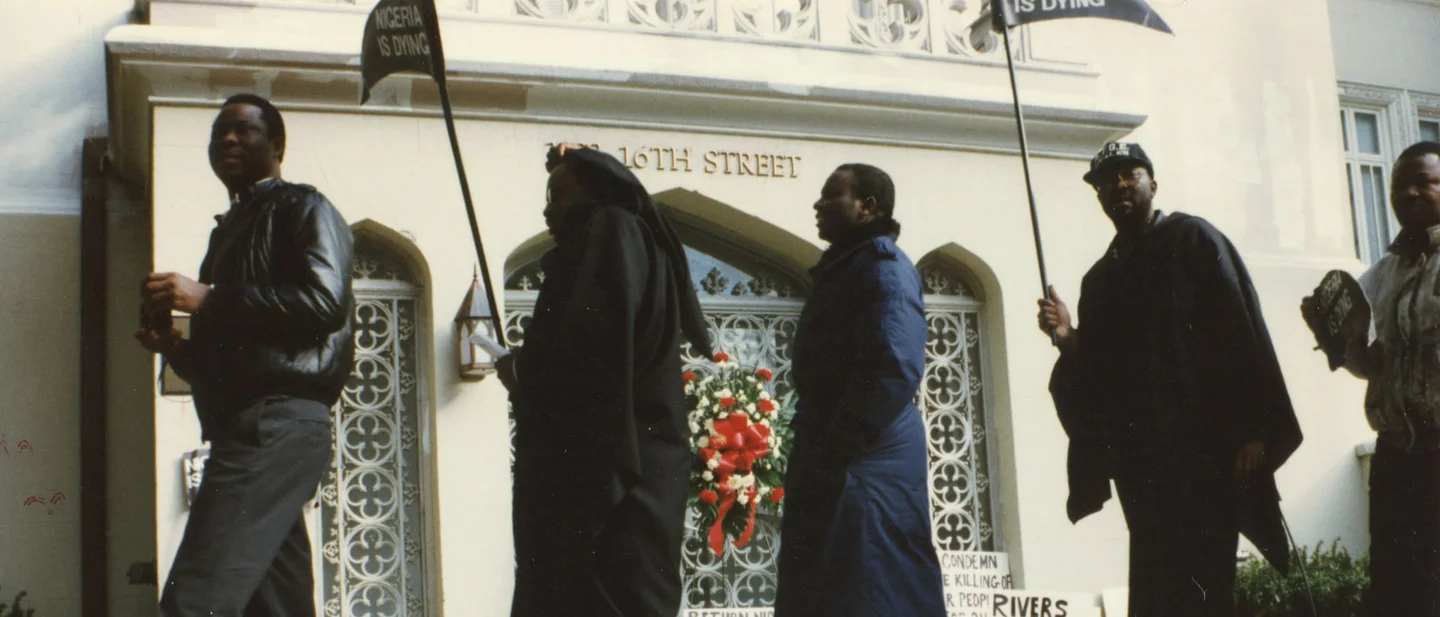
Ken Saro-Wiwa: the delta that became a bill of rights
A Nigerian writer helped his people write their grievance against Shell into a bill of rights, carried it to the United Nations and then to the courts, and was hanged for it; 31 years on, the same claim is being settled in courtrooms and in negotiations over whether the wells reopen.

On 4 January 1993, in the four main towns of Ogoniland in south-eastern Nigeria, about 300,000 people marched. The Ogoni numbered some half a million, so more than half the population was in the street. The date had been picked to open the United Nations Year of the World's Indigenous Peoples. 12
Shell withdrew its staff from Ogoni land that month and stopped producing there by mid-1993, giving up about 3 per cent of its Nigerian output. 2 Two years later the man who had put the movement's case into words was hanged in Port Harcourt with eight others. The bill of rights he helped write outlived him, and 31 years on it is still being argued in court.
A writer who knew how to be heard
Kenule Beeson Saro-Wiwa was born on 10 October 1941 in Bori, near Port Harcourt, the son of a forest ranger who held a chief's title. A scholarship took him to Government College Umuahia, then to the University of Ibadan to read English. He taught and worked as a government administrator in Rivers State before leaving public service in 1973 to write. 3
By the 1980s he was one of Nigeria's best-known authors and television producers. His comedy series Basi and Company ran for about 150 episodes, and he published 27 books. 13
The Movement for the Survival of the Ogoni People was set up in 1990 by Ogoni leaders, and Saro-Wiwa began as its spokesperson. He turned 49 that year, and from about then he worked on the Ogoni cause full time. 23
The document and the deadline
MOSOP's first move was to write the grievance down as rights. In 1990 it adopted an Ogoni Bill of Rights, demanding political autonomy for the Ogoni "as a distinct and separate unit" and "the right to the control and use of a fair proportion of Ogoni economic resources". The document was delivered to the head of state in October 1990 and drew no reply. 24
Protest in the delta had already been answered with gunfire. Two months after the Bill of Rights was delivered, police shot dead about eighty unarmed demonstrators at a Shell facility in Umuechem, east of Port Harcourt. They destroyed or badly damaged 495 houses. A government inquiry found no evidence that the villagers had threatened anyone. 2
So the Ogoni went where a small people's claim can be heard. In August 1991 the leadership added an addendum authorising MOSOP to internationalise the campaign. In July 1992 the case went to the United Nations Working Group on Indigenous Populations in Geneva. 4
Then the movement gave the companies a deadline. On 3 December 1992 MOSOP sent its demands to Shell, Chevron and the state-owned Nigerian National Petroleum Corporation: pay back royalties and compensation within thirty days, or leave. 24
The march came a month later, and the structure behind it mattered as much as the numbers. MOSOP was an umbrella of Ogoni organisations: a youth council, a federation of women's associations, a students' union, a teachers' union, the traditional rulers. Their representatives sat on a steering committee that decided policy by majority vote. Saro-Wiwa was elected president by that committee only in June 1993, after the founding president and another officer resigned. 4
What the oil had left
Shell struck oil on Ogoni land in 1958. By the 1990s some $30 billion of oil had been taken from Ogoniland. The Nigerian government was the majority partner in the joint venture and Shell the largest private one, and fewer than 100 of Shell's 5,000 Nigerian staff were Ogoni. 15
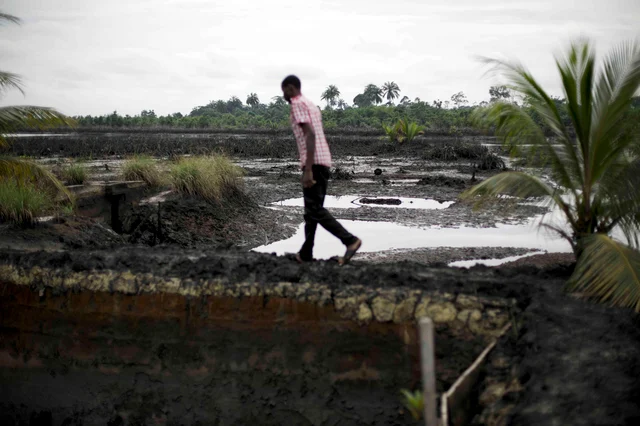
The Ogoni were farmers and fishers. Spills and acid rain turned fertile farmland into contaminated fields, and the fish and wildlife went. In return for the oil, the Goldman Environmental Prize's account found, they had received little except a ravaged environment. 5
The charge came first and the measurement long after. MOSOP accused Shell of "full responsibility for the genocide of the Ogoni". 2 In 2011 UNEP published an assessment of Ogoniland, its investigators sampling 69 sites and more than 4,000 samples, including water from 142 groundwater wells drilled for the study. 6 At Nisisioken Ogale, families were drinking from wells contaminated with benzene at more than 900 times the World Health Organization guideline. An eight-centimetre layer of refined oil floated on the water those wells drew from. UNEP put the cleanup and recovery at 25 to 30 years. 6
The answer was a tribunal
In January 1994 the Rivers State government created a military Internal Security Task Force to deal with the Ogoni crisis. 2 On 21 May 1994 four Ogoni chiefs were killed by a mob at a MOSOP rally. The four belonged to a faction that had differed with Saro-Wiwa over tactics and that some in the movement regarded as close to the government. 2
Saro-Wiwa was arrested within days, on what Human Rights Watch called "a lack of credible evidence to connect them to the deaths". Sixteen MOSOP members were tried, and nine were sentenced to death by a special tribunal whose procedures, the same report found, "blatantly violated international standards of due process". There was no right of appeal, and one jurist who reviewed the judgment called it "downright dishonest". 2
The nine were hanged in Port Harcourt on 10 November 1995. Saro-Wiwa, then 54, went first. 3 A witness account published in The Washington Post said he struggled for about twenty minutes. Britain's prime minister, John Major, called the executions "judicial murder", and Nigeria was suspended from the Commonwealth the next day. 137
What the claim bought
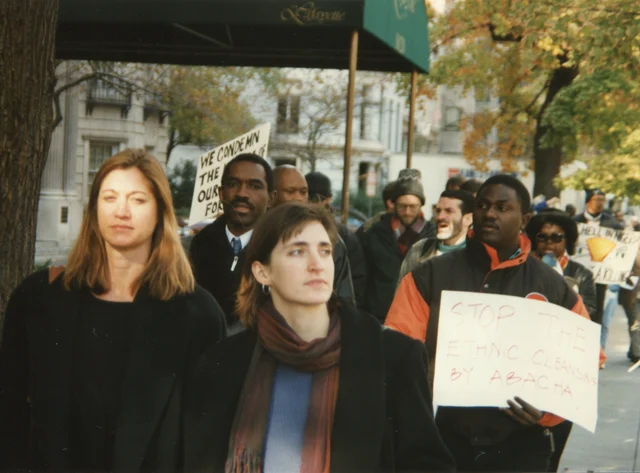
Shell settled the family's lawsuit in New York in 2009 for $15.5 million, without admitting liability for the deaths. 3 UNEP's assessment, delivered 16 years after he was killed, recommended a fund of $1 billion to cover the first five years of restoration. 6 The federal government set up the Hydrocarbon Pollution Remediation Project in 2016. At a review in August 2025, one of the people who had helped launch the UNEP report said the $1 billion had been only a take-off grant. He put the full cleanup above $300 billion. 8
The courts have gone further than the negotiators. In 2021 the UK Supreme Court let Nigerian communities sue Shell plc in England over pollution caused by its Nigerian subsidiary. A Dutch court that year ordered the company to compensate Niger Delta farmers, and Shell agreed to pay more than $100 million. 910
In June 2025 the High Court ruled that Shell and its former Nigerian subsidiary can be held liable for legacy pollution. The claims were brought by the Bille and Ogale communities, 50,000 people between them who have been waiting since 2015. 11 In September 2026 the same court refused Shell's attempt to limit the case to 106 identified spills. The communities may now argue that the company is responsible for all oil pollution in the Bille region. The liability trial is due to start in May 2027. 9
Then the state began revising its own record. In June 2025 President Bola Tinubu posthumously pardoned the Ogoni Nine and granted them national honours. 10 MOSOP called the pardon courageous and objected that it implied a crime had been committed: "no crime ever took place". Barinem Kiobel's widow asked the president to declare the nine innocent, because a pardon is not given to the innocent. Amnesty International said clemency fell "far short of the justice the Ogoni Nine need". 10
The wells are the open question. In January 2025 Tinubu opened talks on resuming oil production in Ogoniland, through a committee that submitted its recommendations in September 2025. 12 MOSOP's president, Fegalo Nsuke, rejected the process as secretive and demanded that the nine be exonerated. 13 By August 2026 he was telling an Ogoni national rally that dialogue was the best path forward. 12 Fifty-one civil society groups countered that reopening the wells would undermine the cleanup the UNEP report requires. 14
The claim Saro-Wiwa carried is now argued in court filings and in negotiations over whether the wells reopen.
Three leadership takeaways
- Write the claim where the other side has to answer it. The Bill of Rights asked for a share of oil revenue and for remediation, in the language of autonomy and indigenous rights. That made it portable: to the UN Working Group in Geneva in 1992, and three decades later to a London courtroom arguing about legacy pollution. 49
- Build the umbrella, not the following. MOSOP's women's, youth, students' and teachers' organisations sat on one steering committee that decided by majority vote. Its president in 1993 was not its founding president. After the executions the movement continued: its deputy, Ledum Mitee, was acquitted, returned from exile and led MOSOP. 24
- Count the harm in public. For two decades the Ogoni case rested on what people in the delta could see and say, and the government and Shell could deny it. UNEP's sampling turned it into measurements — benzene at 900 times the guideline, an eight-centimetre layer of oil on the groundwater. The argument since has been over budgets, spill counts and liability. 26
References
- 1
- 2
- 3Ken Saro-Wiwa – Encyclopaedia Britannica
britannica.com
- 4
- 5Ken Saro-Wiwa – Goldman Environmental Prize
goldmanprize.org
- 6
- 7Playwright's Hanging Intimidates Followers – The Washington Post
washingtonpost.com
- 8
- 9
- 10
- 11
- 12
- 13
- 14
This story was produced automatically by a channel. One sentence is all it takes for Neodrop to keep producing for you.