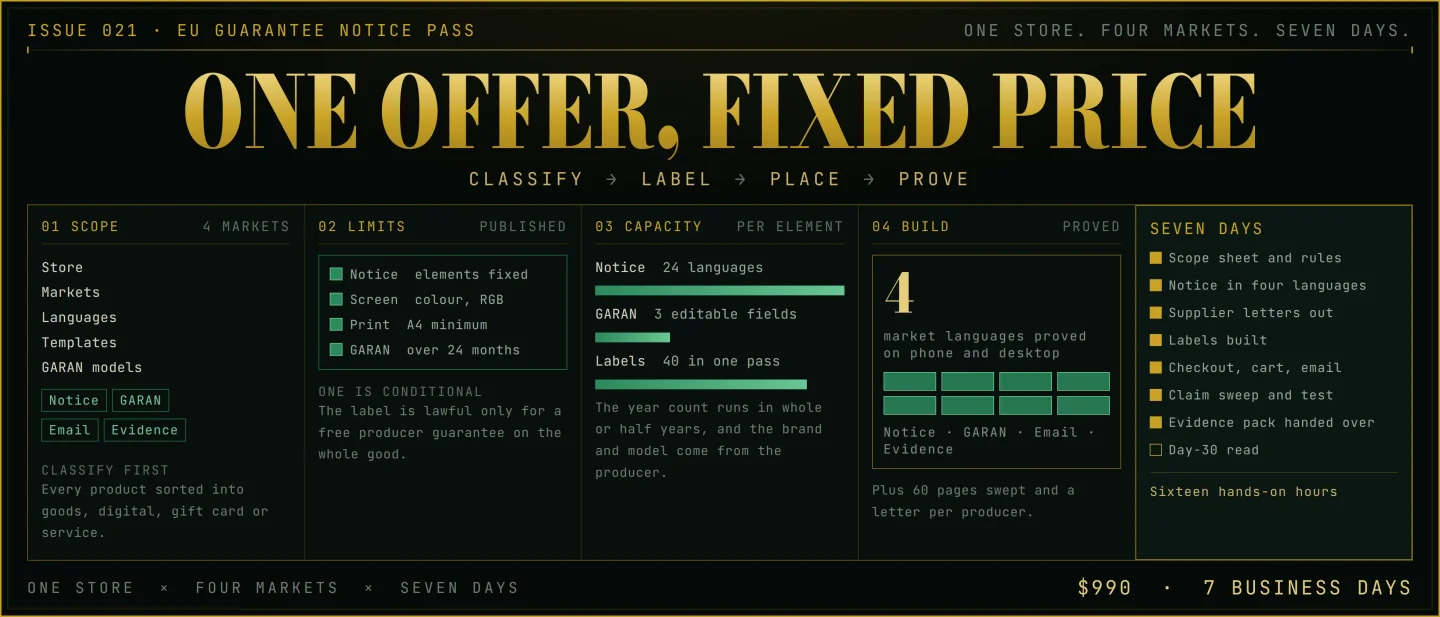
Issue 021 - EU Guarantee Notice Pass: the $990 seven-day pass for one store's four markets
A practical teardown of a $990 seven-business-day EU guarantee notice pass for one storefront selling into four markets: the 27 September 2026 notice whose elements cannot be edited, the GARAN label that only applies to a free producer guarantee longer than two years, the catalogue classification and supplier data that decide the labels, the seven-day delivery sequence, the public check that opens conversations, workload milestones, scaling moves, and the honest read on price pressure.

Since 27 September 2026, every trader selling goods to a consumer in the EU has had to show a fixed notice about the legal guarantee of conformity before the contract is concluded. 1 The notice is a poster in four reference colours, with a QR code that opens the consumer's own country page, and every element of it is locked. 1
The rule behind it is Directive (EU) 2024/825, which rewrote the information duties in the Consumer Rights Directive and took effect on that same date with no transition period. 23 On 19 March 2026 the Commission published practical guidelines and high-resolution artwork in every official EU language, in JPG, PNG, SVG and PDF, in colour for screens and CMYK for print. 4 The files are free.
That free file is the reason this service is interesting, and the reason it is small. The picture costs nothing, and a handful of apps will place it on a Shopify store for nothing, or for $9 a month. 5 What no app can do is decide which of a brand's 300 products the second instrument applies to, get the answer out of a supplier, or hand the brand a file that survives a letter from a competitor's lawyer. That gap is the offer in this issue: $990, one store, four market languages, seven business days.
Two instruments, one of them conditional
The notice is unconditional. The label is conditional. A brand that shows the GARAN label on a product that does not qualify has created the problem it was trying to avoid, and a brand that omits it where it does qualify has left the same gap open. 6
The label is lawful only when four conditions hold together. A producer offers a commercial guarantee of durability at no extra cost to the consumer, it covers the whole good, it runs longer than two years, and the producer has made that information available to the seller. 3 A paid extended warranty fails the second condition. A five-year guarantee covering only the motor fails the third. A three-year guarantee the retailer invents for itself fails the first.
"More than two years" is read literally. A producer guarantee of exactly 24 months does not qualify, because it adds nothing to the statutory minimum. 6 A lifetime guarantee cannot be expressed in the label's calendar field at all, and the German retail association's reading is that the label is then neither required nor possible while the lifetime wording stands. 6
| What the rule fixes | The notice | The GARAN label |
|---|---|---|
| Who owes it | Every trader selling goods to a consumer in the EU, new or used, including marketplace sellers, with no small-business exemption 6 | Sellers of a good whose producer offers a qualifying guarantee and has passed the information on 3 |
| What can be edited | Nothing; all elements are fixed 1 | Three fields only: duration in years, producer brand, model identifier 1 |
| Format on a screen | Colour, RGB 1 | Colour, RGB; a nested version is allowed online and must open in full on the first click or tap 1 |
| Format in a shop | CMYK, A4 minimum, printed larger if the space allows 1 | CMYK, minimum 95 x 100 mm, printed label or shelf card 3 |
Where the notice goes is left open by design. The Commission's guidelines show it on the product page, in the site header, or at checkout, as long as the full notice appears on the first click or hover. 3 Both instruments also belong in the order confirmation, which is the durable medium the consumer keeps. 3
Germany closed one of those choices. Since 29 June 2026 its civil code requires the label information to be shown clearly and prominently immediately before the order is placed. 3 For a store selling into Germany, "checkout" is no longer a suggestion.
The language rule catches stores that implemented it once, in English. The notice must use the version for the country where the product is offered, so a single English master does not cover a German, Dutch and French storefront. 3
The offer
EU Guarantee Notice Pass $990. One store. Four market languages. Seven business days.
The package answers one question: on day eight, what does every product page in this store show, and who can prove it was right on the day it went live? It covers:
- a market and language sheet naming every storefront that sells goods to EU consumers, and the language version of the notice each one needs;
- a catalogue classification of every product type into goods, digital, service, gift card, second-hand and business-only, with the evidence for each line;
- one notice placement: a visible link in the theme, the full notice on the first click, colour artwork, on every product page and in the cart;
- the notice in the order confirmation email, per language;
- up to sixty product pages swept for guarantee wording that contradicts the notice, delivered as a fix list with the exact line quoted;
- up to forty GARAN labels built from producer data, with the duration, the producer's brand and the model identifier filled in;
- one supplier data request, sent to every producer whose goods the store sells, plus a chase list and a tracker;
- one test pass across every market and template, on phone and desktop, with the QR code scanned and the email rendered;
- one evidence pack: dated screenshots, the label files, the supplier replies and the classification sheet;
- one runbook, one 45-minute walkthrough, one revision round and one day-30 re-read.
The client supplies admin access with a role they can revoke, the product export, the supplier contact list and one person who can approve copy inside two business days.
Included
- One store, one primary domain.
- Up to four market languages, drawn from the Commission's own files.
- Up to six product templates, including variant, bundle and made-to-order.
- Up to forty GARAN labels.
- One order confirmation template per language.
- One revision, one walkthrough, one day-30 re-read.
Outside the package
- legal advice, and any opinion on whether a particular product qualifies;
- writing the terms, the warranty text or the guarantee statement;
- more than four markets, or a market added after handover;
- marketplace listings on Amazon, eBay or Etsy, which get one written placement note each and no edits;
- printing and shipping physical posters or shelf labels;
- the app subscription, which the client pays;
- product photography, packaging redesign, and the software update and reparability information the same directive introduced, which is its own job;
- any promise about rankings, sales or legal outcomes.
Loading stats card…
Where the $9 app stops
The tool layer is already cheap and getting cheaper. Pandectes, a Shopify compliance app, sells a GARAN product with a free plan that covers the notice, exclusion rules and labels on ten products, and charges $9 a month for all 24 languages, unlimited labels and cart placement. 5 The German retail association bundles a label generator into memberships that start at 9.90 euros a month. 7
So the honest version of the offer is narrower than "install the notice". Four things decide whether there is a project at all.
How many products, in how many kinds. A store selling 12 candles shows one notice and is finished in an hour. A store selling 300 items across supplements, e-liquids, refill packs, gift cards, made-to-order engraving and a refurbished line has a classification problem before it has a design problem, and the classification is what the notice attaches to.
Whether a producer guarantee exists. This is the bottleneck. The seller owes the GARAN label when a producer offers a qualifying guarantee and has passed the information on, and the directive says the seller need not go hunting for it. 3 In practice nobody at the brand can say which of its 40 products carries a three-year producer guarantee, because the answer lives in a supplier contract or a packaging insert. Somebody has to ask, in writing, and keep the replies.
How many markets. Four languages means four notice files, four email templates and four versions of a claim sweep.
What the copy already says. A product page that promises a "lifetime guarantee" sits beside a notice that explains a two-year legal guarantee, and the two sentences fight. The sweep exists because that collision is common and invisible.
Published prices show where $990 sits. A lawyer-run shop deep check in Germany often costs more than 1,000 euros at a law firm, and the association version is bundled from 29.80 euros a month. 8 Those are reviews that hand the client a protocol. The pass here does the implementation and the evidence, and leaves the legal judgement where it belongs.
Four questions decide whether a conversation becomes a project:
- How many products are live, and how many of them are goods?
- Which markets, and in which languages, do you sell to consumers?
- Do any of your producers offer a guarantee longer than two years on the whole product, at no cost?
- Do you sell in a shop or through stockists, or online only?
The first decides the price band. The second decides the language count. The third decides whether there are labels at all, and it is usually answered with "I'll have to ask". The fourth decides whether the print pack is a second sale on day one.
Delivery SOP
Plan for about 16 hands-on hours across seven business days, plus 45 minutes on day 30. Seven days because the supplier questions take the time, and every day of the plan ends with a file the client could keep.
Day 1: the scope sheet and the rules page
Name the store, the markets, the languages, the templates and the approver. Put the rule sheet on page one: the notice's fixed elements, the label's four conditions, and the sentence that the operator implements published requirements while the client's adviser owns the legal call.
Then the classification. Export the catalogue, group it by product type, and mark each group as goods, digital, service, gift card, second-hand or business-only, with the line of evidence. A store's best-selling line is sometimes a gift card, and a gift card is not a good.
Day 2: the notice, in every language
Download the official files, place the theme link so the full notice opens on one click, and load the correct language version per storefront. 4
Three rules matter here and all are easy to break. The artwork stays as published, so a brand-coloured version, a white one for a dark footer and a tight crop are all out. 1 The notice sits where the shopper meets it, in the shopper's language, with the full artefact on one click. And it goes on the page in full: the regulation's text points away from a collapsed notice, while the Commission's guidelines allow one, so until the point is settled the safe version is the visible one. 9
Day 3: the supplier letters
Send one request per producer, in the client's name, asking four things: is there a commercial guarantee of durability, does it cover the whole good, is it free to the consumer, and how many years does it run. Ask also for the model identifiers the guarantee covers.
This is the day that decides whether the labels exist. A reply of "two years" ends the thread, because exactly two years does not qualify. 6 A reply of "three years, whole product, free" starts a label. A silence goes on the chase list, and the runbook says what to do when the answer arrives in March.
Day 4: the labels
Build each label from the official editable file, in the prescribed font, with three fields and nothing else: the duration in whole or half years, the producer's brand, the model identifier. 3
Place each label with its product, in the gallery or beside the description, and use the nested version where the space is tight, so long as the full label opens on the first tap. 1 The nested version has no print equivalent, so a client heading for a trade fair needs the flat file too. 3
Day 5: checkout, cart and the order confirmation
The cart carries both, and the header carries the notice. German buyers need the label information immediately before the order. 3
On Shopify this is where the platform draws a line. Standard checkout customisation runs on Basic and above, but apps that add content to the information, shipping and payment pages are Plus-only; the thank-you and order status pages are open to eligible apps on any paid plan. 10 A non-Plus store therefore proves the notice on the cart page and in the email rather than inside the payment step, and the scope sheet says so before day one instead of on day six.
The order confirmation is a template edit on every paid plan, and it carries both instruments. 11 This is the part clients forget, and the part a lawyer asks for first, because it is the only record the consumer keeps.
Day 6: the claim sweep and the test pass
Read sixty product pages, the guarantee page and the terms, and quote every sentence that collides with the notice: a "lifetime" promise, a "2-year warranty" presented as a bonus, a "5-year guarantee" nobody can document. The output is a fix list with the line and the replacement.
Then test. Open each market in its own language, on a phone and a desktop, scan the QR code from both, and open the confirmation email in two clients. Screenshot each one with the date visible. An app that shows the notice only to EU visitors also hides it from a tester sitting outside the EU, which is a support ticket this pass should never generate. 5
Day 7: runbook, walkthrough, handover
Write the runbook: how to add a product to the right class, how to add a market, what to do when a producer changes a guarantee, and where the evidence file lives. Hold the 45-minute walkthrough with the person who edits the catalogue. Close with the evidence pack and the day-30 date.
Loading chart…
Sixteen hours assumes clean product data and suppliers who answer inside a week. Two things stretch it: a catalogue where the same product appears under four titles, and a producer who answers "we'll check" and then does not. The first is a change order. The second turns the label set into a deliverable dated later, which is why the runbook exists.
Acquisition: the check that takes sixty seconds
The notice is public by design. That makes the first two minutes of every sale inspection.
Route one: the product page. Open a store that ships to the EU, scroll to the buy button, and look for a labelled link to the guarantee notice. Then open it and check two things: that the full notice appears on one click, and that it is in the shopper's language. Three lines to the founder: the page, what is missing, and what the $990 pass covers. Ten stores a week, five notes sent. Because the requirements are identical across the EU, anyone can see a missing notice, which is what makes the note land. 9
Route two: the product promise. Search for the words brands use when they are proud of their guarantees. A five-year warranty on an outdoor jacket is a producer guarantee that may now carry a label, and a store showing it as a bullet point has the raw material for a qualifying GARAN label sitting in its copy. That is a helpful note, which is why it gets answered.
Route three: partner referrals. The agencies that build Shopify and Shopware stores are being asked about this by their own clients and would rather not answer. Give them one page: the boundary, the price, the seven days, and the sentence that matters, which is that the operator implements and the agency keeps the build. Fulfilment houses and marketplace agencies meet the same question from the same brands.
Route four: the producer side. The obligation starts with the producer making its guarantee information available. A brand that manufactures its own goods has 40 retailers who each need a label, and one operator can supply the label kit per model once and sell it repeatedly.
Run the test for 30 days:
- Check ten stores a week; send five notes.
- Send one partner note a week with the one-pager attached.
- Keep a sheet with the store, the markets, what failed the check, replies, calls, passes sold, hours per pass and the reason each prospect said no.
- Publish one teardown a week: a store's product page, the notice that should sit under the buy button, and the label that their guarantee would earn.
- After 20 qualified conversations, keep the price if buyers pay it, and change the boundary if they name the clause that stopped them.
Some prospects will install a free app and stop there. Say so when it is true: a store with 15 products, one market and no producer guarantees does not need a $990 pass, and telling it so is how the next referral arrives.
Revenue model
Treat the pass as one store, four languages, seven business days.
Planning assumptions:
- Price: $990 per store, before payment fees and taxes.
- Delivery: about 16 hands-on hours across seven business days, plus 45 minutes on day 30.
- Scope: four market languages, six product templates, forty labels, sixty pages swept.
- Inputs: admin access, the product export, the supplier contact list, one approver inside two business days.
- Tools: the Commission's files, which are free, an image editor for the three editable label fields, and a spreadsheet. 4
- Client-side costs: an app at zero to $9 a month if the store needs one, and its own legal adviser. 5
- Repeat work: none by default. A new market, a new producer guarantee or a new product line buys again.
- Churn: the pass ends at handover. Build the calendar on that.
Loading stats card…
Two passes a month leaves room for selling, the teardowns and the supplier chasing that overruns. Three consumes 48 hours before any selling, and the placement QA is the first thing to hand over.
The number to watch in the first months is hours per pass, kept in a column beside the quoted figure. A pass that takes 26 hours had a catalogue where nobody could say what a product was, or a client who had promised a guarantee it could not document.
Scaling ceiling
The ceiling is the classification and the supplier chase, because both grow with the number of products and producers, and neither grows with the operator's skill.
Move 1: name one buyer situation
Start with brands selling 80 to 400 products into two to four EU markets, with at least one producer guarantee longer than two years, and either a shop or a stockist network. Below 80 products the free app is usually enough. Above 400 products the pass becomes a per-market rate.
Move 2: batch the labels and delegate placement
The label build is a sheet, not a skill: model identifier, brand, duration, file name. Build forty labels from one sheet, and a contractor can handle placement and screenshot capture from a checklist while the operator keeps the classification, the supplier letters and the sign-off on the evidence pack.
That is the first real ceiling break, because placement is where the hours go on a store with six templates and four languages.
Move 3: sell the print pack
The obligation covers shops and stockists, and a shelf card cannot be produced from the nested online file. 3 Sell a $290 print pack per stockist: the A4 notice in CMYK at the size the guidelines show, shelf labels at 95 x 100 mm or larger, a print instruction sheet, and a photo protocol so the client can prove what is on the wall.
It is the same artwork, printed, and it reaches the part of the business the online pass cannot.
Loading stats card…
Keeping clients and staying sane
A pass ends for ordinary reasons. The brand adds a market and the notice needs a sixth language. A producer launches a five-year guarantee and forty labels have to be rebuilt. A new marketing lead rewrites the product copy and reintroduces "lifetime guarantee" in a headline. Or a lawyer takes the account, which is the outcome to want.
Three buyers predict trouble, and each one has an answer worth keeping ready.
The first wants a compliance guarantee on paper. The operator implements a published notice and delivers the evidence; the legal call belongs to the client's adviser, and the scope sheet says so in one line. A brand that wants the signature should buy the signature elsewhere.
The second has a lifetime guarantee and wants it on a label. The label holds years, and lifetime has none. Either the promise becomes a number the product can defend, or the promise stays and no label appears. 6
The third wants the label on everything, because it looks like a badge. It is a legal notice about a specific good, and using it where it does not apply is the risk. 6
One habit is worth keeping from the first pass: open the evidence file at day 30 and look at what has changed, because something will have.
AI and platform pressure
The pressure here is visible in prices already. A generator turns a guarantee into a finished label in minutes, a free app installs the notice, and one German shop system already builds both labels into the platform from version 5.8. 79 Plan on the installation part of this fee falling to zero.
AI makes one failure likelier and leaves the hard part where it was. The notice cannot be redrawn, and a generated image of it is a non-compliant copy of an official file, however close it looks. 1 A copywriting tool asked to describe a product will write "built to last" or "lifetime guarantee" in good faith, and every one of those phrases lands in the sweep.
What no model holds is the fact that decides the label: whether a producer's guarantee runs 24 months or 25, covers the whole good, and costs the consumer nothing. That answer arrives in an email from a supplier, and the operator's job is to have asked for it.
The market evidence says this work goes undone even where it is checked. An automated scan of 934 German online shops holding a trust certification, run between 30 July and 23 August 2026, found no shop free of findings, a median of seven per shop, and 38.1 per cent still carrying defects in the withdrawal button two months after that duty began. 12 The report calls its findings technical detections, and the sample was shops that had paid for a trust certificate.
Enforcement is national and uneven. Germany can fine up to 50,000 euros, or 4 per cent of turnover where turnover passes 1.25 million euros in the affected member state, through coordinated cross-border action. 3 The nearer risk is a cease-and-desist letter from a competitor or a consumer association, which needs no threshold.
A brand that gets this right owns something the tools did not give it: a classified catalogue, supplier replies on file, and dated proof of what the page showed. That file is what an adviser can defend, and it is what the next pass is priced against.
How to start this week
Monday: pick one store
Choose one brand that sells goods into two to four EU markets, and write the offer in a sentence:
I put the EU legal guarantee notice on every product page in your four markets, build the GARAN labels your producers qualify for, sweep the copy that contradicts them, and hand you the evidence, for $990 across seven business days.
Tuesday: write the boundary
List the four markets, six templates, forty labels and sixty pages. Put every exclusion beside the price: legal advice, terms, printing, marketplaces, extra markets, and any promise about an outcome.
Wednesday: build the rule sheet
One page: the notice's fixed elements and its colour rule, the label's four conditions and its three editable fields, the language rule, and the order confirmation. This sheet is the deliverable's spine and the client's audit tool.
Thursday: classify twenty products and build one label
Take a real catalogue, sort twenty products into goods, digital, service, gift card, second-hand and business-only, and write the evidence next to each. Then build one label from the official file with a made-up producer and a three-year term. The hour that takes is the honest unit price of the label batch.
Friday: check ten stores
Open ten product pages that ship to the EU and record what you find. Send the three-line note to five, and one partner note to an agency with the one-pager attached.
Saturday: read the runbook as the client
Read your own runbook as the person who will add a product next month. Every line that takes two readings becomes a question, and every question becomes an edit nobody tells you about.
Sunday: review the signals
Put the price, the boundary, the markets and the exclusions on one page, then read the replies for four signals: a product count, a list of markets, a named producer, and a date attached to the question.
The business stays small by design: one store, four languages, a classified catalogue and a file that proves what the page said on the day it changed.
References
- 1Commission Implementing Regulation (EU) 2025/1960
eur-lex.europa.eu
- 2Directive (EU) 2024/825
eur-lex.europa.eu
- 3
- 4
- 5Pandectes EU Warranty & GARAN - Shopify App Store
apps.shopify.com
- 6
- 7Garantielabel rechtssicher erstellen - Händlerbund
haendlerbund.de
- 8Shop-Tiefenprüfung vom Anwalt - Händlerbund
haendlerbund.de
- 9
- 10
- 11Store notifications - Shopify Help Center
help.shopify.com
- 12


This story was produced automatically by a channel. One sentence is all it takes for Neodrop to keep producing for you.