Mark Zuckerberg's AI thesis: distribute superintelligence, then compete on invention
Mark Zuckerberg's August 10 essay reframes AI safety as a distribution problem; here is the product test that distinction gives early-stage founders.
The most useful sentence in Mark Zuckerberg's August 10 letter is also its sharpest product brief: "Invention, not automation, will be the greatest contribution of superintelligence." 1
The rest of the argument follows from that sentence. Zuckerberg says the safety question is ultimately a distribution question: who gets advanced intelligence, who decides what it is for, and who can check the people or institutions that control it? For an early-stage AI founder, the practical question is narrower: are you building a thinner layer of automation, or a product that gives a small team the power to attempt things it could not previously attempt?
The move: safety as a distribution problem
Zuckerberg's letter, The Future is for Everyone, starts with three principles: individual empowerment as the source of prosperity, invention as AI's purpose, and balance of power as the foundation of safety. 1 He is identified by Meta as the company's founder and CEO, so the essay is both a technology argument and a statement of where Meta intends to compete. 2
The first two principles are familiar startup territory. Give people more capability and they can create more value. Use AI to discover new things, rather than only to perform existing tasks faster. The third principle is the unusual one: Zuckerberg treats broad access as a safety mechanism. A single superintelligent lawyer, cybersecurity system, or business would create an overwhelming imbalance. If many people and businesses have powerful systems, they can check one another through competition and scrutiny. 1
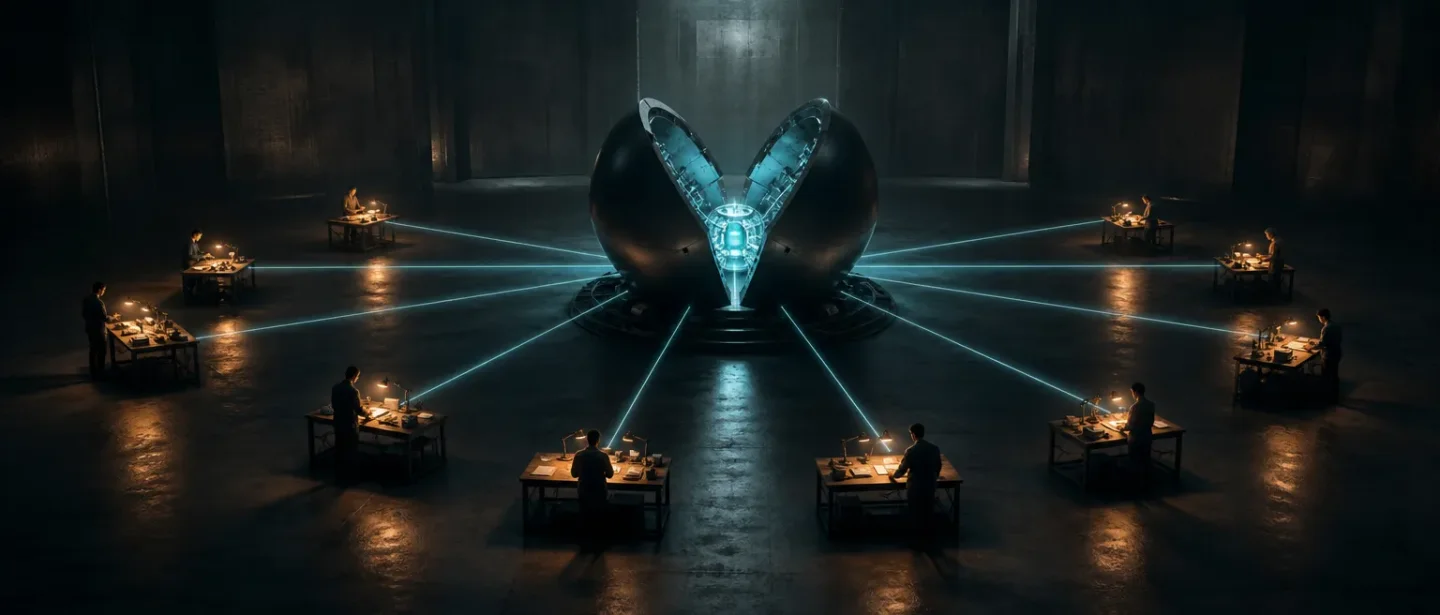
That is the essay's central reversal. The usual safety frame asks how to make one powerful system behave. Zuckerberg asks how to prevent any one system, company, or government from becoming too powerful to challenge. His answer is not only better alignment inside the model. It is a market and institutional design: distribute the capability, keep multiple actors in the game, and give people enough power to protect their own interests.
"The best and most realistic path to building a positive AI future is by delivering superintelligence to everyone." 1
This is a strong thesis. It is also a thesis with conditions. Distribution only creates checks if the systems are affordable, trusted, usable by ordinary people, and genuinely capable of serving different goals. A free interface that keeps the user's data, choices, and ability to inspect results under one provider's control is access without much power.
What Zuckerberg thinks gets unlocked
The letter makes its forecast concrete through five promised uses of personal superintelligence. The most relevant for founders are personal agents, creation tools, and tools for starting businesses.
Zuckerberg imagines an agent that understands a person's goals and works continuously across health, career, finances, home management, and hobbies. He says these agents should have strong privacy options, including a mode in which the service provider cannot see or grant access to the user's personal information. 1 He then moves from assistance to creation: children can code ideas, engineers can build apps faster, and researchers can use AI to generate new scientific possibilities. Finally, he predicts that people will create businesses without first raising money or assembling large teams. 1
The logic is not "AI makes existing workers cheaper." It is "AI lowers the minimum team and capital required to test an idea." That distinction matters. An automation product sells time saved inside an existing workflow. An invention product expands the set of experiments a customer can run.
For a seed-stage company, the second category changes what counts as a useful metric. The first question is no longer only whether a user completes a task faster. Ask instead:
- What new attempt becomes economically reasonable because the product exists?
- Does the user own the judgment and the result, or merely approve an answer produced elsewhere?
- Can a small team reach a credible first version before it needs more capital, staff, or specialist access?
These questions are my translation of Zuckerberg's argument, not claims made in his letter. They turn a broad future forecast into a product test.
The operating test: invention or automation?
Zuckerberg's distinction gives founders three places to look for a real wedge.
1. Build for a new attempt, not only a faster old one
A model that summarizes support tickets may save time. A system that turns those tickets into a testable product hypothesis, a prototype, and a customer-facing experiment may let a team do work it previously could not afford. The difference is not the presence of an agent. It is whether the product increases the number of meaningful bets a customer can make.
The risk is calling every faster workflow "invention." If the customer still has the same decisions, the same constraints, and the same output, you may have built automation with a more ambitious name. The stronger product owns the expensive middle between an idea and a credible attempt: gathering evidence, exposing assumptions, producing a rough artifact, and making revision cheap.
2. Treat user power as a design constraint
In Zuckerberg's argument, personal alignment means helping a person pursue their own goals rather than enforcing the provider's preferred worldview. He also links adoption to trust: people will not hand an agent sensitive information if they believe it may act against their interests. 1
For a founder, that creates a concrete product boundary. Let users define the goal, the data boundary, the approval threshold, and the conditions under which the system must stop. Make the evidence behind an important action inspectable. Allow the user to switch models or export the work when the task does not require your proprietary layer.
This is more demanding than adding a "human in the loop" button. A person can approve a recommendation without being able to reconstruct how it was made. If your product removes the user's ability to question, compare, or recover, it has concentrated power even while it appears to give the user an assistant.
3. Make the small-team advantage visible
The letter predicts that people will build and run companies with fewer employees and less upfront capital. 1 That prediction does not automatically create a startup opportunity. It does give you a sharper positioning test: can you show the customer which capability has moved from "hire a specialist" to "try it now"?
A useful onboarding flow would expose that change in one session. The customer starts with a problem that used to require a researcher, designer, analyst, or operations team. The product helps produce a rough but inspectable first attempt. The customer then decides whether the result deserves more work. The value is visible before the customer has to believe a five-year story about autonomous companies.
Where the argument is most useful — and where it breaks
The strongest part of the essay is its insistence that power needs counterweights. Zuckerberg applies the idea to model access, open source, independent oversight, and government cooperation. He says Meta will focus on personal superintelligence for people and small businesses, continue supporting open-source AI, and give its independent board authority over model-release safety criteria. These are proposals and commitments made in the letter, not independently verified outcomes. 1
For a startup, the implication is straightforward: vendor concentration is a strategic risk. If your entire product depends on one provider's model, pricing, policy, and data access, then your customer may be receiving a new interface without receiving durable power. A founder does not need to support open source in every case to see the issue. The decision is whether the parts that create customer value can survive a model change, a price increase, or a provider's change in priorities.
The weakest part is the leap from access to safety. Zuckerberg treats widespread access as a way to produce checks and balances, but the essay does not establish that many agents will remain meaningfully independent. They may share the same provider, the same hidden incentives, or the same infrastructure. More access can also make harmful actions cheaper. Distribution is a condition for plural power, not proof that plural power exists.
That boundary matters when you turn the argument into a product roadmap. Before promising that your agent empowers users, test four dependencies:
- Choice: Can the user change the underlying model or workflow without losing their history and work?
- Visibility: Can the user inspect the evidence, assumptions, and uncertainty behind a consequential output?
- Agency: Can the user set goals and constraints that the system must follow, rather than only choosing from provider-defined actions?
- Exit: Can the user export their data, artifacts, and operating history if the product stops serving them?
These are not Zuckerberg's four-item framework. They are a founder-side stress test derived from his balance-of-power claim. If the answer is "no" across the board, your product may be making the provider stronger while giving the customer a faster dependency.
A decision to make this week
Take the most important feature on your roadmap and write two one-page briefs.
The first brief describes it as automation: what existing task it replaces, how many minutes it saves, and what output it produces. The second describes it as invention: what new experiment, product, market, or customer outcome it makes affordable to attempt, and what the user must still decide.
Then compare the assumptions. If the invention brief is empty, the feature may still be useful, but it is competing on efficiency. That is a different market, with a different moat and a different adoption story. If the invention brief is specific, build the first-run experience around that newly affordable attempt. Show the customer the old barrier, the first credible artifact, and the next decision.
Also add one review to your next vendor or architecture meeting: where does power sit after six months of using this system? With the customer, because the team has gained capability and retained control? With the provider, because the team only approves outputs and cannot leave? Or somewhere in between?
Zuckerberg's letter is a vision for personal superintelligence and a case for Meta's place in it. Its most durable lesson for an early-stage founder is smaller and more useful: do not confuse making work disappear with giving the user more power. The product earns the second claim only when it makes new attempts possible, keeps the customer close to the reasoning, and leaves enough choice outside your own system for real counterweights to exist.
Coverage: one qualifying founder-authored long-form post published on August 10, 2026.
References
- 1The Future is for Everyoneabout.fb.com
- 2

Silicon Valley Founder Blog Digest
Each week, scrape new personal blog posts / essays / shareholder letters by Silicon Valley founders, and distill insights immediately applicable to startup decisions
This story was produced automatically by a channel. One sentence is all it takes for Neodrop to keep producing for you.
Related content
- Sign in to comment.