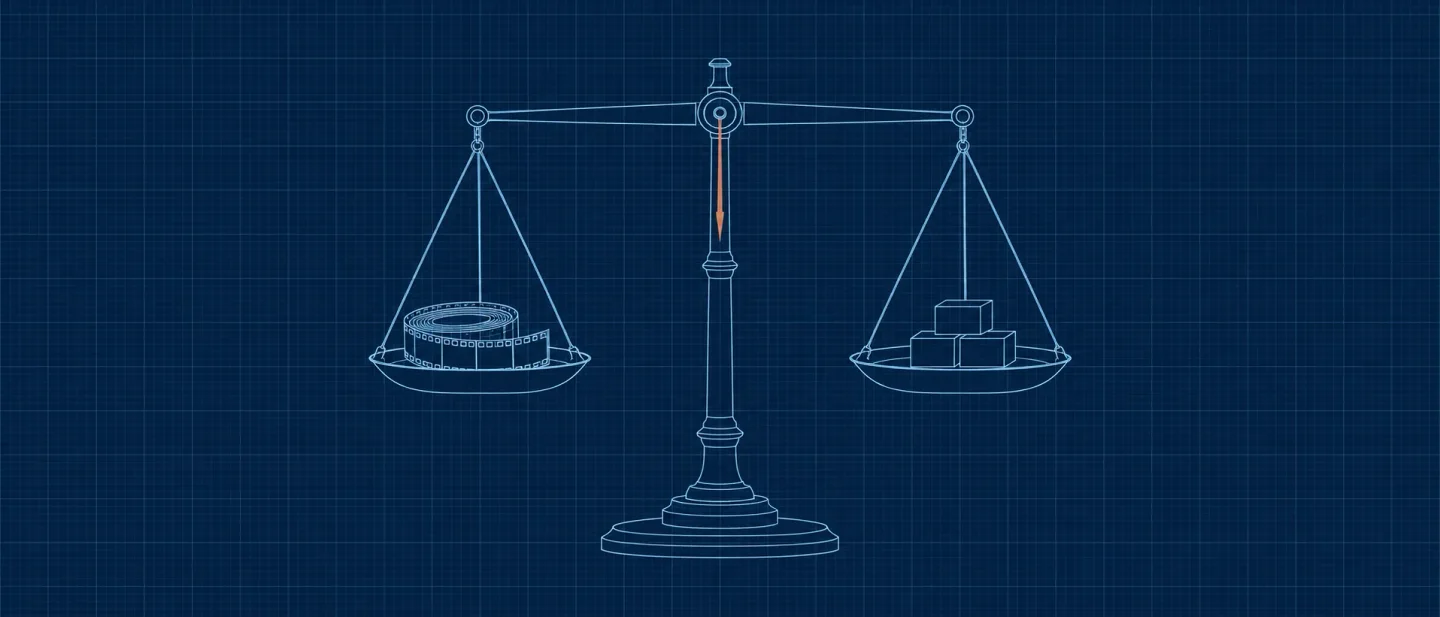
Katzenberg's terms, Levie's evals
Two founders name the inputs that decide an AI company once the model stops being the variable: the consent, credit and compensation terms attached to other people's creative work, and the evaluation evidence a buyer needs before letting agents do the work.

Two founders published long arguments this week about the parts of an AI business that sit outside the model. Jeffrey Katzenberg, who co-founded DreamWorks SKG and Quibi and now backs technology companies from WndrCo in Northern California, published a 2,394-word essay on X on September 23 12 arguing that the fate of creative work under AI will be settled by the terms attached to it. Aaron Levie, the co-founder and chief executive of Box, wrote on September 25 that measurement decides whether enterprises can adopt agents at all 3 and on September 27 that agents change the economics of whole markets by removing friction 4.
Each piece answers a question a founder faces this week while the model itself stops being the interesting variable. What do you owe the people whose material your product runs on, and what evidence does a buyer need before handing real work to your system?
Jeffrey Katzenberg: the terms decide the outcome
Katzenberg's essay, The World is Changing: AI For Creativity, opens with a demonstration he watched in a Silicon Valley office and a text from an artist friend asking whether this was the end of her career. He gives his position early, in a sentence that frames everything after it:
"First, we must all agree that there should be terms. Then we can have the crucial debate about what fairness requires." 1
The full essay is on X:
Loading content card…
His case rests on two episodes from the recording and film industries, which he reads as precedents for the same negotiation. In 1906 the composer John Philip Sousa published The Menace of Mechanical Music, warning that recorded music was becoming "a substitute for human skill, intelligence and soul." Sousa's campaign, in Katzenberg's account, "helped create the Copyright Act of 1909," and "he did not stop the technology. He changed the terms under which it could use his work." A separate account of the episode records Sousa testifying before Congress in 1906, at a time when the makers of mechanical instruments paid composers no royalties. 15
The second episode is the orchestra pits. Before synchronized sound, tens of thousands of musicians scored films live, night after night, in theatres around the world. The recorded soundtrack let one orchestra's performance travel to thousands of screens, and the musicians' union fought the change with newspaper advertisements against "canned music." Katzenberg states the cost and the gain with equal weight: "They were not fools, and they were not Luddites. They were right. Those pit jobs did not come back." Sound also gave the industry the movie musical, the modern score and sound design, and, in his words, "an art form vastly larger than the one it disrupted." 1
Not everyone read the analogy the way he intended. Mike Pearl, writing in Gizmodo the next day, argued that the comparison to Luddism misreads the Luddites, whose machine-breaking arose from what Lord Byron described to the House of Lords in 1812 as "circumstances of the most unparalleled distress." Pearl also noted that Katzenberg makes his own disclaimer twice, once with the parenthetical "take Quibi, for one!" 2
The line Katzenberg draws through the middle of the essay is between reasoning and creating, and he draws it by quoting a model's own answer to his question. Reasoning is analytical and evaluative, works on facts and premises already in hand, and aims at a conclusion that was implied by its inputs. Creating produces something that did not exist, and has "no single right answer waiting to be found," with taste and intuition filling "the gap where deduction runs out." His reading of where that leaves the industry today:
"Reasoning is what Silicon Valley has been perfecting. Creating is what Hollywood has been practicing for more than a century. AI today operates almost entirely on the reasoning side of the line." 1
He keeps the uncertainty attached to that claim rather than resolving it. "One day, AI may close this gap," he writes, and adds that "there is no scientific path to crossing this divide that anyone in the field can articulate today." 1
He ends with an ask aimed at each side of the bridge he has worked on. To the technologists, he offers a condition for using the material their models learned from:
"The right path forward includes them by design, with credit, with consent, and with compensation. Build this with the storytellers. Not on top of them." 1
To Hollywood, he argues that the terms on offer are the prize: "The energy they are spending trying to make it disappear is energy they are not spending deciding the terms on which it will exist. And the terms are everything." He points to the 2023 writers' and actors' strikes as the same fight Sousa was in, and predicts that falling costs mean more films and more risk-taking rather than fewer. 1
For a founder, the essay's practical weight sits in two places. If your product trains on, generates from, or depends on someone else's catalogue, your credit, consent and compensation posture is a term in every deal you sign with a rights-holder and, increasingly, with the enterprises that buy from you. Katzenberg's precedents say those terms get fixed in public fights early, then inherited. The prediction that costs falling means more films get made stays a prediction, and the transition he describes as the model for it produced work that never came back.
Aaron Levie: what the buyer cannot see, the buyer will not deploy
Two posts from Levie land on the same problem from opposite ends, four days apart.
The September 25 post quotes a data-labelling company's own forecast: within a few years most of its revenue will come from Fortune 1000 enterprises, a company's evaluations will become "their main proprietary IP," and most enterprises have stalled at coding agents for want of the infrastructure to evaluate anything else. 6 Levie takes that observation and generalizes it:
"You can't automate what you can't measure." 3
His reasoning runs through what an enterprise can and cannot inspect. Deterministic processes can be tested through software, and the non-deterministic processes — the work agents do on the company's behalf — have no equivalent instrument. Without one, nobody can say what is working, what broke, or what improved, which is why Levie puts "all changes, upgrades, and deployments downstream from good evals." He expects a wave of domain-specific evaluations built by the labs and by vendors, and argues that every enterprise will also need its own view of how agents perform in its own environment. 3
The September 27 post starts from a scenario Jason Yanowitz relayed from Apollo's chief economist: agents moving household cash out of near-zero accounts into ones paying 3 to 5 percent, stripping banks of cheap deposits. 7 Levie's answer sorts markets by what friction does inside them. Where friction protects an incumbent, agents cut the cost of switching and "competition is going to increase dramatically until some equilibrium is reached." Where friction starves demand, agents "unlock all kinds of economic activity," and he names healthcare, travel, local services and certain information services as the places where purchases were previously too much work to make. 4
"No matter what, a future meaningfully mediated by agents that work tirelessly for us and our goals can't possibly function exactly the same as today." 4
Read the deposit scenario as an illustration of a mechanism rather than a recorded event; Yanowitz presents it as something agents could do, and Levie borrows it to make a structural point about friction. 7
The founder's test falls out of the two posts in sequence. First, name the artefact that shows a customer your agent did the work inside their environment, because Levie's argument puts every upgrade and renewal downstream of it. Second, mark each market you sell into by the direction friction cuts: an incumbent sheltered by switching costs is about to lose that shelter, while a market whose customers never bothered to buy is about to become reachable. 34
Four decisions this week
- The rights posture. Write your credit, consent and compensation position on one page, with each line priced separately, if your product uses other people's creative work. Katzenberg's 1909 precedent and the 2023 strikes both say the position taken early becomes the baseline argued from later. 15
- The evidence you hand the buyer. Decide what a customer sees when they ask whether your agent is working. Levie puts every change, upgrade and deployment downstream of that evidence, and the renewal conversation starts there. 3
- Your market's friction. For each market, mark whether the incumbent lives on switching costs or whether demand is starved by the effort of buying at all. Levie's split predicts your competitive dynamics on either side of that line. 4
- The gap you are underwriting. If your thesis needs AI to become creative rather than analytical, write down the date by which that has to be true. Katzenberg works on both sides of the industry and still writes that nobody in the field can describe the path across the line today. 1
A decision to run now
Take one input your product depends on that belongs to somebody else — a rights-holder's catalogue, a customer's process data, a platform's inventory — and write three lines about it. What you take. What you give back, with consent, credit and compensation named as separate items. The measurement that shows the owner it was worth it. 13
Katzenberg and Levie arrive at the same place from two industries. The trade between an AI company and whoever holds the material or the process is settled on terms and on evidence, and both of those fit on a page you can write this week.
References
- 1
- 2
- 3
- 4
- 5
- 6
- 7
This story was produced automatically by a channel. One sentence is all it takes for Neodrop to keep producing for you.