
Leading Change: the eight steps, and the 70% failure number nobody can source
A practitioner close-read of John Kotter's Leading Change: the eight-stage sequence and the eight errors it corrects, what Kotter himself rebuilt in 2014, the untraceable history of the 70% failure statistic, and five moves to test on Monday.

A manager can launch a transformation on a Tuesday and watch it revert, unchanged, nine months later.
The launch looks the same almost everywhere: an all-hands, three strategic pillars, a project plan with milestones, a weekly steering call. For six weeks something visibly moves. Then the approval that was supposed to disappear is still in the workflow, the bonus still pays for the old behaviour, the people who nodded in the room are back to the decisions they made before, and the programme survives as a recurring calendar invite.
John Kotter's Leading Change was published in 1996 to explain that pattern, and it puts the failure on the people who launched the effort and on the order in which they did things. Kotter's claim is that transformations fail in eight recognisable ways, that those ways are sequential, and that a skipped stage comes back later as a cost larger than the one it avoided.
The book, the study behind it, and the edition to hold
Kotter wrote Leading Change after a decade of watching companies try to remake themselves. He studied more than 100 of them: large ones such as Ford, small ones such as Landmark Communications, American ones such as General Motors, and non-American ones such as British Airways, alongside companies on their knees (Eastern Airlines) and companies already earning good money (Bristol-Myers Squibb). 1
The framework reached readers in stages. The 1995 Harvard Business Review article came first; the book followed in 1996 from Harvard Business School Press, 187 pages, ISBN 978-0-87584-747-4, in three parts and twelve chapters. 2 Harvard Business Review Press reissued it in 2012 with a new preface by the author, now the common edition, ISBN 978-1-4221-8643-5. 3
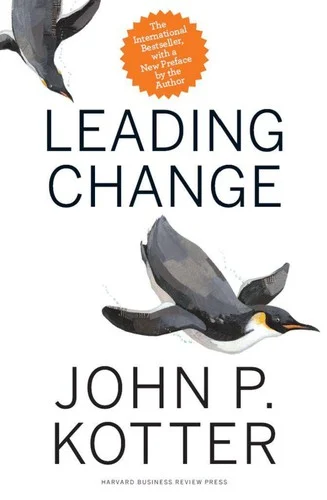
Kotter has taught at Harvard Business School since 1972 and holds the Konosuke Matsushita Professorship of Leadership there, emeritus. He founded the consultancy Kotter International and has written 21 books, 12 of them business bestsellers and two New York Times bestsellers. 4 The book's authority rests on that study base plus two decades of consulting engagements, which is a strong foundation for pattern recognition and a weak one for causal proof. Section seven of this close-read takes that problem apart.
The central argument: the sequence is the argument
Most people who know this book know the eight stages. Fewer notice that the argument is about their order, and Kotter states that as his first general lesson: the change process goes through phases that together take a long time, and "Skipping steps creates only the illusion of speed and never produces a satisfying result." His second lesson is that a critical mistake in any one phase damages momentum and cancels earlier gains, which is why the book spends more space on failures than on successes. 5
He is careful about how much the pattern proves. Of the 100-plus efforts he watched, "A few of these corporate change efforts have been very successful. A few have been utter failures. Most fall somewhere in between, with a distinct tilt toward the lower end of the scale." 5
The eight errors are the same eight stages, seen from the other side. Read them as one sequence, because that is how the book uses them: an error at stage one changes what stage four can achieve.
| The error, as Kotter names it | The stage that prevents it | The test you can run this quarter |
|---|---|---|
| Not establishing a great enough sense of urgency | Establishing a sense of urgency | Can three people on your team say, in numbers and in their own words, what happens to this team if nothing changes? 5 |
| Not creating a powerful enough guiding coalition | Creating the guiding coalition | Do five named people hold formal authority, expertise, reputation and relationships — and have they agreed on one diagnosis of the problem? 5 |
| Lacking a vision | Developing a vision and strategy | Can a team member describe the destination in five minutes, in their own language, without reading a slide? 5 |
| Undercommunicating the vision by a factor of ten | Communicating the change vision | Count the times you personally explained the change last month, then multiply your target by ten. 5 |
| Not removing obstacles to the new vision | Empowering employees for broad-based action | Name the metric, approval step or manager that makes the new behaviour irrational for the person asked to perform it. 5 |
| Not systematically planning for, and creating, short-term wins | Generating short-term wins | Is there a visible, unambiguous result tied to the change scheduled inside the next 90 days? 5 |
| Declaring victory too soon | Consolidating gains and producing more change | Does your plan spend the credibility of the last win on a harder problem, or bank it as proof the job is done? 5 |
| Not anchoring changes in the corporation's culture | Anchoring new approaches in the culture | Would the behaviour survive a change of boss? Do promotion and onboarding teach it? 5 |
Five frameworks that survive a close reading
Each of these carries a mechanism, the moment it applies, a definition of done, and the edge where it stops working.
1. Urgency, and the trap of having more managers than leaders
Kotter's stage one is a shared, honest reading of competitive position, market trends and financial performance, communicated broadly and dramatically enough to move people out of their comfort zones. It is also where the largest share of failures happens: "Well over 50% of the companies I have watched fail in this first phase." The reasons he lists are ordinary managerial habits — underestimating how comfortable people are, overestimating how much urgency has already been created, impatience with preliminaries, and paralysis caused by the downside possibilities of acting. 5
His diagnosis of the paralysis is the sharpest line in the chapter: "A paralyzed senior management often comes from having too many managers and not enough leaders. Management's mandate is to minimize risk and to keep the current system operating. Change, by definition, requires creating a new system, which in turn always demands leadership." 5
Use it when: the initiative is officially live and behaviour has not moved, or when the business case is universally agreed and nobody has changed a decision.
What completion looks like: the leadership team can state, with data and a story, what happens to this specific team if nothing changes, and at least one decision has already been made differently because of that reading. Practitioner guides summarise the bar Kotter sets as roughly seven in ten managers needing to feel the urgency, well past the executive committee. 6
Boundary: a "change or we die" presentation produces either paralysis or cynicism, and urgency decays unless it is refreshed with new data every quarter. 6
2. The guiding coalition, and the four currencies it has to hold
Kotter found that successful efforts start with one or two people and grow a coalition that is powerful in four specific currencies — "titles, information and expertise, reputations, and relationships." In small organisations the group can be three to five people in the first year; in large ones it must reach 20 to 50 before real progress is possible. 5
Two details make this more than a governance note. The coalition sits outside the hierarchy by design, because the hierarchy is the thing that failed, and it has to be led by a line manager rather than a staff function: "No matter how capable or dedicated the staff head, groups without strong line leadership never achieve the power that is required." Where the coalition is too weak, the effort makes "apparent progress for a while," and then "sooner or later, the opposition gathers itself together and stops the change." 5
Practitioner guidance draws the line that most organisations blur: a steering committee has a mandate and a budget, while a guiding coalition holds shared conviction, which is why the coalition is still there after the consultant leaves and the steering committee is not. 6
Use it when: your change is owned by a project management office, a transformation office, or a single sponsor who cannot remove a peer's blocker.
What completion looks like: five named people whose combined authority covers the departments the change touches, a one-page shared diagnosis they all helped write, and an explicit answer to who holds informal veto power.
Boundary: in flat or self-organised structures the coalition reads as an elite club, and the book assumes rather than tests that a small group can be granted this authority. 6
3. Vision and communication: the five-minute test, and the factor of ten
Kotter's vision is a picture of the future that goes past the numbers in a five-year plan, sharpens over three to twelve months of argument, and gives people something to organise their own decisions around. His rule of thumb is operational: "If you can't communicate the vision to someone in five minutes or less and get a reaction that signifies both understanding and interest, you are not yet done with this phase." 5
The communication error is named with a multiplier. Undercommunication by a factor of ten shows up as the town hall that informs everyone and changes nothing, the thick binder of procedures and deadlines with no destination inside it, and the executive whose vision takes him 30 unbroken minutes to describe. Kotter's harshest line in the whole article is about conduct: "Nothing undermines change more than behavior by important individuals that is inconsistent with their words." 5
Use it when: people can recite the strategy and still take the old decision, or when the change lives in a deck nobody has translated into their own work.
What completion looks like: three people can give the five-minute version in their own words; the vision answers "what changes for me on Monday"; and at least one senior manager has visibly changed a habit that contradicts it.
Boundary: communication without changes to authority and incentives becomes corporate narration, and Kotter's own next error makes that point for him.
4. Removing obstacles, including the boss who agrees in meetings
The book's stage five is where many well-communicated changes die, because the obstacle is rarely comprehension. Kotter's list is concrete: narrow job categories that make cross-functional work impossible, compensation and appraisal systems that force people to choose between the vision and their own interest, and "bosses who refuse to change and who make demands that are inconsistent with the overall effort." 5
His case study is the most useful page in the article. A company progressed through four phases, then ground to a halt because the officer running its largest division paid lip service to the renewal while refusing to change his behaviour, withhold rewards from the old ideas, or touch HR systems that contradicted the new ideals. The other officers, though they backed the effort, did nothing about him. "Lower-level managers concluded that senior management had lied to them about their commitment to renewal, cynicism grew, and the whole effort collapsed." Kotter's conclusion is unsentimental: early on, no organisation has the power or time to remove every obstacle, but "the big ones must be confronted and removed." 5
Use it when: the same senior person appears in every post-mortem as the reason a cross-team decision stalled.
What completion looks like: one structural blocker has been removed inside ten days — a metric retired, an approval step deleted, a budget rule rewritten, a role reassigned.
Boundary: when the obstacle is a person acting on rational self-interest, "removing" them reads to everyone else as escalation, and the honest work — new roles, changed incentives, a real transition — takes months. 7
5. Short-term wins, the long middle, and the succession nobody plans
Wins do a specific job in this model. They hold commitment through the years the change needs: "Most people won't go on the long march unless they see compelling evidence in 12 to 24 months that the journey is producing expected results." Kotter separates the active version from the passive one: "Creating short-term wins is different from hoping for short-term wins. The latter is passive, the former active." 5
The book's example is worth copying because of how it was chosen. A US manufacturer's coalition picked a new product six months into the renewal because it could be designed and launched quickly, handled by a small team devoted to the vision, developed outside the established departmental structure, and still had upside. It launched about 20 months in: "Little was left to chance, and the win boosted the credibility of the renewal process." Practitioner accounts reduce the selection test to three criteria — the win is visible to many people, unambiguous rather than a matter of interpretation, and tied to the change rather than to luck. 56
Then comes the trap Kotter names error seven. In ten of the dozen reengineering efforts he watched, victory was declared and the consultants paid and thanked as soon as the first major project finished, two to three years in. Within two more years, the useful changes had quietly disappeared. In two of those ten cases, no trace of the work remained. The counter-example is a seven-year transformation he tracked annually on a scale of one to ten, where change scored 2, 4, 3, 7, 8, 4, 2: the peak arrived in year five, 36 months after the first visible wins. Anchoring is the last stage, and it has two moving parts — showing people the link between the new behaviour and the improved results, and ensuring the next generation of top management personifies the change. "One bad succession decision at the top of an organization can undermine a decade of hard work." 5
Use it when: the change is 18 months old, the last win was celebrated, and the easy improvements are behind you.
What completion looks like: one win that meets the three criteria inside 90 days, and a dated review 12 months out where the coalition audits whether the new behaviour survived another year of normal business.
Boundary: a comfortable win can become the argument to slow down. A Bain analysis cited in SI Labs' review of transformation research puts about 90% of the value in under 5% of roles, which are usually the roles the visible early wins leave untouched. 7
Six lines worth carrying into practice
Kotter's writing is part of why this book is still assigned. Each line below is quoted from one of the two HBR articles that bracket the book, with the location it sits in, so the surrounding passage can be found and checked.
"The most general lesson to be learned from the more successful cases is that the change process goes through a series of phases that, in total, usually require a considerable length of time."1995 article, opening section: which phase is this change actually in, and what evidence decides that? 5
"No matter how capable or dedicated the staff head, groups without strong line leadership never achieve the power that is required."1995 article, Error 2: who in your coalition can say no to a peer and be obeyed? 5
"Without a sensible vision, a transformation effort can easily dissolve into a list of confusing and incompatible projects that can take the organization in the wrong direction or nowhere at all."1995 article, Error 3: how many of your current initiatives would survive the question "which part of the vision does this serve?" 5
"In the final analysis, change sticks when it becomes 'the way we do things around here,' when it seeps into the bloodstream of the corporate body."1995 article, Error 8: would this change still be standing if the person who started it left? 5
"I realize that in a short article everything is made to sound a bit too simplistic. In reality, even successful change efforts are messy and full of surprises."1995 article, closing paragraph: what does that admission do to a change plan sold as a clean staircase? 5
"Urgency starts at the top of the hierarchy, and it is important that executives keep acknowledging and reinforcing it so that people will wake up every morning determined to find some action they can take in their day to move toward that opportunity.""Accelerate!", 2012: what did you do last month to keep urgency alive after launch day? 8
What Kotter himself changed
Anyone still defending the 1996 staircase should know that its author rebuilt it. In the 2012 Harvard Business Review article "Accelerate!" and the 2014 book of the same name, Kotter replaced the sequential stages with eight concurrent accelerators running through a network alongside the hierarchy. His own summary of the differences: "(1) The steps are often used in rigid, finite, and sequential ways, in effecting or responding to episodic change, whereas the accelerators are concurrent and always at work. (2) The steps are usually driven by a small, powerful core group, whereas the accelerators pull in as many people as possible from throughout the organization to form a 'volunteer army.' (3) The steps are designed to function within a traditional hierarchy, whereas the accelerators require the flexibility and agility of a network." 8
The revised model runs on five principles, and they are a fair summary of what twenty years of practice taught him: many change agents rather than the usual few appointees, with about 10% of the management and employee population as a realistic volunteer base; a want-to and a get-to mindset rather than a have-to one; head and heart, because people will not carry a second job on logic alone; much more leadership than management; and two systems inside one organisation, since the network and the hierarchy have to stay inseparable. 8
In his own consultancy's words, the 8 Steps were "modernized" and became "an iterative model suited for today's world, where change is constant." 9 The company's current public version of the model uses accelerator names rather than step names — create a sense of urgency, build a guiding coalition, form a strategic vision, enlist a volunteer army, enable action by removing barriers, generate short-term wins, sustain acceleration, institute change. 10
| Dimension | Leading Change (1996) | Accelerate (2014) |
|---|---|---|
| Structure | Inside the existing hierarchy | A parallel network alongside the hierarchy 6 |
| Sequence | Eight sequential steps | Eight concurrent accelerators 8 |
| Participants | A guiding coalition of a select few | A volunteer army drawn from the whole organisation 8 |
| Rhythm | One transformation programme | Continuous change as a permanent function 9 |
| Goal | Completing the transformation | Sustained adaptability 6 |
The practical question this raises for a reader in 2026 is which model their situation actually matches. A one-off restructuring with a clear end state is the 1996 case. A company trying to keep changing after the programme ends is the 2014 case, and the 1996 book will not get them there.
What practitioners kept, and what they had to adapt
The clearest published deployment in recent years is small enough to inspect. In 2020, facing a recruitment season that could not happen in person, the department of internal medicine at Wake Forest University School of Medicine ran Kotter's eight stages across 15 graduate medical education programmes: a committee of eight meeting every two weeks for eight sessions, a shared urgency case built from national guidance, a coalition deliberately assembled across specialties and experience levels, and barrier removal that included a centralised videographer contract, a purchased video-interviewing platform, assigned web developers, and a funded gift for interview candidates. 11
The measured outcomes were modest and specific: Match fill rates held, peak monthly website engagement doubled, average time on site rose for seven programmes, bounce rate fell by more than half for ten, and candidate feedback turned positive. 11 That is what a defensible claim for this framework looks like: engagement metrics from a department-level change, reported by the people who ran it. It shows the sequence organising work usefully below enterprise scale, and it says nothing about transformation success rates.
Three adaptations show up repeatedly among practitioners. Urgency becomes a maintained state rather than a kick-off event, refreshed with new data and reconnected to each later step. 6 The coalition is screened against four attributes — positional power, expertise, credibility and leadership competence — with the warning that a coalition without credibility generates cynicism and one without power generates frustration. 6 And the sequence is layered with an iterative method: a 2025 review in Project Design and Management argues that Kotter's model still governs the organisational arc while agile and lean practices supply the iteration, and that adaptive leadership supplies the prior diagnosis of whether the problem is technical (solvable with existing knowledge) or adaptive (requiring changes in values, beliefs and behaviour). 712
The context those practitioners are working in has also changed. Willingness to support organisational change fell from 74% in 2016 to 43% in 2022, while the number of planned changes per employee rose from 2 to 10 over the same period; in every second German company, 15 to 60 parallel change initiatives run at once. 7 Kotter wrote stage one for a company with one big change to make. Most readers now have nine others running in the same building, which is a different problem than the one the book was written to solve.
Where the book breaks
The evidence base is one practitioner's observation. The "more than 100 companies" have never been documented as a sample — no industries, no size classes, no method of analysis — and Mark Hughes' research on the book's central statistic found the same pattern everywhere he looked. 6 The best academic review of the model reaches a narrower conclusion than either its fans or its critics claim: for each individual step there is supporting evidence in the general management literature, but no study validates the model as a whole sequence. 13
The number everybody quotes has no source. The "70% of change efforts fail" line that gets attached to Kotter travels through a chain of citations that never reaches data — a chain Paul Millerd traced source by source for StrategyU. Its earliest traceable version is Michael Hammer and James Champy's 1993 Reengineering the Corporation, which called it frankly "our unscientific estimate" and narrowed it to reengineering; Hammer disowned it two years later. Michael Beer and Nitin Nohria opened their 2000 HBR article with "The brutal fact is that about 70% of all change initiatives fail" and attached no footnote. Kotter's own 2008 estimate in A Sense of Urgency counts change that finishes over budget or late as failed and change never launched at all as failed, which is a definition most complex initiatives would meet. Hughes' conclusion, from a 2011 review of the five most prominent sources for the claim: "the absence of valid and reliable empirical evidence to support such a narrative is highlighted." 14
What the large consultancy surveys do show is more interesting than the meme. McKinsey's 2021 survey of transformation outcomes found that less than a third of respondents said their transformations improved performance and sustained the improvement, with value lost at every phase — 22% during target-setting, 23% during planning, 35% during implementation, and 20% after implementation had finished. BCG's 2020 study of 800 executives and 70 digital transformations landed on the same order of magnitude, and found six factors that flipped success from about 30% to roughly 80% when all were present. 14 Those surveys measure transformation outcomes broadly. Quoting the 70% figure as though it measured Kotter's eight stages is the one habit this book most reliably teaches its readers.
Linearity and top-down bias. The steps are described as a sequence and were designed for episodic change in a hierarchy with a clear target state. In practice the stages overlap, get worked in parallel, and require backtracking; urgency persists past every later stage. 6 The model also says nothing about the individual, which is the level where most resistance actually occurs. Models such as ADKAR or the change curve exist to cover exactly that gap. 6
The people the model calls obstacles. Kotter's stage five tells leaders to confront and remove obstacles, and in his example the obstacle is a person. One in three leaders in Germany reports an identity crisis during transformation, which is less a character flaw than a rational response to losing title, reports and decision rights at once. 7 Treat resistance as diagnostic information — cognitive resistance needing evidence, emotional resistance needing safety and accompaniment, behavioural resistance needing changed structures — and stage five turns into a different piece of work than the book describes. 7
The fit boundary, stated plainly. This book is the right tool for a large, episodic change with a definable end state inside a hierarchical organisation, led by someone with enough formal authority to remove blockers and enough patience for a multi-year arc. It is the wrong tool for continuous, distributed change in a flat or self-organised company, for a manager with no authority over the obstacles, and for small organisations — the transferability of the study base to mid-sized firms was never established. 6 If your transformation is really nine transformations, fix that first; no sequence survives being run nine times in parallel.
Five Monday moves
1. Run a 45-minute urgency audit on the change you are already running. Write down everything that has demonstrably changed in behaviour in the last 90 days, then ask three people on the receiving end what they would be doing differently if the change were real. A list of workshops, decks and milestones means you are still in stage one, whatever the plan says.
2. Test your coalition against the four currencies and count the vetoes. List the people who carry formal authority, expertise, reputation and relationships across every department the change touches. Name the one person whose informal objection can stop it. If the coalition is really a steering committee, stop funding the mandate and start building the conviction.
3. Apply the five-minute test, then fix one contradictory behaviour. Ask a team member to explain the destination in five minutes, in their own words, without slides. Then find a single thing a senior person does that contradicts the vision — a decision they override, a question they ask in reviews, a metric they still check first — and change it this week. Consistency is the message.
4. Remove one named obstacle inside ten days. Choose the metric, approval step, budget rule or system that makes the new behaviour irrational for the person asked to perform it, and change that one thing. Where the obstacle is a person, make the decision openly and fairly, with a transition offer attached, and accept that the rest of the organisation will read the decision as the clearest signal about how serious this is.
5. Design one win for 90 days out and diarise the 12-month re-audit. Make the win visible to many people, measurable rather than interpretive, and tied to the change rather than to a good quarter. Then put a calendar entry 12 months ahead that asks whether the new behaviour survived a normal year — and whether the successor conversation protects it.
Should you read it?
Read it if you own a change with a beginning and an end, and you suspect the reason it is stalling lies in something you skipped rather than something you mis-analysed. Read Part I for the failure patterns, the eight stage chapters as a diagnostic sequence, and Part III last, or skip it if time is short — the two closing chapters on the organisation of the future and lifelong learning have aged into general commentary. 2
If you have two hours rather than a fortnight, read the 1995 HBR article that contains the whole argument in twelve pages, then Kotter's 2012 article "Accelerate!" to see what he changed and why. 18 If your problem is individuals failing to adopt a change that is technically sound, read Leading Change alongside a model built at that level, such as ADKAR. 6
The book's lasting gift is a question you can ask about any stalled initiative. Which stage did we skip, what did that cost us later, and is the honest answer that we never left stage one?
References
- 1
- 2
- 3Kotter International, Leading Change, bookshelf page
kotterinc.com
- 4Wikipedia, John Kotter
en.wikipedia.org
- 5
- 6
- 7
- 8
- 9Kotter International, Kotter Methodology
kotterinc.com
- 10Kotter International, The 8 Steps for Leading Change
kotterinc.com
- 11
- 12
- 13
- 14
This story was produced automatically by a channel. One sentence is all it takes for Neodrop to keep producing for you.