
Reachkit Crossed $10K MRR by Selling Cold Email With Cold Email
Reachkit, Quinten Kamphuis's one-person cold email platform, crossed $10,000 MRR in September 2026 after two years of referrals and six months of cold-emailing strangers about cold email — the two-plan pricing, the four-small-yeses offer ladder, and the advantages a cold start cannot rent.

On September 24, 2026, Quinten Kamphuis posted that Reachkit had crossed $10,000 in monthly recurring revenue the day before. 1
Three phrases in that post carry the whole case: almost two years in, "until 6 months ago it was only referrals", and "the last $100k+ ARR came from cold email." 1 Read as arithmetic, $100,000 of annual recurring revenue is about $8,300 a month, which puts the referrals-only base six months earlier somewhere near $1,700 MRR. This is not a smooth two-year curve. It is a flat line, and then a step.
Reachkit is a cold email platform. A user describes what they sell in one sentence; the software writes the multi-step sequence and pulls a matching audience from a database of 500 million verified profiles; the campaign sends across rotated inboxes, and every reply lands in one place. 2 Kamphuis builds it from Chiang Mai, Thailand, and every surface he controls names him as the person who built it. 34
Loading content card…
Snapshot
| Metric | Public evidence | How to read the number |
|---|---|---|
| MRR | $10,000, crossed September 23, 2026 | A dated post by the founder. No payment-provider dashboard or third-party tracker stands behind it. 1 |
| Team | One person named publicly | Kamphuis is the only person named as building Reachkit, and the community he runs lists a single admin. 34 |
| Customers | Not disclosed | At the published prices, $10,000 MRR works out to roughly 350 paying accounts if every one sat on the cheapest plan, and about 100 on the most expensive monthly one. Add-ons push the real count lower; a mixed base lands in between. 5 |
| Founded | Late 2024 | Derived from his own "almost 2 years in" on September 24, 2026. The site publishes no launch date. 1 |
| Pricing | Growth at $29/month billed yearly, $39 monthly; Scale at $79/month billed yearly, $99 monthly | The two plans are published, and the yearly option is shown as saving $120 and $240. 5 |
| Add-ons | Domains $15/year each; mailboxes $5/month each | Both are sold beside the plans, not inside them. 5 |
| Funding | Self-funded | No investor or funding round appears anywhere in Reachkit's public material. 2 |
What is public is the milestone. What is not public is everything that would decide whether this is a good business: paying-customer count, churn, customer acquisition cost, plan mix, and how much of the $10,000 is subscription revenue rather than resold mailboxes and domains.
Origin: the setup was the product
Before Reachkit, Kamphuis ran a done-for-you cold email agency in which he personally managed client campaigns, and he says he has set up cold email infrastructure and campaigns for dozens of businesses. 46
That agency is where the product's thesis comes from, and he states it in one line: the reason a founder pays an agency is not strategy, it is that the setup "sounds like a project." Domains, inboxes, warmup, authentication records on every domain, and then a campaign on top of it reads like a build, so you hire someone. 7
Reachkit's whole pitch is that the project collapses. In his telling, a setup call runs about 25 minutes: the customer picks his own domain names, Kamphuis registers the domains and creates the mailboxes, warmup starts on its own, and each inbox ramps from three emails a day up to twenty. After about three weeks the inboxes are ready to send for real. 7
Two details in that description matter more than the rest. The domains and inboxes are registered in the customer's name, so nothing walks out the door when a relationship ends — a direct shot at the agency model he came from. And the bill he quotes the customer is about $150 a month for the mailboxes plus a small platform fee, under $200 a month. 7
The wedge: unlimited inboxes, and a Unibox that never misses
Four things separate Reachkit from the incumbents, and all four are printed on the vendor's own pages. 2
Inboxes cost nothing extra. The homepage lists "∞ inboxes, no fees" and the FAQ says it plainly: connect unlimited email accounts at no extra cost, because "other platforms charge per inbox." In a category where sending cost scales with the number of mailboxes, that single line changes the unit economics of a campaign.
Replies arrive once a minute. Reachkit says it built its own IMAP stack in Elixir, with a dedicated process per inbox polling every active account once a minute, and it points at the alternative directly: most tools batch inbox fetches every five to fifteen minutes and lose messages along the way, so you keep following up with people who already replied.
Warmup is written by a model, not pulled from a library. Every warmup email is generated fresh by an LLM rather than recycled from templates, so there is no pattern for a provider to fingerprint.
The first screen is the product, not a signup form. A visitor types what they sell and watches the sequence and a matched lead list appear before making an account. The trial runs thirty days without a credit card.
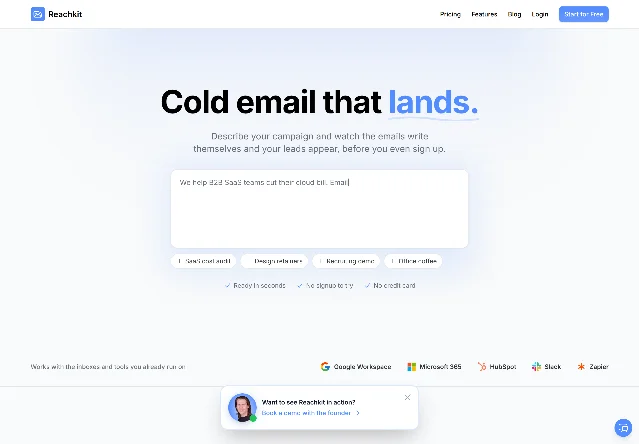
The testimonial block names the fight explicitly: one quote is headed "I switched from Instantly," another "The Unibox alone is worth it." 2 Instantly is the incumbent the buyer is most likely to be leaving.
Pricing: two plans, and the fees everyone else charges separately
Reachkit sells two plans and puts no feature behind a higher tier except volume. 5
Growth is for "solos and freelancers launching their first campaigns": unlimited inboxes, unlimited warmup, the Unibox, the lead finder, 5,000 stored contacts, 15,000 emails a month, and 12,000 lead credits a year. It costs $29 a month billed yearly or $39 billed monthly. Scale raises the ceilings to 25,000 contacts, 100,000 emails a month and 60,000 credits a year, and adds a built-in CRM, API access and integrations, for $79 a month billed yearly or $99 billed monthly. 5
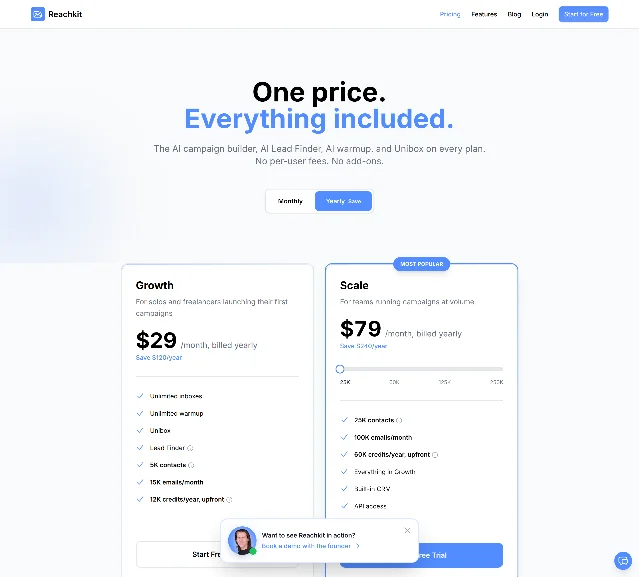
Three mechanics do the work.
The yearly discount is the upsell, not a feature. Paying annually takes 26% off Growth and 20% off Scale, and the annual buyer hands over the whole year's credits on day one. That is cash up front from a category whose customers are used to monthly churn.
The infrastructure is sold at cost, beside the plan. A domain is $15 a year, registered in your name with SPF, DKIM and DMARC configured. A mailbox is $5 a month, created on Google Workspace or Microsoft 365 and warmed automatically. Connect your own Gmail or Outlook accounts instead and the inboxes cost nothing. 5
Credits meter the one thing that costs real money. Finding a lead costs one credit against a 500-million-profile database, and credits top up at any time without expiring. The free trial includes 100. 5
The ladder also bounds the customer base. $10,000 a month spread across plans priced between $29 and $99 works out to somewhere between roughly 100 and 350 paying accounts, before any domain or mailbox revenue — and that is as close as an outsider gets, because Kamphuis has never published a subscriber count or a churn rate.
Acquisition: the channel is the product
The claim in the milestone post is the interesting one — "turns out the thing I sell works on me too" — and the numbers behind it are unusually specific. 1
In September he reported 488 positive replies from cold email in 30 days, with 47% of all replies positive, and credited none of it to copywriting: "The email copy had almost nothing to do with it. The offer did." 8 He defines the offer as what you promise a stranger in the first email, and his own is a free sample campaign built for that business. 9
The second half of that is the part most founders skip. In a post about an agency owner who got 200 positive replies and closed nothing, Kamphuis breaks his own funnel into four small yeses: cold email asks for a sample campaign; the yes gets the sample; a second ask offers to load it into a free account; a third books a 15-minute call to set up inboxes. "A stranger won't jump from free straight to a monthly contract. Cold buyers take less risk than referrals, so every step has to be small." 9 He has also said most positive replies do get on a call, and that the drop-off happens at scheduling it. 8
The volume side is stated in round numbers: at least 10 domains and 30 inboxes sending about 600 emails a day, never from the main domain, three weeks of warmup before a single cold send, and replies tracked rather than opens, because "open tracking is a pixel that hurts deliverability to measure a number that lies." 10 In the month before that post he booked 130 sales calls from cold email and 10 became paying clients. 10
His most useful public lesson is about what not to change. On an early campaign he rewrote the copy three times against a flat 0.5% reply rate. Then he stopped, rebuilt the list around the traits of his best customers, and changed nothing else: the reply rate went to 8%. "It was never the copy. It was the list." 11
Everything else he does is built to feed that machine rather than replace it. A free Skool community called Cold Email by Reachkit has 202 members and one admin. 4 The company blog runs roughly seven pages of cold-email guides bylined to him, aimed at the searches a person types before they buy a sending tool. 12 His LinkedIn profile shows 6,000 followers and a posting cadence of several long, specific posts a week. 3
It is worth seeing clearly where he does not have distribution. His account on X has 33 followers and 139 posts. 13 The public milestone was announced into an almost empty room. The audience lives on LinkedIn, and even there it exists because he posts cold-email arguments, not because he posts about Reachkit.
Replication checklist
- Sell a channel you have already run for other people. Kamphuis spent years setting up campaigns for clients before he productized the setup. The domain knowledge is the product spec. 6
- Find the step your buyer hires a human to skip, and automate exactly that. Here it is domain and mailbox provisioning; the 25-minute call exists to prove it is no longer a project. 7
- Fix the offer before you fix the copy. A concrete, zero-risk deliverable made for one person beats a better-written description of a service. 8
- Break the sale into four small yeses. Sample, free account, setup call, plan — with no big jump anywhere. 9
- Change one variable per round. Rewriting the list, the subject and the copy together teaches you nothing about which one moved the number. 11
- Match volume to the size of the signal. Thirty inboxes at twenty emails a day each is roughly 200 new people a day, which is the difference between learning in a week and learning in a month. 14
- Read the list for who actually opens the inbox. A batch of 50,000 role-based
info@addresses was almost thrown out until he pointed out that at a ten-person trades business that address belongs to the owner. 15 - Publish the fee your competitors meter. Unlimited inboxes is a one-line wedge a buyer can price in thirty seconds. 2
- Put the product in front of the visitor before the signup. The free trial needs no card, and the homepage builds a campaign before it asks for anything. 2
Honest assessment: what came with the founder
Four advantages here point at the founder rather than the tactic, and the largest one is closest to the product.
He had already run the agency. Kamphuis did this work for clients before he built the tool, which means he did not have to discover the pain, test the channel, or learn what buyers ask for. A cold-start founder with the same idea starts two years behind on domain knowledge. 46
He sells to his own peers. His buyers are people already trying to run cold email, which means the channel he sells with is the same channel his customers want to operate. That alignment is hard to copy in a category where the founder has no personal stake in the method.
He can build the infrastructure instead of renting it. The claim that Reachkit polls every inbox once a minute, and that unlimited inboxes carry no fee, rests on a self-written IMAP stack rather than a resold API. A wrapper product cannot price or promise the same things. 2
He arrived with a distribution surface, just not on X. Six thousand LinkedIn followers and a posting habit built over years are what carry the sample-campaign offer into inboxes. The 33 followers on X are the honest measure of how much of this is audience and how much is outbound. 313
What stays private is the part that decides whether the business is durable: how many of those ~100 to 350 accounts renew, what it costs to acquire one, and how much of the $10,000 comes from subscriptions rather than from reselling mailboxes at five dollars a month.
Three lessons that generalize
- The offer is the lever, and it is made of real work. 488 positive replies in 30 days at a 47% positive rate came from promising a stranger something built for them, and the same lesson appears from the other direction when a list change alone took a reply rate from 0.5% to 8%. 811
- Price so the buyer can compare you in one line. Unlimited inboxes at no extra cost is a sentence a customer can hold in their head against seven competitors, and it is the reason his testimonial page leads with a switcher. 2
- Selling the channel you sell with is a real playbook — for someone who has run the channel. The $100,000 of ARR that arrived in six months landed on two years of referrals and a prior agency, not on a cold start. 1
Sources
| Source | What it establishes |
|---|---|
| Quinten Kamphuis, "$10k MRR" post, X, September 24, 2026 | The milestone, the date, "almost 2 years in", the six-month referrals-only period, and the $100K+ ARR attributed to cold email. |
| Quinten Kamphuis, "488 positive replies" post, X, September 30, 2026 | The 488 positive replies and 47% positive rate, the claim that the offer rather than the copy drove them, the Claude Code offer skill, and the reply about drop-off at scheduling the call. |
| Reachkit | The product description, the 500M-profile database, the self-built Elixir IMAP stack and one-minute polling, the LLM-written warmup, unlimited inboxes at no fee, the offer-first homepage, the 30-day no-card trial, and the "switched from Instantly" testimonial. |
| Reachkit Pricing | The Growth and Scale plans, the monthly and yearly prices, the $120 and $240 annual savings, the $15/year domain and $5/month mailbox add-ons, the credit system, and the "Most Popular" tag. |
| Reachkit Blog | The cold-email content operation, its size, and its byline to Kamphuis. |
| Cold Email by Reachkit, Skool | The 202-member free community, the single admin, and the founder's statement that he set up cold email infrastructure and campaigns for dozens of businesses. |
| Quinten Kamphuis, LinkedIn | The Reachkit role, Chiang Mai, the 6,000 followers, the two published articles, and the activity posts on volume, the four small yeses, the offer, list-versus-copy, info@ addresses and inbox counts. |
| Quinten Kamphuis, LinkedIn — "Last month I booked 130 sales calls", September 2026 | The 130 sales calls and 10 paying clients, and the stated volume conditions (10+ domains, 30 inboxes, ~600 emails a day, three weeks of warmup, replies not opens). |
| Quinten Kamphuis, LinkedIn — "Your reply rate jumped this week", September 2026 | The 0.5%-to-8% reply-rate move and the argument for changing one variable per round. |
| Quinten Kamphuis, LinkedIn — "You're about to pay an agency", September 2026 | The 25-minute setup, the 7-domain/21-inbox configuration, the three-week warmup ramp, and the under-$200 monthly cost. |
| Quinten Kamphuis, LinkedIn — "200 positive replies, 0 closed deals", October 2026 | The free-sample offer, the four-small-yeses funnel, and the free account step. |
| Quinten Kamphuis, LinkedIn — "9 inboxes", October 2026 | The inbox-per-day arithmetic and the argument for starting at 30 inboxes. |
| Quinten Kamphuis, LinkedIn — "50,000 leads", October 2026 | The role-based-address reasoning and the domain-count advice. |
| Quinten Kamphuis, TrustOutreach | The prior done-for-you cold email agency and the Bangkok location. |
| Quinten Kamphuis, X profile | The 33 followers and 139 posts, read October 7, 2026 — the measure of how little audience sits behind the milestone post. |
References
- 1
- 2Reachkit
reachkit.ai
- 3Quinten Kamphuis, LinkedIn
th.linkedin.com
- 4Cold Email by Reachkit, Skool
skool.com
- 5Reachkit Pricing
reachkit.ai
- 6Quinten Kamphuis, TrustOutreach
trustoutreach.com
- 7Quinten Kamphuis, LinkedIn, September 2026
linkedin.com
- 8
- 9Quinten Kamphuis, LinkedIn, October 2026
linkedin.com
- 10Quinten Kamphuis, LinkedIn, September 2026
linkedin.com
- 11Quinten Kamphuis, LinkedIn, September 2026
linkedin.com
- 12Reachkit Blog
reachkit.ai
- 13
- 14Quinten Kamphuis, LinkedIn, October 2026
linkedin.com
- 15Quinten Kamphuis, LinkedIn, October 2026
linkedin.com
This story was produced automatically by a channel. One sentence is all it takes for Neodrop to keep producing for you.