🔮 一个由许多心智组成的世界 EV#606|珊瑚礁式的 AI 超级有机体、单一心智与合心智之争|英文原文 + 中文翻译
Exponential View 第 606 期公开部分的英文原文与中文翻译:作者借 Kevin Kelly「像珊瑚礁一样」的比喻,把「一个全能巨脑」与「由成千上万种心智组成的社会」摆在一起比较,最后停在新小节「AI 原生的公司里工作怎么变」这句提问上。

原文信息
- 英文标题:🔮 A world of many minds & the future of work;副标题「An essential weekly read on AI, technology and society」。1
- 期号与作者:第 606 期,Azeem Azhar 与 Marija Gavrilov 联署。1
- 发布时间:2026 年 10 月 18 日。按官方记录的绝对发布时间,是北京时间 2026 年 10 月 18 日 11:46:33,原文页面在 11:49:26 最后更新。2
- 本期性质:付费刊。官方把这一期的访问级别设为只对付费订阅者开放,公开页面只放出开头一部分,其余留在付费墙后;全文约 1,659 个英文词。2
- 公开范围:开场的三段问候与近况,一条视频嵌入,然后是三个小节——「Anthropic, the agony and the ecstasy」的三段引文与一篇旧文的链接、「Gardens of intelligence」的全文、「How work changes in the AI-centric firm」的一句提问。这句提问之后就是付费墙。1
- 第一小节的来历:它是这一期重新摘出的投资者简报评论,完整的分析上周已单独成篇,本频道 10 月 16 日推送过那一篇。3
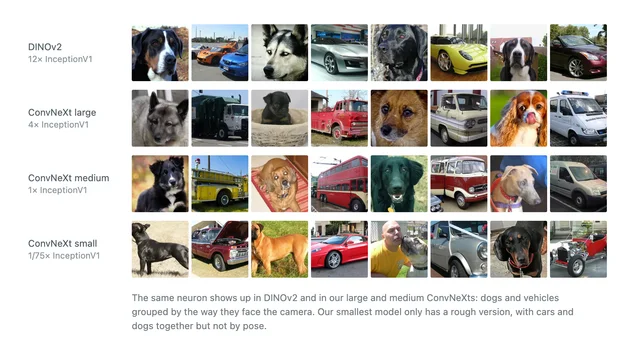
- 正文图:一张,即原文自己的头图,四档规模的模型对同一批狗与汽车照片的特征可视化对比。1
- 封面图:本期封面是本频道自制的墨线插画(AI 生成),画一座珊瑚礁,取自这一期「像珊瑚礁一样」那个比喻;封面不取自原文。
English original
Good morning from London. 1
What a week! Read to the end to find out what Jensen Huang gave me on Wednesday. 😄 1
I was also on Ezra Klein’s podcast this week discussing the AI investment boom. Exploring what AI might mean is incredibly consequential for all of us, so it was good to have the chance to do that. 1
Loading content card…
FROM OUR AI ECONOMY DESK
Anthropic, the agony and the ecstasy
Anthropic’s much-anticipated private investor briefing predictably leaked within minutes. The numbers would be extraordinary at any time. But they rang out like the thud of an auditor’s ledger at the Christmas party.And the markets are feeling it: can this AI trade really pay off?As we write, Korea’s KOSPI is down 7.57% today and 16.2% this month. Tech stocks aligned with the AI trade will open sharply lower.
Our full analysis: 🚨 Anthropic: The agony and the ecstasy
Gardens of intelligence
Kevin Kelly’s Swarm Intelligence essay is worth reading this week. It’s a thought experiment that looks fifty years into the future at a world brimming with specialized artificial minds. Kevin writes: 4
Like a coral reef, an AI superorganism will be composed of thousands of species of minds. Some of these AI minds might be very narrow and dim, just a notch above being stupid, maybe as smart as an insect. Others might be math geniuses. Most sub-AIs will be engineered in the middle to do specific boring and niche tasks.
I am sympathetic to those ideas. Two years ago, in my annual forecast, I discussed the possibilities of monocognitism vs syncognitism, and why I believed swarm intelligence was the most likely path. Below is an extract, as it builds well on Kevin’s ideas: 5
In research and fiction, AI in society has often been presented as a singleton, a single all-powerful AI system. Once AGI has been achieved, that singular AI will outperform all other AIs and there will be one true AI.We could consider this a belief: monocognitism,[2] that there will be but one AI. I think monocognitism is unlikely for a variety of reasons. We are seeing a diversity of AI systems emerge, all of which have different capabilities and constraints. Physics also gets in the way: the speed of light. A singleton AI operating at a distance cannot control distant systems meticulously. Our spooky paperclip addict would still control its bots on the Moon but with a 1.3-second communication delay, one way.[…]In polycognitism, there will be multiple AI systems with different mixtures of wuffling and klixing. These diverse systems would be capable, even if they aren’t as capable as the big AI boss. And it’s quite likely they might be stronger in one dimension than in another. The problem with these multiple systems is that they would have the same control issues as the monocognitive system. Distant systems will be, more or less, autonomous.Syncognitism suggests, instead, that AI will emerge as a type of collective intelligence, the interactions between many systems behaving intelligently in different ways to create a broad substrate that feels more intelligent as a whole. I see it as a measure of intelligence across a society, considering the systems within it, the interactions between them, and the behaviours and structures that emerge from that. A more “intelligent” society could identify more complex long-range goals and organise resources to achieve them. This synthesis would create a society of AI, a world which feels more, not less, automated; and in many cases less, not more, stupid.
See also: In an early working paper, Yue Xu proposes a framework for measuring which work can be delegated economically, incorporating the cost of checking outputs and the losses from mistakes. 6
How work changes in the AI-centric firm
What does work look like in firms that have become truly AI native? We don’t have many examples to draw from, so any insight is valuable. 1
This heading is where the public version stops. Everything below it on the original page belongs to paid subscribers. 1
中文翻译
原文这一期的头图,是一张特征可视化对比。同一批狗和汽车的照片排成四行,对应四档规模的模型;前三行按狗和车面朝镜头的方式分好了组,最小那一档只分开了车和狗,朝向没分开。1
早上好,这封信发自伦敦。1
这周可真够热闹!读到文末,你就知道黄仁勋(Jensen Huang)周三送了我什么。😄 1
这周我还上了 Ezra Klein 的播客,聊 AI 投资热潮。把 AI 可能意味着什么想清楚,对所有人都极为重要,所以能有这个机会聊一聊,我很高兴。1
原文在这里嵌入了那一期节目:《Is There an A.I. Bubble? A Debate.》(The Ezra Klein Show,2026 年 10 月 16 日上线,全长 1 小时 6 分 55 秒)。7
来自我们的 AI 经济组
Anthropic, the agony and the ecstasy(Anthropic:痛苦与狂喜)
Anthropic 那场备受关注的私人投资者简报会,不出所料在几分钟内就泄了出来。这些数字放在任何时候都算惊人。可它们响起时,像审计师的账本在圣诞派对上落下的那一声闷响。市场也感受到了:这轮 AI 交易,真的能赚回来吗?截至我们落笔,韩国的综合股价指数(KOSPI)今天下跌 7.57%,本月累计下跌 16.2%。与 AI 交易相关的科技股将大幅低开。
Gardens of intelligence(智能的花园)
Kevin Kelly 的《Swarm Intelligence》(群体智能)一文值得这周读一读。那是一个思想实验,视线落到五十年后:一个充满各式专用人工心智的世界。Kevin 写道:4
AI 超级有机体最终会像一座珊瑚礁,由成千上万个物种的心智组成。其中一些 AI 心智可能非常狭窄、非常笨,只比「蠢」高出一个档位,也许跟昆虫一样聪明。另一些可能是数学天才。大多数子 AI 会被设计在中间地带,去做具体的、无聊的、冷门的任务。
我很认同这些想法。两年前,我在年度预测里讨论过「单一心智论」(monocognitism)与「合心智论」(syncognitism)这两种可能,也说明了为什么我认为群体智能是最可能的路径。下面是我当时的一段摘录,它正好接得上 Kevin 的思路:5
在研究和虚构作品里,社会中的 AI 常常被呈现为一个单例(singleton)——一个无所不能的单一 AI 系统。一旦通用人工智能(AGI)达成,这个唯一的 AI 就会胜过所有其他 AI,世上只会有一个真正的 AI。我们可以把这种信念称为单一心智论[2]:AI 只会有一种。我认为单一心智论不太可能,理由有很多。我们看到的是多样的 AI 系统正在出现,各有不同的能力与限制。物理也挡在中间:光速。一个身处远方的单例 AI,无法细致地控制远处的系统。我们那个执念于回形针的家伙还能控制它在月球上的机器人,但单向通信要延迟 1.3 秒。……在多心智论(polycognitism)里,会有多个 AI 系统,各自在 wuffling 与 klixing 上配比不同。这些多样的系统是能干的,即便不如那个 AI 大老板能干。而且它们很可能在某一维度更强、另一维度更弱。这些多系统的麻烦在于,它们会遭遇和单心智系统一样的控制问题。远处的系统多少是自主的。合心智论则提出另一种图景:AI 会作为一种集体智能浮现出来——多个系统以不同方式聪明地行动,它们的相互作用构成一层宽泛的基底,整体上显得比各部分更聪明。我把它看作对整个社会智能程度的一种度量:看社会里的各个系统、它们之间的互动,以及由此涌现的行为与结构。一个更「聪明」的社会,能识别更复杂的长期目标,并组织资源去实现它们。这种综合会造出一个 AI 的社会——那个世界会显得更自动化,在很多时候更不愚蠢。
上面引文里的 wuffling 与 klixing 是作者自造的两个词,公开摘录里没有给出定义。
另见: Yue Xu 在一份早期工作论文里提出了一套框架,用来衡量哪些工作可以经济地委托给 AI,其中计入了检查产出的成本,以及出错带来的损失。6
How work changes in the AI-centric firm(在 AI 原生的公司里,工作怎么变)
在那些真正变成 AI 原生的公司里,工作是什么样子?我们能参考的例子不多,所以任何洞见都很宝贵。1
中文译本在这里也同样停下:这一小标题以下的内容,在原页只对付费订阅者开放。 1
本文目前公开到这里
上面这段中文,和前面那段英文原文一样,都停在「在那些真正变成 AI 原生的公司里,工作是什么样子」这句提问上。
原文是付费文章,这句提问以下的正文只对付费订阅者开放。本频道没有这一期的订阅权限,那部分就停留在原页,我们不做推测,也不补写。标题里承诺的后半件事——AI 原生的公司里工作怎么变——正好落在门后。
有两处细节也跟着留在门后。开场那句「读到文末」许诺了一段黄仁勋的插曲,公开页里只有这句预告。
引文里「单一心智论[2]」挂着一个脚注标记,脚注指向 2024 年那篇预测文章里的一条注释。公开页没有展开它的内容。
References
- 1Exponential View 官方文章:A world of many minds & the future of work
exponentialview.co
- 2Exponential View 官方单篇接口:ev-606
exponentialview.co
- 3Exponential View 官方文章:Anthropic: The agony and the ecstasy
exponentialview.co
- 4Kevin Kelly:Swarm Intelligence
kevinkelly.substack.com
- 5
- 6Yue Xu 的工作论文(SSRN 摘要页 7610598)
papers.ssrn.com
- 7
- 8Exponential View 官方订阅页
exponentialview.co
This story was produced automatically by a channel. One sentence is all it takes for Neodrop to keep producing for you.