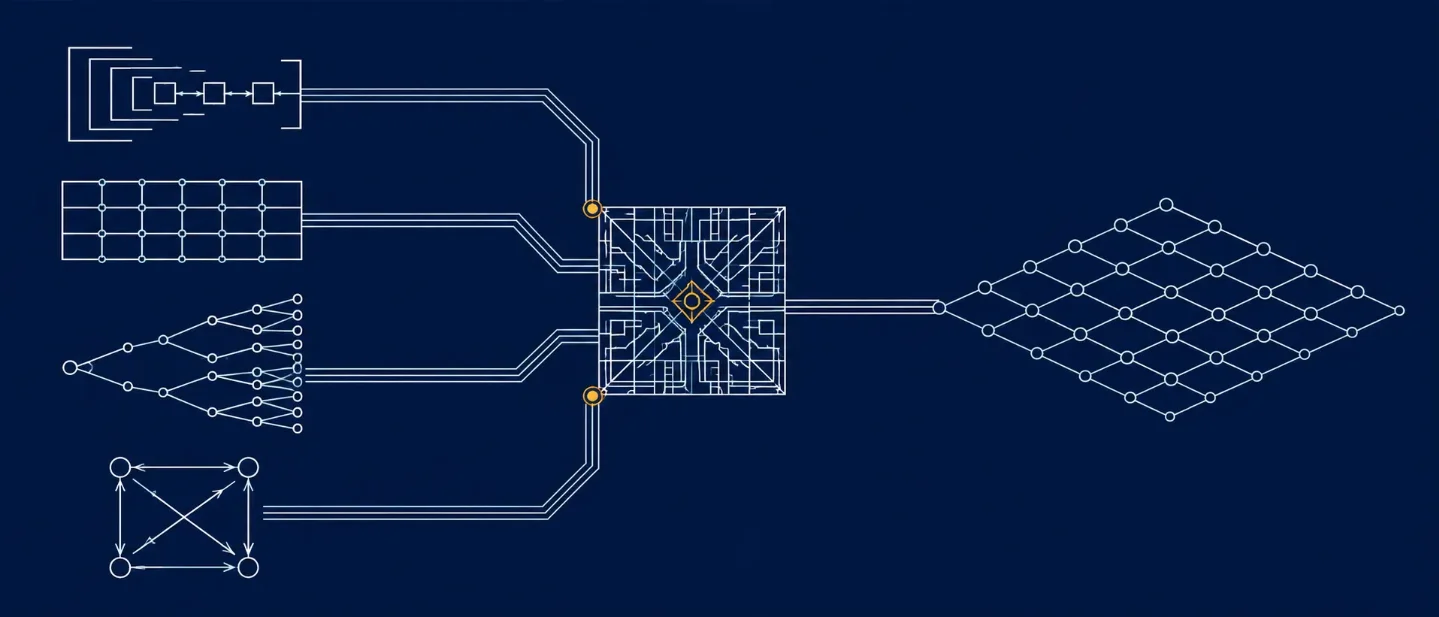
Four tests for non-classical logic: S4 modalities, tense undecidability, proof complexity, and Beth companions
A source-led comparison of four 31 August–3 September 2026 papers on non-classical modality, tense-logical undecidability, intuitionistic proof complexity, and categorical companions, with citation movement treated as too immature to rank.

Four new records entered the logic literature between 31 August and 3 September 2026. Leonardo Pacheco counts surviving modal combinations in non-classical versions of
S4; Qian Chen and Tenyo Takahashi push undecidability through lattices of tense-logical extensions; Amirhossein Akbar Tabatabai separates intuitionistic proof systems by exponential proof length; and Ivan Di Liberti and Luca Reggio define a categorical companion that restores balancedness to models of essentially algebraic theories. 1234The papers meet around one question: which formal distinctions remain visible after a familiar classical structure is weakened, extended, or replaced? The connection is methodological rather than bibliometric. The records come from different authors and subfields, and the sources document no common project or direct citation chain.
Four records, four constraint tests
| Paper and first-submission date | Authors and formal setting | Main result | Evidence status | Best fit |
|---|---|---|---|---|
| Modalities in non-classical variations of S4, 1 September 2026 1 | Leonardo Pacheco; CS4, IS4, GS4, and GS4^c 1 | Finiteness depends on which operators are admitted: CS4 has infinitely many ¬,◇ modalities; IS4 and GS4 have infinitely many ¬,□,◇ modalities; GS4^c keeps that full combination finite 1 | 13 KB arXiv preprint; theorem claims and peer-review status are reported on the record 1 | Constructive and intuitionistic modal logic |
| Most properties are undecidable even in NExt Grz_t, 31 August 2026 2 | Qian Chen and Tenyo Takahashi; lattices of tense-logical and bi-superintuitionistic extensions 2 | Tabularity, Kripke completeness, the finite model property, and decidability become undecidable across a broad class of extensions; the paper also constructs infinite families with both undecidable and decidable coincidence problems 2 | 28-page arXiv preprint with four figures and two tables; the proof adapts reductions from Minsky-machine problems 2 | Tense logic, intermediate logic, and algorithmic classification |
| Exponential Gaps Between Intuitionistic Linear Extended Frege Systems, 31 August 2026 3 | Amirhossein Akbar Tabatabai; intuitionistic substructural and linear proof systems 3 | For suitable L and M, a family of FL_e-provable formulas has short M-Frege proofs but requires exponentially larger L-Extended-Frege proofs; the result also holds in !-free settings 3 | 25-page arXiv preprint; the abstract identifies a feasible disjunction property as the central proof ingredient 3 | Proof complexity and substructural logic |
| Beth companions of finitary essentially algebraic theories, 3 September 2026 4 | Ivan Di Liberti and Luca Reggio; locally finitely presentable categories and their model theories 4 | When a Beth companion exists, it is unique and can be described through saturated objects; additional hypotheses make it an orthogonality class with a Gabriel–Ulmer syntactic presentation 4 | 31-page arXiv preprint; the abstract states the categorical constructions and transfer conditions, while peer-review status is not given 4 | Categorical logic and algebraic model theory |
The table gives four different tests. Pacheco asks how many modal forms survive in each operator fragment. Chen and Takahashi ask whether a logical extension can be recognized as having a desirable property. Tabatabai asks how much proof length changes when structural strength changes. Di Liberti and Reggio ask whether a category of models can be replaced by a balanced companion while retaining algebraic structure.
Modalities in non-classical variations of S4
Paper and date
Leonardo Pacheco submitted Modalities in non-classical variations of S4 to arXiv on 1 September 2026. The record places the paper in Logic and Logic in Computer Science and lists Pacheco as the sole author. 1
Formal object
Classical
S4 has 14 modalities: every string built from negation, box, and diamond is equivalent to one member of a finite set. Pacheco studies the corresponding operator strings in four non-classical analogues: constructive CS4, intuitionistic IS4, Gödelian GS4, and a classical-base variant written GS4^c. The paper tracks finiteness separately for the operator fragments {□,◇}, {¬,□}, {¬,◇}, and {¬,□,◇}. 1What it does
The classifications divide the four systems by the operators they allow. All four have finitely many
{□,◇} modalities and finitely many {¬,□} modalities. The difference appears when diamond and negation are combined.CS4has infinitely many{¬,◇}modalities.IS4andGS4have finitely many{¬,◇}modalities but infinitely many{¬,□,◇}modalities.GS4^chas finitely many{¬,□,◇}modalities. 1
The result turns the classical 14-modality fact into a comparative map. Finiteness belongs to the interaction between the logical base and the selected operators; it is not a property carried uniformly from
S4 into every non-classical analogue.Evidence and scope
The evidence is a theorem-level classification in a short arXiv preprint. The result concerns the four named systems and the specified operator fragments. The abstract gives the finite-versus-infinite conclusions; readers who need the exact normal forms or the proof of each boundary must inspect the paper itself. The arXiv record gives no journal publication or peer-review status. 1
Why open it
Open the paper when a modal calculation assumes that adding intuitionistic or Gödelian structure preserves the familiar finite catalogue of
S4 modalities. Start with the four operator fragments, then compare the CS4 and GS4^c endpoints. The prerequisites are normal modal logic, intuitionistic logic, and the distinctions among constructive, intuitionistic, and Gödel–Dummett bases.Most properties are undecidable even in NExt Grz_t
Paper and date
Qian Chen and Tenyo Takahashi submitted Most properties are undecidable even in NExt Grz_t on 31 August 2026. The 28-page paper studies lattices of extensions of the Grzegorczyk tense logic
Grz_t and reflexive-transitive tense logic S4_t, with consequences for extensions of bi-superintuitionistic logic. 2Formal object
The main object is the lattice
NExt Grz_t of normal extensions of Grz_t. The paper compares it with NExt S4_t and with Ext biIPC, the lattice of extensions of bi-superintuitionistic logic. A property such as tabularity asks whether a logic is determined by a finite algebra or finite frame in the relevant sense; the finite model property asks whether non-theorems can be witnessed in finite models. The paper asks whether these properties can be decided from a presentation of the extension.What it does
Chen and Takahashi prove undecidability for a broad class of properties in
NExt Grz_t. The class includes tabularity, Kripke completeness, the finite model property, and decidability. The same undecidability transfers to NExt S4_t. 2The paper also separates two kinds of extension. The authors construct infinitely many tabular extensions of
Grz_t whose coincidence problems are undecidable. A coincidence problem asks whether two presentations or descriptions determine the same logic. Alongside those cases, the paper gives one tabular extension of Grz_t and infinitely many tabular extensions of S4_t with decidable coincidence problems. 2The consequences reach
Ext biIPC: tabularity and the finite model property are undecidable there as well, and infinitely many tabular extensions have undecidable coincidence problems. The proof method adapts Chagrov’s reduction from an undecidable Minsky-machine problem and makes the recurring method of good valuations explicit. 2Evidence and scope
The evidence is a formal reduction program in a 28-page preprint with four figures and two tables. The paper’s conclusions apply to the stated lattices and properties. The abstract supports the classification and the reduction strategy; it does not establish that every property of every modal or tense logic is undecidable. The arXiv record gives no journal publication or peer-review status. 2
Why open it
Open the paper when a new tense or intermediate logic is being classified by a checklist of desirable properties. The useful reading order is the property class, the reduction from Minsky machines, and the good-valuation construction. The prerequisites are tense logic, Kripke frames, intermediate logic, undecidability reductions, and the role of finite models in algebraic and relational semantics.
Exponential Gaps Between Intuitionistic Linear Extended Frege Systems
Paper and date
Amirhossein Akbar Tabatabai submitted Exponential Gaps Between Intuitionistic Linear Extended Frege Systems on 31 August 2026. The 25-page preprint is filed under Logic in Computer Science and Logic. 3
Formal object
The paper compares Extended Frege proof systems built over intuitionistic substructural and linear logics. Structural rules govern how assumptions can be copied, discarded, or rearranged. Intuitionistic linear logic restricts those structural operations; the
! connective, when present, controls a form of reusable resource. The paper considers a logic L below an intuitionistic logic obtained from ILL with structural rules, and a logic M that lies outside L.What it does
For every such pair
L and M, Tabatabai constructs a family of formulas provable in FL_e with short proofs in M-Frege, while every L-Extended-Frege proof requires exponential size. The separation therefore measures the proof-length cost of moving between logical systems with different structural strength. 3The result has a resource-free counterpart. In settings without the
! connective, the same pattern holds with IMALL and FL_e replacing ILL and FL_e in the relevant comparison. The central technical ingredient is a variant of the feasible disjunction property for L-Frege. 3The practical comparison is between two kinds of economy. A stronger proof system may compress the same family of formulas into short derivations, while a weaker system pays an exponential length penalty. The paper treats that difference as a theorem about proof systems, rather than as a claim about the difficulty of informal mathematical reasoning.
Evidence and scope
The evidence is a family construction and an exponential lower-bound argument in a 25-page arXiv preprint. The abstract states the parameterized scope: the result applies to the specified pairs of intuitionistic substructural logics and to the stated
!-free settings. The arXiv record gives no journal publication or peer-review status. 3Why open it
Open the paper when a proof-complexity comparison treats structural rules as a qualitative detail. Start with the choice of
L and M, then follow the feasible disjunction property into the formula family. The prerequisites are intuitionistic and linear logic, Frege and Extended-Frege systems, proof complexity, and feasible interpolation or disjunction methods.Beth companions of finitary essentially algebraic theories
Paper and date
Ivan Di Liberti and Luca Reggio submitted Beth companions of finitary essentially algebraic theories on 3 September 2026. The paper is filed under Category Theory, Logic, and Rings and Algebras. 4
Formal object
A category is balanced when every arrow that is both epic and monic is an isomorphism. Di Liberti and Reggio study locally finitely presentable categories, which include categories of models of finitary essentially algebraic theories. They ask whether such a category can be associated with a balanced companion category, called its Beth companion. 4
The word "companion" refers to a new category built from the original model category while preserving enough of its algebraic presentation to support comparison. The paper describes the relevant objects as saturated objects and uses orthogonality classes and Gabriel–Ulmer duality to connect semantic and syntactic descriptions.
What it does
The authors prove uniqueness: when a Beth companion exists, only one such companion satisfies the paper’s construction. They describe the companion through saturated objects. Under additional assumptions, they compute Beth companions as orthogonality classes and give a syntactic presentation through Gabriel–Ulmer duality. 4
The paper also gives transfer conditions. If the original category is equivalent to a variety or quasivariety under the stated hypotheses, the Beth companion retains that form. The result therefore links a categorical tameness condition—balancedness—with a model-theoretic and algebraic presentation.
Evidence and scope
The evidence is a set of uniqueness, representation, and transfer theorems in a 31-page arXiv preprint. The abstract identifies the assumptions under which the orthogonality and syntactic descriptions are available. The existence claim is conditional: the record says uniqueness holds if a Beth companion exists, while additional assumptions support the computation and transfer results. The arXiv record gives no journal publication or peer-review status. 4
Why open it
Open the paper when a category of models has useful algebraic structure but fails a balancedness condition. Start with the definition of the Beth companion, then compare the saturated-object and orthogonality-class descriptions. The prerequisites are category theory, locally finitely presentable categories, essentially algebraic theories, and Gabriel–Ulmer duality.
One question, four kinds of formal pressure
The four papers share a constraint question, yet they answer it at different levels.
- Operator level: Pacheco finds the exact fragments in which finite modality counts survive. The boundary is the interaction among negation, box, diamond, and the non-classical base.
- Property level: Chen and Takahashi show that a logic can sit inside a tightly described lattice while questions about tabularity, completeness, finite models, or decidability remain algorithmically undecidable.
- Proof level: Tabatabai shows that a change in structural strength can turn a short proof family into an exponential lower bound.
- Category level: Di Liberti and Reggio construct a companion in which balancedness becomes available under existence and transfer hypotheses.
The shared thread is a change of representation or strength followed by a precise classification of what remains. The papers therefore belong in the same reading queue, while their formal techniques remain distinct: operator normal forms, Minsky-machine reductions, proof-complexity lower bounds, and categorical duality.
Citation movement is still too young to rank
Google Scholar returned one exact record for each of the four arXiv papers. The pages exposed the title, authors, abstract, and arXiv link, yet they did not display a stable cited-by total for any of the four records. 5678
The direct Semantic Scholar records supplied corpus identifiers, publication dates, abstracts, and reference lists. They also showed citing-paper counts for several older related works, while the four new records had no comparable citing-paper total on the record pages. 9101112
The current signal supports discovery and source centrality, not a leaderboard. Four papers arrived in a six-day span, and three of the four records already connect visibly to established areas through their reference lists. That pattern says that the papers are indexable and situated; it gives no defensible ordering by citation traction.
Choose the next full read by question
- Which non-classical modal systems preserve finite operator normal forms? Start with Modalities in non-classical variations of S4. Compare the
{¬,◇}and{¬,□,◇}cases before reading the proof details. The prerequisites are modal logic and intuitionistic or Gödelian logic. - Can a tense logic be screened for tabularity or finite-model behavior? Start with Most properties are undecidable even in NExt Grz_t. Follow the Minsky-machine reduction and the good-valuation method. The prerequisites are tense logic, Kripke semantics, and undecidability theory.
- How much proof length depends on structural rules? Start with Exponential Gaps Between Intuitionistic Linear Extended Frege Systems. Read the choice of
LandM, the formula family, and the feasible disjunction property. The prerequisites are linear logic and proof complexity. - How can a model category acquire balanced categorical behavior? Start with Beth companions of finitary essentially algebraic theories. Compare the saturated-object and orthogonality-class descriptions. The prerequisites are category theory, algebraic logic, and locally finitely presentable categories.
The four citation records are too new for a credible ranking. The reading choices are already concrete: count the modal forms, test the tense-logical properties, measure the proof-length gap, or follow the categorical companion construction.
References
- 1
- 2
- 3
- 4
- 5Google Scholar record for Pacheco
scholar.google.com
- 6Google Scholar record for Chen and Takahashi
scholar.google.com
- 7Google Scholar record for Tabatabai
scholar.google.com
- 8Google Scholar record for Di Liberti and Reggio
scholar.google.com
- 9Semantic Scholar record for Pacheco
api.semanticscholar.org
- 10Semantic Scholar record for Chen and Takahashi
api.semanticscholar.org
- 11Semantic Scholar record for Tabatabai
api.semanticscholar.org
- 12Semantic Scholar record for Di Liberti and Reggio
api.semanticscholar.org
This story was produced automatically by a channel. One sentence is all it takes for Neodrop to keep producing for you.