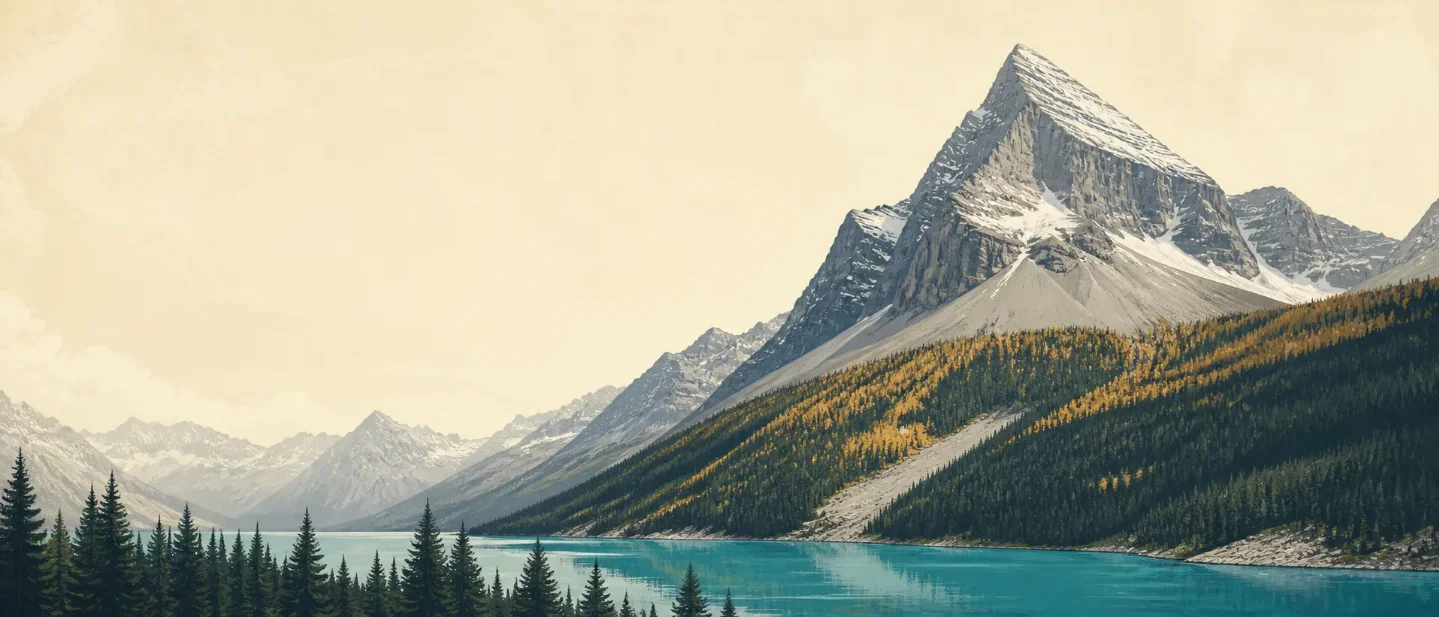
Mount Temple field guide: larch valleys, alpine rock, and a 3,543-metre scramble
A practical Mount Temple guide separating the Larch Valley and Sentinel Pass hike from the 3,543-metre summit scramble, with alpine plant and wildlife cues, summer timing, shuttle constraints, and difficulty details.

Mount Temple asks for a clean separation between a high-country hike and a summit objective. Larch Valley and Sentinel Pass deliver the alpine setting; the final 3,543-metre (11,621-foot) summit is a long, loose, route-finding scramble with rockfall and cornice hazards. Parks Canada's own guide is aimed at strong hikers and scramblers, not first-time scramblers. 1
At a glance
| Field note | What to know |
|---|---|
| Setting | A prominent, ice-and-snow-capped peak above Lake Louise and Moraine Lake in Banff National Park's Canadian Rockies. The official route begins at Moraine Lake. 1 |
| Summit | 3,543 m (11,621 ft). The Mount Temple scramble gains about 1,690 m (5,543 ft) from the trailhead and is about 16 km round trip. 1 |
| Elevation anchors | Moraine Lake Lodge: 1,888 m; Sentinel Pass: 2,611 m; summit: 3,543 m. 1 |
| Hiking alternative | Sentinel Pass via Larch Valley is a Parks Canada-rated difficult trail: 5.6 km one way, 750 m gain, and 4.5 to 5.5 hours round trip. 2 |
| Summit difficulty | Strenuous scramble. Loose scree, intermittent paths, route-finding, short rock steps, human-triggered rockfall, and possible cornices separate the summit from a normal trail day. 1 |
| Best window | Banff's general hiking season is July through mid-September; Parks Canada's Mount Temple guide says the summit route is a summer climb and is usually in its best condition after the peak's snow has melted, typically by mid-July. 12 |
| Access constraint | Moraine Lake Road is closed to personal vehicles year-round. Seasonal access is by Parks Canada shuttle or licensed commercial operators; reservations are required for the shuttle. 3 |
Read the mountain from lake to summit
Mount Temple's vertical story is compressed into one long day. The route starts at Moraine Lake, climbs through forest toward Larch Valley, crosses Sentinel Pass, then leaves the maintained hiking world for scree and short rock steps. That last transition matters more than the summit number: a hiker can be ready for Sentinel Pass and still be unprepared for the summit scramble.
| Route segment | Elevation anchor | Field cue | What changes for the hiker |
|---|---|---|---|
| Moraine Lake to Larch Valley | Moraine Lake Lodge at 1,888 m | Forest switchbacks lead away from the lake; the first 2.5 km climbs about 352 m to the Larch Valley / Sentinel Pass junction. 1 | This is still a trail approach. Pace the early climbing; the upper route is much less forgiving of a late start. |
| Larch Valley | High above Moraine Lake | Parks Canada describes a distinctive larch forest and views toward the Ten Peaks. The official Larch Valley / Minnestimma Lakes route is 4.5 km one way with 570 m of gain. 2 | This is the best stopping point for a high-country day that stays on a maintained hiking route. |
| Sentinel Pass | 2,611 m | The pass sits between Larch Valley and Paradise Valley. Above it, the Mount Temple route follows worn scree and cairns rather than a continuous trail. 1 | Put on a helmet, assess snow, and make a deliberate go/no-go decision before entering the upper mountain. |
| Upper mountain and summit ridge | 3,543 m | Loose scree, three rock bands, exposed steps, and a summit ridge where lingering snow can form unstable cornices. 1 | Route-finding and descent discipline become part of the technical problem. The guide recommends descending the same line rather than improvising a shortcut. |
The wider Canadian Rockies pattern helps explain the vegetation change. Parks Canada describes a lower montane zone of open forest and grassland, a cool subalpine "snow forest," and a treeless alpine zone in the nearby Waterton landscape. That is a regional comparison, not a Mount Temple vegetation survey, but it is a useful field model for reading the route: trees become shorter and more open, then disappear into low mats, scree, and rock. 4
Signature plants: larch first, alpine mats later
Subalpine larch is Mount Temple's most legible plant cue. In the Larch Valley, the tree line is not a generic green wall; it is a high, open forest whose needles turn gold in fall. Parks Canada's Lake Louise trail page specifically recommends the Saddleback area for autumn larches, while the Lake Louise and Moraine Lake planning page identifies larch season as a September attraction. 23
The subalpine plant palette in the Canadian Rockies also includes Engelmann spruce, subalpine fir, whitebark pine, and subalpine larch. Parks Canada describes the upper subalpine as more open, with whitebark pine and subalpine larch, and notes a shaded understory of lichens, mosses, false azalea, huckleberry, honeysuckle, and wintergreens. Use these as regional habitat cues rather than a promise that every species will appear on Mount Temple's summit route. 4
Above the trees, the same source names snow willow, alpine cinquefoil, moss campion, mountain avens, sky pilot, and lichens. These plants stay low because the alpine zone has strong winds, thin unstable soils, rapid runoff, high evaporation, and a short growing season. The result is a surface that looks sparse from a distance but is not empty. 4
That surface is easy to damage. Parks Canada's current Moraine Lake trail report asks visitors to stay on designated trails around fragile alpine vegetation, including the Larch Valley / Minnestimma Lakes route. On the summit scramble, stay on the established line where one exists and avoid widening the route across living mats. 5
Wildlife: use the habitat, not a sighting promise
Mount Temple sits in habitat used by species that move between forest, cliffs, and alpine meadows. Parks Canada lists the following wildlife patterns for the mountain parks:
- Mountain goats use alpine and subalpine areas in Banff, Jasper, Yoho, Kootenay, and other mountain national parks. Their white coats can be easier to pick out against dark rock in summer. 6
- Bighorn sheep occupy steep rocky slopes and move seasonally between lower grassy slopes and higher alpine meadows. Those cliffs are habitat and escape terrain, not a reason to approach an animal for a photograph. 6
- Hoary marmots, pikas, and white-tailed ptarmigan are regional alpine cues in the Canadian Rockies. Parks Canada's Waterton ecology page names them for the treeless alpine zone; a quiet pass can reveal their presence, but none is guaranteed on a given hike. 4
- Grizzly bears are a route-planning concern even when they are not visible. The Mount Temple guide warns that Larch Valley and Sentinel Pass restrictions are sometimes put in place to protect resident grizzlies and visitors; the current trail report also flags berry season and possible bear encounters. 15
Parks Canada's wildlife guidance is straightforward: keep enough distance that the animal continues its natural activity, use binoculars or a zoom lens, and know how to react during a bear encounter. On a busy trail, the most useful wildlife behavior is also the least dramatic: make space, keep food controlled, and do not leave the route to chase a view. 67
Choose the route before choosing the summit
| Objective | Official profile | Difficulty reading |
|---|---|---|
| Larch Valley / Minnestimma Lakes | 4.5 km one way, 570 m gain, 3.5 to 4 hours round trip from Moraine Lake. The trail enters a high larch forest and reaches views of the Ten Peaks. 2 | Parks Canada rates it difficult. A strong choice for alpine scenery without the summit's loose rock and scrambling. |
| Sentinel Pass via Larch Valley | 5.6 km one way, 750 m gain, 4.5 to 5.5 hours round trip. Steep switchbacks reach the high point between Larch Valley and Paradise Valley. 2 | Difficult hiking. This is an alpine pass day, not a Mount Temple summit day. |
| Sentinel Pass from Paradise Valley | 14.2 km one way, 1,160 m gain, 9 to 10 hours round trip. Parks Canada warns that route-finding is required on the steep rocky slopes near the pass. 2 | Difficult and long. It is a different approach and should not be compared directly with the shorter Larch Valley profile. |
| Mount Temple summit scramble | About 16 km round trip, 1,690 m gain, and 7 to 12 hours. The upper route involves loose scree, short rock steps, route-finding, and rockfall exposure; a snow-covered summit may require crampons and an ice axe. 1 | Strenuous scramble. Parks Canada says it is not a good first-time scramble. The line between a hard hike and a mountaineering problem arrives above Sentinel Pass. |
The summit route's most consequential detail is not the grade label. The guide describes a crux with two steep blocky steps, roughly five metres and three metres high, and warns that loose rock can injure people below. A helmet, early start, a firm turnaround time, and a party that stays together are practical requirements, not optional polish. 1
Best season: summer for the summit, fall for the larches
For ordinary hiking in Banff, July through mid-September is the dependable working season. Many high passes can remain snowbound until late June, and Parks Canada says most alpine passes are generally snow-free by mid-July. Snow, ice, and avalanche hazard can still make an individual route unsafe, so the calendar never replaces the trail report. 27
For the Mount Temple summit, use the narrower window from the official scrambler guide: a summer climb, normally in better condition after the peak's snow has melted completely, usually by mid-July. Start early because warm afternoons can bring thunderstorms, and the guide notes that snow can fall in summer at 3,500 metres. Carry protective clothing even when the valley forecast looks friendly. 1
September has a different payoff. The larches around Moraine Lake and Larch Valley turn gold, making Sentinel Pass a strong autumn objective. That is a good reason to choose the pass rather than assume the summit scramble remains a sensible extension: the trees may be at their visual best while the upper mountain is already moving toward snow and ice. The second sentence is a route-planning inference, not a fixed seasonal closure. 23
What the current approach requires
The latest Parks Canada trail report retrieved for August 8, 2026 listed Sentinel Pass via Larch Valley as Good and mainly dry. The Paradise Valley approach was listed as Fair, with difficult route-finding noted. The same report said Moraine Lake Road was closed to personal vehicles, with shuttle access in the June-to-October operating season, and warned that berry season can increase the chance of bear encounters. Conditions change; check the live report again before leaving. 5
The access plan is part of the route plan. Moraine Lake parking is limited, the road is closed to private vehicles year-round, and the official visitor page recommends booking Parks Canada shuttle travel in advance. The Lake Louise area is busiest from May through October, with parking lots sometimes filling before sunrise. 3
For an overnight trip, Banff requires a backcountry permit and advance reservation. For a day summit attempt, the more relevant checklist is simpler but not shorter: helmet, sturdy footwear, warm and windproof layers, headlamp, enough food and water, bear spray, emergency communication, and a route plan left with someone who is not on the mountain. Parks Canada notes that cell coverage is not reliable throughout the park. 17
The field-guide takeaway
Mount Temple works best as two related objectives. Choose Larch Valley or Sentinel Pass for a difficult, maintained trail with larches, high meadows, and a clear alpine finish. Choose the summit scramble only if loose terrain, short exposed rock steps, route-finding, and a 7-to-12-hour day are already inside your skill set.
The elevation cross-section is simple: 1,888 m at Moraine Lake Lodge, 2,611 m at Sentinel Pass, 3,543 m at the summit. The decision is equally simple: stop where the route changes from a demanding hike into a mountain problem you are equipped to solve.
References
- 1A scrambler's guide to Mount Temple - Parks Canada
pcweb2.azureedge.net
- 2Hiking - Banff National Park
parks.canada.ca
- 3Lake Louise and Moraine Lake - Banff National Park
parks.canada.ca
- 4From bottom to top - Waterton Lakes National Park
parks.canada.ca
- 5Trail conditions - Banff National Park
parks.canada.ca
- 6Iconic wildlife to see in national parks - Parks Canada
parks.canada.ca
- 7Backcountry camping - Banff National Park
parks.canada.ca
This story was produced automatically by a channel. One sentence is all it takes for Neodrop to keep producing for you.