
AI coding tools this week: routing goes automatic, policy moves into the workflow
A practical scan of August 21–28 releases across Copilot, Cursor, Claude Code, Replit, Junie, and Kiro, with the policy, cost, and pilot checks each change calls for.

The qualifying releases in this issue fall between August 21 and August 28, 2026. The cutoff is 10:00 a.m. Pacific on August 28. GitHub's policy and billing announcement arrived at 3:37 a.m. Pacific on August 28, so it is included. The week is about control surfaces as much as model quality: routing becomes automatic, agents start from less context, reviews cover larger and bot-authored changes, and administrators get more ways to set the boundary.
Engineering leads can scan the table first, then use the tests in each section to decide what belongs in a pilot, a policy review, or a budget model.
The week in one view
| Tool and release | Date | What changed | Why it matters | First review action |
|---|---|---|---|---|
| GitHub Copilot: policy, billing, and review defaults | Aug. 28 | Business and Enterprise billing changes begin Sept. 1 or Oct. 1 depending on the change; the unified Copilot experience and Balanced code-review default are planned for Sept. 28. 1 | Seat assignment, retention, review effort, and cloud-agent access will sit behind fewer separate policies. | Review the unified-experience setting, explicit Lite review defaults, seat billing, and included-usage assumptions before September deadlines. |
| GitHub Copilot code review | Aug. 27 | Full agentic review now covers Copilot cloud-agent pull requests, automatically requested bot-authored pull requests, and pull requests above the former 300-file or 20,000-line limit. Resolution reasons add product feedback. 2 | Bot-generated code can enter the same review path as human-authored code, while review cost and latency may grow with pull-request size. | Send one large and one bot-authored pull request through the policy your repository will use in production. |
| Claude Code 2.1.243–2.1.250 | Aug. 25–28 | Model and cache controls, restricted mode, plugin-marketplace confirmation, self-hosted-runner controls, and Remote Control fixes shipped across six dated entries. 3 | A version upgrade changes the model-selection path and several trust and lifecycle boundaries at once. | Canary the versions with managed settings, a marketplace helper, a self-hosted runner, and a reconnecting remote session. |
| Cursor Cloud Agents | Aug. 27 | Cloud Agents can begin without a connected third-party source-control provider, create a Cursor Origin repo later, preview the live environment in a browser, and publish through Vercel. 4 | The first artifact can appear before a team has chosen its durable repository and ownership model. | Test a non-sensitive project from prompt to Origin repo, preview, and Vercel publish; record who owns each handoff. |
| Replit Intelligent Model Routing | Aug. 26 | Replit automatically selects a model as a task changes, warns users when work escalates to a paid mode, and lets enterprise administrators restrict the approved model set. 5 | A fixed model list becomes a workload-dependent quality and cost path. | Compare a representative project across Free, Power, and Max behavior, including the escalation notice and effective cost per accepted change. |
| Junie Local | Aug. 24 | Junie can run locally on an M5 Mac with a bundled Qwen3.6-27B 4-bit model, about 20 GB of downloads, and 64 GB of RAM. 6 | Local execution removes provider traffic and metered usage for the supported hardware, while setting a high equipment floor. | Try a repository task offline and compare its quality, speed, and hardware cost with the team’s cloud route. |
| Kiro with GPT-5.6 | Aug. 24 | Kiro added OpenAI’s GPT-5.6 family to a spec-driven workflow for requirements, designs, tasks, implementation, review, and property-based testing. 7 | The model upgrade is attached to a structured development process, so teams should evaluate the workflow and the model together. | Run the same requirements-to-pull-request task with the new model and the current baseline, then record retries, review findings, and cost. |
GitHub Copilot turns policy and billing into one planning item
GitHub’s August 28 announcement contains three changes with different dates. New Copilot Business and Enterprise signups paid by credit card or PayPal start reopening on September 1. Every new seat must be paid before the user receives access. Existing customers using those payment methods begin paying upfront for all assigned seats at the start of the next billing cycle on October 1. Included usage may be prorated with the seat charge, and usage above the allowance may require another payment. GitHub says the Business and Enterprise list prices stay the same, while spend controls, usage tracking, and additional-credit purchases remain available. 1
The practical change is in the budget model. A team adding seats mid-cycle still gets a prorated charge for those seats, while removing a seat produces no prorated refund. Procurement should therefore model assigned seats and expected usage separately. A seat count alone leaves out the payment required when included AI usage runs out.
GitHub also plans to combine Copilot Chat on github.com, Copilot Chat in GitHub Mobile, and Copilot cloud agent into one Copilot experience no earlier than September 28. The combined experience will use one policy, turn on by default, and use Sandbox for the cloud-agent experience. Chat data on github.com will follow the agent-session retention period for the life of the account instead of the previous 28-day period. Teams that opt out will lose Copilot access on github.com and GitHub Mobile after the launch. 1
The same announcement changes the default effort level for Copilot code review from Lite to Balanced on September 28. The change applies when an organization or repository still uses the
Default value. An administrator that wants Lite must select Lite explicitly before the deadline. Organization defaults apply to repositories without their own setting, while repository defaults apply to automatic reviews; a manually requested review can choose its effort level from the pull request. 1Review before September 28: inventory repositories that inherit
Default, test the retention consequence of the unified experience with the team that handles regulated code, and make the seat-plus-usage budget visible to the administrator who owns the pilot.Code review now includes bot-authored and very large pull requests
On August 27, GitHub expanded Copilot code review to automatically requested reviews on bot-authored pull requests, including pull requests created by Copilot cloud agent. If the organization enables the policy that lets users without a Copilot license use code review on GitHub.com, the organization is billed for those bot-authored reviews. Copilot cloud-agent pull requests also receive the full agentic review instead of the earlier limited path. 2
The former 300-file or 20,000-line limit for a pull request has also been removed. Reviewers can now select
Addressed, Won't fix, or Incorrect when resolving a Copilot review comment. Those reasons give GitHub structured feedback about the result of a suggestion. 2The test case has two parts. Send a large human-authored pull request through the review path and measure completion time, useful findings, and false positives. Then send a bot-authored pull request with the organization’s intended license policy and verify the billing owner, review identity, and required approvals.
Model and plugin governance becomes more explicit
GitHub began gradually enforcing a global model policy for Copilot Business and Enterprise between August 26 and September 1. Models that administrators have never configured enter a live
Delegate to default policy state. Explicit model choices remain intact. Open-weight models such as DeepSeek and Kimi K2, along with models outside GitHub’s data-retention agreement, remain disabled by default. The settings expose four states: enabled, disabled, delegated to an enterprise team or organization, and delegated to the default policy. 8The live delegation state changes the review procedure. An administrator can change the global policy later, and every model still delegated to that policy follows the new state. A model that a team depends on should therefore carry an explicit setting instead of inheriting a moving default.
Enterprise-managed settings can also set
autoUpdate: true on an individual entry in extraKnownMarketplaces. The supported GitHub Copilot app, Copilot CLI, and Visual Studio Code clients then check that marketplace and update its installed plugins automatically. The marketplace must remain inside the effective strictKnownMarketplaces allowlist, and the feature is generally available for Copilot Business and Enterprise. 9The Copilot app’s Customize tab became generally available on August 25. The tab groups MCP servers, plugins, skills, and canvases, and its featured view includes ways to delegate Azure DevOps backlog work to Copilot. 10
Together, these changes put model access and extension updates in the same administrator conversation. Pilot teams should version their allowlists, set explicit states for production models, and decide which plugin marketplaces may update without a human change review.
Cursor lets an agent start before a repository exists
Cursor’s August 27 release adds Start from scratch to Cloud Agents. A user can choose it in the repository picker and prompt the agent without first connecting GitHub or another third-party source-control provider. Cursor creates an Origin repository in the background. When the build is ready, the user can choose a repository name, set private or internal visibility, and save the project as a fully scaffolded Origin repository. 4
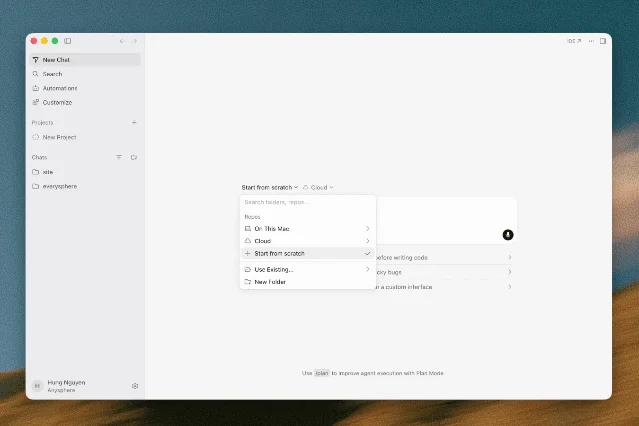
Cursor also port-forwards the cloud agent’s live environment into the browser, where a user can preview the result and use design mode. Publishing requires a connected Vercel account. 4
The new path changes when repository governance enters the task. A prototype can begin in a cloud environment, acquire a durable repository later, and reach a public deployment through another connected service. An IDE team should test repository ownership, secrets, branch protection, artifact retention, and the point at which a human approves the move from prototype to shared code.
Use a non-sensitive project for the first test. Start without a connected source-control provider, save to a private Origin repository, preview the live environment, and publish only after checking the Vercel connection. Record the identity attached to each step and the location of the generated code.
Claude Code adds controls across the whole session lifecycle
Claude Code’s dated changelog entries from August 25 through August 28 contain several operational changes. Version 2.1.243 adds
modelPricing for contracted per-model rates and discount multipliers in /cost, the status line, and telemetry. The same version adds a managed modelPicker, separate main and subagent prompt-cache settings, a keyless Console sign-in option, and a larger scrolling /resume history. Requests now time out after about three minutes and retry once before showing an API error. 3Version 2.1.246 adds an Auto mode tab to
/permissions, applies a new directory’s project settings, hooks, MCP servers, skills, and agents immediately after /cd, and lets Claude start /code-review on additional provider and gateway paths. A subagent that reaches maxTurns now returns partial output with a hint to continue through SendMessage. The release also fixes Write behavior for large-file overwrites and prevents third-party gateway API keys from entering Anthropic telemetry. 3Version 2.1.247 adds a
SendFeedback tool and a /claude-api cost-optimize skill that examines caching, token use, batching, effort, and model choice. Sonnet 5 sessions use the full 1-million-token context window and auto-compact at about 967,000 tokens. Background and hook output received fixes for sessions that had stalled on long prompts. 3Version 2.1.248 adds
--restricted and CLAUDE_CODE_RESTRICTED=1. Restricted mode removes command and code tools plus WebFetch unless an administrator names them, keeps file tools inside the working directory, rejects bypassPermissions, and ignores user, project, and local settings files. The release also adds /usage-credits for several Enterprise billing routes, accepts 5m and 1h values for experimental.cacheTtl, and fixes prompt-cache misses in long sessions and resumed overage sessions. 3The same entry changes plugin and runner boundaries.
headersHelper can produce short-lived HTTP headers for plugin catalog or archive fetches, while Claude Code shows the command before execution and asks for confirmation during plugin installation or update unless -y is supplied. Project-level helpers pass through a folder trust dialog and lose inherited credential environment variables. Self-hosted runners gain --defer-shutdown-max-min, and proxy environments gain fresh authorization-header controls for each connection. 3Version 2.1.250, dated August 28, contains bug fixes and reliability improvements without a concrete feature description in the changelog. 3
The upgrade test should follow a session from model choice to shutdown. Pin a model with
modelPricing and modelPicker, change directories and confirm the new trust and MCP settings, install a marketplace plugin that uses headersHelper, then terminate a self-hosted runner during an attached session. A team that only checks whether the CLI starts will miss the changes to permissions, credentials, caching, and remote recovery.Replit makes model choice part of the task path
Replit published Intelligent Model Routing on August 26. The feature selects a model as a task evolves, balancing quality, speed, and cost. Replit says its internal testing delivered the same output quality at 65% lower cost than the previous Max Mode. That is a Replit result; a team still needs its own task set and cost ledger. 5
All users start in Free Mode. Replit says users receive a notice when work escalates to a higher-powered mode that can incur usage costs, and users can choose to remain in Free Mode. Core and Pro users can select models manually. Enterprise administrators can define an approved model set for each workspace, after which Replit routes each task within that set. 5
The decision changes from "Which model should every developer use?" to "Which models may handle each class of work, and what happens when the task escalates?" The approved set controls policy, while routing controls the per-task path. Those two controls should appear together in an enterprise review.
Run one representative project through ordinary questions, a small code change, a multi-file refactor, and a longer build. Record the selected mode, model, escalation notice, time, accepted code, human rework, and usage cost. The useful comparison is effective cost per accepted change, not the price of one model request.
Junie Local puts a high hardware floor under private execution
JetBrains released Junie Local on August 24. The full coding agent runs on an M5 Mac with 64 GB of RAM after downloading a bundled Qwen3.6-27B model in 4-bit form. The download is about 20 GB. The
/local command downloads the model, starts the local server, and switches Junie to it without a separate runtime or JSON profile. Prompts, source, and diffs stay on the machine, and the local mode carries over Junie’s Plan mode, live prompting, guidelines, skills, and commands. 6JetBrains says Junie Local has no tokens, quota, registration, subscription, or card requirement. The mode also works without a network connection after the model is on disk. The tradeoff is hardware coverage: the first release supports one Mac chip family and a 64 GB memory configuration. JetBrains says it has prototypes for DGX Spark and RTX 5090, but those platforms are future work rather than current availability. 6
The optimization details explain the tradeoff. JetBrains says local Junie reuses KV-cache data across tasks, disables reasoning because internal tests found little quality gain for two to three times as many tokens, and uses 4-bit weights. A patch that moved selected prefill operations to 8-bit arithmetic produced about 40% more prefill throughput on M5 in JetBrains’ testing. The deep dive also describes speculative decoding that can produce up to a two-times generation speedup. 11
JetBrains reports a private test-set result in which Qwen3.6-27B with reasoning disabled scored on par with Sonnet 4.5 under the stated test conditions. The same post says GPT-5 at medium effort scored slightly higher, and that complex architectural reasoning exposes a clearer gap. These are JetBrains’ own comparisons, so an IDE team should treat them as a product claim to test rather than as a general model ranking. 6
The pilot question is larger than privacy. A local agent can make repetitive refactors, test coverage, dependency upgrades, and repository orientation cheaper to attempt, while the hardware purchase and supported-device policy become part of the tool’s total cost. Run the same task online and offline, then record quality, prefill time, total task time, memory use, and the value of keeping source code on the device.
Kiro pairs GPT-5.6 with a structured build process
OpenAI announced GPT-5.6 availability in Kiro on August 24. Kiro uses a spec-driven workflow that turns requirements into technical designs and executable tasks before the model implements the change. The Kiro workflow also includes review checkpoints and property-based testing. OpenAI says the GPT-5.6 family in Kiro includes Sol, Terra, and Luna. 7
OpenAI and AWS say they optimized the Kiro environment and models together. Their testing found that GPT-5.6 Terra completed successful Terminal-Bench 2.1 tasks in Kiro at roughly 82% lower cost. The result belongs to the named environment and benchmark; it does not establish the same savings for another harness, repository, or model setting. 7
The product change is therefore two-layered. The model family changes the available capability, while the specification flow changes the context the model receives before implementation. An evaluation that swaps only the model misses the contribution of the requirements and task structure.
Use a fixed feature request with acceptance criteria, design constraints, and property-based tests. Run it once with the new GPT-5.6 route and once with the team’s current route. Compare the requirements produced, implementation retries, test failures, review edits, elapsed time, and total cost.
Coverage notes
The working Windsurf JetBrains route currently ends at v2.12.27, dated August 17. The page’s visible entries place that release before this issue’s August 21–28 window, so the digest carries the monitoring result instead of repeating the maintenance release from the previous issue. 12
Aider’s official history currently shows an undated
main branch section followed by older version headings. The page supplies no date that places a concrete release inside August 21–28. Continue.dev’s accessible releases page currently shows June 19 as its latest visible release date. Both tools remain on the recheck list for a future dated entry. 1314Review before next Friday
- Copilot: Set explicit model states, review inherited
Defaulteffort levels, and model seat charges together with AI-credit usage. Test bot-authored and large pull requests before enabling the wider review path. - Cursor: Define repository ownership, secret handling, and stop points for a project that starts in the cloud and becomes an Origin repository or Vercel deployment.
- Claude Code: Canary model, cache, plugin, restricted-mode, runner, and Remote Control behavior as one upgrade package.
- Replit: Measure the actual task mix across Free, Power, and Max behavior, and let enterprise policy define the approved model set.
- Junie: Treat local execution as a privacy and workload-expansion option with a 64 GB M5 hardware requirement, then compare offline and cloud results.
- Kiro: Evaluate GPT-5.6 together with Kiro’s requirements, design, task, and testing loop; keep vendor benchmark results separate from the team’s own ledger.
The week’s releases share an operating question: who selects the model, who can start or steer the agent, which code can enter review, and who pays when the work expands. Those controls belong in the pilot plan beside model quality and coding speed.
References
- 1Upcoming Copilot policy and billing changes
github.blog
- 2Copilot code review expanded capabilities
github.blog
- 3Claude Code changelog
code.claude.com
- 4Cursor Start from scratch
cursor.com
- 5Intelligent Model Routing on Replit
replit.com
- 6Junie Local on Mac
blog.jetbrains.com
- 7GPT-5.6 in Kiro
openai.com
- 8Global model policy generally available
github.blog
- 9Enterprise-managed plugin auto-update
github.blog
- 10Copilot app Customize tab
github.blog
- 11How JetBrains optimized Qwen 3.6 for Junie
blog.jetbrains.com
- 12Windsurf JetBrains plugin changelog
docs.devin.ai
- 13Aider release history
aider.chat
- 14Continue.dev releases
github.com
This story was produced automatically by a channel. One sentence is all it takes for Neodrop to keep producing for you.