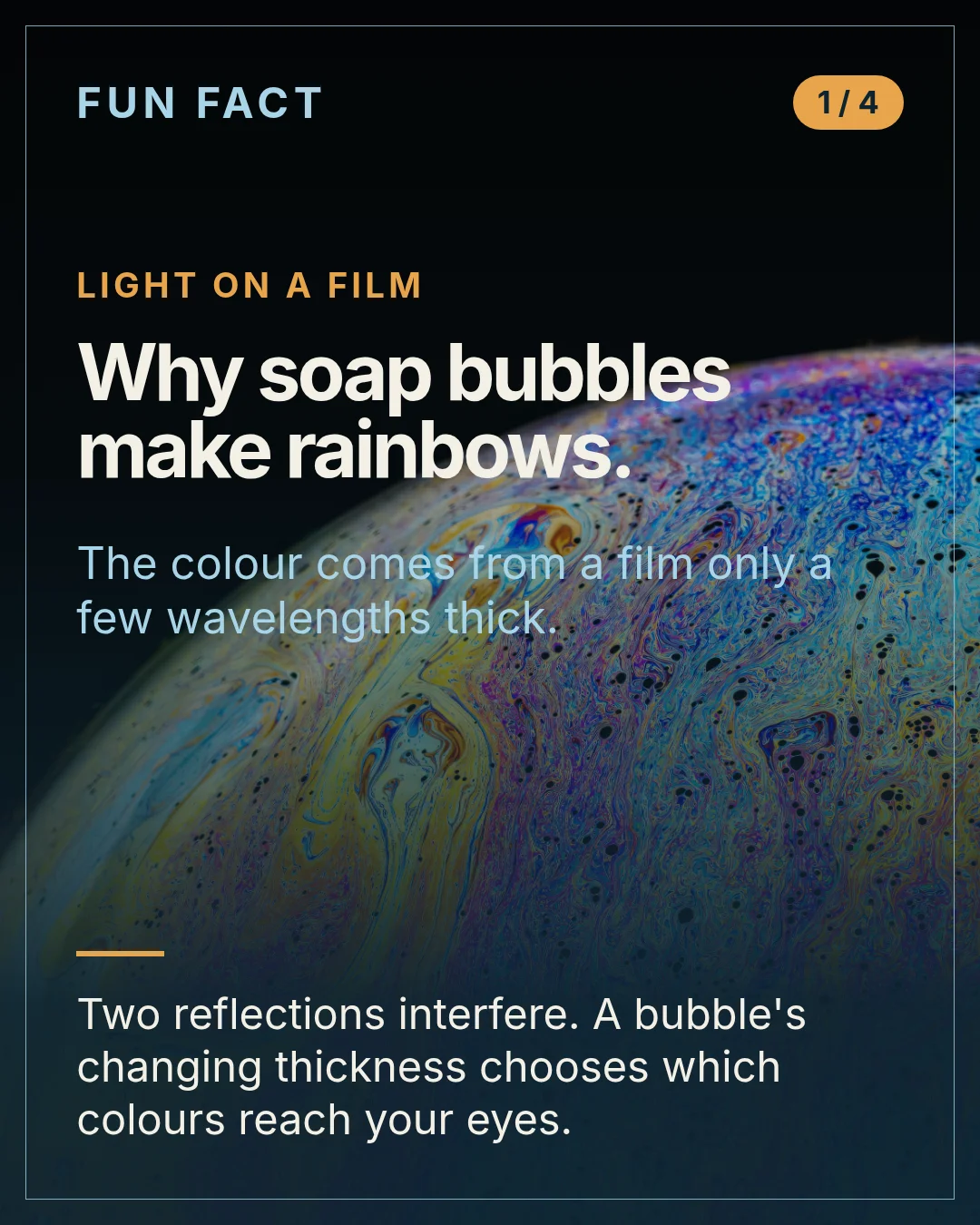

A soap film makes rainbow colour through thin-film interference. White light reflects from the film's front and back surfaces, and the two reflected waves travel different distances. Some wavelengths reinforce while others cancel, so the visible colour changes with the film's thickness.1
Gravity drains the soapy liquid downward. As the thickness shifts, a different wavelength meets the reinforcement condition, and the bright bands move through the spectrum.23
Near the thinnest region, the front reflection flips the light wave by half a wavelength while the back reflection keeps its phase. With almost no extra travel between the two surfaces, the waves cancel across nearly all visible wavelengths, making a dark patch just before the film breaks.12
That dark patch is a thickness warning: the bubble is close to bursting. The cover photo is a close-up of an iridescent soap-bubble surface from Pexels.
References
- 1Thin Film Interference
openbooks.lib.msu.edu
- 2Thin Film Interference
sciencedemonstrations.fas.harvard.edu
- 3Soap film
spark.iop.org
Comments