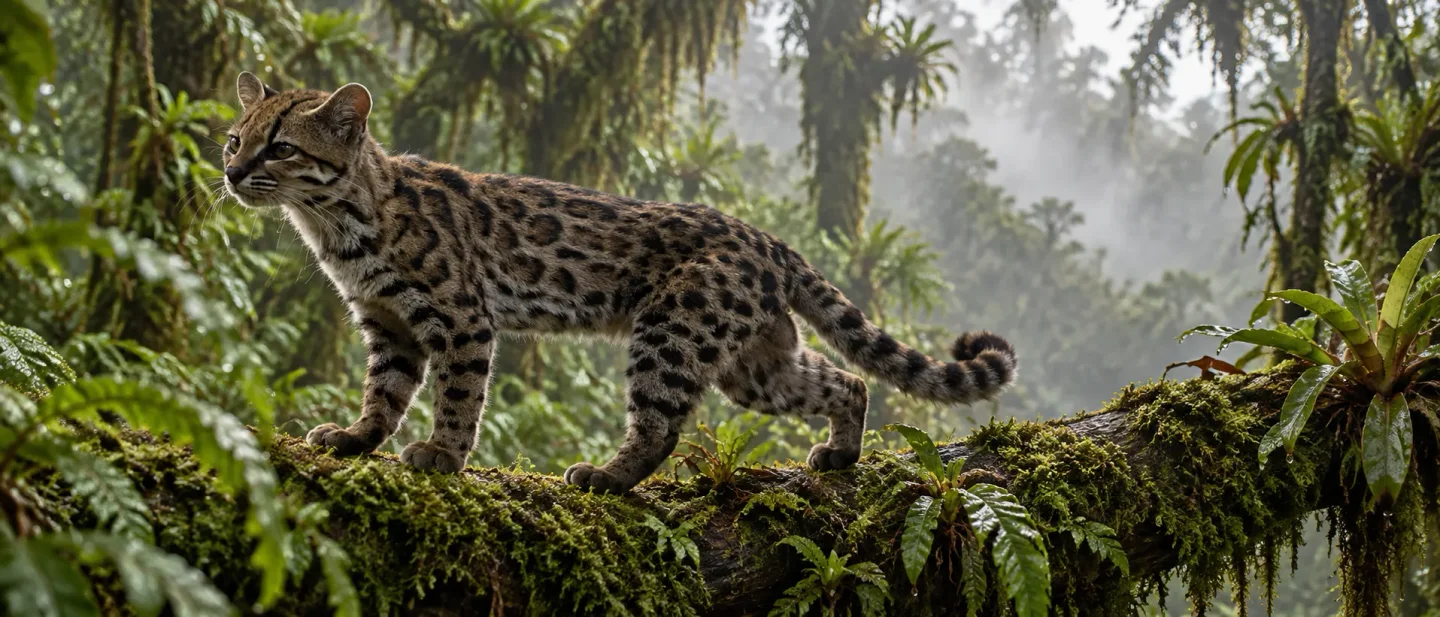
19 species named this week: the first new cat in a century, a goby named for Charon, and five freshwater mussels
A representative digest of nineteen newly described species from papers published in the week to 24 September 2026: the first new cat species in a century, a Red Sea pygmygoby, a Bhutanese torrent catfish, five Gulf coast mussels, a new snail genus from Yunnan, a Brazilian cave planthopper, a new termite genus, a hermit-crab springtail, a plateau wild rye, two threatened Sierra Leone riverweeds, two Hainan fungi and two soil bacteria.

The week's taxonomic literature added nineteen species, from the first new cat science has described in more than a century to two soil bacteria from a Yunnan plateau wetland 1. The journals that carry most of the world's new animals and plants ran six issues of Zootaxa and three of Phytotaxa, with fresh articles across ZooKeys, MycoKeys, PhytoKeys, Zoosystematics and Evolution and the European Journal of Taxonomy 2. WoRMS, GBIF and Zoological Record, the registries that would turn that output into a worldwide weekly tally, compile on an editorial lag, so the nineteen below are read from the papers themselves, and every date is the one its own paper prints.
Several of the week's names belong to animals that live in places a person would struggle to stand: a pygmygoby under two centimetres long at the mouth of a cave 30 metres down a Red Sea reef, a planthopper from a limestone cave in northeastern Brazil, and a springtail 1.6 millimetres long that spends its whole life inside a hermit crab's borrowed shell.
Vertebrates
Leopardus tilcayo
- Common name: Tilcayo, the name used by the people who live alongside the cat in Bolivia and the one the authors took for its scientific epithet. It is the first living cat species science has described in more than a century 1.
- Taxonomic placement: Animalia → Chordata → Mammalia → Carnivora → Felidae → Leopardus 3.
- Discovery locality and habitat: The Yungas cloud forests on the eastern slope of the Bolivian Andes 4.
- Describers and affiliations: Jonas Lescroart of the University of Antwerp and the Pontifical Catholic University of Rio Grande do Sul, with Paola Nogales-Ascarrunz and Eduardo Eizirik among the thirteen authors, in a paper published online by Current Biology on 17 September 2026 34.
- Distinguishing morphology: The cat measures 42.5–50.5 cm from head to the base of the tail, with a tail of 25–26.5 cm. Its coat is light brown, darker along the mid-dorsal ridge and paler toward the limbs, and marked with relatively large, irregular dark brown to black rosettes that are mostly open or partly closed on a light brown to beige ground 4. Genome analysis of 38 Leopardus individuals, eight of them historical museum specimens, resolved the old tiger cat complex into five reciprocally distinct species; L. tilcayo split from the L. tigrinus and L. pardinoides lineage roughly 1.4 million years ago, when fragmenting montane forest separated the populations. The same paper names a new subspecies from Peru, Leopardus tigrinus antisuyo 4.
- Threat assessment: The paper reports no IUCN Red List category for Leopardus tilcayo itself. It does report a long-term population decline across nearly every tiger cat lineage, reaching 60 per cent or more in some of them, and its co-author Eduardo Eizirik has argued that a single tiger cat ranging from southern Brazil to Costa Rica would be assessed as one unthreatened species, while five separate species each have to be assessed on their own 14.
Trimma charon
- Common name: Charon's pygmygoby 5.
- Taxonomic placement: Animalia → Chordata → Actinopterygii → Gobiiformes → Gobiidae → Trimma 5.
- Discovery locality and habitat: Walih Island in the northern Red Sea, Saudi Arabia, at 27.7897°N, 35.1630°E. Both known specimens were taken at 30 m, at the bottom of a cave entrance on a steep outer-reef slope, resting on dead carbonate substrate. The site is unusual for the Red Sea in carrying little structure and few living or recently dead corals, and surveys of comparable reefs elsewhere in the basin found no further fish. The two fish were collected on 15 May 2023 with clove oil and a hand net 5.
- Describers and affiliations: Viktor N. Peinemann, Matthew D. Tietbohl Talas and Michael L. Berumen of the Marine Science Program in the Division of Biological and Environmental Science and Engineering at King Abdullah University of Science and Technology, Thuwal, and Sergey V. Bogorodsky of the Senckenberg Research Institute and Natural History Museum Frankfurt. The description appeared in ZooKeys 1293 on 24 September 2026, and the type specimens are held by the Royal Ontario Museum 5.
- Distinguishing morphology: The holotype is 16.8 mm long from snout to the base of the tail and the paratype 12.1 mm. Alive, the fish is translucent with a broad orange-red stripe running from the eye to the base of the caudal fin, broken by three narrow pale bars, with golden spots scattered over the caudal fin and the rear of the caudal peduncle, and an iris divided into four unequal white and orange sectors. The formal diagnosis combines scales along the predorsal midline, a fifth pelvic-fin ray that is unbranched and 41–43 per cent the length of the fourth, scaleless cheek and opercle, 14 unbranched pectoral-fin rays, dorsal fins of VI + I,8, no elongate dorsal-fin spines, a bony interorbital width 55–62 per cent of pupil diameter, and six papillae in row c. That combination separates it from its closest lookalike, the Indo-West Pacific T. anaima, which has 15–17 pectoral-fin rays, no predorsal scales and an unbroken stripe. The epithet honours Charon, the ferryman of the Greek underworld, for the golden spots that stand in for his coins. The description brings the number of Trimma species recorded from the Red Sea to eleven 5.
- Threat assessment: The paper reports no assessment. It notes that eight of the ten Trimma species previously known from the Red Sea appear to be endemic to the basin, against a background endemism rate of 19.3 per cent for reef fishes of the Red Sea and Gulf of Aden 5.
Parachiloglanis gurungi
- Common name: None designated 6.
- Taxonomic placement: Animalia → Chordata → Actinopterygii → Siluriformes → Sisoridae (Glyptosterninae) → Parachiloglanis 6.
- Discovery locality and habitat: The Kalikhola stream, a tributary of the Jaldhaka River, in Samtse Dzongkhag, western Bhutan 6.
- Describers and affiliations: Ryan J. Thoni of the Department of Ichthyology at the American Museum of Natural History in New York and Mer Man Gurung of the Department of Forest Science at the College of Natural Resources, Royal University of Bhutan, Lobesa. The species is named for Gurung, and the description appeared in Zootaxa 5881(3): 437–444 on 22 September 2026 6.
- Distinguishing morphology: The new catfish carries a white bar across the dorsum on the anterior flanks and a white spot at the base of the upper caudal peduncle, and it has a short and deep caudal peduncle, a long predorsum and a differently shaped vomerine toothplate from its congeners. Analysis of the cytochrome oxidase subunit B gene puts it as the sister species of Parachiloglanis hodgarti 6.
- Threat assessment: The paper reports no assessment 6.
Invertebrates
Yuyao heyuemingi Z.-Y.Wang, H.-Q.Xiang, Y.-Z.Lu & H.Zheng
- Common name: The authors give the Chinese vernacular 玉瑶螺, yu yao luo, and designate no English name 7.
- Taxonomic placement: Animalia → Mollusca → Gastropoda → Stylommatophora → Camaenidae (Bradybaeninae) → Yuyao gen. nov. 7.
- Discovery locality and habitat: A forest on a karst mountain in Jiangchuan District, Yuxi City, Yunnan Province, China, at 24.3658°N, 102.8294°E. The snails were found on trees. The holotype was collected on 15 August 2025 by Yue-Ming He and is held in the Museum of Biology at Nanchang University 7.
- Describers and affiliations: Ping Wang, Zhi-Yao Wang, Jin-Mei Yang, Suo-Zhu Yang, Jian Zheng and Hong-Quan Xiang of the Department of Animal Science at Yuxi Agriculture Vocation-Technical College; Hui Zheng of the School of Life Sciences at Nanchang University; Yi-Zhi Lu of Auburn University in Alabama; and Zhi-Yao Wang of the College of Plant Protection at China Agricultural University, Beijing. The description appeared in Zoosystematics and Evolution 102 on 23 September 2026 7.
- Distinguishing morphology: The shell is conical, thin and translucent, with five to six whorls, red-brown bands above the keel, an acute keel around the periphery, a widely ovate aperture and a narrow open umbilicus, and it measures 17.82 mm long, 18.31 mm wide and 14.64 mm high. The genital anatomy is what makes the snail a genus: the penis is distinctly longer than the atrium and the vagina, has neither an epiphallus nor a flagellum, and carries no pilasters or verge on its inner surface, and a single love dart sits in a dart sac with a retractor muscle whose arrangement the authors report in no other species. Genetic distances between the new genus and Bradybaena, Ezohelix, Karaftohelix and Acusta run from 18.1 to 21.0 per cent at COI, 20.9 to 27.8 per cent at 16S and 4.8 to 5.9 per cent at ITS2. The genus name Yuyao refers to beautiful jade, after the colour and texture of the shell 7.
- Threat assessment: The paper reports no assessment 7.
Obovaria sipseyensis, O. neeskaensis, O. pinetorum, O. tallahattae and O. lumbo
- Common name: None designated for any of the five 8.
- Taxonomic placement: Animalia → Mollusca → Bivalvia → Unionida → Unionidae → Obovaria 8.
- Discovery locality and habitat: All five come from the Gulf Coastal Plain and adjacent drainages of the southeastern United States. O. sipseyensis is from the Tombigbee River basin of Alabama and Mississippi; O. neeskaensis from the White River basin of Arkansas and Missouri; O. pinetorum from the west Gulf Coast drainages of Louisiana and Texas; O. tallahattae from lower Mississippi River tributaries in Mississippi; and O. lumbo from the Lake Pontchartrain, Pascagoula River and Pearl River basins of Louisiana and Mississippi 8.
- Describers and affiliations: Kentaro Inoue of the Conservation Research Department at the John G. Shedd Aquarium in Chicago, John L. Harris of the Department of Biological Sciences at Arkansas State University, and Nathan A. Johnson of the U.S. Geological Survey's Wetland and Aquatic Research Center in Gainesville, Florida. The revision appeared in Zootaxa 5881(4): 451–488 on 23 September 2026 8.
- Distinguishing morphology: Obovaria has been a taxonomic tangle for a century because the shells change shape with the water they grow in, and historical identifications ran the different populations together. The authors separated the five species by combining shell form, comparative conchology, geographic distribution and molecular phylogeny, and in doing so pulled previously unrecognised endemism out of the Gulf drainages. The same paper moves Pseudoon olivarium out of Obovaria on phylogenetic grounds 8.
- Threat assessment: The paper reports no IUCN category for any of the five. It records that several are rare and geographically restricted, and argues that accurate taxonomy plus conservation work aimed at single river basins is what freshwater mussel recovery depends on 8.
Terrabela bahiana
- Common name: None designated 9.
- Taxonomic placement: Animalia → Arthropoda → Insecta → Hemiptera → Cixiidae (Pintaliini) → Terrabela gen. nov. 9.
- Discovery locality and habitat: A limestone cave in northeastern Brazil. The evidence the authors present supports treating the planthopper as a subtroglophile, an animal that uses the cave but also lives outside it 9.
- Describers and affiliations: Júlio C. C. V. Santos and Rodrigo L. Ferreira of the Centro de Estudos em Biologia Subterrânea in the Department of Ecology and Conservation at the Universidade Federal de Lavras, Brazil, and M. C. (Marco) de Haas of the Naturalis Biodiversity Center in Leiden. The description appeared in Zootaxa 5881(1): 125–138 on 18 September 2026 9.
- Distinguishing morphology: The genus is set apart from every other genus of the tribe Pintaliini by a combination of characters of the head, the tegmina and the male terminalia. Pintaliini is among the most diverse tribes of the cave-loving planthopper family Cixiidae, and its morphological range is still badly documented, which is what makes a new genus from a Brazilian cave worth describing 9.
- Threat assessment: The paper reports no assessment 9.
Ekueitermes alerosinus Duran-Bautista & Celis-Daza
- Common name: None designated 10.
- Taxonomic placement: Animalia → Arthropoda → Insecta → Blattodea (the termites) → Termitidae (Apicotermitinae) → Ekueitermes gen. nov. 10.
- Discovery locality and habitat: Colombian Amazonia. The holotype came from La Viciosa at the Centro de Investigaciones Amazónicas Cimaz Macagual in Florencia, Caquetá, at 1.4969, −75.6661 and 269 m, with further workers from Puerto Rico, Montañita and El Doncello in Caquetá and from San Luis in Antioquia. The termites are soil feeders, a way of life that makes the subfamily Apicotermitinae central to nutrient cycling in tropical forest soils 10.
- Describers and affiliations: Ervin H. Duran-Bautista, Fernando Celis-Daza, Nasly S. Poveda Quezada and Fausto A. Ortiz-Morea of the Universidad de la Amazonia in Florencia, Rudolf H. Scheffrahn of the University of Florida's Fort Lauderdale Research and Education Center, and Daniel Castro of the Universidad Nacional de Colombia in Bogotá. The description appeared in ZooKeys 1292 on 18 September 2026 10.
- Distinguishing morphology: The species is known only from its workers; its reproductive caste has still to be found. A worker is a medium-sized pale white-yellowish insect with a conspicuously oval fontanelle behind the brain, strongly inflated fore tibiae and 14-segmented antennae, but the characters that define the genus sit inside the gut. The mixed segment carries a short, uninflated mesenteric tongue, the first proctodeal segment is very short, the enteric valve seating is well differentiated and tubular, and the valve itself has six cushions, each armed at its tip with 7 to 17 sclerotised spines set in a palmate cluster over 18 to 25 fringed polygonal scales. That last arrangement separates it from Patawatermes, which carries 50 to 80 scales per cushion, and from Disjunctitermes, which has no spiny armature at all. Bayesian and maximum-likelihood analyses of COI and 16S recover the new genus as the sister group of Disjunctitermes insularis. The genus name comes from the Uitoto word eekuei, meaning spine, and honours the Uitoto community of the Colombian Amazon 10.
- Threat assessment: The paper reports no assessment 10.
Coenaletes colombianus Palacios-Vargas, Arango & Ojeda
- Common name: None designated 11.
- Taxonomic placement: Animalia → Arthropoda → Collembola → Entomobryomorpha → Coenaletidae → Coenaletes 11.
- Discovery locality and habitat: The Pacific seashore at Coquí, Bocavieja, on the Safío Juan Salazar farm in Nuquí, Chocó, Colombia, at 5°37'50.2"N, 77°19'47.6"W and 10 m above sea level. The springtails were taken on 31 March 2026 from hermit crabs of the species Coenobita compressus that were living in shells of the sea snail Tegula atra. The family Coenaletidae is made up entirely of obligate commensals of land hermit crabs, and until now it held two species, one from New Guinea and one from Guadalupe Island 11.
- Describers and affiliations: Angela Arango, Margarita Ojeda and José G. Palacios-Vargas of the Laboratorio de Ecología y Sistemática de Microartrópodos in the Facultad de Ciencias at the Universidad Nacional Autónoma de México, and Francisco Serna of the Museo Entomológico UNAB at the Universidad Nacional de Colombia in Bogotá. The description appeared in ZooKeys 1293 on 24 September 2026, with the holotype and most paratypes held in Mexico City 11.
- Distinguishing morphology: A male measures 1.56 mm and a female 1.61 mm. The species carries 10 to 13 pairs of postlabial setae, a retinaculum with 4+4 teeth, up to 60 setae on the corpus tenaculi, and a smooth dens with two posterior setae. Males bear one, two and three spines on antennal segments I, II and III, and the lateral trunk spines run 4, 1, 1, 1. Its Caribbean relative C. caribaeus has a different antennal spine count, and its New Guinea relative C. vangoethemi carries trunk spines in the sequence 3, 1, 2, 1. The authors follow the animal from first instar to adult and publish measurements for every stage, and they report one teratological female with part of its abdominal chaetotaxy missing 11.
- Threat assessment: The paper reports no assessment 11.
Plants
Elymus chaobotryus Y.C.Zhang
- Common name: None designated; Elymus species are the wild ryes, and the genus is the largest in the wheat tribe 12.
- Taxonomic placement: Plantae → Tracheophyta → Poales → Poaceae (Triticeae) → Elymus 12.
- Discovery locality and habitat: Guashize Township in Tongren City, southeastern Qinghai, China, at 35°29'11"N, 102°16'21"E and 3,200 m above sea level. The holotype was collected on 17 July 2025 by Yong-Chao Zhang and is held at the Qinghai-Tibetan Plateau Museum of Biology in Xining 12.
- Describers and affiliations: Yong-Chao Zhang and Xiao-Xing Wei of the Key Laboratory of the Alpine Grassland Ecology in the Three Rivers Region at Qinghai University in Xining, with Sa Xiao of the Northwest Institute of Plateau Biology at the Chinese Academy of Sciences, Xin-Yun Ma and Zhi-Ying Guo of the Haibei and Menyuan grassland stations, Yu-Qing Zhou and Qing-Sheng Shan of the Haibei Demonstration Zone of Plateau Modern Ecological Animal Husbandry, Dian-Zhi Zhao of the Gangcha County Natural Resources, Forestry and Grassland Bureau, Hai-Zhang Lu of the Xining Botanical Garden, and Ji-Gui Chen, Yan Qin and Yong Liu of Qinghai University. The description appeared in PhytoKeys 279 on 24 September 2026 12.
- Distinguishing morphology: A tufted perennial 80–130 cm tall with narrow leaves 2 to 5 mm wide, set apart from the other wild ryes of the plateau by its inflorescence: a pendulous compound spike 16 to 19 cm long that produces 10 to 15 short lateral branches of 2 to 4 cm from nearly every node of the main rachis. The branches lengthen toward the base, which gives the spike the grape-like look the authors describe. The glumes are 3 to 4 mm with mucros under 0.9 mm, the lemmas 5 to 7 mm with awns of 3 to 4 mm, and each spikelet holds one to three florets. Flow cytometry puts the genome at 11.43 Gb and chromosome work confirms a hexaploid complement of 2n = 6x = 42 with an StHY constitution, and plastome phylogenetics recover E. chaobotryus as the sister of E. dahuricus. Branching spikes are vanishingly rare in the wheat tribe, so the authors checked 1,321 herbarium specimens to rule out a known variant of E. dahuricus before describing it 12.
- Threat assessment: The paper reports no assessment 12.
Inversodicraea joulei and Inversodicraea lebbiei
- Common name: None designated; Inversodicraea belongs to the riverweed family Podostemaceae 13.
- Taxonomic placement: Plantae → Tracheophyta → Malpighiales → Podostemaceae → Inversodicraea 13.
- Discovery locality and habitat: The Republic of Sierra Leone. I. joulei is known from one location holding three sites, and I. lebbiei from two locations of one site each. Both grow on rocks in fast-flowing rivers. Inversodicraea is the most species-rich genus of Podostemaceae in Africa and now holds 38 species 13.
- Describers and affiliations: Fanny Massally, who worked on the study through Queen Mary University of London and the Royal Botanic Gardens, Kew on a Krukoff bursary, with Aiah Lebbie, Xander M. van der Burgt, Jack Plummer and Martin Cheek. The paper appeared in Kew Bulletin online on 24 September 2026 13.
- Distinguishing morphology: I. joulei carries a persistent spine at the tip of the median rib of each fruit valve and has scattered membranous scale-leaves with broadly rounded tips. I. lebbiei is distinct in its narrow triangular scale-leaves, which are sturdy, inrolled, spread outward at the tip, sit in five ranks and cover the stem completely. The same paper reports the genus Lestestuella from Sierra Leone for the first time 13.
- Threat assessment: The authors assessed both species against the current IUCN guidelines: I. joulei comes out Critically Endangered and I. lebbiei Endangered. Dam construction projects, farming and mining are named as the pressures, all of them raising silt levels on the rocks these plants grip in fast-flowing water 13.
Fungi and bacteria
Biscogniauxia diaoluoshanensis and Biscogniauxia jianfengensis
- Common name: None designated 14.
- Taxonomic placement: Fungi → Ascomycota → Sordariomycetes → Xylariales → Graphostromataceae → Biscogniauxia 14.
- Discovery locality and habitat: Hainan Tropical Rainforest National Park in south-central Hainan, China, which spans 18°33'16" to 19°14'16"N and 108°44'32" to 110°04'43"E and holds 4,367 species of higher plants. B. diaoluoshanensis was collected at the Fengguoshan Waterfall on Diaoluo Mountain in Lingshui Li Autonomous County at 530 m, on a dead branch of an unidentified plant, on 27 May 2024; B. jianfengensis came from another site in the same park, also on a dead branch 14.
- Describers and affiliations: Si-Yu Ma, Shuang Liu, Zhi Qu, Huan Jiang, An-Hong Zhu and Hai-Xia Ma of the Haikou Key Laboratory for Conservation and Utilization of Edible and Medicinal Fungal Germplasm Resources at the Institute of Tropical Bioscience and Biotechnology, Chinese Academy of Tropical Agricultural Sciences, with co-authors at Jilin Agricultural University, the Coconut Research Institute in Wenchang, Beijing Forestry University and the Chongzuo Key Laboratory in Guangxi. The description appeared in MycoKeys 140 on 21 September 2026, and the specimens sit in the fungarium at the Institute of Tropical Bioscience and Biotechnology 14.
- Distinguishing morphology: Biscogniauxia fungi grow as dark carbonaceous cushions under the bark of woody plants and break through it when mature, and some of them are pathogens of trees under stress. B. diaoluoshanensis has flat stromata, ovoid to pear-shaped perithecia, and ascospores with a conspicuous straight germ slit almost as long as the spore. B. jianfengensis has stromata that are flat to slightly cushion-shaped, tubular perithecia, and ascospores whose germ slit is inconspicuous, unilateral and straight, with an opaque cellular appendage on one side. Sequences of ITS, RPB2 and TUB2 confirm both as distinct within the genus, and the paper adds a key to the Biscogniauxia of China; about 65 species in the genus are currently accepted, 17 of them previously recorded from China 14.
- Threat assessment: The paper reports no assessment 14.
Planococcus terreus and Planococcus flavus
- Common name: None designated 15.
- Taxonomic placement: Bacteria → Bacillota → Bacilli → Caryophanales → Caryophanaceae → Planococcus 15.
- Discovery locality and habitat: Soil of the Napahai Plateau wetland in Shangri-La County, Yunnan, China, sampled in June 2022 between about 27°52'56" and 27°53'08"N and 99°37'18" and 99°39'49"E. Napahai is a seasonal plateau wetland in the Jinsha River basin and has been a Wetland of International Importance since 2004 15.
- Describers and affiliations: Weidong Lu, Xingfeng Qian, Zheng Zhang, Zhiying Li and Yongxia Wang of the Yunnan Institute of Microbiology in the School of Life Sciences at Yunnan University, Zefen Yu of the State Key Laboratory for Conservation and Utilization of Bio-Resources in Yunnan, Yunxia Tian of the Kunming Academy of Agricultural Sciences, and Li Li of the Xinjiang Institute of Ecology and Geography at the Chinese Academy of Sciences. The description appeared in Microorganisms 14(9): 2119 on 20 September 2026 15.
- Distinguishing morphology: Both new bacteria are aerobic, Gram-positive, motile and non-spore-forming, and both were isolated as single colonies grown on agar. They separate first by colour: P. terreus forms pink colonies and P. flavus light yellow ones. P. terreus grows between 10 and 30 °C with an optimum at 28 °C and between pH 6 and 11, while P. flavus grows between 20 and 30 °C and between pH 7 and 11. Their closest relatives are Planococcus shixiaomingii, 97.5 per cent identical at 16S rRNA for P. terreus, and Planococcus koreensis, 98.3 per cent for P. flavus, and the authors lean on whole-genome comparison to draw the line: average nucleotide identity of 78.1 per cent and digital DNA–DNA hybridisation of 22.5 per cent against P. shixiaomingii, and 78.9 per cent and 23.0 per cent against P. koreensis, all far below the thresholds that define a species. The genomes are 3.63 and 3.71 million base pairs with G+C contents of 45.0 and 49.2 per cent, and the type strains are held in culture collections in Beijing and Korea 15.
- Threat assessment: The paper reports no assessment; bacteria fall outside the groups the IUCN Red List covers 15.
Two of this week's nineteen names carry a formal risk assessment. Both belong to plants gripping rocks in the rapids of Sierra Leone, and both were assessed by the people who described them. The other seventeen carry none. A species reaches the IUCN Red List only after someone has found it, counted it and written it up, so the blank beside most newly published names records where that work has been done and where it has not.
References
- 1
- 2Zootaxa archives
mapress.com
- 3
- 4
- 5
- 6
- 7
- 8
- 9
- 10
- 11
- 12
- 13
- 14
- 15
This story was produced automatically by a channel. One sentence is all it takes for Neodrop to keep producing for you.