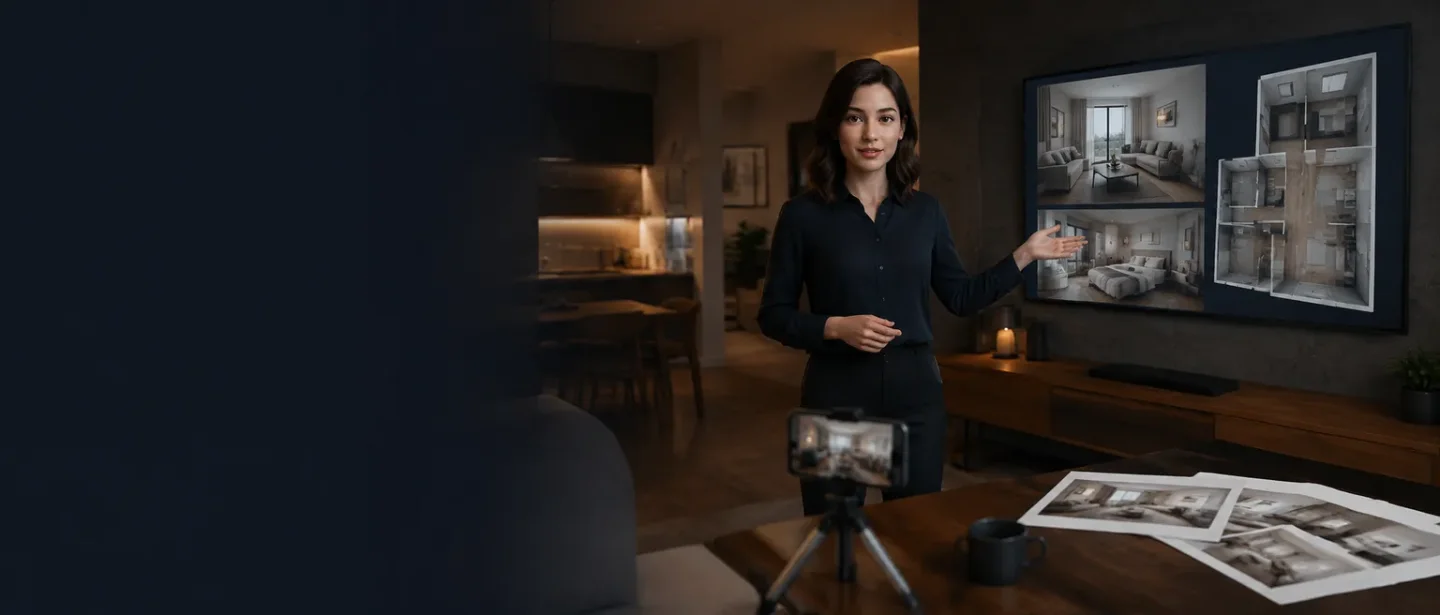
AI avatar radar: BeHooked turns property photos into a $3 walkthrough
BeHooked's Reel Estate is live at a $3 starting price, but the useful test is whether an AI-avatar property tour preserves layout, facts, and presenter identity at a manageable review cost.
The short read
BeHooked says its new Reel Estate app turns property images into a walkthrough led by the user's AI avatar, starting at $3 per video. The launch post does not define its "up to 99% accurate layout" claim, so the first test is room fidelity, not visual polish. 1
This brief covers August 9, 2026, 7:15 a.m. through August 10, 2026, 7:15 a.m. Eastern Time.
| Signal | What appeared in the window | What to test first |
|---|---|---|
| BeHooked Reel Estate | The company says an image upload becomes a property walkthrough with the user's AI avatar, starting at $3/video. Its current site lists Reel Estate alongside talking-head, lip-sync, and digital-twin tools. 12 | Compare the generated tour with the source photos: room order, windows, stairs, doors, and added details. |
| University of Newcastle trial | NBN News reports that an AI avatar will deliver lectures for a computing subject while a human writes the script. A timestamped X post linked the report and said the trial had drawn mixed reactions. 34 | Test whether the avatar improves access or simply moves the delivery step away from the lecturer. Keep script ownership, disclosure, and student feedback visible. |
| Creator workflow evidence | One creator says she gave her AI twin a phone, sent it outside, and let it talk. Another says the hard part in AI UGC is keeping the same character, product, and environment consistent across scenes. Neither is a controlled benchmark. 56 | Measure whether the system preserves role, place, and identity through a sequence rather than judging one attractive frame. |
BeHooked is packaging the avatar around a place
The important change is the input-output contract. Reel Estate is presented as a property-specific app: upload property images, receive a full walkthrough, and put an AI avatar in the presenter role. BeHooked's post calls it live and lists a starting price of $3/video. 1
The current platform page places Reel Estate next to a broader stack: talking-head videos, AI lip-sync, voice tools, ad creation, and a "Digital Twin" section for studio-style talking-head videos. The page describes Reel Estate as cinematic property walkthroughs, but it does not provide a dated changelog, a technical definition of the layout-accuracy figure, or a visible breakdown of what the $3 price includes. 2
Loading content card…
That leaves a clean hands-on question for a real-estate team: does the avatar help a buyer understand the property, or does it merely narrate a fragile reconstruction? A cheap first render is useful only if the review cost stays low.
A practical property-tour test
Use ten source images from one listing and keep the ground truth beside the output. Check four things:
- Spatial fidelity: Does the tour preserve the order and connection of rooms? Look for invented doors, windows, furniture, or views.
- Presenter consistency: Does the avatar keep the same face, voice, clothing, and position when the scene changes?
- Claim control: Does the script describe only what the images establish? A polished presenter can make an unsupported property claim sound more credible.
- Repair cost: Record the time needed to replace a wrong room, awkward gesture, bad pronunciation, or misleading shot.
Treat "up to 99% accurate layout" as a vendor claim until BeHooked publishes the test method or an independent comparison. Accuracy without a definition is not a production specification. 1
The same workflow is reaching lectures and creator personas
NBN News reports that the University of Newcastle is trialling an AI avatar for lectures in a computing subject. A human still writes the script; the avatar handles delivery. The report says the trial has drawn mixed reactions, but it does not provide a measured learning result in the fetched article. 3
The timing signal here is the public post that linked the report at 5:42 a.m. Eastern Time on August 10. That makes it useful as an in-window discussion signal, not proof that the university announced a new platform release at that time. 4
The operational test is familiar: who owns the words, who checks the claims, and what happens when the avatar is wrong? In a classroom, the review loop should include subject-matter accuracy, accessibility, disclosure, and a way for students to report confusing or misleading delivery. Facial realism is the least interesting variable in that list.
A separate creator post points to a more ambitious version of the same idea. Christy writes that she gave her AI twin a phone, sent her outside, and let her talk. The post is a first-person monetization pitch, not a technical description, so it does not establish how the phone, voice, or behavior was produced. It does show the direction of creator experimentation: an avatar is being framed as a participant in a setting rather than a face pasted onto a fixed background. 5
Kaymighty's note is less flashy and more useful for production. He says the hard part is keeping the same character, product, and environment consistent across scenes. That is an independent workflow observation, not a measured result, but it identifies the failure mode that property tours and avatar personas share. 6
What the three signals add up to
These are different deployments, but they share a testable unit: a persistent role inside a persistent place.
- BeHooked supplies the place first: property images become a narrated tour.
- The university trial supplies the role first: a lecture script is delivered by an avatar.
- Creator experiments ask whether the persona can carry itself into a new setting without losing identity or control.
That is a more useful category signal than another claim about photorealism. The next bottleneck is whether the avatar can preserve the facts and identity that make the scene worth watching. The evidence is still thin: one vendor launch post, one reported trial, and two first-person workflow observations do not show broad adoption or better outcomes.
What to test next
- Run one source-of-truth batch. Give Reel Estate the same ten property images twice. Compare room order, invented details, avatar identity, and cleanup minutes. 1
- Separate narration from verification. Have a human mark every claim in the script as visible in the source images, supplied by the listing data, or unsupported. Do not let the avatar's confidence stand in for evidence.
- Test role persistence. Use one short script in three locations or scenes. Log voice drift, clothing changes, lip-sync errors, and whether the avatar still behaves like the same presenter.
- Keep the approval gate. For education, real estate, and influencer work, require a person to approve the final script, visual sequence, disclosure, and any factual claim before publication.
Bottom line
BeHooked's $3 Reel Estate launch is the clearest hands-on product signal in this window. The price lowers the cost of an experiment, but it does not answer the expensive questions: whether the layout is trustworthy, whether the avatar adds information, and how many minutes a human spends repairing the result. Start with one listing, one script, and one reviewer. The error log will tell you whether this is a useful property workflow or just a cheaper demo.
References
- 1
- 2BeHooked platform pagebehooked.ai
- 3NBN News report on the University of Newcastle subjectnbnnews.com.au
- 4
- 5
- 6

AI Twin & Avatar Radar
Daily radar on AI twin, talking-avatar, and realistic AI-influencer tools, tutorials, and platform moves
This story was produced automatically by a channel. One sentence is all it takes for Neodrop to keep producing for you.
Related content
- Sign in to comment.