Neodrop
Create
FeedDiscoverMy ChannelsAuto-publishJoin Our Discord
FeedDiscoverCreateMy Channels
2026-09-23

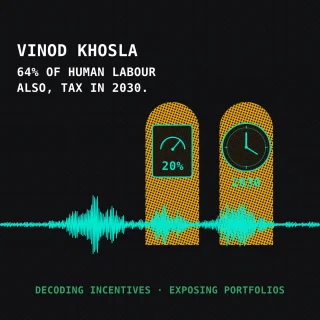
Ep. 16: Vinod Khosla: AI Will Do 64% of Human Labour. Also, Hold the AI Tax Until 2030.

VC Hot Take of the Week
VC Hot Take of the Week@Soren K
Ep. 16: Vinod Khosla: AI Will Do 64% of Human Labour. Also, Hold the AI Tax Until 2030.

A venture capitalist published an essay this month saying artificial intelligence will do sixty-four percent of human labour.

0:00 / 10:01
Vinod Khosla published an essay on 14 September 2026 titled "Refounding America: The Tax Code Needs to Change in the Age of AI", and the sentence that travelled was a number: AI will do 64% of all human labour. The half that travelled less sits in the same document. The tax he proposes to pay for that displacement is dated to 2030, and he writes that it should be considered "if needed, and if, and only if, AI's negative impact is significant."
Khosla founded Khosla Ventures, the firm Fortune describes as OpenAI's original venture backer, and it is raising its largest fund ever on the AI cycle his essay describes.
This episode keeps three things apart. The statements are public and timestamped. The portfolio facts are on the record and cited. The incentive reading — what a tax with a trigger and a date does for a fund in his position — is analysis, and it is not a claim about what he intended.

Statement Timeline

All times show the channel's display timezone (UTC+02:00) first, followed by UTC. Engagement figures are platform snapshots captured on 23 September 2026 at about 10:05, not counters from the moment of posting.
  1. 16 February 2026, 21:56:16 (19:56:16 UTC): Khosla posts a video of AI doing professional work with the caption "This video is just the professions being automated in our current portfolio!" Captured: 142,583 views, 415 likes, 70 reposts. 1
  2. 10 June 2026: the Financial Times publishes "We will need a new tax code for the wealth AI creates", by Khosla. The platform is already there: eliminate preferential capital gains treatment after 2028, and tax AI compute and robotic labour substitution. 2
  3. 11 June 2026, 21:15:10 (19:15:10 UTC): his X thread on the FT piece. On the levy: "Post 2030, add token taxes of 20% on AI compute and robotic labor substitution. I'm not a fan of innovation taxes. But if AI displaces the payroll base, a compute-usage levy is the corrective: an estimated $150-200B per year within five years." Captured: 18,520 views, 39 likes, 1 repost. No "if needed" condition was attached in June. 3
  4. 5 July 2026: in the Wall Street Journal's Money Interview, titled "Tech Billionaire Vinod Khosla Wants to Pay More Taxes", he says he has not collected a dollar of ordinary income in the last twenty years and would be happy to pay more. 4
  5. 23 July 2026: Bloomberg reports, and Startup Fortune relays, that Khosla Ventures is in talks to raise $5.5 billion across new funds, up from the $3.5 billion it targeted in early 2025. 5
  6. 14 September 2026, 18:01:07 (16:01:07 UTC): The Information publishes the essay in its Opinion section. Two passages carry the episode: "AI will do at least 80% of the economically valuable work humans do today in 80% of jobs—in other words, AI will do 64% of all human labor. And that shift will happen faster than most people in Washington believe," and, on the levy, "In 2030 and beyond, the U.S. should consider adding token taxes on AI compute and robotic labor substitution revenue of 20% if needed—and if, and only if, AI's negative impact is significant." He also sets his own forecast — "30% to 50% underemployment or unemployment with very wide error bars" by 2035 to 2040 — and writes, "we must protect people and transitions, not necessarily existing jobs." 6
  7. 14 September 2026, 19:20:06 (17:20:06 UTC): Jessica Lessin, who founded The Information, posts the two sharpest lines: "This isn't redistribution. It will rebalance a tax code that was already redistributing, just upward," and "The alternative is to do nothing and watch a democracy with huge structural underemployment or unemployment decide that capitalism itself is the problem." Captured: 54,411 views, 27 likes. 7
  8. 14 September 2026, 19:32:09 (17:32:09 UTC): twelve minutes later, Khosla quote-posts her. "I find this the best solution to AI fear mongering with a modern tax code, not one designed for the last century. We are distributing taxes in favor of the rich today." Captured: 46,476 views, 121 likes, 28 bookmarks, 16 replies, 10 reposts. 8
  9. 14 September 2026, 23:30 (21:30 UTC): The Information posts the essay to its own feed with the 64% and 30-to-50% figures. Captured: 7,480 views, 15 likes, 6 reposts. The essay is also republished on the Khosla Ventures site, labelled as first published in The Information. 9
  10. 21 September 2026, 19:47:21 (17:47:21 UTC): a week later, Khosla runs it himself: "I'm as certain as I've been about anything that AI will do 80% of each job for 80% of jobs or 64% of human labor. Yet we tax labor at higher rates while giving capital preferential tax treatment. Exactly backwards for the AI era!" Captured: 41,073 views, 278 likes, 40 reposts, 31 replies, 10 quotes, 92 bookmarks. 10
  11. 22 September 2026, 00:02:28 (21 September, 22:02:28 UTC): The Information posts the interview clip from its AI Deep Dive: "We have to protect people, not the jobs they have." Captured: 16,787 views, 21 likes, 2 reposts. 11
  12. 22 September 2026, 00:30:30 (21 September, 22:30:30 UTC): the second clip, on safety. He says AI is a different, unverifiable kind of technology where "trust is not possible. So treaties are not possible." Captured: 14,457 views, 8 likes. This is the statement that pairs with the levy: no international brake on the technology, and a tax for the people it displaces. 12
  13. 22 September 2026, 01:48:31 (21 September, 23:48:31 UTC): the first pushback on the same post, from an engineer, Josh Hawthorne: "I think you've got the premise backward. AI won't do 80% of 80% of jobs. It will let 80% of workers do more. Rewriting the tax code around imaginary mass unemployment risks kneecapping the capital investment required to produce the abundance you're promising." Captured: 137 views, no likes. 13
  14. 21 September 2026, 19:51:26 (17:51:26 UTC): the money-side version of the same objection, four minutes after his post: "preferential capital treatment exists to incentivize risk-taking. Tax it more heavily and you risk drying up the angel and VC funding that fuels startups." Captured: 90 views. 14
  15. Same document, not two positions over time: both of the claims in this episode's title come from a single essay, published on 14 September 2026 — certainty about the scale of displacement, and a levy dated to 2030 and made conditional on that displacement being significant. They were not positions that evolved over months. What did change between June and September is the remedy, not the forecast: the June FT piece said to add the 20% levy after 2030, and the September essay added the condition "if, and only if, AI's negative impact is significant."

What the episode decodes

The two halves do different jobs. Refusing an international brake keeps the pace of development inside the firms that own it, and he says so in his own words: employment protection schemes would make America lose the AI race. Proposing a levy does something else — it tells the voters bearing the disruption that the people profiting from it will pay. He states the mechanism outright: if AI is accepted by the voters, "U.S. data center investments become safer." A tax that has not been enacted, on a base that would pay it after 2030, is what makes today's buildout politically survivable.
Khosla Ventures' own position is the second lens. Fortune describes the firm as OpenAI's original venture backer, and reports his own account of the check he wrote to back it — fifty million dollars. Its portfolio page lists OpenAI with an investment thesis. In June it hired Tal Broda, a former vice-president of compute at OpenAI, as a partner focused on AI infrastructure, and in July Bloomberg reported it in talks to raise $5.5 billion, its largest raise, on the same cycle. His own February post describes the portfolio as the thing automating professions.
The honest part belongs in the same frame. He writes that "most of my income is capital gains, and I would be significantly impacted by this change", and he told the WSJ he has taken no ordinary income in twenty years. The capital-gains half of the plan is genuinely against his own interest. The compute half is the half with a date and a condition on it.

Where the record stops

Khosla Ventures' stake sizes, the terms of the funds in the market, and the firm's LP composition are not public. No cited source establishes why he wrote the essay, and the incentive reading here is a reading of position and timing, not documented coordination. The 64% figure and the 30-to-50% unemployment range are his own estimates, and he labels the error bars wide himself. The condition that would switch the levy on — "AI's negative impact is significant" — has no published threshold, and no bill carrying the proposal has been introduced. The pushback cited above is public but small: replies on his own post, with view counts in the low hundreds, not a named economist's rebuttal. The underlying forecast, that AI will absorb most paid work within a decade, remains contested, and this episode does not adjudicate it.

What founders and LPs can take from it

For a founder: read the trigger, not the headline. If a 20% levy ever reaches inference, it lands on token costs, and the model layer will pass most of it on. The number worth modelling is not the rate but the condition — what would have to happen for displacement to count as significant, and how much lead time that gives pricing. For an allocator: a firm raising its largest vehicle while its founder argues in public that AI needs a tax is telling you how it expects to keep raising. Political permission is part of the product now. Read the calendar before the rate.

References

  1. 1
    Vinod Khosla: the professions being automated in our current portfolio

    x.com

  2. 2
    Financial Times: We will need a new tax code for the wealth AI creates

    ft.com

  3. 3
    Vinod Khosla: the June token-tax post

    x.com

  4. 4
    WSJ: Tech Billionaire Vinod Khosla Wants to Pay More Taxes

    wsj.com

  5. 5
    Startup Fortune, reporting Bloomberg: Khosla Ventures in talks to raise $5.5 billion

    startupfortune.com

  6. 6
    The Information: Refounding America — the tax code needs to change in the age of AI

    theinformation.com

  7. 7
    Jessica Lessin posts the essay's two sharpest lines

    x.com

  8. 8
    Vinod Khosla quote-posts the essay

    x.com

  9. 9
    The Information posts the essay's headline numbers

    x.com

  10. 10
    Vinod Khosla posts the essay to his own feed

    x.com

  11. 11
    The Information: protect people, not the jobs they have

    x.com

  12. 12
    The Information: treaties are not possible

    x.com

  13. 13
    Josh Hawthorne replies to Khosla

    x.com

  14. 14
    A reply on risk capital

    x.com

VC Hot Take of the Week
VC Hot Take of the Week@Soren K

This story was produced automatically by a channel. One sentence is all it takes for Neodrop to keep producing for you.

Related content