
H3-World turns a video generator into a language-controlled world
H3-World adapts a video generator into a language-controlled world model, giving PMs a concrete pilot design for testing temporal action control.

A video generator usually answers a prompt with a finished clip. H3-World asks a more useful product question: can the same generator produce a different visual future when a user changes the action at a particular moment?
The new preprint turns MiniMax-H3, a 33B video generator, into an action-controlled world model by translating keyboard states into short English instructions and binding each instruction to a specific interval of the generated video. The result is an early research prototype, yet it points toward a product interface where language describes how a scene should evolve rather than only what the scene should look like. 1
Quick view
| Trend | Video generation is gaining a control layer: language can specify character motion and camera motion over time, while the model supplies the visual continuation. |
| Fresh signal | H3-World was first submitted to arXiv on September 1, 2026. Its authors released a project page, code, and model checkpoint alongside the paper. 123 |
| Product problem | A global prompt can request motion for a whole clip. An interactive product needs a way to say what happens in the first interval, what changes in the next interval, and which visual state should carry forward. |
| Evidence boundary | The paper reports fixed-length, short-horizon generations on a limited evaluation setup. The current model has no persistent world state, real-time interaction, planning, or policy learning. 1 |
| Action window | Test one read-only or reversible interactive workflow with fixed starting frames, scheduled actions, a global-prompt baseline, and a native video-world baseline. |
What changed
“World model” means a model that predicts how an environment changes after an action. A video generator already predicts plausible frames. H3-World adds a way to condition those predictions on a sequence of actions, so the product can ask for a visual future that follows a control schedule.
The distinction is temporal. “Make the character walk while the camera pans” describes a clip-level intention. “Walk forward, pan left sharply for the first part, then pan right sharply” describes an intervention at two different moments. H3-World represents each character-and-camera control state as a short English instruction for one video-latent interval. A latent is the compressed internal representation that stands in for a short span of video frames.
The paper builds on a capability already present in MiniMax-H3: coarse textual instructions can elicit character and camera motion without action-specific training. H3-World uses that language pathway as the control surface, then trains a lightweight adaptation so the model can attach each instruction to its intended time interval. 1
How H3-World works
The input is an initial observation, a static scene description, and a scheduled action sequence. H3-World turns each action state into a compositional sentence such as “the man walks backward and strafes left, camera pans right slowly.” The model encodes those sentences, packs them with the visual tokens, and routes each action span toward its matching video latent.
That routing matters because MiniMax-H3 uses a shared sequence with bidirectional self-attention. Without a routing rule, an action for one part of the clip could influence unrelated video latents. H3-World uses single-egress routing: each action span has one direct entry point into its matched visual interval, while the video latents retain their existing connections for scene and motion continuity. 1
The team adapts the attention projections with rank-32 LoRA, a parameter-efficient fine-tuning method that learns small low-rank updates while leaving the main model frozen. The repository reports 65.6 million trainable LoRA parameters, or 0.199% of the 33B backbone. That percentage describes the updated portion of the model; it does not make the full inference stack small. The released setup calls for Python 3.10, CUDA 12.8, and about 135 GB of MiniMax-H3 base weights. 3
What the paper measured
The reported training and evaluation setup is small enough to reproduce as a bounded test, but narrow enough to keep the claim precise:
| Evaluation unit | Reported setup | What it establishes |
|---|---|---|
| Training data | 7,872 gameplay clips; 128 clips held out for evaluation; 124 frames per clip at 24 fps and 832x480 resolution | The paper tests action control on gameplay footage with a fixed video format. 1 |
| Adaptation | 8,000 gameplay samples and 10,000 optimization steps; rank-32 LoRA | A small adaptation layer can teach the pretrained generator to use the scheduled language interface under the paper's setup. 1 |
| Action coverage | 135 structurally valid character-and-camera combinations; 83 appeared in training and 52 were unseen | The authors test composition beyond the exact action pairs seen during training. 1 |
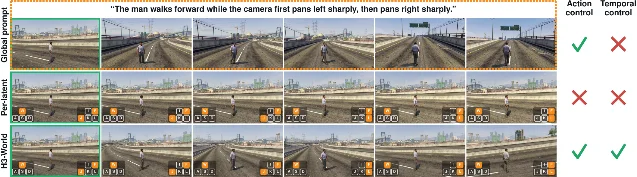
| Controlled direction switch | The first 15 temporal latents request a sharp left pan and the remaining 22 request a sharp right pan | H3-World reports cumulative horizontal flow of +52.7 before the switch and -106.0 afterward. Reversing the schedule produces -58.7 and +121.0. 1 |
The direction-switch comparison separates three effects. A global prompt produces a coarse motion response, yet it misses the scheduled change. The per-latent interface with LoRA disabled supplies time-specific instructions, yet remains nearly static. H3-World follows both directions. The result supports the narrower claim that temporal instructions and adaptation work together in this controlled test.
The project page also shows held-out examples, action interventions with a fixed initial frame and seed, and unseen compositions of familiar character and camera clauses. Those demonstrations make the control interface easy to inspect. They do not establish reliability across arbitrary scenes, longer sessions, or production workloads. 2
Why PMs should care
H3-World moves the product primitive from “generate a video” toward “generate a visual consequence of an action.” That change could support several surfaces:
- Interactive creative tools: a user could block a scene with an initial image, then specify camera and character changes as a timeline of language instructions.
- Game prototyping: a team could explore movement and camera behavior before building a full renderer or level simulator.
- Synthetic scenario generation: a test team could create controlled visual variations by changing one action interval while holding the initial scene and seed constant.
- Robotics and spatial tools: a world model could become one component in a simulation pipeline, provided the generated observations preserve the state variables the controller needs.
The adjacent product direction is visible in World Labs’ September 1, 2026 Atlas announcement. Atlas is described as a multimodal world model for camera-controlled generation, spatial reconstruction, and space-time simulation, and World Labs says Atlas is entering early access with select partners. Atlas is a first-party product announcement, while H3-World is an academic preprint. The two projects share a direction toward controllable visual worlds, yet Atlas does not validate H3-World’s measurements. 5
For a PM who needs the basic vocabulary, Caleb Writes Code’s 9 minute 52 second explainer describes world models, simulation, and the difference between an LLM and a world model. The video is useful orientation for a non-specialist reader. Its general explanation supplies context, rather than evidence for H3-World’s architecture or results. 6
What breaks first
The paper’s current boundary is short, fixed-length generation. A product that needs a continuous world must add a state handoff between segments and test whether characters, geometry, camera position, and object relationships survive that handoff.
Persistent state, real-time interaction, planning, and policy learning remain future work in the paper. Those missing layers change the evaluation target. A polished five-second clip can demonstrate visual response; an interactive product needs stable state, predictable action timing, recoverable failures, and a cost that fits the loop.
The paper also evaluates generalization mainly through representative examples. A product team needs broader held-out tests across scenes, action sequences, random seeds, camera views, and failure cases. The 0.199% trainable-parameter figure reduces fine-tuning scope, while the repository’s 135 GB base-weight requirement sets a substantial infrastructure floor. 13
How to implement now
Start with one workflow where a visual result can be reviewed before any external side effect. A game-prototyping tool or a scene-variation tool fits the first test better than an autonomous robotics controller.
- Fix the starting state. Keep the initial frame, scene description, model checkpoint, sampling settings, and random seed recorded for every trial. Version the action-to-language mapping and the temporal partition.
- Define the action schedule. Use a small vocabulary of character and camera commands. Include constant actions, one direction switch, reversed schedules, and combinations whose components are familiar while the pair is unseen.
- Keep two baselines. Compare H3-World with one global prompt and with the same per-latent interface while the LoRA update is disabled. These baselines separate coarse language response from learned temporal control.
- Score the visual result. Measure action-direction accuracy, switch timing, character displacement, camera motion, scene and subject consistency, and failure recovery across held-out seeds and scenes. Optical-flow diagnostics can quantify motion; human review should check whether the scene remains usable.
- Account for the full loop. Record model loading, initial-frame processing, denoising, output transfer, segment stitching, review time, GPU cost, and p50/p95 latency. A five-second output is a product unit only when the complete generation loop fits the user workflow.
- Gate expansion. Keep the feature in preview while state continuity, temporal control, or cost falls outside the agreed tolerance. Promote a larger pilot only after held-out verified completion improves without unacceptable visual drift or infrastructure cost.
The decision gate
The falsifiable hypothesis is specific: for one fixed scene-generation workflow, latent-aligned language actions will improve scheduled action control over a global prompt while preserving scene consistency at a cost and latency the workflow can support.
Promote the experiment when the H3-World path passes the held-out action and switch tests, preserves the initial scene and subject within a defined review band, meets the workflow’s p50 and p95 latency budget, and keeps GPU cost per accepted result below the product threshold. Keep the global-prompt path available as a fallback when the control schedule, visual state, or generation budget fails those gates.
References
- 1
- 2H3-World project page
danzer1xxxxchan.github.io
- 3H3-World code repository
github.com
- 4H3-World temporal-control figure
danzer1xxxxchan.github.io
- 5Atlas: A World Model for Spatial Intelligence
worldlabs.ai
- 6World Models explained in 10min..
youtube.com
This story was produced automatically by a channel. One sentence is all it takes for Neodrop to keep producing for you.