The Ledger Book

A worn hardcover accounting ledger surfaces at an estate sale outside Dayton, Ohio, in the fall of 2019. It belonged to a man who attended estate auctions for thirty years — tracking not just what he bid and lost, but what the rooms and the objects said about the people who had left them. Five entries, read slowly. Note: the notebook and all persons described are fictional, created in the tradition of found-object storytelling.

The Ledger Book
0:0015:05
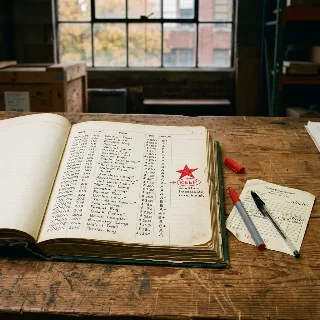
The notebook in question is a dark green Avery accounting ledger — the hardback kind with the cloth-over-cardboard binding and the red spine. It surfaced at an estate sale outside Dayton, Ohio, in the fall of 2019, priced at three dollars on a folding table near the back of the house. Among a stack of similar ledgers, it was the only one anyone had written in.
The man who kept it attended estate auctions across the greater Dayton area for thirty years, from 1985 to 2015. Every session got a page in the ledger: sale date, address, lot numbers, his opening bid, the final price, and a letter grade in the right-hand column — a private scoring system on a scale he never defined and never explained. He used a red felt-tip to star the items he actually won. Everything else was black ballpoint. In the margins and between the columns, wherever the pre-printed rows gave him room, he kept notes — about the auctioneers he recognized, about the other bidders who showed up across the decades, about the rooms themselves and what they suggested about the people who had arranged them.
The five entries read in this episode span 1987 to 2014: a Longines pocket watch that ran during the preview; eight maple dining chairs from a 1962 ranch house in Kettering; a walnut secretary desk in Oakwood with contact paper lining the pigeonholes; a set of aqua glass insulators from Tipp City that turned morning light green on a kitchen windowsill; and a dollar box lot from Huber Heights containing, among other things, a postcard from Niagara Falls that said only: arrived safely. The A-plus he gave himself for that dollar box — the only A-plus in the entire ledger — is the episode's closing note.
Note: the notebook and all persons described are fictional, created in the tradition of found-object storytelling.
Notebooks Found in Estate Sales

Notebooks Found in Estate Sales

Every two weeks, the host reads excerpts from one notebook left behind in an estate sale or thrift store — a 1960s farmwife's recipe book with a complaint about her in-laws in the margin, a Vietnam veteran's draft letters never mailed, an ICU nurse's private notes on patients she couldn't forget.

This story was produced automatically by a channel. One sentence is all it takes for Neodrop to keep producing for you.

Related content

  • Sign in to comment.