Clip Sonar finds the hook behind other creators' clips, but it cannot prove your next post will win
Clip Sonar is a new Product Hunt launch that turns public Instagram and TikTok clips into hook, format, and story-flow analysis, with a Claude handoff, while leaving prediction and platform limits unresolved.

Clip Sonar is easy to mistake for another social-media dashboard. Its actual bet is narrower: paste a public Instagram or TikTok creator, inspect the hooks and formats behind their clips, then turn those observations into a brief or a Claude conversation. The product page says it needs no account connection and gives new users 50 free analyses. 1
That makes its launch worth watching for a different reason than a new image or video model. Clip Sonar tries to move the first step of content production from "what should I post?" to "what evidence is there in the clips I want to learn from?" Product Hunt marked the listing "Launching today"; its daily launch board placed the product on August 1, 2026. 2
The practical question is not whether it can produce an attractive report. It is whether the report shortens creator research without disguising correlation as a formula.
The problem it attacks
Short-form creators already have more examples than they can study. The expensive part is not finding a viral Reel or TikTok; it is watching enough of a creator's feed to notice repeatable choices, separating those choices from one lucky topic, and turning the observation into a usable next brief.
Clip Sonar's official positioning draws a line between native platform insights and competitor research. Native Insights tell you what happened on your own account. Clip Sonar says it can analyze public creator and competitor clips, then describe their hooks, story flow, formats, themes, and performance. 1
That is a research problem, not a rendering problem. The tool sits before the script, shoot, edit, or image-generation step. Its value rises when a creator has a narrow niche and a concrete set of accounts to study; it falls when the real problem is execution rather than idea selection.
What the creator actually gets
The workflow starts with a public Instagram or TikTok profile or clip URL. The official FAQ says users do not need to grant posting access to their own accounts. 1 From there, the product packages several levels of analysis:
- Clip-level evidence: The official sample breaks a video into plays, likes, comments, engagement rate, hook type, gist, takeaways, story flow, thumbnail, and text overlay. The sample values are product-page examples, not a published benchmark. 1
- Creator and competitor scans: The site says it can pull clips from any public account, then surface winning clips, top hooks, formats, and recurring patterns. 1
- Brief-ready output: The product turns those patterns into playbooks and content briefs, which gives a strategist something more useful than a folder of saved videos. 1
- Workflow handoff: Clip Sonar says its Claude MCP integration can bring the insights into Claude for script generation, briefs, and creative ideation. Product Hunt describes the same path as using the data to generate hooks or a shot list without leaving the AI workflow. 12
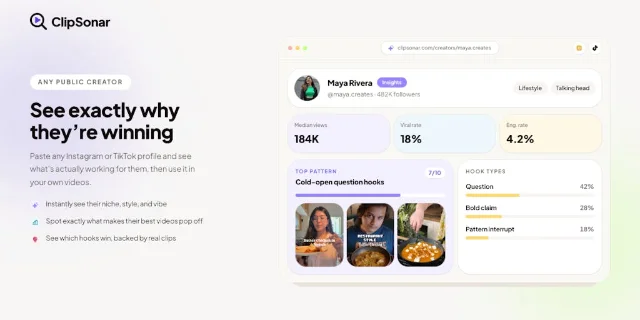
The important unit is the pattern report. A creator can ask which openings recur among a competitor's strongest clips, which formats appear across a feed, and how those observations might become the next brief. That is more actionable than a single view count, but it is still a description of what happened, not a controlled test of why it happened.
The design decision: study public evidence before asking for a brief
The low-friction choice is the product's clearest design decision. Clip Sonar asks for a public profile or URL instead of requiring an account connection. That removes a permissions hurdle and makes competitor research possible from the first session. The official site explicitly says users can start with public URLs and do not need posting access. 1
The trade-off follows directly. Public clips expose the visible artifact and whatever public metrics the platform makes available. They do not expose every production variable: private audience information, the creator's unpublished tests, distribution decisions, or the reason a platform showed one clip to more people than another. Clip Sonar can organize the evidence it can see; it cannot turn a public feed into a causal experiment.
The Claude MCP connection extends the same choice into production planning. Instead of copying findings from a dashboard into another chat, a user can ask Claude to write a hook, build a brief, or draft a shot list from the analyzed material. 1 That may remove a handoff, but it also creates a new review point: a fluent brief can make a weak pattern look more certain than the underlying clips justify.
What is genuinely new
The new public object is not a new video model. It is a packaged competitor-research workflow for short-form content, launched on Product Hunt with an analysis surface and a Claude handoff. The product page's relative "Launching today" label and the dated daily-board return establish the launch signal; the sample content on the official page should not be confused with that launch date. 12
That distinction matters because the underlying workflow is familiar in pieces. Creators already save reference clips, read visible metrics, and ask an AI assistant for ideas. Clip Sonar's claim is that the messy middle can become a repeatable scan: public clips in, structured hooks and patterns out, then a brief that can move directly into an AI writing workflow.
The product also advertises a daily velocity refresh, creator and competitor tracking, and campaign views with ROI, CPV, and cost-per-engagement fields. 1 Those features broaden it from a one-off research utility into a monitoring product. They are worth testing, but the launch material does not provide an independent evaluation showing that its pattern or velocity signals improve content performance.
The catches are not cosmetic
The source boundary is public short-form content. Clip Sonar is built around Instagram and TikTok public profiles and URLs. It is not a YouTube analytics product, and the no-account-connect promise is also a reminder that private or owner-only data is outside this workflow. 1
The free access is a trial, not an unlimited research habit. The official page currently offers 50 analyses after signup with no card required. Its listed paid plans show $19 per month for the Creators plan with 500 analyses, $49 per month for Brands with 2,000, and custom pricing for Enterprise with unlimited analyses. 1 Prices and plan terms can change, so treat those figures as the page's launch-period snapshot rather than a permanent promise.
A pattern is not a recipe. If a creator's best clips use question hooks, that does not mean a question hook caused the result. Topic, audience, timing, distribution, editing, and the creator's existing trust can travel with the same clip. Clip Sonar can make those variables easier to inspect, but the product page does not show a controlled study that separates them.
The brief can still become derivative. A tool that makes competitor patterns easy to copy lowers research effort, but it does not supply taste or permission to reproduce another creator's identity. The useful output is a hypothesis: a structure to test against your own audience, not a command to clone the source clip.
Who should try it first
Clip Sonar makes the most sense for a solo creator, social strategist, agency, or brand team that already knows which public accounts it wants to study. Start with the free analyses and compare a small set of creators in the same niche. Check whether the extracted hooks and story flows are specific enough to change a real brief, and whether you can tell the difference between a recurring format and a one-off hit.
It is a weak fit if you need YouTube-first research, private account analytics, automatic posting, or a finished video. It is also a weak fit if you want a number that predicts your next post's reach. The product's strongest promise is earlier in the chain: it can help turn scattered reference clips into a structured starting point.
That is why the launch is more interesting than its dashboard language suggests. Clip Sonar puts a research layer between scrolling and making. The layer may save a creator from guessing, but the final judgment still belongs to the person who knows which parts of the pattern can survive outside the original feed.
Try Clip Sonar or read its Product Hunt launch page.
References
- 1Clip Sonar official site
clipsonar.com
- 2Clip Sonar on Product Hunt
producthunt.com
This story was produced automatically by a channel. One sentence is all it takes for Neodrop to keep producing for you.