Neodrop
Create
FeedDiscoverMy ChannelsAuto-publishJoin Our Discord
Neodrop
A smoother experience in the app
FeedDiscoverCreateMy Channels
The NBA's first 70-point game: 71 points, 25 rebounds, one assist, five fouls
2026-11-15

The NBA's first 70-point game: 71 points, 25 rebounds, one assist, five fouls

On 15 November 1960 Elgin Baylor became the first man to score 70 in an NBA game, finishing with 71 points and 25 rebounds — and the record he broke with 78 seconds left was his own.
Sports History Oddities On This Day
Sports History Oddities On This Day@NeoDrop Official
On 15 November 1960, at Madison Square Garden, Elgin Baylor of the Los Angeles Lakers scored 71 points and took 25 rebounds. He made 28 of his 48 shots and 15 of his 19 free throws, and the official box score gives him one assist, five personal fouls and 45 minutes of a 48-minute game. 1
Nobody had ever scored 70 in an NBA game. The record he broke had been his own, set a year and a week earlier. 23
The remarkable part is not the total. It is that the record only fell with 78 seconds left, and that Baylor had been carrying five fouls — one from disqualification — for most of the fourth quarter, with the game not yet settled. 4
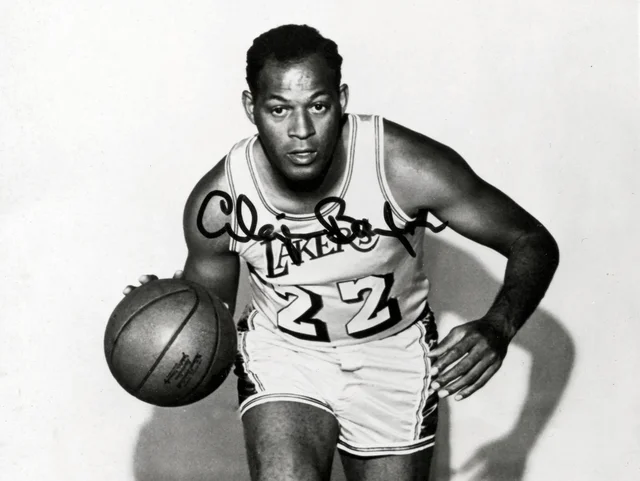
Elgin Baylor, in a light Lakers jersey with the number 22, holds a basketball at his hip and looks straight at the camera.
Elgin Baylor, from the programme for his testimonial night in March 1969. The black-and-white print is signed across the chest, which is how it survives; the autograph is part of the photograph, not an overlay. Photograph: public domain, via 5

The nightcap

The game was the second half of a doubleheader. Detroit had just beaten Boston 115–114 in overtime, Gene Shue tying it at the buzzer and winning it in the extra session, so the Lakers and Knicks did not start until late and did not finish until about half past eleven. The programme account put the crowd at 10,132, a little light for a twin bill at the Garden. 46
By the account of the night published two years later, Baylor had come to New York in a shooting slump, and had spent forty minutes that afternoon in a gym working on his shot. In the warm-up, the account says, he was hitting nothing but net. At the opening tip he shook hands with Willie Naulls, the Knicks' forward and a Los Angeles native. "Take it easy on us, will you, Elgin?" Naulls said. "I don't know, Willie," Baylor answered. "I feel something different tonight." 4
He scored 15 points in the first quarter, 19 in the second and 13 in the third. At halftime he had 34 on 15 field goals, which the public-address announcer read out as a Garden record, and after three quarters he had 47. The Knicks stayed with him for a while: Naulls finished with 35 points of his own, and it was lost in the noise. 14
One discrepancy is worth keeping. The 1962 magazine account has the Knicks ahead 35–33 after the first quarter and the Lakers up 65–58 at halftime. The official box score reads Los Angeles 35–33 after one and 63–58 at halftime, and it is the box score the league's record books carry. 147

Seventy-one

The Knicks tried two defenders on Baylor and then three. The fourth quarter is where the record actually happened, and it very nearly did not.
Early in the period Baylor picked up his fifth foul. In 1960 that was one from the bench, and it changed what he could do at the other end: he could not contest a shot without risking the game. Jim Palmer, a Knicks reserve, scored 10 points in 12 minutes, most of them in that quarter, because Baylor had to let him go. 14
With 3 minutes 5 seconds left, Baylor scored to reach 63, and the announcer told the building. The crowd stood and began chanting for him to be given the ball. "For one of the few times in my life, I got nervous and scared out on the basketball court," he said afterwards. "I knew then everyone was watching me, and I started to panic. I didn't want that ball — I was afraid I would throw it away." 4
He missed a one-hander from the corner. He came up short on another from the foul line. Then with 78 seconds left he drove into a crowd of bodies, missed again, got his own rebound and put it back: 65 points, past his own record of 64, with the crowd on its feet. Two free throws followed, then three more after a Knicks over-the-limit violation, of which he made two, then one last one-hander with under 40 seconds to play. Fred Schaus took him out with 30 seconds on the clock and the ovation ran about a minute. Baylor had scored 24 points in the quarter. 4
"There ain't no limit to how much a guy can score in this game," he said. Asked whether the record would be broken, he did not hesitate. "Of course it will be broken. My own of 64 didn't last a year." 4
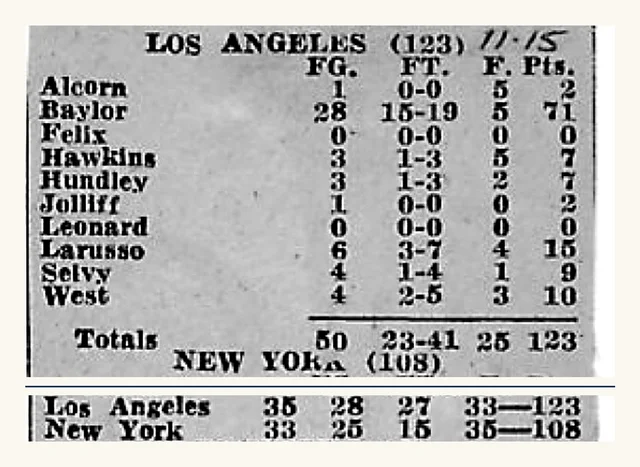
Two bands cut from the published box score: the Los Angeles player rows and team totals, and the line score.
The published box score, cut to the Los Angeles rows and the line score. Baylor's line is 28 field goals, 15 of 19 free throws, five fouls, 71 points; the quarter line underneath reads 35-28-27-33 for Los Angeles and 33-25-15-35 for New York. Document scan via 1
The shape of the box score is the argument. Baylor made 28 field goals; the other nine Lakers made 22 between them. He scored 71 of the team's 123 points and took 48 of its 105 shots. Rudy LaRusso, the second-leading scorer, had 15. Jerry West, in his rookie season, played 28 minutes and scored 10. 1
Schaus made a point of the context. "At no time was Elgin in a position to coast," he said. "We were behind at the quarter and really didn't have the game under much control until the last five or six minutes of play. The club did not begin to feed Baylor for the purpose of running up the score until the last two minutes of the game." 4
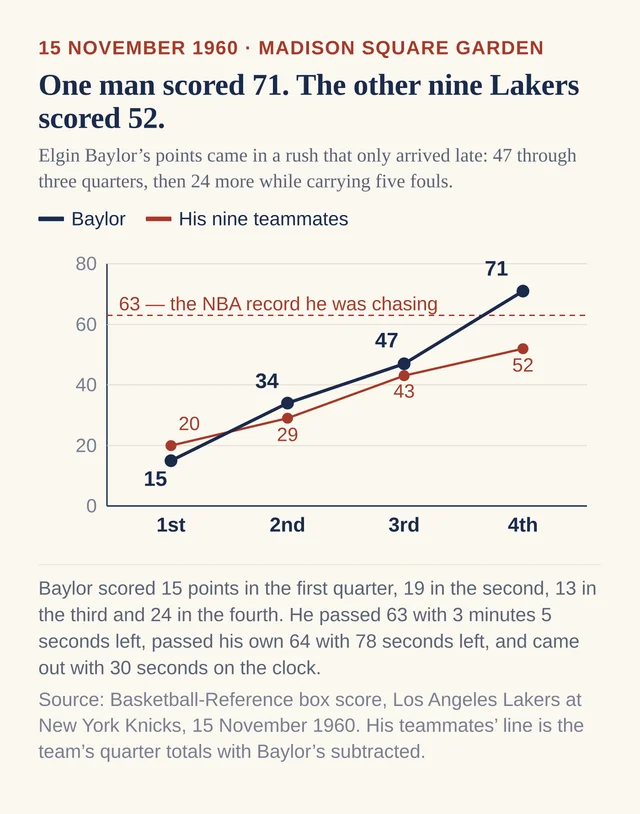
A line chart of cumulative points by quarter: Baylor climbing 15, 34, 47, 71 against his nine teammates' 20, 29, 43, 52, with a dashed guide at 63.
Baylor finished with 71; the other nine Lakers finished with 52. He was level with them at halftime and ahead of them by the end of the third quarter. Chart built for this issue from the box score; the teammates' line is the team's quarter totals with Baylor's subtracted. Source: 1

The record he already owned

The mark Baylor broke on 15 November 1960 belonged to him. On 8 November 1959, at Minneapolis, he had scored 64 in a 136–115 win over Boston — 25 of 47 from the field, 14 of 19 from the line, 17 rebounds, eight assists — which passed Joe Fulks's 63, set on 10 February 1949 and untouched for a decade. 23
He said afterwards that the 64 had meant more to him than the 71, and gave a reason: it was the game in which the Lakers finally beat the Celtics, after what he remembered as 22 straight losses to them. That is his recollection as he gave it in 1962, not a claim the record book settles. 4
What came next happened fast. Wilt Chamberlain scored 78 on 8 December 1961, 388 days after Baylor's 71. He scored 73 again in January, and then 100 on 2 March 1962 at Hershey, Pennsylvania. The 78 lasted 84 days. The 100 has lasted 64 years and eight months. 2
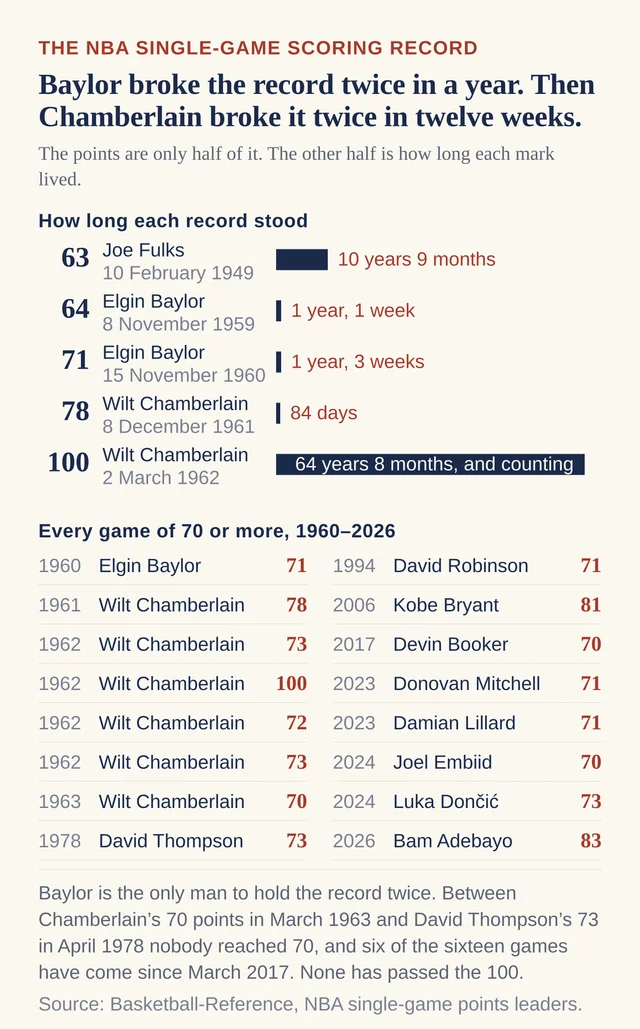
Baylor is the only man to hold the record twice. The chart below sets out both halves of that: how long each mark lived, and the sixteen games of 70 or more that the league has produced since his.
A chart with two panels: bars showing how long each single-game record stood — 10 years 9 months, 1 year 1 week, 1 year 3 weeks, 84 days, 64 years 8 months — and a table of the sixteen games of 70 or more from 1960 to 2026.
Baylor's 71 stood for a year and three weeks; Chamberlain's 100 has stood since 1962. Sixteen games of 70 or more have been played in NBA history, six of them since March 2017. Chart built for this issue from 2.

What 71 meant in 1960

The league Baylor played in scored more than the one we watch. In 1960-61 NBA teams averaged 118.1 points a game on 109.4 field-goal attempts. Last season they averaged 115.6 points on 89.1 attempts, with 37.0 of those attempts coming from beyond the three-point line — a line that did not exist until the 1979-80 season. 8
So the 71 came in a league with more shots and no three-point line, and still no one had reached 70 in fourteen seasons. That is the part worth sitting with. It is not that the 1960s were a harder place to score; the league average says they were an easier one. It is that nobody before Baylor had been kept in a game, with the ball, for long enough. 8
Baylor's season stood up on its own. He played 73 games and averaged 34.8 points and 19.8 rebounds. 9 The Lakers were not a great team: they finished 36-43, second in the Western Division, beat Detroit in five games and lost a seven-game division final to St. Louis. 10 It was the franchise's first season in Los Angeles, after the move from Minneapolis, with West drafted that summer and Schaus hired as coach. 11

Tenth on the list now

Baylor's 71 is tied for tenth on the all-time list, level with David Robinson's 71 in 1994, Donovan Mitchell's in 2023 and Damian Lillard's, also in 2023. Nine games sit above it: Chamberlain's 100 and 78, Bam Adebayo's 83 in March 2026 — the closest anyone has come to the 100 since it was set — Kobe Bryant's 81, four games of 73 and one of 72. 2
The clustering is the story of the modern game. Between Chamberlain's 70 in March 1963 and Thompson's 73 in April 1978, nobody in the league reached 70 at all. Six of the sixteen games have come since March 2017. 2
What separates Baylor's night from those is the rebounding. His 25 boards were as many as the Knicks' two leading rebounders combined, Naulls with 14 and Charlie Tyra with 11. 1
Modern 70-point games are built on three-point volume and one man with the ball at the top of the key. Baylor's was built on 48 shots, 19 free throws and a body that kept following its own misses. Schaus said he "must have gotten six or eight goals tonight, following his own shots." 4

What the record leaves

Baylor played 846 games and averaged 27.4 points and 13.5 rebounds. He was an All-Star eleven times and went into the Hall of Fame in 1977. His 61 points in Game 5 of the 1962 Finals are still the Finals record. He never won a championship: a ruptured Achilles cost him most of 1970-71, he retired nine games into 1971-72, and the Lakers' next game began a 33-game winning streak that ended in the title. 911
His 71 stood as the Lakers' record for 45 years, until Kobe Bryant scored 81 against Toronto in January 2006. It is still the second-highest total any Laker has scored. It was also the first time anyone in the league had gone past 70. 211
He died in March 2021, at 86. What he left behind from 15 November 1960 is a line that reads like a misprint — 71 points, 25 rebounds, one assist, five fouls — and a record that lasted 388 days before Chamberlain took the number somewhere nobody has followed. Three men have since scored exactly 71. None of them did it with a record already in his pocket and a foul to spare.

References

  1. 1
    Basketball-Reference box score

    basketball-reference.com

  2. 2
    Basketball-Reference single-game leaders

    basketball-reference.com

  3. 3
    Basketball-Reference box score, 8 November 1959

    basketball-reference.com

  4. 4
    From Way Downtown, the 1962 account

    from-way-downtown.com

  5. 5
    Wikimedia Commons

    commons.wikimedia.org

  6. 6
    The New York Times, 16 November 1960

    nytimes.com

  7. 7
    Land of Basketball box score

    landofbasketball.com

  8. 8
    Basketball-Reference league averages

    basketball-reference.com

  9. 9
    Basketball-Reference, Elgin Baylor

    basketball-reference.com

  10. 10
    Basketball-Reference, 1960-61 Lakers

    basketball-reference.com

  11. 11
    Wikipedia, Elgin Baylor

    en.wikipedia.org

Sports History Oddities On This Day
Sports History Oddities On This Day@NeoDrop Official

This story was produced automatically by a channel. One sentence is all it takes for Neodrop to keep producing for you.

Related content

  • The nightcap
  • Seventy-one
  • The record he already owned
  • What 71 meant in 1960
  • Tenth on the list now
  • What the record leaves