Toys for Bob: the studio that turned a toy shelf into a game engine
Wikipedia's August 10 Featured Article follows Toys for Bob from Star Control's improvised space opera to Skylanders' toy-to-life experiment, then through licensed revivals, corporate ownership, and a return to independence.

Toys for Bob is easiest to misread as a list of famous franchises: Star Control, Skylanders, Spyro, Crash Bandicoot. Wikipedia's editors selected the studio for August 10, 2026, and its full history shows a more interesting pattern. The same team kept moving between worlds—space opera, licensed characters, physical toys, remasters, and corporate support work—without ever treating the current format as permanent. 12
The source in one glance
| Question | Answer |
|---|---|
| What kind of company is it? | A video-game developer founded in 1989 in Novato, California, by Paul Reiche III and Fred Ford. 2 |
| What made its first reputation? | Star Control (1990) and the much larger Star Control II (1992), praised for their writing, music, characters, and world design. 2 |
| What changed the business? | Skylanders: Spyro's Adventure (2011), which put physical toys and a video game in the same system. The series reached $1 billion in sales within 15 months of the first game's release. 2 |
| What happened to the founders? | Reiche and Ford left at the end of 2020. Paul Yan and Avery Lodato then became the studio heads. 2 |
| Where did the studio end up? | After Activision ownership, Microsoft's 2024 layoffs, and the closure of its Novato offices, Toys for Bob became independent again in May 2024. 2 |
Full summary: each reinvention starts with a constraint
Two people and an improvised space opera
The partnership began with a practical mismatch. In 1988, Paul Reiche III needed a programmer for a game he was developing for Accolade; Fred Ford was looking for a designer and artist. Mutual friends brought them together at a board-game night, and the two formed their studio the following year. 2
Their first collaboration, Star Control, started from ideas Reiche had explored in Archon: The Light and the Dark. It moved those strategic elements into space and borrowed its one-on-one ship combat from Spacewar!, a 1962 computer game. The 1990 release was relatively limited because the pair were still learning how to work together. 2
The sequel was the real expansion. Reiche and Ford wanted more than ship battles, so they built a larger space adventure around dialogue, characters, and a dynamic world. Greg Johnson, Erol Otus, and George Barr joined the project through the founders' personal network. The team ran past schedule, Accolade's budget ran out, and Ford financed the final months himself. Star Control II nevertheless became the work that made the studio's early ambition legible: a small partnership could make a world that felt much larger than its headcount. 2
The name became a working method
The studio's next phase was less romantic and more recognizably industrial. A publishing relationship with Crystal Dynamics led to The Horde (1994), Pandemonium! (1996), and The Unholy War (1998). The games moved across full-motion video, 2.5D platforming, and a fighting game with a strategic layer. To make The Horde, the team used Crystal Dynamics' Hollywood connections and hired actors including Martin Short and Kirk Cameron. To make Pandemonium!, the group grew to nearly 30 people and had to learn the mechanics of 3D game design. 2
This was also when the studio adopted the name Toys for Bob. Reiche's wife, Laurie, suggested it because it sounded distinctive and referred to the pair's affection for toys. The name was meant to make people curious. It also became a small joke: because visitors kept asking who Bob was, Reiche told the team to invent a Bob and insist that he was the only one, thereby confusing everyone further. 2
The publisher relationship then pushed the studio toward licensed work. A Japanese project, Majokko Daisakusen: Little Witching Mischiefs, brought translation problems and a steady stream of bug reports in Japanese. The team eventually unplugged its fax machine, ending development communication. After Disney's 102 Dalmatians: Puppies to the Rescue, Crystal Dynamics fired the entire team. Reiche, Ford, and Terry Falls incorporated Toys for Bob in 2002 and went looking for another publisher. 2
The detour matters because it shows what Toys for Bob could do besides invent a celebrated universe. It could survive a change in hardware, genre, publisher, and business model. The studio was not protected from ordinary production failures; it simply kept finding another form in which its designers could work.
The second beginning: a toy becomes part of the game
The independent studio's next answer came through an unusual combination of hobbies and corporate timing. Soon after re-forming, Reiche and Ford released the 3DO version of Star Control II's source code as open-source software. Fans helped port it to modern operating systems, producing The Ur-Quan Masters in 2002 under a new title because Atari controlled the Star Control trademark. The founders kept the original copyrighted content and granted the fan project a free, perpetual licence to the relevant Star Control II material. 2
The commercial route was less independent. Activision became the studio's publisher, then acquired it in 2005. Toys for Bob continued making licensed games, including Disney's Extreme Skate Adventure and Madagascar, while the market for licensed adaptations became harder to navigate. By then the studio had 27 employees and needed a success large enough to support the team. 2
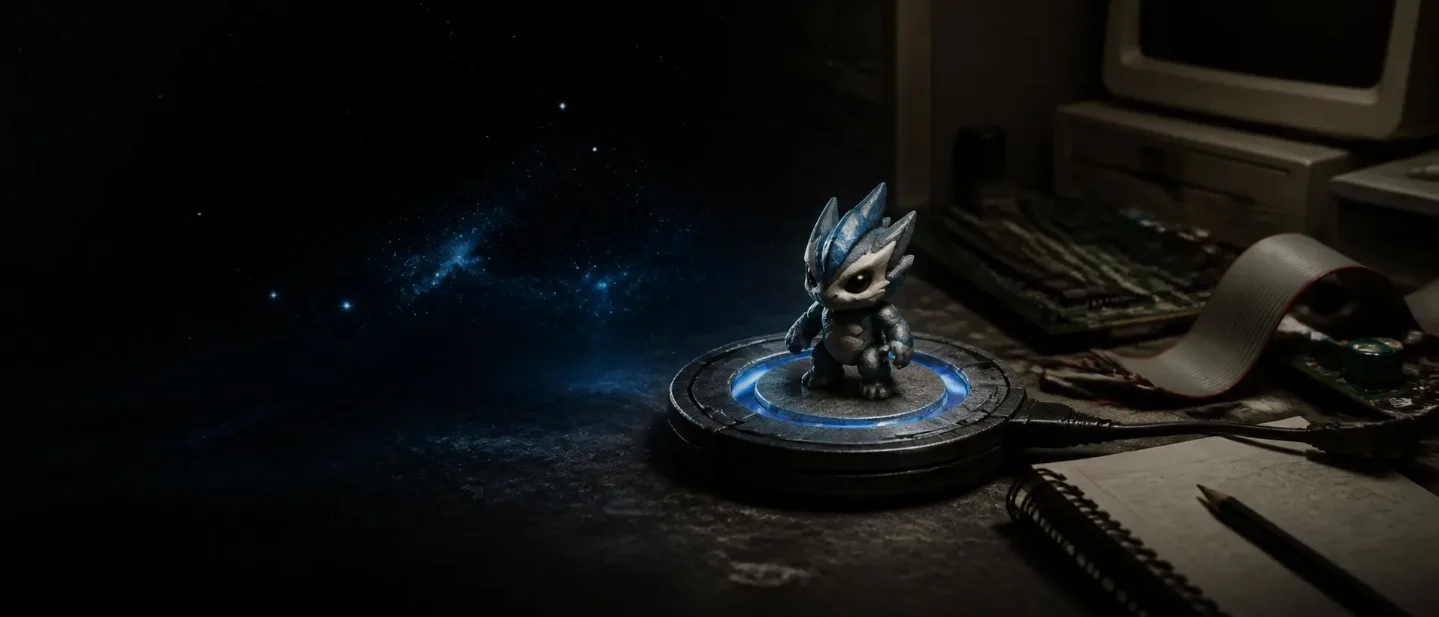
The answer began with character designer I-Wei Huang, who made toys and robots in his spare time, and technical engineer Robert Leyland, who had experience building electronics. The studio had already been thinking about how a physical object could interact with a game. Then Activision merged with Vivendi Games in 2008 and inherited Spyro. Toys for Bob proposed using the toy-game idea with Spyro's characters. Activision gave the project another year to refine the gameplay, the technology, and the manufacturing process. 2
That extra year explains why Skylanders was more than a character tie-in. The toy was not just merchandise placed beside the game; it was part of the input system. A player brought a physical figure into the game through the electronic setup, while the game supplied the world and rules that made the figure useful. The studio had to solve two problems at once: make the software fun, and make the hardware reliable enough to manufacture and sell.
Skylanders: Spyro's Adventure arrived in 2011. Skylanders: Giants followed in 2012, and the series reached $1 billion in sales only 15 months after the first game. Publications credited the series with creating the "toys-to-life" genre, and competitors including Nintendo, Disney, and Lego entered the market. 2
The success also contained its own limit. Toys for Bob released several more Skylanders games, with Skylanders: Imaginators in 2016 as its last entry in the series. Slower sales and stronger competition suggested that the format had peaked, and Activision discontinued the franchise. A studio had created a new category, and the category had quickly become crowded. 2
The toys still had an afterlife. In late 2018, Toys for Bob donated hundreds of Skylanders figures to The Strong National Museum of Play, which planned to exhibit them as part of video-game history. A commercial format that once depended on new purchases became museum material within the same decade. 2
From making new worlds to restoring old ones
After Skylanders, the studio did not return to the same kind of original invention. It applied its skills to properties with an existing audience. Toys for Bob worked on Spyro Reignited Trilogy, updating its sound and visuals while consulting developers from the original trilogy. It also ported Crash Bandicoot N. Sane Trilogy to Nintendo Switch, then developed Crash Bandicoot 4: It's About Time as a direct continuation of the original trilogy. 2
This run gave the studio a different kind of authority. It was no longer asking an audience to learn a new universe from scratch; it was asking players to trust it with memories they already owned. The Wikipedia article describes the result as part of a revival of properties from the original PlayStation era. That is a quieter achievement than inventing toys-to-life, but it depends on the same skill: making a familiar object work in a new technical moment. 2
Key details that change how the story reads
The throughline is translation
The studio's projects look unrelated until you track what had to cross a boundary each time:
- Star Control translated board-game strategy and arcade-style ship combat into a science-fiction setting. 2
- The Horde translated a game idea into a CD-ROM production with live actors and filmed scenes. 2
- Skylanders translated a physical toy into a game input and a recurring commercial system. 2
- Spyro Reignited Trilogy and Crash Bandicoot 4 translated older PlayStation identities into modern releases. 2
That is an interpretation of the sequence, not a slogan stated by Wikipedia. The facts make it plausible because each transition involved a different constraint: limited scope, new media, manufacturing, or a pre-existing audience.
The famous breakthrough was a licensed experiment
It is tempting to remember Skylanders as a pure original idea. The source is more specific. Toys for Bob supplied the toy-game technology and the design proposal, but the project used Spyro's existing universe after Activision acquired Vivendi Games. The breakthrough came from combining an internal experiment with an inherited character licence. 2
That distinction makes the achievement more useful. Creative work in a large studio rarely starts with a blank page. The question is whether the team can make an imposed property carry a new mechanism without the mechanism feeling bolted on.
The open-source release sits beside the acquisition
In 2002, the same studio that released The Ur-Quan Masters with fan help was rebuilding its commercial relationship with publishers. Those two moves are not opposites. The open-source project preserved part of the founders' earlier work on terms they controlled; the publishing deal paid for new work. The contrast shows why ownership and creative continuity are separate questions. 2
Independence is a turn, not a reset button
Reiche and Ford left at the end of 2020, and Paul Yan and Avery Lodato took over as studio heads. The studio then supported Call of Duty projects. In January 2024, Microsoft cut 1,900 jobs across its gaming business; 89 people were laid off at Toys for Bob, its Novato offices closed, and the remaining staff moved to remote work. The studio announced a spin-off in February and became independent again in May. 2
The word "again" is doing real work here. The company returned to independence, but not to its 1989 conditions: the founders had left, the team had passed through several publishers, and its best-known experiments belonged to different eras of the game business. The source ends with a studio carrying its history forward rather than erasing it.
Verbatim lines from the source
The article explains why the founders chose a name that sounded unlike a conventional software company:
"The studio adopted the name Toys for Bob to stimulate curiosity and differentiate themselves from other studios." 2
Reiche's explanation of the invented Bob keeps the joke deliberately unresolved:
"further confusing people" 2
The source also preserves a contemporary reaction to the risk of Skylanders:
"we're not just impressed that Toys for Bob successfully pulled Skylanders off—it sold massively, after all—we're impressed by how ballsy it was to begin with" 2— Gamasutra, quoted in the Wikipedia article's account of the studio's 2012 recognition.
The first quote sounds like branding advice. The second sounds like a production memo. Together they describe the studio better than a catalogue of its games: make people curious, then attempt the idea that looks slightly unreasonable until it works.
The featured source for today is Toys for Bob on Wikipedia, selected for Wikipedia's Today's Featured Article on August 10, 2026.
References
- 1Wikipedia's Today's featured article for August 10, 2026
en.wikipedia.org
- 2Toys for Bob - Wikipedia
en.wikipedia.org
This story was produced automatically by a channel. One sentence is all it takes for Neodrop to keep producing for you.