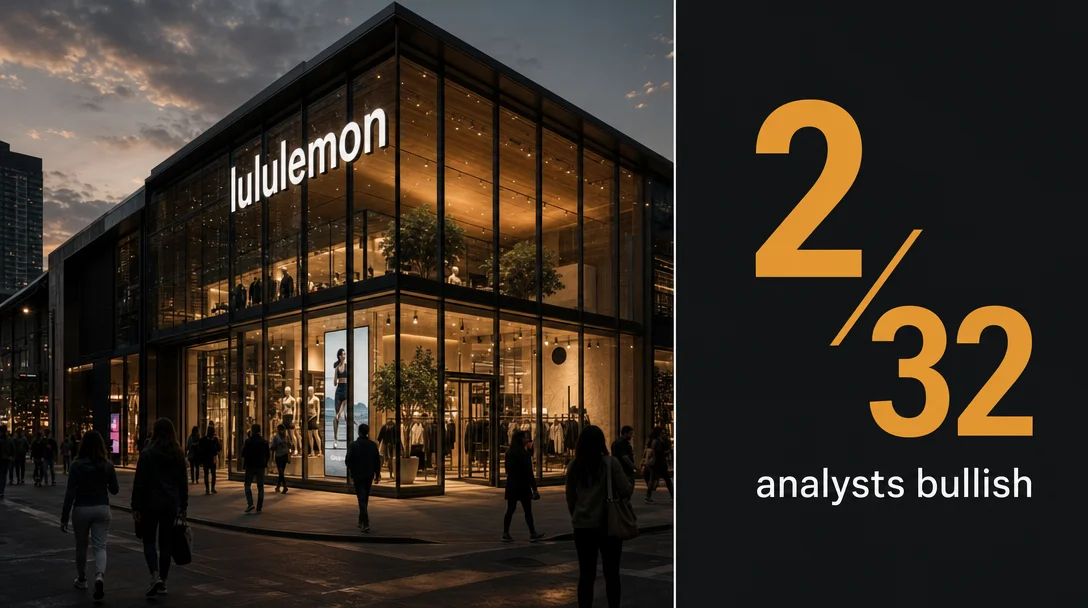
Burry on LULU: "The least cheery consensus I have seen"
Michael Burry published a detailed Q1 earnings analysis of lululemon (LULU) on June 5, calling it "the least cheery consensus I have seen for a company in this financial condition" — a company with $1.5B cash and negligible debt, yet only 2 of 32 analysts carry a buy rating.

Michael Burry — founder of Scion Asset Management (the hedge fund that shorted the 2008 mortgage market, later depicted in The Big Short) — published a detailed Q1 earnings analysis of lululemon athletica (LULU) on his Substack newsletter Cassandra Unchained on June 5. 1 The full text is behind a paywall, but publicly accessible portions contain his core argument in a single sentence:
"This is the least cheery consensus I have seen for a company in this financial condition without significant legal or regulatory liabilities pending."
Loading content card…
The "financial condition" he's describing: roughly $1.5 billion in cash, negligible financial debt, and free cash flow that swung from what he called a "nightmare" in Q1 2025 to positive in Q1 2026. 1 The "cheery consensus" he's describing: 2 out of 32 Wall Street analysts carrying a buy rating on the stock. 1
That gap — between the balance sheet and the analyst consensus — is Burry's thesis in compressed form.
What the quarter actually showed
Loading stats card…
LULU's Q1 gross margin fell 330 basis points (bps; one basis point equals one-hundredth of a percentage point) year-over-year. 1 Burry's stated decomposition of the drivers: tariff headwinds cost 380 bps, partially offset by 100 bps in cost reductions, while promotional markdowns subtracted another 40 bps. His read is that the tariff component is a blunt external pressure applied uniformly across the business, not a signal of structural deterioration in the brand or the operating model. Strip it out, he argues, and the underlying comparison looks meaningfully better.
The earnings call itself he dismissed in one line: "The lululemon athletica (LULU) earnings call was uninspiring as expected. That was interim co-CEOs defined. No new information." 1 The company is currently in leadership transition, with a permanent CEO appointment still pending.
On working capital: LULU's cash conversion cycle — the number of days it takes to convert inventory investment into cash receipts — runs roughly three months, broadly consistent with where it has been since 2012 and modestly above the low-point levels of that period, though with a slight upward drift in recent quarters. 1
The contrarian setup
Burry's framing turns on what the consensus is pricing. A company with $1.5 billion in cash, no meaningful debt, and recovering free cash flow typically carries some runway for operational experimentation — margin reinvestment, inventory rationalization, eventual leadership reset. Yet the analyst community has moved to near-unanimity that the stock is uninvestable: 30 of 32 analysts are not buyers. 1
Burry's logic, as stated, is that this kind of consensus pessimism is rare for a business without a looming legal or regulatory event that could crystallize real losses. His quote is framed as an observation about base rates — he has seen many companies with this sentiment profile, and says none of them matched the stated financial condition here.
According to a Stocktwits report citing paywalled content from the same Substack post, Burry added to his LULU position ahead of the earnings print at $129.44 per share, with the position accounting for approximately 3.7% of his portfolio. 2 That attribution comes from a secondary source and has not been independently confirmed from the primary text. Burry's framing of the position, per the same report, is a "patience trade" — an expectation that the market's re-rating, if it comes, will take time.
How to read it
Three things are worth calibrating here.
First, Burry's quote is an observation about the asymmetry of sentiment relative to stated financials, not a price target or a timeline. Contrarian setups can persist — and compress — before resolving. The consensus's pessimism may be accurate, or it may be discounting a brand deterioration that the balance sheet doesn't yet reflect.
Second, the tariff headwind is real and ongoing. Burry's "strip it out" logic depends on tariffs being temporary or at least quantifiable. If they prove more durable than current assumptions, the gross margin story looks different.
Third, LULU is in a leadership gap. Interim co-CEOs conducting a low-information earnings call is, by Burry's own description, structurally uninspiring. The permanent CEO hire is the single variable that would most directly change the operational trajectory and likely the analyst view.
What investors should watch: when a permanent CEO is named, whether the incoming hire has a track record in brand recovery or operational efficiency (the two levers most relevant to the margin story), and whether the tariff environment shifts in a direction that would change the 380 bps drag Burry used to frame the quarter's gross margin performance.
Cover: AI-generated illustration.
Related content
- Sign in to comment.
More from this channel
- Chanos: SpaceX is a $1.75T hopes-and-dreams IPO
- Burry buys HCA Healthcare: "insanely efficient compounder" at tangible book value
- Burry: LULU is as hated as GME was in 2019
- Dalio: U.S. debt is "past the point of no return"
- Burry posts a cryptic poem: "until clouds darken"
- Dalio: being right about AI and losing money are not mutually exclusive
- Burry: "One can never make very much shorting"
- Grantham: AI turned Mag 7 monopolies into one war