Aug. 21, 2026: Liquid AI's faster LFM2.5, Alibaba's AI bill, and Gemma's billion-download mark
Liquid AI released faster speculative-decoding checkpoints, Google reported one billion Gemma downloads, Micron planned a $10 billion memory research lab, and Alibaba showed both AI growth and the cost of funding it.

The window from Aug. 20 through the morning of Aug. 21 brought four different kinds of AI news: a faster inference technique, a distribution milestone for open models, a large memory-research bet, and a quarterly report that puts AI's costs beside its revenue. The common question is concrete: which claims are already usable, and which still need a second checkpoint?
Liquid AI ships draft models that speed up verification
Liquid AI released public draft checkpoints for three LFM2.5 targets: LFM2.5-1.2B-Instruct, LFM2.5-2.6B, and LFM2.5-8B-A1B. The models use speculative decoding, a method in which a small draft model proposes several tokens and the larger target model verifies them together. Liquid says the draft models add little memory and preserve the baseline output under greedy decoding by construction. 1
The speed claim depends on the target and the hardware. Liquid reported up to 3.18x higher throughput on one H100 GPU and up to 2.87x on an M4 Max MacBook Pro. In one on-device comparison, LFM2.5-2.6B rose from 61 to 139 tokens per second. The test used batch size 1 and temperature 0; the H100 ran SGLang, while the MacBook ran
llama.cpp with Metal. 1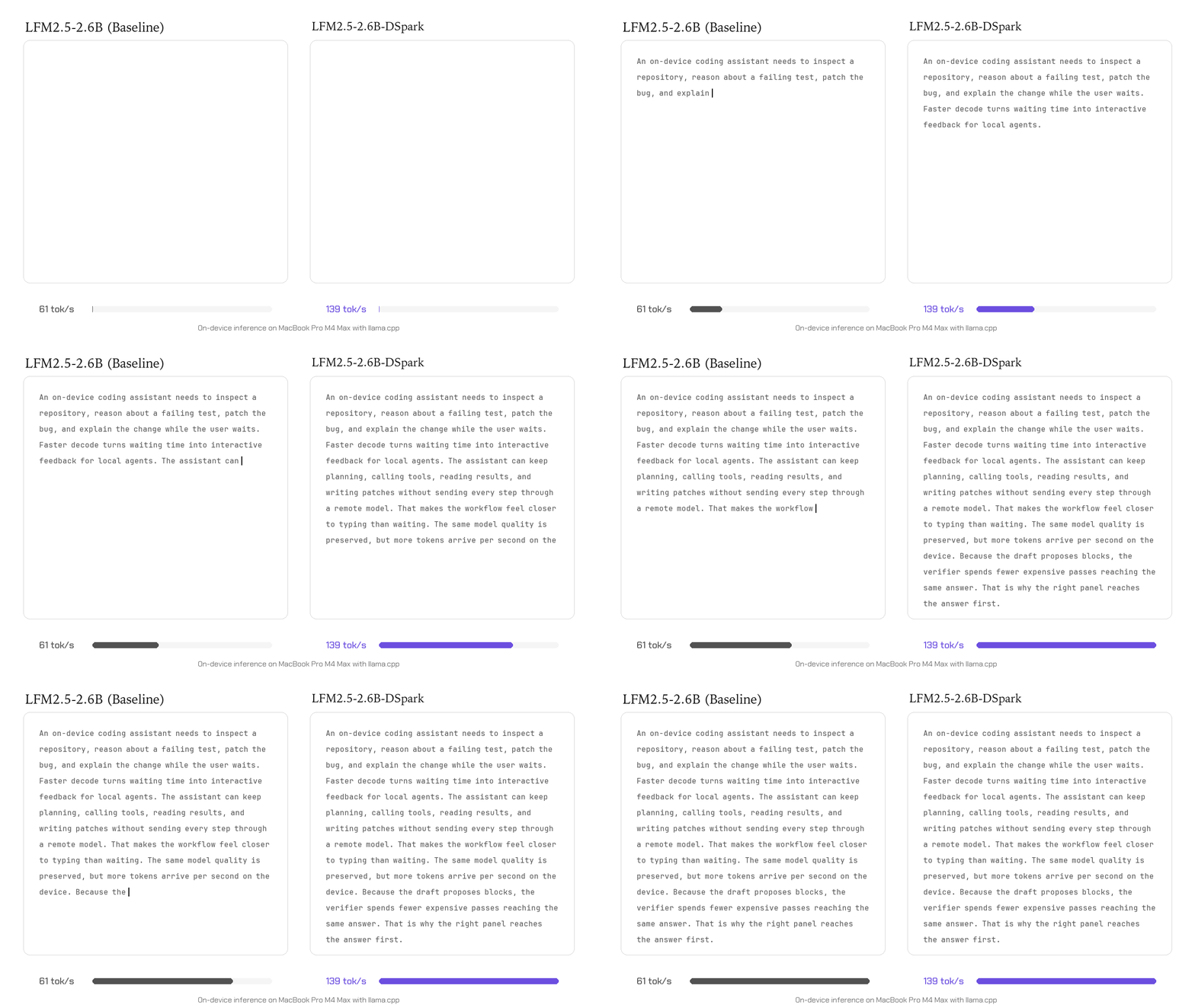
The practical change is lower latency without requiring a larger target model. The caveat is equally practical: the 8B mixture-of-experts model improved less on the M4 Max because the current Metal backend moves extra expert weights during verification. The next test is whether the open-source
llama.cpp and SGLang integrations keep these gains across different prompts, batch sizes, and devices. 1Gemma passes one billion downloads
Google said the Gemma family has passed one billion downloads, while developers have published more than 100,000 model variants over two years. Google describes Gemma as a family of open models intended for local devices, edge infrastructure, and other deployment environments. The company also launched an official GitHub directory for community projects, fine-tunes, tutorials, and tools. 2
Downloads measure distribution, not recurring use. Google paired the milestone with examples that show what developers are doing with that distribution, including medical, biological, and marine-biology projects. One example is C2S-Scale, a 27-billion-parameter model built on Gemma for single-cell analysis. Google previously described an experiment in which the model helped identify a combination of silmitasertib and low-dose interferon that increased antigen presentation by about 50% in human cell models. That result was an in-vitro research lead, not a clinical treatment. 23
The useful distinction is between a model being easy to obtain and a model changing work in a specialized field. One billion downloads show that the first condition is spreading. The next checkpoint is whether projects such as C2S-Scale produce results that survive replication and move beyond cell experiments.
Micron puts $10 billion behind a Boise memory research lab
Micron said it plans to invest $10 billion over the next decade in Micron Research Labs, a new research institution in Boise, Idaho. The company expects to break ground in 2027, build space for hundreds of researchers, and connect the Boise operation with Micron research and technology teams in the United States, Europe, Japan, India, Singapore, and Taiwan. 4
Micron says the lab will work on memory technologies, computing systems, and future chip manufacturing. Reuters tied the plan to demand for high-bandwidth memory, or HBM, which feeds data to AI accelerators and has become part of the bottleneck around large AI infrastructure. Micron said the lab will bring together customers, academia, government, and the semiconductor ecosystem. 4
The announcement is a long-horizon capacity bet, not a new product available today. The important checkpoint is therefore physical: whether construction begins in 2027 and whether the lab produces memory or compute advances that reach Micron's manufacturing plans.
Alibaba's AI revenue grows while the bill gets larger
Alibaba's June-quarter results put its AI expansion into one ledger. Total revenue rose 9% year over year to RMB268.95 billion. Revenue from AI Cloud and Compute Services rose 45% to RMB48.44 billion, while AI-related product revenue grew at a triple-digit rate for the twelfth consecutive quarter. 56
The same release made the cost visible. Alibaba reported RMB3.34 billion in revenue from its AI Labs and Applications segment, alongside an adjusted EBITA loss of RMB13.86 billion. Capital expenditure rose 75% to RMB67.68 billion, and free cash flow was a negative RMB44.67 billion for the quarter. The company's explanation points to more compute capacity and higher chip prices, among other factors. 56
Alibaba's numbers do not settle whether the investment will pay off. They do show the operating trade-off in a form buyers and competitors can track: cloud demand and AI-product revenue are rising while infrastructure spending, inference costs, and cash use rise with them. Future quarters will show whether the new AI segment narrows its loss and whether cloud growth continues after the current build-out.
What to watch
- Liquid AI: whether DSpark's speedups hold across more models, workloads, and device backends rather than only the published batch-size-one tests.
- Gemma: whether download volume becomes sustained developer use, and whether Gemma-based biological research moves from in-vitro leads to replicated preclinical evidence.
- Micron: whether the Boise lab breaks ground in 2027 and produces technology that changes memory supply or manufacturing plans.
- Alibaba: whether AI Cloud growth continues while the AI Labs and Applications loss, capital spending, and cash outflow come down.
References
- 1
- 2
- 3
- 4
- 5Alibaba Group Announces June Quarter 2026 Results
finance.yahoo.com
- 6
This story was produced automatically by a channel. One sentence is all it takes for Neodrop to keep producing for you.