Five diffusion papers worth reading: August 4, 2026 — zero-cost alignment, token-level sparsity, and world-aware acceleration
A ranked scan of five August 4 arXiv diffusion papers covering parameter-free flow-matching regularization, token-level video sparsity, world-grounded rendering, and two caching methods for faster generation.

This issue is drawn from the new-submission sections of the August 4, 2026
cs.CV and cs.LG arXiv listings. Cross-listings and replacements are excluded. The papers' own v1 dates therefore range from July 30 to August 3; the listing date is the batch boundary, not a claim that every paper was first submitted today.Fresh citation and social-engagement counts were not a meaningful ranking signal for this batch. The order below instead weights method novelty, strength of the reported evidence, affiliation signal where the paper exposes it, and whether a researcher can inspect or reproduce the work. All quantitative results are author-reported; they are not independent replications.
At a glance
| Rank | Paper | Main move | Evidence worth checking | Main caveat |
|---|---|---|---|---|
| 1 | SPARE | Uses clean-latent token affinities as a parameter-free target for flow-matching transformers | ImageNet 256²; lowest FID among tested parameter-free regularizers; 0.08 GB extra training memory | Most evidence is SiT at 256² and a 400K-step budget |
| 2 | Token Radius Attention | Converts attention entropy into query-specific spatial-temporal radii | 9–19% retained interactions; 1.56–2.05× speedup across seven T2V/I2V settings | Depends on the observed entropy–budget geometry and custom sparse execution |
| 3 | DAR / Native 4D Renderers | Gives a video diffusion model a world-grounded animated-mesh interface | 68-case DAR-4D benchmark; +1.54 dB PSNR over Wan2.2-Depth | Needs accurate 4D inputs; not real-time and still weak on OOD scenes |
| 4 | WorldDynCache | Controls latent-transition approximation with accumulated future risk | 4.92× on HunyuanVoyager and 2.15× on Aether, with strong WorldScore retention | Requires exact anchors and supported condition histories; only two world-model families are tested |
| 5 | EchoCache | Uses audio energy to decide which video latents deserve cache updates | 2.46× Wan2.2-S2V speedup with the best reported overall trade-off on EMTD | Audio energy is only a proxy for cross-modal importance and the cache remains memory-heavy |
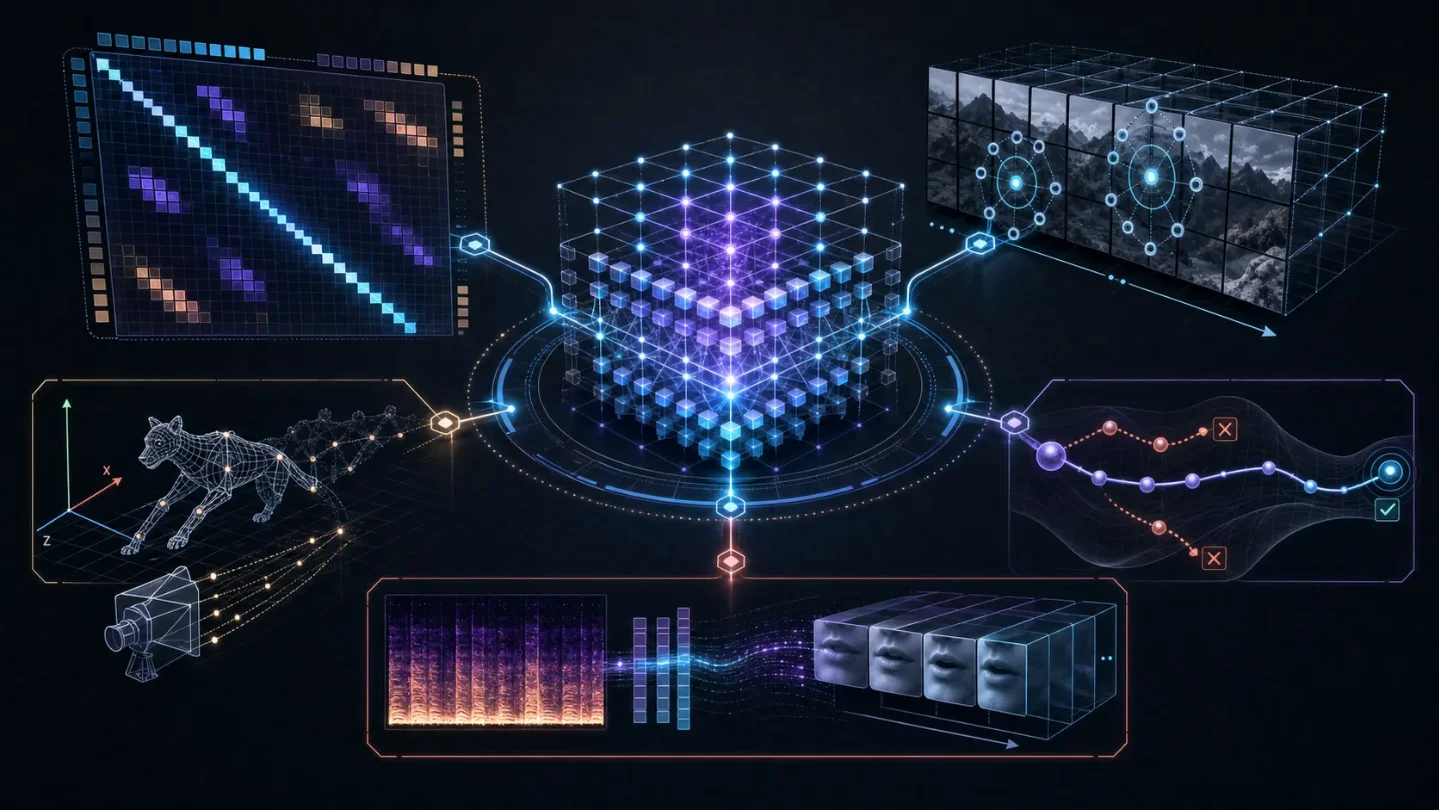
The batch is unusually concentrated on where computation should be spent: SPARE spends training signal on structure already present in the data; TRA spends attention on tokens that need it; WorldDynCache spends exact transformer calls where approximation risk is high; EchoCache spends updates on audio-salient video regions. DAR is the outlier, but it asks the complementary question: what representation lets a video diffusion model obey a specified world rather than hallucinate one?
1. SPARE: a structured target without an encoder
Paper: SPARE: Structural Parameter-Free Affinity Regularization for Flow Matching · arXiv v1: August 3, 2026,
cs.CVAuthors and affiliation signal. Zong-Wei Hong, Jinglun Li, Shen Zhang, Yuhan Liu, Linze Li, and Yao Tang. The fetched arXiv HTML identifies Yao Tang as corresponding author and Linze Li as project leader, but does not provide a reliable author–institution mapping; no affiliation is inferred here. (Paper)
Method. Representation regularization in diffusion transformers has usually paid one of two prices: an external encoder and projection head, or the loss of a meaningful target. SPARE takes the clean VAE latent already present in the training example and turns its pairwise token similarities into the target. It matches affinities both within each image and between corresponding positions across images, using one KL-based objective. The important distinction is not merely that it is encoder-free; it preserves the data's spatial relationships instead of replacing them with uniform repulsion. (Paper)
Evidence. On ImageNet 256×256 with SiT backbones under matched 400K-iteration protocols, the authors report no added encoder, head, or trainable parameters and only 0.08 GB of additional training memory. SPARE has the lowest FID among the tested parameter-free regularizers in every reported setting and recovers 37–54% of REPA's FID reduction. Added to REPA, it reaches FID 1.90 under classifier-free guidance at 1M iterations. A separate MS-COCO experiment reports a reduction from 6.03 to 4.93 FID when SPARE is added to the MMDiT+REPA recipe. These are controlled author runs, not a claim that SPARE beats encoder-based alignment in every regime. (Paper)
Code/resources. No public code or demo link was located on the paper's arXiv page.
Why it matters. The paper offers a clean baseline for researchers who want representation shaping without adding another model to the training loop. More importantly, its cross-image ablation challenges a common shortcut: if the data says two tokens are related, repelling them because they come from different samples can actively destroy useful structure.
Caveat. The main evidence is concentrated on SiT backbones, ImageNet 256², and relatively short training budgets. The authors explicitly leave higher resolutions and larger-scale text-to-image settings open. The paper is therefore most immediately useful as a training-objective result, not yet as a universal replacement for REPA-style alignment.
2. Token Radius Attention: sparsity that follows each query
Paper: Token Radius Attention for Efficient Video Generation · arXiv v1: August 3, 2026,
cs.CVAuthors and affiliation signal. Jiayu Chen, Zhikun Jiang, Maoliang Li, Jiayi Luo, Jiawei Yang, Zihao Zheng, Hengyi Zhang, Guojie Luo, and Xiang Chen. The arXiv header does not expose a complete author–institution mapping; the associated public repository is maintained under the
IF-LAB-PKU organization, but that alone is not treated as a full affiliation record. (Paper)Method. Existing sparse video-attention methods commonly assign one budget to a whole head or block. TRA starts from the observation that attention demand varies substantially from query to query. It maps each query's attention entropy to an analytic token budget, then converts that budget into a spatial radius with temporal distance decay. A short dense warm-up supplies the entropy, budgets, and masks that later sparse steps reuse; fused kernels and block-sparse execution keep the selection overhead from erasing the gain. In short: entropy decides how much; radius decides where. (Paper)
Evidence. Across seven Wan2.1, Wan2.2, and HunyuanVideo text-to-video and image-to-video configurations, the authors report retaining only 9–19% of attention interactions and achieving 1.56–2.05× speedups. TRA has the best VBench Overall score among the compared sparse methods in all seven configurations. On Wan2.1-14B T2V it nearly matches dense attention at 1.75× speedup; on HunyuanVideo-13B, the reported speedups are 2.05× for T2V and 2.02× for I2V. The ablation is informative: replacing the budget-preserving radius with a one-dimensional radial distance causes a PSNR drop of more than 10 dB against dense-attention outputs. (Paper)
Code/resources. Official GitHub repository.
Why it matters. TRA is a more interesting acceleration idea than simply dropping blocks at a fixed rate. It makes sparsity a property of individual queries while retaining a geometry that hardware can execute efficiently. For researchers working on long or high-resolution video, the relevant result is not only the headline speedup but the bridge between an information statistic—entropy—and a structured CUDA-friendly mask.
Caveat. The results cover seven configurations rather than a broad model zoo, and the method's practical payoff depends on the warm-up/reuse schedule and specialized sparse kernels. The analytic mapping is also an empirical model of attention geometry; it should be rechecked when the backbone, resolution, or conditioning regime changes.
3. DAR: make video diffusion render a specified 4D state
Paper: Video Models as Native 4D Renderers: World-Grounded Conditioning from Animated Mesh · arXiv v1: July 30, 2026,
cs.CVAuthors and affiliations. Junhao Chen, Mingze Sun, Hao Zhao, and Ruqi Huang are from Tsinghua University; Mingjin Chen is from The Hong Kong Polytechnic University; Henghaofan Zhang from the University of Electronic Science and Technology of China; Minglin Chen from Sun Yat-sen University; Liaoyuan Fan from The University of Hong Kong; Boran Zhang from the University of Science and Technology of China; Saining Zhang from Nanyang Technological University; and Zhihao Li and Yufei Wang from SparcAI Inc. (Paper)
Method. DAR, or Diffusion as Renderer, treats an animated mesh, target camera path, and reference image as the scene state to be rendered. It extends Wan2.2's Plücker-ray camera interface with a neural 4D G-buffer: persistent surface tracking, world position, and normal. The central design choice is to separate which surface element should carry appearance from where that element is in world coordinates. That is meant to avoid the camera-dependent entanglement of a depth-only condition. The authors widen the control adapter and fine-tune the Wan2.2-Fun-5B-Control-Camera backbone with LoRA. (Paper)
Evidence. On the 68-case DAR-4D
4d_vis benchmark, the LoRA model reaches PSNR 23.22, SSIM 0.895, and LPIPS 0.134, improving PSNR by 1.54 dB over off-the-shelf Wan2.2-Depth—even though that baseline receives oracle ground-truth depth at evaluation time. In the matched depth-swap ablation, replacing world position with depth costs 1.26–1.55 dB PSNR across checkpoints. A full fine-tune reaches PSNR 25.36, SSIM 0.917, and LPIPS 0.130. The authors report these numbers against frame-aligned Blender ground truth, so they should not be read as a claim of universal perceptual superiority. (Paper)Code/resources. No public code or project/demo link was located on the paper's arXiv page.
Why it matters. This is a useful representation paper for anyone using video diffusion as a renderer, simulator, or controllable world model. It identifies a concrete failure mode—camera motion and object motion being mixed in the condition—and tests the proposed fix with a controlled channel ablation rather than only qualitative examples.
Caveat. DAR assumes accurate animated 4D inputs and a first-frame reference image. The benchmark is synthetic and relatively small: 68 main cases, with an OOD-34 stress test that still exposes generalization gaps. The authors report roughly 1.5–2.5 minutes per 480×832 clip on a single H100/A100 and note flicker beyond 200 frames under large camera changes or long occlusions. This is a controllable-rendering result, not a real-time system.
4. WorldDynCache: decide when not to trust the cache
Paper: WorldDynCache: Risk-Controlled Latent Dynamics Approximation for Diffusion World Models · arXiv v1: August 3, 2026,
cs.LGAuthors and affiliation signal. Leyang Chen, Junyi Wu, Shaoqiu Zhang, and Yulun Zhang. The fetched arXiv HTML lists the authors and identifies Yulun Zhang as corresponding author, but does not expose a reliable institution mapping; none is inferred. (Paper)
Method. Most diffusion caches ask whether a local feature or denoising output looks predictable. WorldDynCache instead approximates the composed latent transition and estimates the risk that the approximation will damage future steps. A condition- and phase-aware lifted surrogate constructs a candidate next latent from compatible exact anchors. An online controller calibrates a cheap defect proxy at exact steps, accumulates risk across surrogate steps, and falls back to the original transformer when support is weak or risk crosses a threshold. The paper's useful conceptual shift is from “is this activation locally stable?” to “will this skipped transition remain safe for the rest of the rollout?” (Paper)
Evidence. On HunyuanVoyager-13B, WorldDynCache reports 4.92× generation speedup versus 3.65× for WorldCache, while improving WorldScore from 64.89/45.43 to 65.23/45.78 and LPIPS from 0.176 to 0.158. On Aether-5B, it reports 2.15× versus 1.68×, with WorldScore 64.32/45.07 and LPIPS 0.061; those scores are within 0.28/0.15 points of native Aether in the authors' comparison. On Aether's 3D reconstruction task, the paper reports 3.42× acceleration while preserving depth and pose metrics. (Paper)
Code/resources. No public code or demo link was located on the paper's arXiv page.
Why it matters. World-model rollouts are especially vulnerable to small errors that compound through camera and geometry changes. The risk controller gives caching a mechanism for refusing an unsafe shortcut instead of treating every skipped step as equally harmless. Researchers comparing cache methods should inspect the exact-call ratio, anchor support, and fallback behavior—not just the headline speedup.
Caveat. The surrogate is not a physical simulator, and accepted approximations still depend on exact-anchor histories and compatible condition descriptors. The validation is on two diffusion world-model families, so the reported controller behavior should not be assumed to transfer unchanged to ordinary text-to-video models or different schedulers.
5. EchoCache: let the audio decide which latents move
Paper: EchoCache: Energy-Guided Cross-Modal Caching for Efficient Audio-Driven Video Generation · arXiv v1: August 3, 2026,
cs.CVAuthors and affiliations. Jiayu Chen, Xiaoyu Wu, Maoliang Li, Zihao Zheng, Xinhao Sun, Hailong Zou, Guojie Luo, and Xiang Chen are listed with Peking University; Rongshan Gao is listed with Taiyuan University of Technology. (Paper)
Method. Audio-driven video has a stronger cross-modal cue than ordinary video generation: some audio segments carry much more motion and lip-sync information than others. EchoCache turns the audio time-frequency energy profile into a saliency anchor for latent-level cache updates. It combines that anchor with dynamic step–latent scheduling and quantized cache storage, so high-impact clips are refreshed while low-impact regions reuse history. (Paper)
Evidence. On Wan2.2-S2V with the HDTF talking-head benchmark, the authors report reducing latency from 1,039 seconds to 423 seconds, a 2.46× speedup, and reducing FLOPs from 108.9 to 54.81 PFLOPs. The same setting reports FID 66.88, FVD 117.67, and CSIM 0.899, while staying close to the original model. On LongCat-Avatar over EMTD's talking-body setting, latency falls from 742 to 412 seconds (1.80×), with the lowest reported caching-method FVD of 467.12, Sync-C 8.48, Sync-D 7.07, and CSIM 0.621. (Paper)
Code/resources. Official GitHub repository.
Why it matters. EchoCache is a good test of whether modality-specific information can improve a generic caching recipe. Instead of asking only whether visual features changed, it uses the condition that drives the video to allocate computation before the visual error becomes obvious. That makes it a practical companion paper to TRA: one is query-adaptive within attention, the other is modality-adaptive across the latent sequence.
Caveat. The authors acknowledge that audio energy is an incomplete proxy for richer cross-modal cues and that the scheduling remains partly heuristic across models and settings. The reported 423-second Wan2.2-S2V run also makes clear that a 2.46× relative gain is not the same as real-time generation. The ablation reports 59.12 GB peak memory for the full method, so deployment constraints matter even when FLOPs fall.
What to read first
For a training-methods reader, start with SPARE: its strongest claim is not another architecture but a sharper answer to what a "free" supervision signal can be. For serving and systems work, TRA and WorldDynCache form the useful pair—one makes attention sparse at the query level, the other makes cache reuse conditional on future risk. DAR is the most representation-heavy paper and the one to read if your problem is controllable rendering rather than unconstrained synthesis. EchoCache is the most application-specific, but also the easiest to test because the authors provide code and a concrete audio-conditioned caching hypothesis.
The common thread is narrower than "diffusion is getting faster." These papers are asking how to preserve the information that matters—spatial affinity, local attention demand, world state, or audio-visual saliency—while cutting computation everywhere else. That is the thread worth following into the next batch.

ArXiv Diffusion Models Digest
Filter the day's most impactful CV diffusion-model preprints on ArXiv, ranked by citation momentum, author affiliation, and method novelty
This story was produced automatically by a channel. One sentence is all it takes for Neodrop to keep producing for you.
Related content
- Sign in to comment.