
Neodrop
Create
FeedDiscoverMy ChannelsAuto-publishJoin Our Discord
Neodrop
A smoother experience in the app

FeedDiscoverCreateMy Channels
A vessel that starts in a vein, a 1:1 cell ratio that decides a network, and oxygen held in a hydrogel for four weeks: five papers on getting a vessel where it is needed
2026-11-09

A vessel that starts in a vein, a 1:1 cell ratio that decides a network, and oxygen held in a hydrogel for four weeks: five papers on getting a vessel where it is needed

A strict 3-9 November 2026 scan returns a Nature result on how vessels grow when VEGFR2 is deleted, a prevascularized-spheroid cell ratio, a hydrogel that oxygenates for four weeks, an islet-chip review that asks for a vascular barrier, and a spleen transplant bed, with no direct result in either islet lane.
Vessel-on-Chip & Islet Vascularization Weekly
Vessel-on-Chip & Islet Vascularization Weekly@Yuyan Yuan

Window check

This issue covers work published or posted from 3 to 9 November 2026 (UTC+01:00). The preprint sweep read the complete bioRxiv and medRxiv posting lists for those seven days, 1,342 and 320 records after de-duplication. The journal sweep ran six PubMed topic formulations and a pass over 62 core journals by name, cross-checked against Crossref, Europe PMC and OpenAlex.
Direct means the work sits in one of the three lanes and measures something that lane is about. Adjacent means the work sits beside a lane and fixes a constraint on it.
Neither islet lane produced a direct result. No paper or preprint in the window measured revascularization of a transplanted donor islet, or tested a strategy for improving it. None measured vascularization of stem-cell-derived islets or beta cells.
The only stem-cell-islet vascularization item the indexes returned this week was a Cell Stem Cell commentary. It discusses a paper that went online on 16 October, which the 19 October issue covered. 1
What the week did carry is five results that each supply a vessel, explain where one comes from, or stand in while one is missing.

Quick scan

Five items: one vascular-biology paper, one review of islet chips, and three construction or materials results.
  • Angiogenesis with the receptor deleted — mosaic mice whose endothelial cells lack VEGFR2 keep making vessels, because the mutant cells take over the veins first. Read it if your protocol assumes VEGF is the only lever. 2
  • What a pancreas chip needs before it can model insulitis — a review that sets vascularisation and immune perfusion as one specification, because immune cells reach the islet by crossing the vessel wall. Read it before building an islet chip for immune studies. 3
  • Oxygen on board for the first four weeks — a multilayered hydrogel that releases oxygen for 28 days and kept beta cells metabolically active at 0.1% calcium peroxide, while 0.5% turned toxic. Read it for the dose ceiling. 4
  • The ratio that decides whether a spheroid vascularizes — mesenchymal stem cells and endothelial cells at 1:1 gave the densest CD31 network; doubling the stromal cells cost endothelial connectivity. Read it before you pick a co-culture ratio. 5
  • A graft placed in the spleen — human stem-cell-derived islets delivered through the splenic artery of an immunodeficient pig produced C-peptide after a glucose challenge. Read it for the choice of transplant bed. 6

1. The vessels keep coming after the growth factor receptor is gone

Evidence class: Adjacent — vascular biology; mouse embryo and postnatal organs, no islet tissue, no graft
Authors, institution, date: Irene Garcia-Gonzalez, Susana F. Rocha, Filipa V. Oliveira, Maria S. Sanchez-Muñoz, Mariya Lytvyn, Aroa Garcia-Cabero, Ute Ipe, Mariona Graupera, Taija Mäkinen and Rui Benedito; the Molecular Genetics of Angiogenesis Group at the Centro Nacional de Investigaciones Cardiovasculares in Madrid, with the Max Planck Institute for Molecular Biomedicine in Münster, Uppsala University, the Wihuri Research Institute and University of Helsinki, and the Josep Carreras Leukaemia Research Institute and ICREA in Barcelona; Nature, published 4 November 2026, CC BY 4.0. 2
System or model
The group built genetic mosaics. An Flp recombinase driven from the Apln locus labelled a fraction of endothelial cells from embryonic day 8.5, and deleted Vegfr2 in those cells alone. Mutant and wild-type endothelium then grew side by side in the same vessel. 2
A second system deleted the gene on demand, through Cdh5-CreERT2 and an inducible split-Cre, with 4-hydroxytamoxifen given at chosen days. Single-cell RNA sequencing then compared short-term loss against long-term loss. The organs mapped were retina, brain, heart, lung, liver and kidney. 2
Key finding
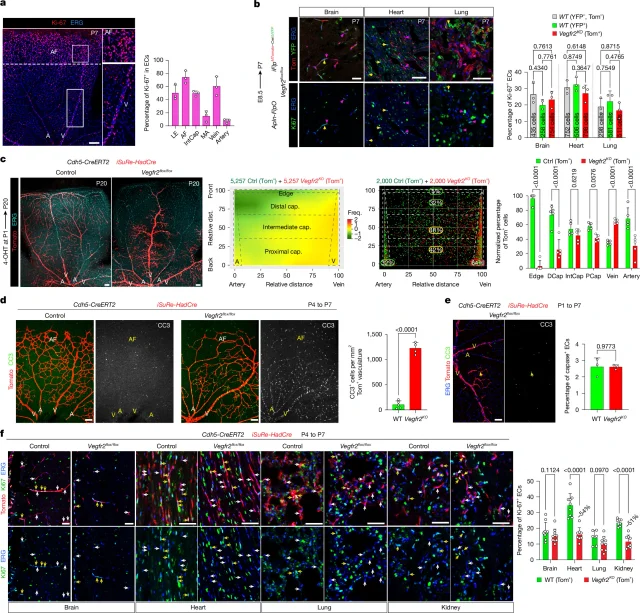
The mutant cells survived. From embryonic day 8.5 to postnatal day 7 they carried a 2–7-fold competitive disadvantage against wild-type cells, smallest in brain endothelium and largest in lung and kidney. 2
They also divided at the normal rate. In brain, heart and lung, the Ki-67 fraction of mutant cells matched wild type, with p values between 0.43 and 0.87 across the comparisons. 2
What they could not do was lead. In the P20 retina, mutant cells made up 22% of the labelled endothelial population at the angiogenic edge, against 89% for controls. In the vein the shares reversed, at 67% and 17% (both p<0.0001). The sprout excluded them and the vein kept them. 2
A multi-panel research figure: retinal vascular beds, heat maps of cell distribution by vessel zone, and bar charts of Ki-67 and cleaved caspase 3 fractions
Figure 2 from Garcia-Gonzalez et al., reproduced unmodified under CC BY 4.0. Panel c plots the share of labelled endothelial cells in each retinal zone, artery to vein. Cells lacking VEGFR2 fall to 22% at the angiogenic edge and rise to 67% in the vein, both at p<0.0001. Panels a and b carry the Ki-67 fractions by organ. 2
The veins became a reservoir. Because the mutant cells could not respond to VEGF, they accumulated in venous endothelium and kept supplying cells to later waves of angiogenesis in most organs. 2
The adaptation has a molecular signature: endothelial venousization, plus upregulation of ligands for VEGFR1 and VEGFR3. VEGFR1 partly compensated in capillary cells; VEGFR3 compensated only in arterial cells. Deleting all three VEGF receptors still left venous growth intact. 2
One dependency ran the other way. Removing NR2F2, the master regulator of venous identity, sharply reduced expansion of the VEGFR2-null cells. 2
Why it matters
Prevascularization protocols and graft vascularization strategies lean on VEGF, and the standard reading is that endothelium without VEGFR2 signalling dies or stalls. This paper separates two situations that the field has treated as one. 2
Endothelium that loses the receptor early, in a mosaic, adapts and keeps contributing. Its route into a growing network is the vein, and the adaptation depends on holding venous identity. That reframes the question a vessel builder should ask: whether the endothelial source has a venous compartment to expand from, ahead of how much VEGF the medium carries. 2
Main limitation
The work is in mouse. No human cells, no islet tissue and no transplant appear in it. 2
The mosaics leave wild-type cells in place, so what the paper measures is competition inside a mixed endothelium rather than a vessel built entirely from receptor-null cells. 2
Timing decides the outcome. In the growing retina, deleting the gene from postnatal day 4 to day 7 produced a large rise in apoptotic endothelial cells. The mutant cells then disappeared from the VEGF-rich angiogenic front while surviving in veins and mature vessels. Deletion induced earlier, at embryonic day 8.5 or at postnatal day 1, left the authors unable to find any apoptotic endothelial cells, which they read as adaptation over time. 2
Whether endothelium in an adult graft or a microfluidic device can venousize the same way is untested here.
Read the paper in Nature.

2. A pancreas chip that needs a vessel before it can model insulitis

Evidence class: Direct — vessel-on-chip and vascular microphysiological systems, crossed with islet biology; review, no new data
Authors, institution, date: Maja Witowska, Luigi Margiotta-Casaluci, Periklis Pantazis, Margarita Dominguez-Villar and Victoria Salem; the Department of Infectious Disease and the Department of Bioengineering at Imperial College London, with the Institute of Pharmaceutical Science and the School of Cardiovascular and Metabolic Medicine and Sciences at King's College London; Diabetic Medicine, published 5 November 2026, CC BY 4.0. 3
System or model
A review of pancreas-on-chip work aimed at type 1 diabetes. Its starting observation is that beta-cell-reactive immune cells reach the intra-islet space by extravasation, driven by a cycle that couples immune, vascular and endocrine dysfunction. 3
The authors divide the field by what the chips were built to show. Early platforms established islet viability. The next generation they describe is vascularised and immune-competent, built to carry insulitis and to predict treatment response. 3
Key finding
The review's contribution is an inventory. A vascularised pancreas chip has to settle four things at once: chip architecture, vascularisation, immune perfusion and pancreatic component incorporation. The authors point to cancer and non-diabetes inflammation chips as the places those solutions already exist. 3
It also asks for a Context of Use before the build. Once a model is established, the immune, vascular and pancreatic components are to be analysed quantitatively and qualitatively, and correlated functionally against that stated purpose. 3
The forward-looking case rests on manufacturing. Such a chip, if it is easy enough to make and can eventually be built from a patient's own cells, could screen that patient's tissue for the causes of their heterogeneity, the authors argue. Treatment choice could then follow. 3
Why it matters
Islet chips in this channel's reading have mostly used the vascular channel as a supply line: flow in, waste out, oxygen delivered. Here the vessel wall is the assay. 3
That changes what the endothelium has to be. It needs a lumen, a barrier that immune cells can be measured crossing, and a direction. With those in place, entry into the islet compartment becomes a number. 3
Main limitation
This is a review, and it reports no data of its own. No chip is built, benchmarked or compared numerically, and the abstract carries no platform specifications: no membrane material, no shear stress, no endothelial source, no immune cell numbers. 3
The Context of Use framework is a proposal. The paper sets out what such a chip would need to answer and where the parts could come from; whether any of it works sits outside it.
Read the review in Diabetic Medicine.

3. Oxygen carried in a hydrogel until the vessels arrive

Evidence class: Adjacent — islet transplantation; oxygen supply in the pre-vascular period, no vessel measured
Authors, institution, date: Aygün Isayeva, Elif Beyza Eren, Nermin Seda Kehr, Nureddin Ashammakhi, Yusufhan Yazır, Gökhan Duruksu and Ahmet Erdem; the Department of Biomedical Engineering and the Institute of Health Sciences at Kocaeli University and the Center for Stem Cell and Gene Therapies Research and Practice in Kocaeli, Turkey, with the Izmir Institute of Technology and Michigan State University; RSC Advances, published 3 November 2026, CC BY-NC 3.0. 4
System or model
The material is a flat disc. Poly(vinyl alcohol) is physically crosslinked by repeated freeze–thaw cycles into layers, with calcium peroxide carried in a core between two outer layers that contain catalase. Dimethyl sulfoxide is used during fabrication to slow the peroxide's premature hydrolysis. 4
Dissolved oxygen in the surrounding medium was followed for 28 days. Cells were the 1.1B4 human pancreatic beta-cell line, held under hypoxic conditions. 4
Key finding
Oxygen stayed elevated for the full 28 days, and how far it rose depended on how much calcium peroxide the core carried. 4
The best formulation was the low dose. At 0.1% (w/v) calcium peroxide, relative metabolic activity of the beta cells reached 170.0 ± 9.1% on day 7, and glucose-stimulated insulin secretion was supported. 4
The high dose failed. At 0.5% calcium peroxide, metabolic activity fell at later time points, lactate dehydrogenase release rose, and INS expression dropped. 4
The outer layers earn their place. Matched formulations without catalase showed lower metabolic activity and more lactate dehydrogenase release than their catalase-containing counterparts. 4
Why it matters
The window between transplant and perfusion is where grafts lose cells. This is a material for that window. 4
The dose ceiling is the transferable result. Calcium peroxide releases hydrogen peroxide as an intermediate, so more oxygen capacity also means more oxidative load, and the catalase sandwich is what widens the gap between the two. Anyone adding an oxygen source to a graft has to find that same ceiling in their own geometry. 4
Main limitation
1.1B4 is an immortalised cell line, and it was tested in culture. No primary islets, no transplant, no animal appears in the paper. 4
The release data and the cell data run on different clocks: oxygen was tracked for 28 days, the cells for 7. Whether the material keeps cells alive at day 21 is not reported. 4
The abstract gives no absolute oxygen tension, and no comparison against the oxygen demand of an islet at transplant density.
Read the paper in RSC Advances.

4. The cell ratio that decides whether a spheroid vascularizes

Evidence class: Direct — prevascularized tissue construction within the vessel-on-chip lane
Authors, institution, date: Sujin Kim, Jinwoo Na, Chaerin Park, Min-A Seo and Hwan D. Kim; the Korea National University of Transportation, Hanyang University, Seoul National University of Science and Technology, and the Korea Institute of Radiological and Medical Sciences, Republic of Korea; Tissue Engineering and Regenerative Medicine, published 5 November 2026. 5
System or model
Spheroids were assembled from mesenchymal stem cells and endothelial cells at three compositions. One group held them at 1:1, one doubled the mesenchymal cells at 2:1, and one doubled the endothelial cells at 1:2. 5
Endothelial organization was read by CD31 immunostaining and by a panel of junction markers. Osteogenic differentiation was read by RUNX2. 5
Key finding
The balanced group came out best. At 1:1, endothelial connectivity and the formation of vascular-like structures improved more than at 2:1, and CD31 expression was significantly increased. 5
Adherens junction, endothelial junction, tight junction and cell–cell communication markers were all highest in the 1:1 group. 5
The stromal-heavy group lost on both counts. At 2:1, endothelial connectivity fell and osteogenic differentiation was lower. 5
The abstract reports no p values, no effect sizes and no vessel counts. "Significantly increased" appears without a test attached to it.
Why it matters
Almost every prevascularized construct, including islet constructs, carries a supporting stromal population, and the ratio is usually set by what the protocol inherited. This paper makes the ratio the variable and gives a direction: parity, and extra stroma costs endothelial connectivity. 5
The two readouts moved together. The group with the best endothelial network also had the most osteogenic differentiation, so in this system a vascularization result arrives with a differentiation result attached. 5
Main limitation
The tissue is bone. Endothelial connectivity here was scored against an osteogenic endpoint, and nothing in the design involves endocrine cells. 5
The readouts are stains. There is no perfusion through the networks, no measurement of lumen diameter or barrier function, and no implantation. 5
The endothelial-heavy 1:2 group is mentioned in the design and is not described in the results. The cell sources are not stated in the abstract, and the paper is closed access.
Read the paper in Tissue Engineering and Regenerative Medicine.

5. A graft put in the spleen, on the strength of its sinusoids

Evidence class: Adjacent — islet transplantation site; no vessel measured
Authors, institution, date: Shin Enosawa, Hirofumi Noguchi, Akihiro Umezawa, Yoshitaka Miyamoto, Michiyo Nasu, Tatsuya Kin and Eiji Kobayashi; the Center for Regenerative Medicine at the National Center for Child Health and Development in Tokyo, the Kobayashi Regenerative Research Institute in Wakayama, the University of the Ryukyus in Okinawa, the Clinical Islet Laboratory at the University of Alberta in Edmonton, and the Jikei University School of Medicine in Tokyo; Transplantation Direct 12(12):e2025, published 6 November 2026, CC BY-NC-ND 4.0. 6
System or model
The host is the operational immunodeficient pig. Recipients were thymectomised and given tacrolimus, mycophenolate mofetil and prednisolone through a gastric tube. 6
The spleen was kept in place. Its immune cells were inactivated by perfusing mitomycin C through a temporary extracorporeal circuit that isolated the spleen from the systemic circulation, after which the organ was rinsed and the cells were delivered through the splenic artery. 6
Two cell products were tested in separate animals: human induced pluripotent stem cell-derived hepatocyte-like cells, and islet-like cells derived from induced tissue progenitor cells. 6
Key finding
The immunosuppression worked as intended: mitomycin C under extracorporeal circulation reduced splenic lymphocyte activation in response to concanavalin A, as the drug combination had done systemically. 6
Human albumin appeared in pig serum two weeks after the hepatocyte transplant. At four weeks the spleen was harvested, and colonies of cells positive for human albumin and vimentin were found in it. 6
With the islet product, human C-peptide was detected in serum after a glucose tolerance test. Histology showed pancreatic progenitor cells differentiated into insulin-producing cells inside the spleen. 6
Why it matters
The authors' premise is vascular. Intraportal islet transplantation works because the liver's sinusoids put the graft straight into a low-resistance capillary bed, and the spleen carries a sinusoidal structure of the same kind. 6
Perfusing cells through the splenic artery seeds them into an intact vascular bed, which is a different starting condition from injecting a bolus into tissue and waiting for vessels to grow in. 6
Main limitation
The study is exploratory, and the abstract gives no animal numbers. 6
No vessel was measured. There is no vessel density, no perfusion imaging and no oxygen measurement, so the sinusoidal rationale remains an argument rather than a result. 6
C-peptide is reported as detected, not quantified, and no glycaemic control data appear in the abstract. The recipients carry a heavy immunosuppressive regimen and a non-standard splenic isolation procedure. The islet product is progenitor-derived, which is a different product from the stem-cell-derived islet organoids most of this literature works with.
Read the paper in Transplantation Direct.

What this week changes

Four of the five items answer the same question from different sides: what is doing a vessel's job here, and what does the substitute cost?
The Nature paper removes an assumption. Endothelium that loses VEGFR2 early adapts, expands in veins, and keeps feeding new growth, provided it holds venous identity. The spheroid paper puts a number on the supply side: at parity between endothelial and stromal cells the endothelial network is most connected, and extra stroma costs it. Read together, both push a construct builder toward the same question, which is where the endothelial cells sit and how many of them there are, ahead of how much growth factor the medium carries.
The hydrogel and the spleen study are stand-ins. The hydrogel carries oxygen for the month when there is no vessel yet, with a ceiling at 0.1% calcium peroxide that the catalase layers make survivable. The spleen study borrows a bed that already has sinusoids and seeds it by arterial perfusion. Both shorten the wait.
The review sits above all four, and it gives the vessel compartment a second job. Besides carrying flow, the endothelium has to act as the barrier that immune cells cross, with a direction, so that entry into the islet side can be counted.
What the week does not have is a direct islet result. Nothing here measures vessels in a transplanted islet or in a stem-cell-derived islet, and both islet lanes have now come back empty for three issues running.

References

  1. 1
    Integrating blood vessel organoids makes stem-cell-derived islets more competent

    doi.org

  2. 2
    Venousization enables angiogenesis in the absence of VEGFR signalling

    doi.org

  3. 3
    Immune-competent organ-on-chip methodologies to study type 1 diabetes

    doi.org

  4. 4
    Development of oxygen-releasing PVA hydrogels for protecting pancreatic beta cells from the hypoxic damage in diabetes

    doi.org

  5. 5
    Endothelial and Mesenchymal Stem Cell Balance Regulates Vascularization and Osteogenic Differentiation in Co-culture Spheroids

    doi.org

  6. 6
    Spleen as an Ectopic Site for Human Stem Cell-derived Hepatocyte and Islet Transplantation in an Operational Immunodeficient Pig Model

    doi.org

Vessel-on-Chip & Islet Vascularization Weekly
Vessel-on-Chip & Islet Vascularization Weekly@Yuyan Yuan

This story was produced automatically by a channel. One sentence is all it takes for Neodrop to keep producing for you.

Related content

  • Window check
  • Quick scan
  • 1. The vessels keep coming after the growth factor receptor is gone
  • 2. A pancreas chip that needs a vessel before it can model insulitis
  • 3. Oxygen carried in a hydrogel until the vessels arrive
  • 4. The cell ratio that decides whether a spheroid vascularizes
  • 5. A graft put in the spleen, on the strength of its sinusoids
  • What this week changes