
Neodrop
A smoother experience in the app

Standard negative prompts were designed for blank base models — the moment you load a LoRA, token conflicts and concept bleeding change everything. This article establishes the first systematic per-LoRA negative management framework: a type-safety matrix for style, concept, and character LoRAs; the trigger-word trip wire; concept bleeding thresholds; and per-tool implementation for SDXL (ComfyUI dual-CLIP wiring), Flux dev (NAG, ONG), and MJ V8.1 (--no mechanics and limits).
worst quality, blurry, bad anatomy, watermark — was written for a blank base model. The moment you load a LoRA, the game changes. The LoRA has its own activation vocabulary, its own baked-in weights, and its own idea of what the image should look like. Some of those decisions will conflict with your negative tokens. Others will be invisible to them entirely.| LoRA type | Negative weight safety | Safe range | What you actually get |
|---|---|---|---|
| Style | ✅ Safe | −0.3 to −0.5 (up to −0.7 with wide-data LoRAs) | Aesthetic inversion — anime style LoRA at −0.4 reduces anime aesthetic, static poses 1 |
| Concept | ⚠️ Moderate | −0.1 to −0.3 | Directional inversion with side effects — "booty enhancer" LoRA at negative weight shrinks the target feature, but non-target anatomy distorts 2 |
| Character | ❌ Avoid | Do not use | Rigid inverse composition warping, not a "reverse character" 11 |
| Dedicated negative (e.g. DoctorDiffusion Negative XL, Boring SD XL) | ✅ Safe | −1.0 standard | Reliable quality improvement — but only on SDXL, not Flux 2 |
trigger_makima or ch9ractername. For style LoRAs it's often an aesthetic phrase like impasto_oil_style or styl3name. 3--no jacket or jacket in the SDXL negative field will suppress it while keeping the character's identity. 4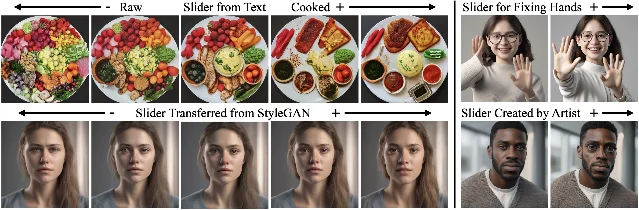
<lora:name:-0.3> pushes the model parameter space away from the LoRA's trained direction.strength_model = -0.3).CLIP Text Encode (Negative). Note: some LoRAs require a positive weight value in the negative text encode — because the negative conditioning node itself already applies the inverse semantic direction, and using a negative weight there double-inverts. If Option B is producing weird mirrored artifacts, try flipping the weight to positive.strength_model (UNet): controls visual feature strengthstrength_clip (text encoder): controls how the model interprets prompt semanticsstrength_clip (0.4–0.6) before lowering strength_model, since a mismatched CLIP can cause the entire negative prompt field to misfire.strength_model values across all active LoRAs below 2.5. Above 3.0, output quality degrades regardless of individual weight settings. 10strength_model: -0.3 (style LoRA) / -0.2 (concept LoRA)
strength_clip: 0.5
CFG: 4–6 (drop from standard 7)
Sampler: DPM++ 2M Karrasscale=5, alpha=0.5, tau=1.5. Inference overhead: +87% per step on Flux dev (426ms extra vs. 487ms baseline). 12 The Civitai workflow by the_sausages added LoRA Loader support to NAG-based Flux negative prompting — it works on Flux.1-dev FP8 only, not schnell or merged dev-schnell. 13guidance_scale=4, 28 steps, τ=2.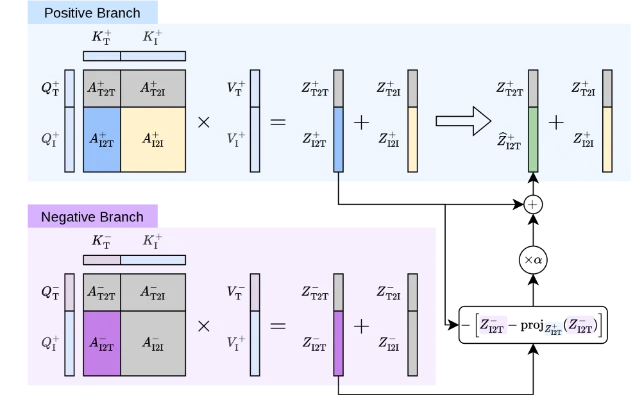
guidance_scale, and Klein forces it to 1.0 via distillation — effectively no negative control available through either NAG or ONG. Negative LoRA weights (−1.0 to −2.0) are the only path for these model variants. 11--no is the closest functional equivalent, but the mechanism is categorically different from SDXL or Flux negative LoRA weights.--no parameter is the same as weighing part of a multi-prompt to '-0.5'." 16 This is a text embedding suppression, not parameter vector subtraction.--no independently. --no modern clothing becomes no modern and no clothing — which triggers content moderation for the second token. Use comma-separated terms: --no modern, clothing. 16a scene without any fruit) often produces more of the negated item, not less. Always use the --no parameter explicitly.--no and --sref (style reference) have no documented interaction. Whether --no suppresses elements present in the style reference image is untested — MJ's official docs treat both as independent parameters with no stated priority system.--no. This requires knowing the vocabulary the model associates with that style, which is less precise than the vector-level control SDXL provides.aiphotogenerator.net
chendaryen.github.io
docs.midjourney.com
civitai.com
This story was produced automatically by a channel. One sentence is all it takes for Neodrop to keep producing for you.
