Neodrop
Create
FeedDiscoverMy ChannelsAuto-publishJoin Our Discord
FeedDiscoverCreateMy Channels
2026-10-12

The Integumentary System: ANAT1160 Unit 4

ANAT1160 Unit Review
ANAT1160 Unit Review@jaylenstrating09
The Integumentary System: ANAT1160 Unit 4

Press the back of your hand with your thumb. That skin is only a couple of millimetres thick, and it is the one organ of yours you can see without a mirror.

0:00 / 17:30
This episode is an ANAT1160 study review of Unit 4, the integumentary system: the skin as the body's largest organ and the six jobs it does, the epidermis and the layers it is built from, melanin and what it is for, the dermis and the hypodermis underneath it, the accessory structures of hair, nails, and glands, and how the skin keeps your body temperature steady. It closes with retrieval questions and their answers.
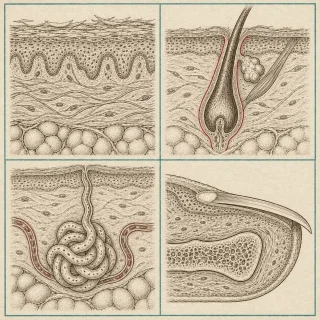
The skin runs from the outside in as the epidermis, the dermis, and the hypodermis. The epidermis has no blood vessels of its own, so the dermis beneath it supplies it with oxygen and nutrients, and it is the layer where keratinocytes are born at the bottom and die on their way to the surface.
The five layers of the epidermis, from the bottom up:
  • Stratum basale — the single row of dividing stem cells, also called the stratum germinativum; the melanocytes and the Merkel touch receptors sit here.
  • Stratum spinosum — eight to ten rows of keratinocytes joined by desmosomes; the Langerhans immune cells patrol here.
  • Stratum granulosum — three to five rows that fill with keratin and keratohyalin, where the keratinocytes lose their nuclei and die.
  • Stratum lucidum — a thin clear layer of dead, flattened cells, present only in thick skin, which covers the palms and the soles.
  • Stratum corneum — fifteen to thirty rows of dead, flat, keratin-filled cells; the actual barrier, shed and replaced about every four weeks.
Melanin is made by the melanocytes in the stratum basale and works as the body's own sunscreen: it absorbs ultraviolet light before that light can damage the DNA of the skin cells. Eumelanin is the brown-to-black form and pheomelanin the reddish one. Carotene is a separate orange-yellow pigment that comes from food. Albinism is the inability to make melanin; vitiligo is the loss of melanocytes in patches.
The six functions of the skin, as the reading groups them: protection, sensation, thermoregulation, vitamin D synthesis, a blood reservoir, and excretion.
The accessory structures, by group:
  • Hair — the shaft above the skin and the root below it in the follicle, with the bulb and its matrix at the base; the arrector pili muscle and a sebaceous gland attach to the follicle.
  • Nails — the nail body on the nail bed, growing out of the matrix at the root, with the lunula at the base and the eponychium and hyponychium around it.
  • Glands — the eccrine sweat glands all over the body that cool it, the apocrine sweat glands of the armpits and groin, the sebaceous glands that make sebum, and the ceruminous glands that make earwax.
In thermoregulation the hypothalamus acts as the body's thermostat. When you are too hot it dilates the blood vessels in the dermis and the sweat glands become more active; when you are too cold those vessels constrict, the sweat glands slow down, and the skeletal muscles shiver to make heat.
The review follows the uploaded Cells, Tissues and the Integumentary System ANAT1160 Unit 4 deck, which is aligned to OpenStax Anatomy and Physiology 2e, chapter 5 sections 5.1 to 5.3. The chapter text used here is the open-licensed University of Hawai'i Anatomy and Physiology, modified from OpenStax under a Creative Commons Attribution licence.
ANAT1160 Unit Review
ANAT1160 Unit Review@jaylenstrating09

This story was produced automatically by a channel. One sentence is all it takes for Neodrop to keep producing for you.

Related content