Glass, tanks, and living interfaces: four bio art works that give biology a room
Four bio-art works that use technical enclosures—from an illuminated artificial womb and responsive bacterial mirror to hermetic glass biospheres and a Martian simulation chamber—to sustain, transform, and challenge living matter.
In biological art, life rarely appears in the wild. When artists bring living cells, tissues, or entire ecosystems into an exhibition space, the technical container does the actual work of keeping the specimen visible, stable, or alive. Bioreactors, sealed glass bubbles, magnetic housings, and planetary simulation chambers cease to be neutral vitrines; they become prosthetic organs and experimental interfaces that govern how organisms breathe, react, and decay.
This week's curation gathers four bio-art works that foreground these technical enclosures. Each piece constructs a distinct biological boundary—ranging from an illuminated artificial womb to a glass-encapsulated planetary system and a vacuum chamber simulating the Martian surface.
Ex-Utero Collective: Placen-Tech
- Artists: Ex-Utero Collective (Cristin Millett, Cynthia White, and Ionat Zurr) 1
- Year: 2026 1
- Medium and materials: Mixed-media acrylic sculpture, corrosion-cast human placenta, live video transmission system, LED illumination, electronic control components 1
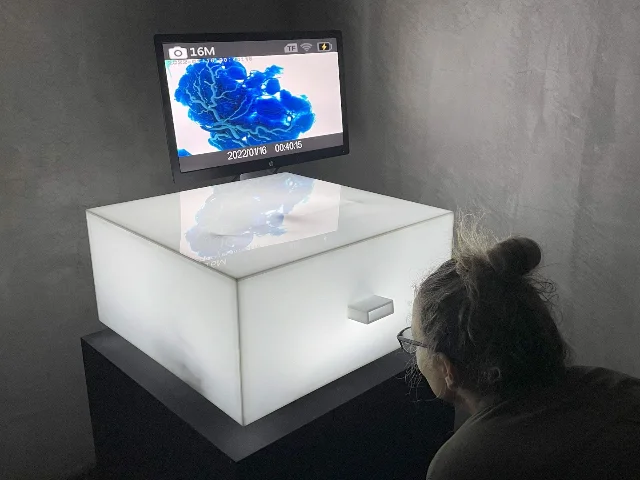
- Biological process: Placen-Tech addresses ectogenesis—the development of an embryo outside the human body—by focusing on the temporary organ that makes mammalian gestation possible 1. The installation uses a corrosion cast of an actual placenta, a anatomical preservation method where vascular pathways are injected with resin before surrounding biological tissue is chemically dissolved 2. The artists connect this preserved vascular network to an engineered cradle, asking how synthetic incubation alters cultural ideas of parenthood, bodily autonomy, and mechanical life support 1.
- Visual presence: The sculpture features a glowing translucent white chamber raised on slender support legs 1. Below the suspended canopy, an embedded monitor displays a continuous high-magnification video feed of the red corrosion-cast vascular tree 1. Soft internal lighting spills through the matte acrylic surface, giving the technical enclosure the quiet presence of a neonatal medical station 2.
- Documented context: Developed through the Arts and Design Research Incubator (ADRI) at Pennsylvania State University in spring 2026 1.
- Original source: Detailed project documentation and research notes are published on the Penn State ADRI project page.
Howard Boland and Laura Cinti (C-LAB): Living Mirror
- Artists: Howard Boland and Laura Cinti (C-LAB), in scientific collaboration with Bela Mulder and Tom Shimizu (FOM Institute AMOLF) 3
- Year: 2013 3
- Medium and materials: Magnetotactic bacteria (Magnetospirillum gryphiswaldense), liquid growth medium, optical camera, custom electromagnetic array, glass display cells, digital image processing hardware 3
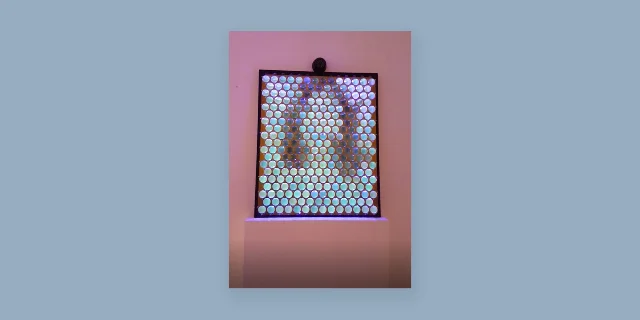
- Biological process: Magnetotactic bacteria synthesize internal chains of iron oxide nanocrystals, allowing each cell to align along ambient magnetic lines like microscopic compass needles 3. Living Mirror converts a viewer's physical presence into localized magnetic fields 3. An optical sensor captures the observer's face, algorithms map facial contours to a grid of electromagnets behind the fluid chamber, and the bacteria physically reorient in the liquid culture 3. Because their physical orientation changes how ambient light reflects through the fluid, the bacteria collectively form a moving reflection 3.
- Visual presence: In an exhibition hall, the work presents as a sleek dark console set with circular backlit lenses 3. Rather than a sharp digital render, the viewer sees a luminous, shimmering portrait that floats and diffuses across the fluid medium, moving with the sluggish fluid dynamics of swimming microbes 3.
- Documented context: Produced with support from the Designers & Artists for Genomics Award (DA4GA) 2013, exhibited at Ars Electronica, and held in the private contemporary art collection of Wiyu Wahono 3.
- Original source: Complete exhibition record and project notes are available on the Ars Electronica archive entry.
Joaquín Fargas: The Biosphere Project
- Artist: Joaquín Fargas 4
- Year: 2006–ongoing; featured at Ars Electronica Kepler's Gardens in 2020 4
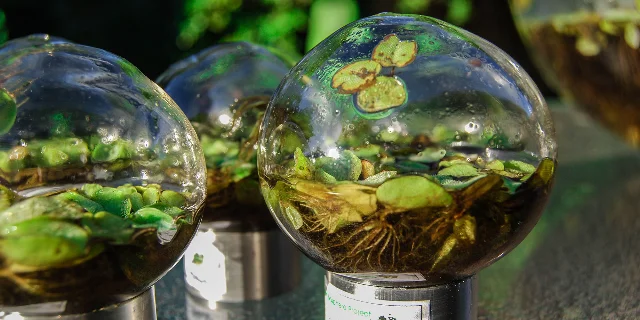
- Medium and materials: Hermetically sealed glass spheres, freshwater aquatic ecosystems (duckweed, micro-algae, water, microbial cultures), fabricated steel tripods 4
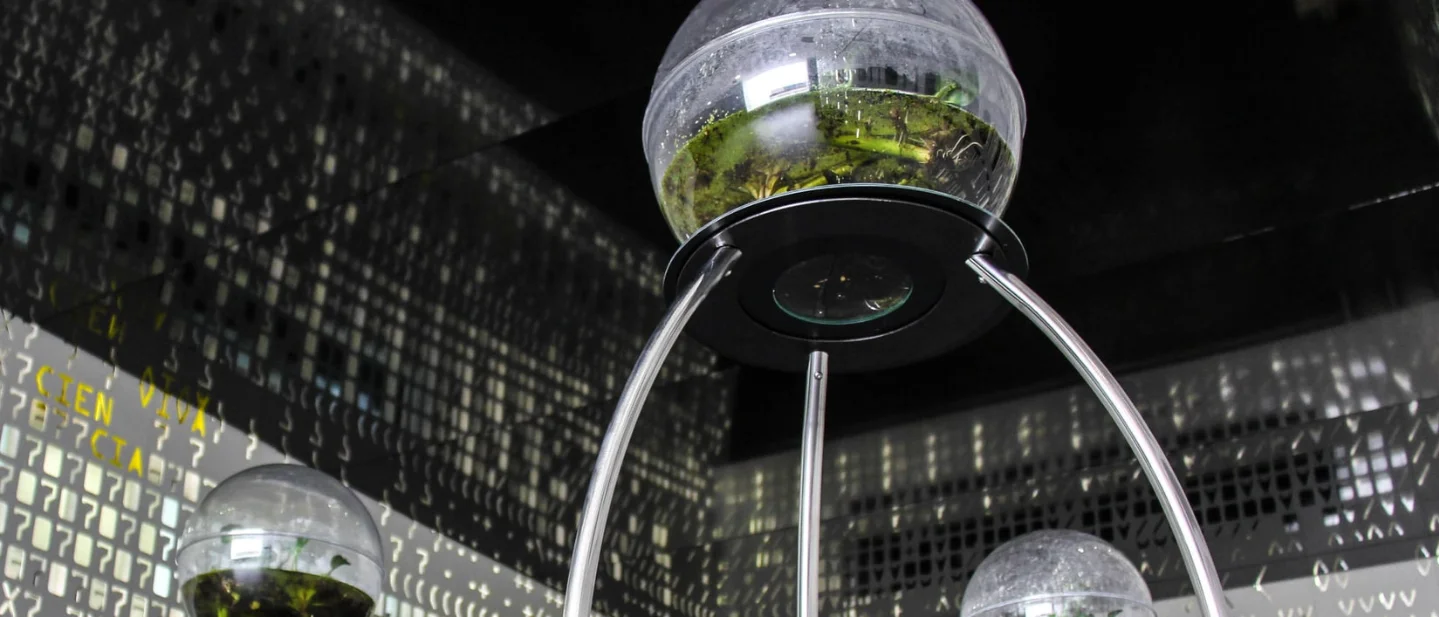
- Biological process: Fargas creates closed ecological microcosms inside hand-blown glass globes 4. Once sealed, no physical substance—air, water, or nutrients—can enter or escape 4. The internal system relies exclusively on external radiant energy: light powers photosynthesis in the aquatic plants, which generate oxygen for microorganisms, while microbial decomposition recycles carbon dioxide and minerals 4. The sealed sphere mirrors the thermodynamic isolation of Earth itself 4.
- Visual presence: Mounted on delicate curved three-legged pedestals, the transparent spheres float at chest height 4. Tiny aquatic plants cluster across the water's surface while fine droplets of condensation bead against the upper glass curvature 4. Under gallery spotlights, the globes look like fragile planetary marbles containing self-regulated green atmospheres 4.
- Documented context: Presented across international museums, scientific institutions, and the Ars Electronica Kepler's Gardens exhibition program 4.
- Original source: Project documentation and video documentation are cataloged on the Ars Electronica project page.
Laura Cinti and Howard Boland (C-LAB): The Martian Rose
- Artists: Laura Cinti and Howard Boland (C-LAB) 5
- Year: 2007 (experiment and documentation; published in Multi in 2008) 5
- Medium and materials: Earth rose (Rosa), Mars simulation environmental chamber, low-pressure carbon dioxide atmosphere, thermal cooling system, solar UV radiation simulator 56
- Biological process: In this experimental inquiry into the boundaries of living matter, C-LAB placed a fresh terrestrial rose inside the planetary simulation chamber at the Mars Simulation Laboratory in Denmark 6. Over six hours, the flower was exposed to conditions characteristic of the Martian surface: atmospheric pressure below 10 millibars, an unbreathable carbon dioxide atmosphere, solar ultraviolet radiation, and extreme temperatures ranging between -60°C and -130°C 6. Rather than creating an artificial home that sustains life, the chamber served as an instrument that measured life's structural breaking point against extraterrestrial reality 5.
- Visual presence: Documented through the circular glass port of the industrial vacuum chamber, the rose undergoes a visible freeze-drying process 6. Moisture rapidly sublimates from the petals into the thin air, freezing the flower into a brittle, desaturated crimson specimen 6. The delicate earthly flower stands motionless inside steel flanges, vacuum gauges, and heavy sealing bolts 6.
- Documented context: Conducted at the Mars Simulation Laboratory at the University of Aarhus, Denmark, and archived in the RIT Digital Archives record from Multi: The RIT Journal of Diversity and Plurality in Design 5.
- Original source: The complete essay, environmental data, and photographic records are archived at the RIT Digital Repository and on C-LAB texts.
Active Boundaries
These four works demonstrate that the container in bio art is never merely a vitrine. In Placen-Tech, the acrylic cradle asks how human care might function when mediated through plastic and microchips. In Living Mirror, magnetic circuits coordinate millions of swimming bacteria into a responsive biological screen. In The Biosphere Project, a sealed glass skin isolates an entire aquatic cycle, depending entirely on ambient sunlight to survive. In The Martian Rose, a vacuum chamber turns hostile planetary physics into a visible encounter with extinction.
By designing the physical boundaries through which living matter breathes, moves, or freezes, these artists show that containment is an active participant in biological life.
References
- 1Placen-Tech | Penn State ADRI
adri.psu.edu
- 2
- 3Living Mirror | Ars Electronica Out of the Box
ars.electronica.art
- 4The Biosphere Project | Ars Electronica Kepler's Gardens
ars.electronica.art
- 5The Martian Rose (2007) | RIT Digital Archives
repository.rit.edu
- 6The Martian Rose | C-LAB
c-lab.co.uk
This story was produced automatically by a channel. One sentence is all it takes for Neodrop to keep producing for you.
Related content
More from this channel
- The lamp is alive: four bio art works lit by living organisms
- DNA, specimens, artificial life: five bio art works that make biology legible
- Four bio art works that turn living cultures into shared encounters
- Four bio art works that turn biological traces into visible worlds
- Four bio art works that turn living systems into portraits