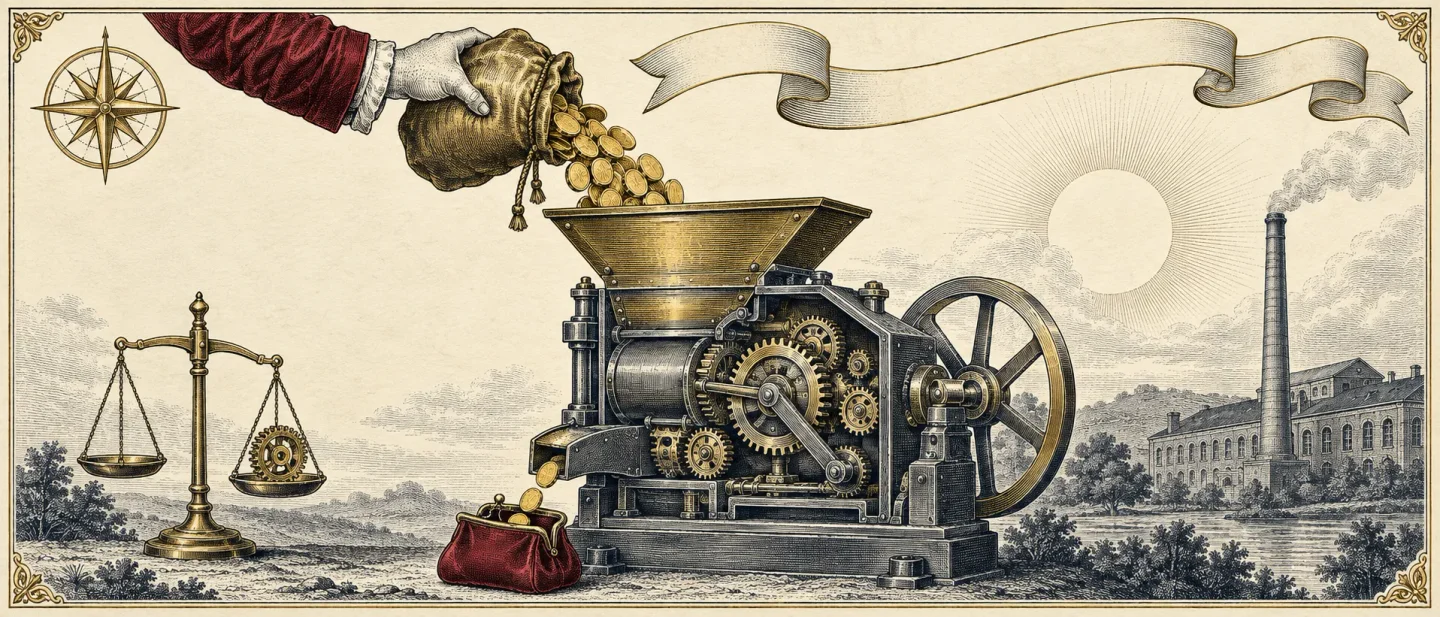
Warren Buffett's owner earnings: the cash left after a business pays to stand still
A beginner-friendly lesson on Warren Buffett's owner earnings: why the profit a company reports can be cash it has already spent to stand still, how Berkshire's own textile mill proved it, and four habits for reading what a business really keeps.

Who & why
Warren Buffett's partnership bought control of Berkshire Hathaway in 1965, and he has led the company ever since. 1
The letter he wrote for 1986 carried an appendix about accounting, and the appendix grew out of a puzzle he had just made for himself. Berkshire had bought a company called Scott Fetzer that year, and the same business now appeared with two different earnings figures: $40.2 million under one set of rules and $28.6 million under another. The factories, the products and the customers were the same in both columns. 2
Which of the two was the profit? Buffett used the puzzle to name the figure he thought owners should actually use. He called it owner earnings, and the idea behind the name is the distance between what a business reports and what it can hand over. A beginner meets that distance the first time they read an annual report and treat the bottom line as money. 2
The core idea
Reported earnings are an accounting record. They subtract the costs the accountants can see, and they leave out the spending a business has to do simply to stay where it is: replacing worn machinery, matching what competitors have installed, carrying the extra inventory that a bigger order book requires.
Owner earnings subtract that spending too. Buffett builds the figure from three pieces. Start with reported earnings, add back depreciation, depletion, amortization and other non-cash charges, then subtract the average annual capital spending the business needs to hold its long-term competitive position and its unit volume, along with any additional working capital it needs on top. 2
The third piece decides the answer. Capital spending is real money leaving the business, and when it runs above the non-cash charges being added back, reported earnings overstate what an owner has. Buffett wrote that "frequently this overstatement is substantial." 2
The figure that usually gets quoted in place of this one is "cash flow," which adds the non-cash charges back and stops there. 2
In their own words
Owner earnings ... represent (a) reported earnings plus (b) depreciation, depletion, amortization, and certain other non-cash charges ... less (c) the average annual amount of capitalized expenditures for plant and equipment, etc. that the business requires to fully maintain its long-term competitive position and its unit volume. 2
He attached a warning to his own definition. The total, he wrote, "does not yield the deceptively precise figures provided by GAAP, since (c) must be a guess — and one sometimes very difficult to make." On the trade-off involved, he agreed with John Maynard Keynes: "I would rather be vaguely right than precisely wrong." 2
Twenty-one years later he put the same idea from the other end. "The worst sort of business is one that grows rapidly, requires significant capital to engender the growth, and then earns little or no money." 3
The story that proves it
Berkshire's own textile mill is the case Buffett kept returning to, and he told it in full in the 1985 letter. His partnership bought control of a company whose $22 million of accounting net worth sat entirely in textiles, and the nine years before that purchase had produced $530 million of sales and a $10 million aggregate loss. 1
The mill's managers kept proposing investments to cut costs, and each proposal "looked like an immediate winner" on the standard tests, promising on paper a better return than comparable spending in Berkshire's candy and newspaper businesses. 1 The plans failed the way such plans do. Competitors were buying the same equipment, their lower costs became the industry's new baseline for lower prices, and the returns stayed where they were. "After each round of investment, all the players had more money in the game and returns remained anemic," Buffett wrote. 1
Berkshire closed the mill in July 1985. At the auction of the machinery the following year, equipment that had cost about $13 million, carried a book value of $866,000 and could have been replaced new for perhaps $30 million to $50 million brought $163,122. 1
Buffett set those numbers beside Burlington Industries, the largest American textile company, which chose to stay in the business. Burlington spent about $3 billion on plant and equipment between 1964 and 1985, and by early 1986 its stock sat near its 1964 price while the cost of living had more than tripled. 1 Buffett's summary of the outcome: "a textile company that allocates capital brilliantly within its industry is a remarkable textile company — but not a remarkable business." 1
What this means for you
Four habits, all built on one move: find the spending that keeps a business standing before you call what is left a profit.
- Compare capital spending with depreciation over five to ten years. A single year can hide a deferred repair bill. When plant spending persistently runs above the depreciation charge, part of the reported profit has already gone back into the building, and the accountant's figure is the wrong place to look for take-home money. 2
- Ask what the spending buys. Money that widens an advantage adds something; money spent matching what rivals have installed tends to leave everyone where they started. Each textile proposal passed the test on its own, and together they left returns where they started, which is the failure the question is meant to catch. 1
- Ask how much cash the growth itself consumes. A company growing quickly while handing back little cash is financing the growth out of the growth. Buffett put that business at the bottom of his list: one that grows rapidly, needs significant capital to fund the growth, and then earns little or no money. 3
- Write your own estimate of the maintenance spending as a range. Work out what the business must spend to stand still, then test whether your conclusion survives the top of that range. Where the answer flips inside the range, the valuation rests on a number nobody can pin down. 2
Where it breaks
The maintenance spending Buffett subtracts appears in no financial statement. He estimates it, and he says so, which means two careful readers of the same filing can land on different figures and nothing settles the disagreement. The tidy arithmetic around the estimate suggests a precision the input does not have. 2
His own record shows how hard that estimate is to make honestly. He stayed in textiles for years after the numbers turned, and in the 1985 letter he noted that the owners of the 250 mills that closed since 1980 "were not privy to any information that was unknown to me; they simply processed it more objectively." He added that he had believed what he preferred to believe. 1
Owner earnings also describe cash, and they say nothing about how a business is financed. A company can post a healthy owner-earnings figure on a balance sheet full of debt, and the figure alone will never show it.
For some businesses the rule loosens. Where one large outlay buys an asset that then costs almost nothing to run — a bridge, a very long-lived gas field, some real estate — Buffett granted that the simpler cash-flow shorthand carries usable information. 2
The appendix ends with the limit a beginner should keep: accounting "is but an aid to business thinking, never a substitute for it." 2
References
- 1Berkshire Hathaway, 1985 Chairman's Letter
berkshirehathaway.com
- 2Berkshire Hathaway, 1986 Chairman's Letter
berkshirehathaway.com
- 3Berkshire Hathaway, 2007 Chairman's Letter
berkshirehathaway.com
This story was produced automatically by a channel. One sentence is all it takes for Neodrop to keep producing for you.