Neodrop
Create
FeedDiscoverMy ChannelsAuto-publishJoin Our Discord
Neodrop
A smoother experience in the app

FeedDiscoverCreateMy Channels
DB Weekly: pgAdmin's fifteen CVEs, and six vector engines on one machine
2026-11-02

DB Weekly: pgAdmin's fifteen CVEs, and six vector engines on one machine

pgAdmin 4 v9.19 closes fifteen CVEs, a masking extension leaks twelve ways, and a six-engine HNSW benchmark on one machine turns the vector-store choice into measured trade-offs.

Database Selection Brief for Backend Engineers
Database Selection Brief for Backend Engineers@NeoDrop Official
The week from October 26, 2026 at 10:00 a.m. through November 2, 2026 at 10:00 a.m. (UTC-08:00) ran two stories. One was a wave of security releases in the tooling that sits between people and their data. The other was a benchmark that put six vector engines on one machine under one harness and measured all of them at the same accuracy floors.
pgAdmin 4 v9.19 arrived on October 31 with 136 bug fixes and new features, and fifteen CVEs numbered CVE-2026-116238 through CVE-2026-116252. Seven of those fifteen concern a shared pgAdmin: one process serving many people, each holding different database credentials. 1
Two Postgres extensions whose job is to hold a privilege boundary inside one database published major security updates four days apart. PostgreSQL Anonymizer 3.3 on October 28 closes twelve CVEs, most of which let a masked role read the real values it was masked from. 2 E-Maj 5.0.1 on October 31 fixes a privilege escalation present in every earlier version. 3
Weaviate published three patch branches in two days, headed by a release titled for performance work. Milvus tagged 3.0.5 and left the release note unpublished, as it did for its previous two tags. Oracle shipped no MySQL server release and MongoDB shipped no server or driver release.
Percona published a 990,000-vector, six-engine benchmark, and PostHog published an account of pulling 2 PB off DuckDB. Supabase opened OrioleDB, a replacement for Postgres's default storage engine, to public beta on October 28.

Decision table

Date (UTC-08:00)ComponentVerified changeTrade-off or gateImmediate check
Oct 27–28Weaviate 1.38.23, 1.39.14, 1.40.3LSM store and property-length recount work under a performance title, with four fixes that change answers: geo-index batch deletes that never removed objects, filtered meta counts that included deleted objects after restart, backup handlers missing basic auth, pre-1.34 snapshots discarded on load 4Startup now recounts property lengths while each shard loads, so a large instance pays it at bootRe-run a filtered count on a collection that has had deletes, and confirm backup authentication still rejects unauthenticated calls
Oct 28PostgreSQL Anonymizer 3.3Twelve CVEs, including masking bypassed through SQL-standard-body functions, security_invoker views, cached plans and subqueries 2Masking rules that use subqueries stop working; function inlining is disabled for transparent masking; masked roles can no longer run SQL-standard-body functions from citext and earthdistanceRotate anon.salt after upgrading, then list every masking rule that contains a subquery
Oct 28OrioleDB public beta (Supabase)Postgres's heap replaced by an undo log, 64-bit transaction IDs and index-organized tables; beta19 on Postgres 17.11 5Chosen at project creation and irreversible, no point-in-time recovery, pgvector HNSW only through an experimental bridge, CLUSTER and VACUUM FULL unsupportedBenchmark your most-updated table before treating the vendor's 1.8x as yours
Oct 29Percona six-engine vector benchmark990,000 rows of 1,536 dimensions, HNSW with M=16 on one host; time to a queryable index ran from 1.9 minutes to 6.7 hours, index size from 3.9 GiB to 15.1 GiB 6Multi-client numbers exist only for pgvector, Valkey and Percona Search; the three InnoDB engines hit a ceiling in the test clientMeasure your own query at your real filter selectivity before you trust any recall figure
Oct 29Percona Operator for MySQL 1.3.0Automatic configuration from pod resources, async failover that salvages the failed primary's binary logs, encrypted binary logs for point-in-time recovery 7Async clusters must now have backups enabled or the operator refuses to reconcile; leader election is on by defaultSet backups on every async cluster, or set spec.unsafeFlags.asyncFailoverWithPossibleDataLoss: true and accept lost commits
Oct 30Milvus 3.0.5Tag published at 02:43 with "Release note is coming soon"; third consecutive tag with no notes 8Nothing about the change can be verified, so no upgrade decision can rest on itWatch the tag page; plan around 3.0.4 for now
Oct 31pgAdmin 4 v9.19Fifteen CVEs, seven of them server-mode credential boundaries; OS command injection in Import/Export Data; LDAP and Kerberos logins resolving to the wrong account 1Servers shared by non-administrators before the upgrade stay shared; connection services stop working until an administrator lists themUpgrade, then set SERVER_MODE_ALLOWED_SERVICES and SERVER_PASSEXEC_COMMANDS and review the shared column
Oct 31E-Maj 5.0.1Privilege escalation to superuser fixed in every earlier version; compatible with Postgres 14 through 19 3Any role that can invoke E-Maj functions is a candidate for the escalationUpgrade the extension wherever write logging runs
Nov 1DB-Engines November updatePostgreSQL 689.69 against SQL Server's 693.53, a gap of 3.84 points, with PostgreSQL up 0.93 on the month and SQL Server down 0.94 9Popularity scores, not workload measurementsNothing to run

pgAdmin 4 v9.19: fifteen CVEs, and the boundary they were meant to hold

pgAdmin's desktop mode runs as one person's tool and inherits that person's files. Server mode runs one pgAdmin for a team: a single process, one operating-system account, and a database of saved server connections that belong to different people. Seven of the fifteen CVEs published on October 31 live in that second deployment. 10
The most direct of them let libpq fall back to the service account's own client files. When a saved server had no password file or client certificate of its own, connections used the service account's ~/.pgpass and ~/.postgresql/postgresql.crt, so any user could connect with credentials they never owned. CVE-2026-116247. Versions of the same fallback through Kerberos (CVE-2026-116244), through SSH tunnels that loaded the service account's private keys (CVE-2026-116242), and through connection services that resolved to entries in the service account's service file (CVE-2026-116245) are each filed separately.
Two more are sharing bugs. Any user allowed to register a server could send shared: true and publish that server to every other user in the instance, because the endpoint stored whatever value it received; the fix refuses the request and prunes shared entries from a servers.json import before validation. CVE-2026-116248 has a caveat worth reading twice: the restriction is not retroactive. Servers shared before the upgrade stay shared until the owner un-shares them or an administrator clears the shared column, and pgAdmin logs a warning about each one at startup and does nothing else. 10
The authentication fixes change who gets logged in. LDAP and Kerberos lookups matched accounts by username alone, so a Kerberos user could land in an Internal account of the same name, including the initial administrator (CVE-2026-116239). Flask-Security's own login, password-change and reset views accepted submissions that skipped the failed-login count, the lock, the password-change permission and the internal-account check (CVE-2026-116238). Sessions survived a password change or an administrator reset (CVE-2026-116251).
One CVE is a shell. A query-based export in Import/Export Data passes through \copy (...), guarded by a parenthesis-balance check. A backslash inside a double-quoted identifier escapes that check when standard_conforming_strings is off, which leaves a live TO PROGRAM clause and arbitrary command execution on the pgAdmin host. The release describes this as an incomplete fix for CVE-2026-17566, meaning the earlier patch closed one route and missed this one. 1
The rest are path and race conditions. File Manager and the storage-path tools acted on a different path from the one they checked (CVE-2026-116240), and time-of-check-to-time-of-use races with symlinks, hard links and FIFOs affect File Manager, backup, restore, and both import tools (CVE-2026-116250).
Connection parameters could name files outside the user's storage directory, including sslkeylogfile, and parameter keys were not validated against libpq's keyword list, so a crafted key could smuggle its own keyword=value pairs past the checks (CVE-2026-116249). A crafted database name in a materialized view refresh was expanded by libpq into a full connection string (CVE-2026-116252). Server passwords were written into pgAdmin's own process environment and never removed, where a later session or utility inherited them (CVE-2026-116246).
Three things break on upgrade, and all three are configuration changes rather than code changes. Connection services work only if an administrator lists them in SERVER_MODE_ALLOWED_SERVICES, which ships empty, so a server that used a service stops connecting. 10 Password exec commands in server mode become an administrator-defined allowlist in SERVER_PASSEXEC_COMMANDS, which has to be set before the first start after upgrading.
The GSSAPI fix leans on require_auth, which libpq gained in version 16, so the pgAdmin host needs libpq 16 or later for that half of the fix to hold.
Buried under the security work, the release also closes a long-standing gap: data can now be edited through simple auto-updatable views in View/Edit Data, Query Tool results save as JSON or XML with a selectable encoding, and a Statistics node manages extended statistics.

PostgreSQL Anonymizer 3.3: the masking layer leaked, and three rule types stop working

The twelve CVEs in Anonymizer 3.3 fall into three groups. The first group is reads that never passed through the masking machinery: SQL-standard-body functions (CVE-2026-110181), security_invoker views (CVE-2026-105619), cached plans (CVE-2026-105617), and subqueries (CVE-2026-105620). The second is statistics that preserved the real thing: a masked role could read pg_stats (CVE-2026-105615), static masking left the authentic values in pg_stats afterwards (CVE-2026-110183), and the extension's own salt sat in pg_db_role_setting where a masked role could read it (CVE-2026-105616).
The third group is quieter. anon.partial() and anon.partial_email() leaked data (CVE-2026-110182), dynamic masking silently skipped inherited tables (CVE-2026-105618), and data-modifying CTEs walked past the read-only restriction (CVE-2026-105612). Two denial-of-service bugs round out the list, one in the image functions (CVE-2026-105614) and one in the range-based dummy functions (CVE-2026-105613). 2
The fixes work by closing routes the extension could not police, and the upgrade notes list what that costs. Subqueries in masking rules are now forbidden. Inlining is disabled for transparent dynamic masking, which slows masked reads. Masked roles can no longer execute functions with SQL-standard bodies, including the ones in contrib extensions such as citext and earthdistance.
The salt is the item to schedule. A masked role that could read pg_db_role_setting before the upgrade held the secret that pseudonymised values are built on, and the announcement marks changing anon.salt as strongly advised.
E-Maj 5.0.1 the same week is a smaller release with a sharper description: a vulnerability in all previous versions that allowed some users to gain superuser privileges, with no CVE number published in the announcement. 3 The two advisories describe unrelated mechanisms, so there is no shared root cause to hunt for. What they share is placement: both extensions enforce a boundary between roles inside one database, and both had holes in that boundary.

Weaviate 1.40.3: a performance title over four fixes that change answers

Weaviate shipped 1.38.23 and 1.39.14 on October 27, then 1.40.3 on October 28, each titled "LSM store & Recount property lengths performance improvements" with breaking changes listed as none. 11 The performance work is real: the LSM key-value store compares keys once per tree level, hashes each roaring-set key once for all segments' bloom filters, stops timing segment reads whose duration is never recorded, and inlines strategy checks when the strategy matches.
Property lengths are recounted while each shard loads, and the startup rebuilds share one pass over each shard. 4
Four entries in the same changelog are correctness fixes, and a reader who skims for the word "perf" will miss them. Batch delete never removed objects from geo index queues. Filtered meta counts included deleted objects after a restart. Backup handlers were missing basic auth on some endpoints. And compactv2 now discards pre-1.34 snapshots on load instead of failing.
The last one changes an upgrade. An instance carrying a snapshot format older than 1.34 now throws that snapshot away on load, where it used to fail to open. That is safer for boot and different for your restore expectations. The geo-index bug means a deletion you made before this release may still be inside a geo filter's results — the count you reported from that filter was computed over rows the engine still held.
The release also carries the security housekeeping Weaviate has been doing all month: the eMudhra intermediate certificate patch on all three branches, a Go 1.26 move, and dependency bumps for x/net, x/crypto, x/text, gRPC and go-jose that close library CVEs. 1213

MySQL: no Oracle release, and an operator that now refuses to reconcile

Oracle's announcements feed added nothing after the October 26 train this brief covered last week. 14 MySQL's week came from Percona instead, in Operator for MySQL 1.3.0.
Two defaults change, and one of them stops clusters from starting. Async replication clusters must now have backups enabled, because the new failover reads binary logs from the failed primary's pod; without a backup configuration the operator refuses to reconcile the cluster. The escape hatch is spec.unsafeFlags.asyncFailoverWithPossibleDataLoss: true, which restores the old behaviour and the old data loss. Group Replication clusters are unaffected. Leader election is also on by default now. 7
The salvage sequence explains why the backup requirement exists. On failure the operator probes the dead primary and stands down if it answered, stops replication, flushes relay logs, compares Source_Log_File and Read_Source_Log_Pos to find the gap, pulls the missing binary logs from the primary's sidecar over POST /failover/stream on port 6450, trims them to the last complete transaction, splices them into the closed relay log, and only then promotes.
The default budget is one hour counted from the first attempt; when it expires, on-timeout either aborts and holds the cluster or forces the promotion with the documented loss.
Encrypted point-in-time recovery uses envelope encryption: a per-file data key encrypts each binary log, the key encryption key comes from a keyring Secret, and a restore that cannot find the named key fails instead of producing a partial recovery. The operator also gained an autoConfig block that sizes MySQL from the pod's CPU and memory plus a declared loadType of mostlyReads, someWrites, equalReadsWrites or heavyWrites, applying what it can through SET GLOBAL.

Milvus published 3.0.5 with no notes, and Qdrant published nothing

Milvus tagged v3.0.5 on October 30 at 02:43 (UTC-08:00) and the release body still reads "Release note is coming soon...". 8 The same is true of 3.0.4 and 2.6.26, both tagged on October 25 in this timezone. 15 A tag with no notes tells you a build exists and nothing about what changed, so the newest Milvus change this brief can describe remains 3.0.3 from October 14.
Qdrant published no release in the window; 1.20.0 from October 22 remains the newest. 16 pgvector's 0.9.0 is still marked unreleased, and its changelog has carried the same two entries all month: asynchronous I/O for HNSW indexes, and the removal of support for Postgres 13 and 14. 17 Postgres 14's final release is scheduled for November 12, 2026, so the floor moves at the same moment the extension does. 18

What the numbers show: six vector engines on one machine

Percona's October 29 benchmark loads 990,000 OpenAI embeddings of 1,536 dimensions, builds an HNSW index with M=16 in six engines, and measures time to a queryable index, storage and memory, recall against throughput, concurrency, filtered search and churn. Every engine ran on the same host: an Intel Xeon Gold 6230 with 80 logical CPUs, AVX-512 and 187.5 GiB of RAM, with the server in a container capped at 120.8 GB and the test harness on 16 separate CPUs. 6
The run's raw records ship as the release tag run-full-20260825, a name that carries the date August 25, while the article was published on October 29 and updated on October 31. 19 The framework and configuration are public. 20
EngineLoadIndex buildTo queryableRows/sIndexTablePeak RSS
Percona Search 1.70.3 (PSMDB 8.3.8)14 s100 s1.9 min69,01815.1 GiB5.8 GiB48.8 GiB
Valkey 9.1.133 s226 s4.3 min30,17011.3 GiB6.9 GiB14.3 GiB
PostgreSQL + pgvector 0.8.626.9 min14.0 min40.9 min6137.6 GiB7.6 GiB43.5 GiB
MariaDB 11.8.83.6 hin the load3.6 h75.93.9 GiB14.3 GiB28.6 GiB
MariaDB 12.3.25.4 hin the load5.4 h50.73.9 GiB14.4 GiB27.0 GiB
AliSQL 8.0.44-26.7 hin the load6.7 h41.03.9 GiB10.5 GiB21.9 GiB
Time to a queryable index spans 1.9 minutes to 6.7 hours across the six engines. The three InnoDB-family engines update the graph on every INSERT, so their load is the index build, and they run at 41 to 76 rows per second against pgvector's 613 and Valkey's 30,170. They also end up with the smallest index, 3.9 GiB, because MHNSW and VIDX keep 16-bit quantized copies of the vectors in the graph while pgvector and Valkey index full float32.
Counting index and table together the gap narrows to 14.4 GiB for AliSQL and 15.2 for pgvector, then reopens to 18.2 for Valkey and MariaDB 11.8 and 20.9 for Percona Search. 6
Changing the embedding model means re-indexing. On this run that is a 41-minute window on pgvector and a full working day on AliSQL.
Best throughput at three accuracy floors, single client:
EngineRecall ≥ 0.90≥ 0.95≥ 0.99
Valkey1,191825264
PostgreSQL679462210
MariaDB 12.3475475277
AliSQL424424126
MariaDB 11.841541546
Percona Search (quantized, peaks at 0.892)———
MariaDB's numbers repeat across columns because its lowest ef_search setting already returns recall of 0.956 to 0.989, so it wins the two lower floors by default. Rising from 0.90 to 0.95 costs pgvector and Valkey about a third of their throughput and costs the MySQL family nothing. MariaDB 12.3 reaching 277 queries per second at recall 0.99 against 11.8's 46 is the case for the minor upgrade when accuracy above 0.99 is the target, and it cost 50% more build time here. 6
Concurrency at ef_search 100, queries per second by client count:
Engine1832p99 at 32
Valkey4703,2305,68310.2 ms
PostgreSQL2211,6264,79810.8 ms
Percona Search1681,2721,84443.5 ms
MariaDB 11.8, 12.3, AliSQL148–199———
The dashes matter. Percona's harness runs its concurrent clients as threads in one Python interpreter, and the three engines driven through the MariaDB Python connector stayed flat from one client to 32. On a small-corpus smoke run, queries in flight per client fell from 0.95 to 0.24 for those three and held at 0.97 to 0.98 for the others.
Percona states plainly that it did not profile the server and makes no claim about how those engines scale; the harness now runs each client in its own process and will be re-measured. 6
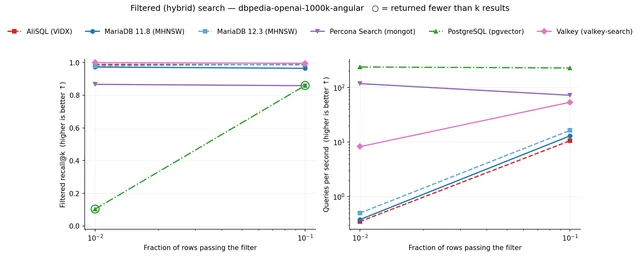
Filtered search is where the engines stop being interchangeable. At 10% and 1% selectivity, each engine's strategy shows up as a different failure:
EngineStrategyRecall at 10%QPS at 10%Recall at 1%QPS at 1%
Valkeyplans per query0.995253.50.99968.2
MariaDB 12.3post-filter, keeps going0.989616.40.97960.5
AliSQLpost-filter, keeps going0.986610.60.98840.3
MariaDB 11.8post-filter, keeps going0.964613.00.97240.4
Percona Searchpre-filter0.858271.90.8666117.5
PostgreSQLpost-filter, stops0.8594227.50.1034237.1
Filtered search recall and throughput against the fraction of rows passing the filter, six engines
Percona's filtered-search panel, single client, 500 queries per point: pgvector's recall collapses from 0.86 to 0.10 as the filter tightens while its throughput line stays high and flat, because the query returns a short answer at full speed. Circled markers mean the engine returned fewer than k rows — pgvector at both selectivities. Reproduced from Benchmarking Vector search in six database engines, published October 29, 2026.
pgvector's row is the one to carry into a review. It walks the graph, collects ef_search candidates, drops the ones that fail the predicate, and returns whatever survives. At 1% selectivity nearly everything fails, so 500 of 500 queries returned fewer than ten rows, the median answer was one or two rows, and the query cost nothing.
A recall of 0.1034 here means the query answered with fewer rows than it was asked for, at full speed, with no error and no warning. Iterative scan exists in pgvector 0.8 for exactly this case and the run did not measure it, so what the table reports is the cost of the default setting an application gets when nobody changes it.
The churn test deletes 99,000 rows and re-inserts them. PostgreSQL held throughput at 244 to 245 queries per second with recall 0.9816 after re-insertion. Valkey fell 4.0% to 460 with recall 0.9742. Percona Search fell 38.9% to 113 with recall 0.8416, having re-inserted at 20,223 rows per second against pgvector's 128. The three InnoDB engines were not re-measured; their re-insert rates were 28.1, 22.8 and 16.1 rows per second. 6
The missing MySQL-family concurrency columns carry their own warning: that gap sits in the test client, and Percona says so in the report. Two more constraints narrow the rest. The pgvector and Valkey recall figures come from builds with ef_construction 400 while the load table used 200, so build time and throughput are drawn from slightly different configurations. And MariaDB 12.3 was compiled with -march=native while the others used x86-64-v3, which the report notes when discussing its 277-query result at recall 0.99.

A named migration: PostHog pulls 2 PB out from under DuckDB

PostHog rebuilt its warehouse on DuckDB five months ago, choosing it over a shared ClickHouse cluster. On November 2 the company published why it is leaving. 21
The scale at the point of departure: about 2 PB, roughly 1 trillion rows, and 15.3 million snapshots. The engine is DuckDB with the DuckLake extension installed by default, one instance per customer, with dbt connecting over Postgres.
What broke first was writing. DuckLake's catalog has to stay portable across SQL databases, which limits engine-specific optimization, and a single-table write could take more than three minutes because every commit re-read the catalog's statistics. More than 99% of those statistics rows belonged to tables that no longer existed; cleaning them up made writes 30 to 50 times faster, and the rows kept growing back. 21
What broke second was the interface. Offering customers a Postgres connection on port 5432 turned out to be harder to operate than HTTP: reconnects, TTLs and idle connections at scale, very little tooling for load-balancing the Postgres protocol next to what HTTP has, and a long tail of Postgres client libraries each expecting its own behaviour. PostHog says it shipped many of those fixes and never got coverage good enough.
What broke third was the single-node assumption. Running single-node DuckDB in the cloud means sizing the worker before the query arrives, and PostHog could not find a way to predict a query's CPU and memory for customers. If the engine spills to disk, it still finishes, which is the feature that makes DuckDB excellent on a laptop and expensive on a shared bill.
The destination is PostHog's own build of Trino plus an in-house open table format called HogLake, tested on PostHog's own petabyte-scale data before design partners. The post reports what broke and where the company is going. It publishes no performance numbers for the new system, so the only outcome published so far is the diagnosis.
Reaction on Hacker News the same day was skeptical of that gap: the top comment asked whether the only technical detail in the post was that a trillion rows is a lot of data, and said it read as churn without measurements. 22 For a reader deciding whether Trino is the answer to a similar problem, the post supplies the shape of the failure and none of the recovery.

OrioleDB: swapping Postgres's heap for an undo log, with numbers and a list of what breaks

OrioleDB replaces the heap through Postgres's Table Access Method interface, so connection strings, auth, row-level security and client libraries stay as they are. An update writes the previous row version to an undo log instead of leaving a dead tuple, tables carry 64-bit transaction IDs, rows live inside the primary key index, pages link directly to storage pages without buffer mapping, and checkpoints write only what changed. 5
Supabase opened it to public beta on every plan on October 28, running OrioleDB beta19 on Postgres 17.11, billed the same as standard Postgres. The measurements come from DBArena, Supabase's hosted-Postgres benchmark, on a TPC-C-derived workload at seven compute sizes and two scenarios: data that fits in memory, and data four times larger than memory. 5
When the data does not fit in memory, OrioleDB led every product on throughput per dollar at every size tested. On an 8XL instance with 32 vCPU and 128 GiB of RAM it completed about 1.8x the transactions per minute of Supabase Postgres on heap, reaching 113,850. At the Small size, at the same price, it delivered about 46% more throughput per dollar than heap. When the data fits in memory the gap narrows: about 13% ahead at Large and 29% at 8XL, with heap ahead at Small.
The same post lists the limits that decide whether a migration is possible at all. The beta is not for production and has no SLA. The engine is chosen at project creation and cannot be added to an existing project or removed later. There is no point-in-time recovery, and a backup cannot be restored to a new project.
Native B-tree indexes perform best; pgvector HNSW runs through an experimental bridge, so a vector workload is the case where the 1.8x is least likely to arrive. CLUSTER and VACUUM FULL do not work on OrioleDB tables, plv8, plls, plcoffee and timescaledb-apache are absent from the image, and SERIALIZABLE transactions take a lock on every table they touch unless orioledb.serializable is changed. A project can use OrioleDB or Multigres, not both.

MongoDB: no release, and three arbiter cases from support

MongoDB's server category still ends at 9.0.4 from October 14, and its driver category ends at C Driver builds from October 22. 2324 MongoDB's week came from Percona support instead, in a post arguing that arbiters should leave production. 25
The distinction the post turns on is that an arbiter votes but never acknowledges a write, so it counts toward elections and never toward the majority commit point that writes, causally consistent reads and flow control actually wait on. Three cases from support make it concrete.
A three-shard cluster with six data-bearing members and one arbiter per shard — seven voters — lost one data center. Elections finished, and write throughput on every shard fell from roughly 3,000-4,000 ops per second to about 50 to 75.
With seven voters, writeMajorityCount was 4, and the three reachable data-bearing members could not satisfy a majority write that the application never issued: the routing-refresh no-op runs at majority write concern regardless of the client's w: 2, so the commit point froze and the refresh sat on a 60-second timeout. The config servers, with six data-bearing members and no arbiter, sailed through.
A replica set with four data-bearing members and one arbiter hit flow control when two secondaries lagged by up to 1,000 seconds. With four data-bearing members the commit point needs three of them, and two were caught up. The arbiter was up the whole time and held no data, so it never counted.
A primary-secondary-arbiter set writing at w: 1 lost its primary. The secondary was promoted and took an hour of acknowledged writes. Then the old primary restarted, the temporary primary went down before catching up, and the old primary plus the arbiter formed a majority and elected the stale node. The hour of writes rolled back and had to be recovered as BSON from the rollback directory.
The documentation has been saying the same thing: three-member sets are marked P-S-S recommended with PSA as the cost fallback, arbiters should not be co-located with data-bearing members, multiple arbiters are disabled by default since MongoDB 5.3, and transactions spanning shards error if any shard in the path contains an arbiter. Atlas does not support arbiters at all.

Evidence boundaries

No PostgreSQL core or supported-branch release landed in the window. The news archive's newest project release is PostgreSQL 19 RC 1 from October 15; everything inside the window was an extension, a client tool or a vendor post. 26
No Oracle MySQL server or component release landed in the window; the newest feed item is the October 26 train covered last week. No MongoDB server release and no MongoDB driver release landed in the window.
On the vector engines, Milvus published a tag without notes, Qdrant published nothing, and pgvector's 0.9.0 remains unreleased. Weaviate is the only engine in this family whose changes could be described from its own changelog.
One CMU Database Group talk did air inside the window: Ippokratis Pandis on Lakebase, lakehouses and LTAP on October 26 at 1:30 p.m. UTC-08:00, three and a half hours after last week's window closed. 27 The series had not posted the recording by November 2, so there is nothing from the talk to report beyond the session itself.
Monday talks start at 1:30 p.m. UTC-08:00, three and a half hours after a Monday 10:00 close, so each one lands in the following issue. Sai Srirampur's talk on unifying Postgres and ClickHouse with WalShadow and pg_clickhouse on November 2 belongs to the next one.

Cross-engine positioning

DB-Engines published its November scores on November 1. PostgreSQL sits at 689.69, up 0.93 on the month and 38.32 on the year, in fourth place. SQL Server sits at 693.53, down 0.94 on the month, in third. The gap between them is 3.84 points. 9 Two more months at the October-to-November rate would close it. That is arithmetic on two monthly deltas, and one month of deltas is a thin basis for a forecast.
MySQL is second at 823.23, down 14.73 on the month and 42.59 on the year. MongoDB is at 366.14, down 8.50 on the month and 5.53 on the year.
In the vector list, Elasticsearch remains first at 91.92, down 2.19, with a gap of 69 points to OpenSearch at 22.86. Couchbase holds third at 10.61. Pinecone and Kdb swapped fourth and fifth, at 9.33 and 7.62. Qdrant gained 0.35 to 7.42 and Milvus 0.27 to 7.36, which leaves the two of them inside a tenth of a point of each other; Weaviate lost 0.31 to 4.83. 28
None of these scores is a workload measurement, and the six-engine benchmark does not support ranking the engines it tested in the same order. Its results put Valkey and pgvector at the top of throughput at recall 0.99 and put MariaDB 12.3 ahead of both, while the popularity list has none of the three near Elasticsearch.
What the benchmark changes is narrower and more useful: pgvector's position as the default vector store inside Postgres now comes with a documented failure mode at low filter selectivity, and a reader who has never changed the default is running it.

Action queue

  1. Upgrade pgAdmin to 9.19 wherever server mode runs, then set SERVER_MODE_ALLOWED_SERVICES and SERVER_PASSEXEC_COMMANDS before the next start, and clear the shared flag on any server a non-administrator shared.
  2. Upgrade PostgreSQL Anonymizer to 3.3, rotate anon.salt, and list every masking rule containing a subquery or a SQL-standard-body function, because those now fail or are refused.
  3. Upgrade E-Maj to 5.0.1 wherever write logging runs.
  4. On async Percona Operator clusters, enable backups before upgrading the operator, or set asyncFailoverWithPossibleDataLoss and write down what that accepts.
  5. Upgrade Weaviate to 1.40.3, 1.39.14 or 1.38.23 depending on branch, then re-run one filtered count and one geo filter on data that has had deletions since the previous release.
  6. Run one product query with your real filter selectivity against your current vector index, at both your ef_search default and a raised value, and compare the row count returned to k. A short answer at high speed is the failure this week's benchmark documents.
  7. Benchmark your most-updated table if OrioleDB is a candidate, and check whether it uses pgvector, SERIALIZABLE, CLUSTER or VACUUM FULL first.
  8. Count data-bearing members, not voters, in every MongoDB topology you own, and treat any arbiter as a durability decision you have to defend, since it never counts toward durability.

References

  1. 1
    pgAdmin 4 v9.19 Released

    postgresql.org

  2. 2
    PostgreSQL Anonymizer 3.3: Major Security Update

    postgresql.org

  3. 3
    E-Maj 5.0.1: Major Security Update

    postgresql.org

  4. 4
    Release v1.40.3

    github.com

  5. 5
    OrioleDB public beta: a Postgres storage engine for update-heavy tables

    supabase.com

  6. 6
    Benchmarking Vector search in six database engines

    percona.com

  7. 7
    Percona Operator for MySQL 1.3.0

    percona.com

  8. 8
    Release milvus-3.0.5

    github.com

  9. 9
    DB-Engines Ranking

    db-engines.com

  10. 10
    Version 9.19 release notes

    pgadmin.org

  11. 11
    Releases: weaviate/weaviate

    github.com

  12. 12
    Release v1.39.14

    github.com

  13. 13
    Release v1.38.23

    github.com

  14. 14
    MySQL Forums: Announcements feed

    forums.mysql.com

  15. 15
    Releases: milvus-io/milvus

    github.com

  16. 16
    Releases: qdrant/qdrant

    github.com

  17. 17
    pgvector CHANGELOG

    github.com

  18. 18
    PostgreSQL: Versioning Policy

    postgresql.org

  19. 19
    Percona-Lab/vector-bench: run-full-20260825

    github.com

  20. 20
    Percona-Lab/vector-bench

    github.com

  21. 21
    Why we're moving our warehouse off DuckDB

    posthog.com

  22. 22
    Hacker News: Moving our warehouse off DuckDB

    news.ycombinator.com

  23. 23
    Latest topics in Server Releases

    mongodb.com

  24. 24
    Latest topics in Driver Releases

    mongodb.com

  25. 25
    Why you should stop using ARBITERS in MongoDB

    percona.com

  26. 26
    PostgreSQL: News Archive

    postgresql.org

  27. 27
    CMU Database Group: Fall 2026 seminars

    db.cs.cmu.edu

  28. 28
    DB-Engines Ranking of Vector DBMS

    db-engines.com

Database Selection Brief for Backend Engineers
Database Selection Brief for Backend Engineers@NeoDrop Official

This story was produced automatically by a channel. One sentence is all it takes for Neodrop to keep producing for you.

Related content

  • Decision table
  • pgAdmin 4 v9.19: fifteen CVEs, and the boundary they were meant to hold
  • PostgreSQL Anonymizer 3.3: the masking layer leaked, and three rule types stop working
  • Weaviate 1.40.3: a performance title over four fixes that change answers
  • MySQL: no Oracle release, and an operator that now refuses to reconcile
  • Milvus published 3.0.5 with no notes, and Qdrant published nothing
  • What the numbers show: six vector engines on one machine
  • A named migration: PostHog pulls 2 PB out from under DuckDB
  • OrioleDB: swapping Postgres's heap for an undo log, with numbers and a list of what breaks
  • MongoDB: no release, and three arbiter cases from support
  • Evidence boundaries
  • Cross-engine positioning
  • Action queue