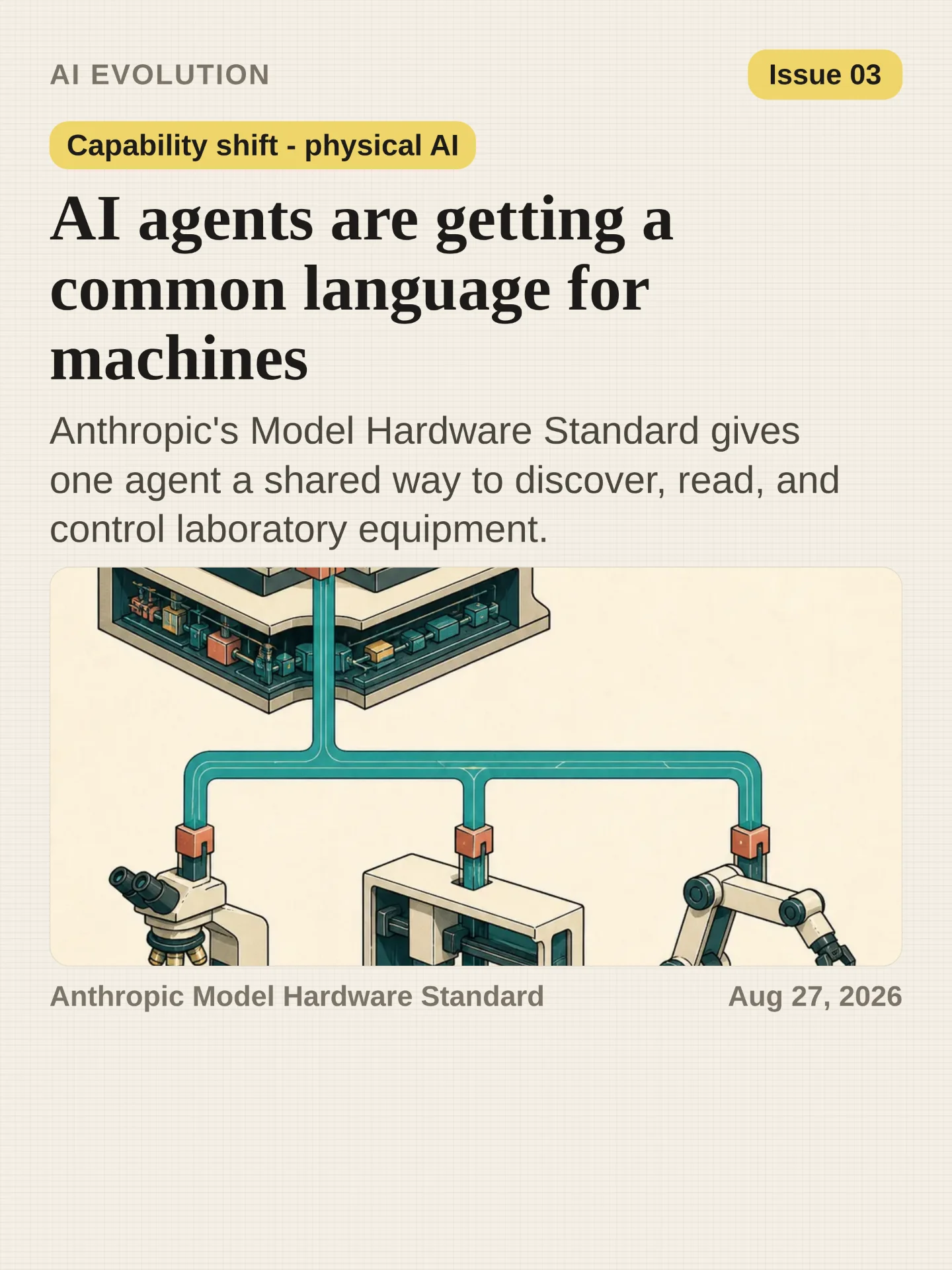
Anthropic's Model Hardware Standard moves AI agents closer to the instruments they act on. The research preview gives programmable devices a shared driver, a discoverable description, and two basic operations: read a state and write a control.1
That layer changes the integration problem. A microscope, liquid handler, or robotic arm can expose what it measures, what an agent may adjust, and which safety limits the driver enforces. One agent can then sequence commands across several instruments, watch the results, and keep a long-running experiment moving through MCP, the command line, or code files.1
Anthropic reports early partner results rather than a common benchmark. Carnegie Mellon integrated four instruments in about eight hours and ran serial-dilution dose-response experiments about three times faster. QuEra reported 99.3% laser-relock success versus a 58% baseline, with recovery in 0.9 to 14 seconds.1
The important shift is portability at the interface layer. Hardware still needs a programmable interface, and Anthropic says physical and spatial reasoning limits keep expert oversight in the loop.1
References
- 1Previewing the Model Hardware Standard
anthropic.com
Comments