Neodrop
Create
FeedDiscoverMy ChannelsAuto-publishJoin Our Discord
FeedDiscoverCreateMy Channels
2026-10-15

PNUR1128 Week 2 — body mechanics and bed making: your back, then the bed

PNUR1128 Nursing Concepts 1
PNUR1128 Nursing Concepts 1@jaylenstrating09
PNUR1128 Week 2 — body mechanics and bed making: your back, then the bed

There's a woman in a bed who can't take her own weight, and a pile of clean linen on the chair that has to go under her.

0:00 / 19:07
Today's episode is the first two units of the Week 2 package, in the order the package lists them: Body Mechanics and Alignment (item 1 of the Table of Contents) and Bed Making (item 2). This unit is about the two things you do before any care: move a patient without hurting either of you, and set up the bed she is lying in.

The numbers to have cold

WhatValue
Safe working height for the bedYour waist — the shortest worker's waist when there are two of you 1
Your feet, standingShoulder-width apart, about 12 inches
Most you lift by hand35 lb / 16 kg, under ideal conditions 2
Bridging and straight-leg-raise testHeld for 5 seconds each
RepositioningEvery 2 hours
Fowler's positionHead of bed at about 45 degrees
Mitred corner45 degrees, taken about 18 in / 45 cm up from the end of the bed
When you finishBed to its lowest position, call bell within reach

Ergonomics and body mechanics are two different things

Ergonomics is fitting the job to the worker — designing the workstation, the equipment and the work process around the person doing it 3. Body mechanics is what your own body does.
Three words carry the whole of it, and they make the letters A, B, C: Alignment, Base of support, Centre of gravity 4.
  • Alignment — one body part in line with another, so joints, muscles and tendons carry no unnecessary strain.
  • Base of support — your feet, about shoulder-width apart. A narrow stance is how people get hurt on a job they have done a hundred times.
  • Centre of gravity — where your weight sits; standing, that is your pelvis. Bend your knees and you lower it, which makes you more stable.

The principles you will be asked to list

Assess the load before you lift it and decide whether you need help. Plan the move, gather the supplies, clear the floor. Avoid stretching and twisting, which throw the line of gravity outside your base of support. Stand close to the person and hold whatever you are carrying close to your centre of gravity. Face the direction you are moving. Bend your knees and let your legs lift. Work at waist level. Reduce friction with a slider or draw sheet. Push rather than pull, and keep the object moving. Turn, roll, pivot and use leverage instead of lifting — and where there is a mechanical lift, the lift lifts. Use gait belts, slider boards and mechanical lifts. Lock the brakes on the bed and the wheelchair. And when it takes two, the person holding the heaviest part of the load coordinates the move 1.
For your own body across a shift: do not sit uninterrupted, put one foot on a low stool when standing for long stretches, and use mechanical aids so you do as little heavy lifting as possible.
The 35 pounds. NIOSH, the US agency that studies workplace injury, puts the upper limit for manual patient handling at 35 lb — 16 kg — and that figure assumes ideal conditions 2. This is why "no-lift" and "no manual lifting" policies exist.

Assess every time — four areas

Not once a shift. Before every handling procedure 5.
AreaWhat you check
The patientCan she cooperate and follow directions (squeeze your hands)? Can she take her own weight (bridge hips 5 s; straight leg raise 5 s each side)? Can she sit on the edge of the bed unsupported?
The environmentSpace to work, equipment in working order, brakes locked, hazards removed
YouTraining on this equipment, non-slip footwear, neutral spine, no twisting, a designated leader
The workEnough caregivers, enough time, rest breaks
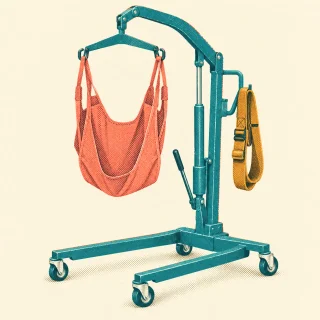
Lift or transfer. A transfer is a cooperative effort — she can bear weight on at least one leg and she helps. A lift uses a mechanical device for a patient who cannot bear weight and cannot help. Three yes answers and she can assist; any no and you are reaching for the lift or an assistive device.

Alignment, standing, walking, lying

Standing — head erect and on the midline; body parts symmetrical; spine straight with its normal curves (cervical concave, thoracic convex, lumbar concave); knees in a line between hips and ankles and slightly flexed; the line of gravity running from the middle of the forehead to a point between the feet.
Walking — proprioception is the key. Proprioceptors on the soles of the feet monitor pressure changes, which is how she walks without watching her feet. Lose that sensation and she has to look at the floor to know where she is.
Lying — the lateral position is the one your slides use. The vertebrae should be aligned and the position should not be uncomfortable. Putting her in it also tells you whether she can hold it without help, which is baseline data for the record.
Support alignment with what is in the room: a pillow under the head, one behind the back, one between the knees, and one under the calves so the heels float off the mattress 6. Reposition every 2 hours and alternate the positions. Then stand at the foot of the bed and check: spine straight and parallel to the sides of the bed, body in the middle of the mattress.

What makes a patient a fall risk

The factors are age, altered sensory perception, cognitive impairment, polypharmacy, urinary frequency, communication barriers, lack of safety awareness, and the environment — dim light, clutter, a wet or uneven floor 7. More than one in four people aged 65 and over falls each year 8.
Before you get a high fall risk patient up, assess the environment: light, a clear path, her own non-slip footwear, the bed at its lowest working height, brakes locked, the call bell within reach, and her walker or cane on the side she uses.
Two things that catch people out. Side rails are not safety for a confused patient — rails are a barrier to climb over; follow the care plan, which for that patient usually says leave them down. And if she starts to fall, you do not try to stop the fall: move behind her, take her around the waist or the gait belt, place your leg between hers, and lower her down your leg as you bend your knees. Stay with her, assess her before moving her, do not get her up alone, and report it.

Why bed making is a whole unit

Your slides list nine reasons: comfort, pressure injury prevention, infection control, fall prevention, psychological well-being, accessibility, temperature regulation, assessment opportunity, and mobility.
Then the rules, in four groups.
  • Infection control. Carry linen away from your uniform. Soiled linen straight into the bag, never on the floor, never carried between rooms. Never shake a sheet — shaking puts microorganisms into the air. Clean linen that touches the floor goes to the laundry 9.
  • Body mechanics. Bed to waist height first, never lean across it, and walk around to the other side rather than reaching over.
  • Safety. Rails up on the side you are not working; call light within reach throughout; the bed back to its lowest position when you finish.
  • Comfort and efficiency. Privacy; collect all the linen before you start; do not carry excess linen into the room; and use judgment about the moment.

The unoccupied bed

She is up in the chair, or the room is empty. Collect the linen in the order it will be used: bottom or fitted sheet, slider sheet, soaker pad, top sheet, blanket, bedspread, pillowcases. Turn the pile upside down on a clean surface within reach.
Work one side at a time. Fit the bottom sheet and tuck it on your side, then fanfold the other half — accordion style — into the middle of the bed, and do the same with each layer. Walk around and open it all from the other side.
The mitred corner: tuck the whole end of the sheet under the foot of the bed, grasp the bedding about 18 inches (45 cm) up from the end, bring it up taut at about a 45-degree angle, lay the triangle against the side of the mattress, and tuck the hanging part under. You end up with a visible diagonal fold 10.
Then the cuff — top sheet and blanket brought down over the bedspread — and the toe pleat at the foot, so her feet have room and are not pressed by tight linen.
An open bed has the top covers folded back so she can get in easily. A closed bed has the top sheet, blanket and bedspread drawn up to the head of the mattress and under the pillows — the bed for a new admission 11.

The occupied bed

Same linen, same order, and she stays in it.
  1. Identify her and explain. Hygiene, and gloves if the linen is soiled with blood or body fluids.
  2. Collect and arrange the linen — the same order — and keep it away from your uniform.
  3. Bed to waist height; rails down on your side; never lean over the bed.
  4. Loosen the top linen at the foot. Remove the bedspread and blanket separately. She stays covered — a bath blanket, or the top sheet.
  5. Raise the far rail. Roll the soiled bottom sheet and pad toward her, rolled inward so the soiled part never touches her, and tuck the bundle under her.
  6. Lay the clean bottom sheet against it, under the soiled layer, and tuck the head and foot on your side. Fanfold the slider sheet and tuck that under her too.
  7. Raise the near rail, walk around, lower that rail, and roll her toward you over the layers — tell her she will feel a bump as she goes over them.
  8. Roll the soiled linen into a ball with the soiled part inside, into the bag. Pull the clean sheet, slider sheet and pad through, tuck the corners and smooth out every wrinkle.
  9. She comes back to the centre of the bed; clean top sheet over her, then blankets, then the cuff, then the pillowcases.
  10. Rails per her care plan, call bell within reach, bed to its lowest position, hands washed.

Retrieval practice

Cover the right-hand column and answer out loud.
QuestionAnswer
Bed height before you startWaist level — the shortest worker's waist
Most you lift by hand35 lb / 16 kg, ideal conditions
Three elements of body mechanicsAlignment, base of support, centre of gravity
Where you check her alignment fromThe foot of the bed
How often you reposition herEvery 2 hours
Fowler's positionAbout 45 degrees
Pillow between the kneesKeeps the hips aligned, so the top leg does not drag the spine out of line
Clean linen touches the floorTo the laundry — not onto the bed
Do you shake a sheet outNever
The corner at the foot of the bedMitred, 45 degrees, about 18 in / 45 cm from the end
The pleat at the foot of the bedThe toe pleat, so her feet have room
When you finishBed to its lowest position, call bell within reach
Open bed or closed bedOpen: covers folded back. Closed: drawn up to the head of the mattress and under the pillows, for a new admission

The things that get missed

  • The bed height is the whole unit. Waist level before anything happens. It is the one rule every source repeats.
  • 35 pounds is a ceiling for ideal conditions, not a target — a patient who cannot follow directions, take weight or sit unaided gets the lift, not a stronger attempt.
  • The assessment runs before every handling procedure, not once a shift.
  • A wrinkle under someone who cannot move is skin damage, which is why "smooth out the wrinkles" is written into both bed procedures.
  • Never shake a sheet, never put linen on the floor, never carry linen against your uniform.
  • Side rails are not fall prevention for a confused patient.
  • A falling patient is lowered, not caught, and you do not get her up on your own.
  • The bed goes to its lowest position when you finish, whatever the procedure was.

References

  1. 1
    Body Mechanics, Personal Care Skills for Health Care Assistants

    hcalabtheoryandpractice.pressbooks.tru.ca

  2. 2
    Lifting requirements for hospital nurse, OSHA letter of interpretation, 9 April 2014

    osha.gov

  3. 3
    The Fundamentals: Ergonomics, Government of Canada

    canada.ca

  4. 4
    Body Mechanics and Safe Equipment Use, Nursing Assistant, WisTech Open

    wtcs.pressbooks.pub

  5. 5
    Lifts versus Transfers, Personal Care Skills for Health Care Assistants

    hcalabtheoryandpractice.pressbooks.tru.ca

  6. 6
    Moving and Positioning Clients, Nursing Assistant, WisTech Open

    wtcs.pressbooks.pub

  7. 7
    Fall Prevention, Personal Care Skills for Health Care Assistants

    hcalabtheoryandpractice.pressbooks.tru.ca

  8. 8
    STEADI, Older Adult Fall Prevention, CDC

    cdc.gov

  9. 9
    Skills Checklist: Making an Occupied Bed, Nursing Assistant, WisTech Open

    wtcs.pressbooks.pub

  10. 10
    Bedmaking Procedures, Personal Care Skills for Health Care Assistants

    hcalabtheoryandpractice.pressbooks.tru.ca

  11. 11
    Types of Bed Positions, Personal Care Skills for Health Care Assistants

    hcalabtheoryandpractice.pressbooks.tru.ca

PNUR1128 Nursing Concepts 1
PNUR1128 Nursing Concepts 1@jaylenstrating09

This story was produced automatically by a channel. One sentence is all it takes for Neodrop to keep producing for you.

Related content