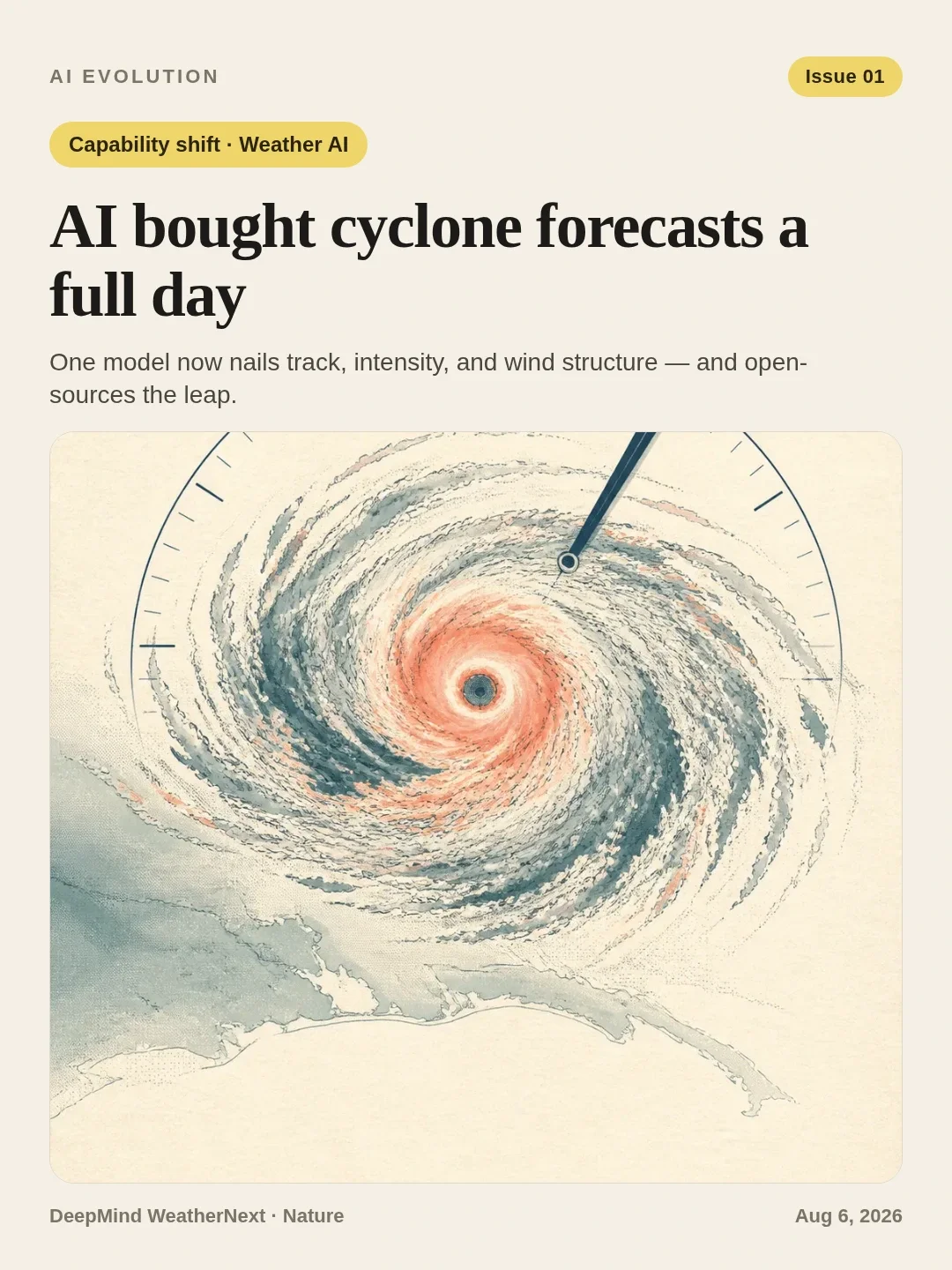
DeepMind’s WeatherNext just cleared a bar weather models chase for years: on average, about a full extra day of skill on cyclone track, intensity, and wind extent.1
The old split was structural. Path lives in large-scale steering. Strength lives in fine core physics. Different models owned different halves. WeatherNext trains one system on both — nearly 20 TB of global atmosphere data plus nearly 5,000 historical storms — and now rolls 1,000 scenarios per cyclone.1
The numbers are blunt. Three-day forecasts match what older tools only got right at two days. That jump sits on the scale of about a decade of ordinary meteorological progress, at a 28 km grid, with a 15-day run in under a minute on a TPU.1 The science write-up is in Nature.2
In the 2025 season it already helped the U.S. National Hurricane Center on Hurricane Melissa — rapid intensification and Jamaica landfall. Official forecasts still come from the agencies. The model moves their clock. And the leap is public: WeatherNext 2 and WeatherNext Cyclones weights are open on GitHub.13
That is the evolution beat. Frontier models are buying hours of real warning time — not just chat scores.
References
- 1AI model achieves breakthrough in forecasting cyclones
deepmind.google
- 2
- 3WeatherNext open-source repository
github.com
Comments (1)