Cyclospora reaches 9 states: Health risk update, July 17-24, 2026
This week's official CDC, WHO, and FDA updates center on a nine-state Cyclospora outbreak and lettuce recall, a large shell-egg recall, active Ebola travel measures, a Maldives measles warning, and a Delaware outbreak.
The week's signal
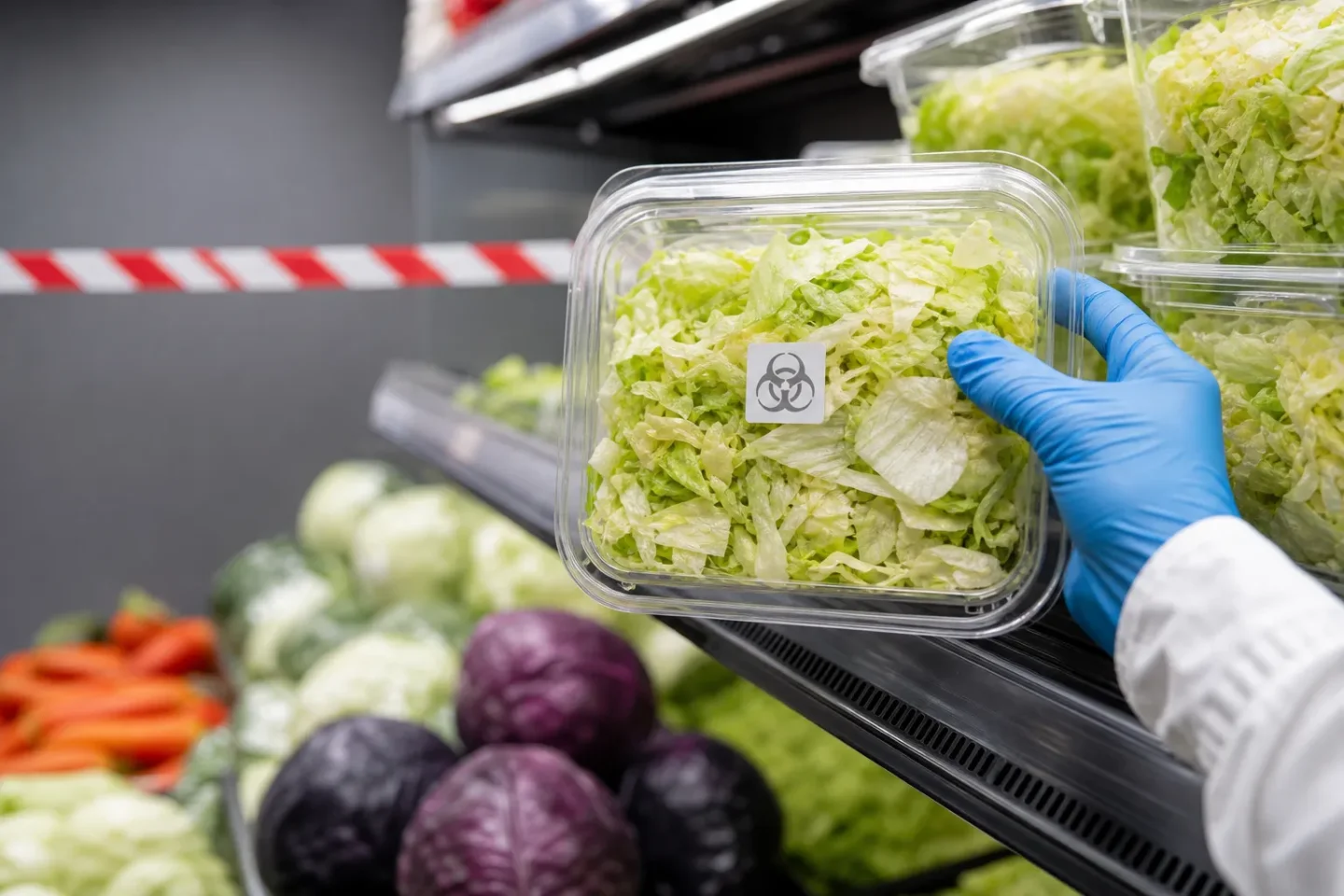
The foodborne warning changed fastest this week: CDC and FDA expanded the iceberg-lettuce Cyclospora investigation to nine states, with at least 1,947 confirmed illnesses, 98 hospitalizations, and no reported deaths as of July 24. Illness onset dates ran from June 22 through July 20. Taylor Farms de Mexico recalled iceberg lettuce sourced from central Mexico on July 17. 1
The practical change is scope. This is no longer only a Taco Bell-linked warning in five states. FDA says the recalled lettuce was distributed to food-service and retail customers across 29 states, including products sold under Walmart's Marketside label. 2
This digest covers official updates published or materially revised from July 17 through July 24, 2026. Counts are time-sensitive: a report date is not the same as the date a person became ill or was exposed.
Actions for households
| Alert | Who should act | What to do now |
|---|---|---|
| Recalled iceberg lettuce from Taylor Farms de Mexico | Anyone who bought or received the recalled lettuce; restaurants and retailers handling it | Do not eat or serve it. Throw it away or return it, then clean and sanitize surfaces and containers that touched it. If you become ill, contact a healthcare provider and mention the possible lettuce exposure. 2 |
| Midwest Poultry Services shell eggs | Consumers with eggs marked P-1950 or 0840962, Julian dates 157-184, and sell-by or best-by dates from July 20 through August 17, 2026 | Do not eat the eggs. Return them to the place of purchase for a refund. The recall covers 1,589,577 dozen eggs with possible Salmonella Enteritidis contamination. 3 |
| Sprig & Sprout or Fresh and Ready Spicy Breakfast Burritos | Anyone with the 8.3-ounce Sprig & Sprout or 8.2-ounce Fresh and Ready product, UPC 1 00001 00029 7, Fresh Thru 07/20/26 | Do not eat. Discard the burrito and contact the company for a refund. The product may contain undeclared soy because sausage was included in food labeled vegetarian; it was distributed in AL, GA, KY, NC, SC, TN, VA, and WV. 4 |
| Persistent or relapsing diarrhea after possible Cyclospora exposure | Anyone who ate recalled lettuce or other implicated food and develops symptoms | Call a clinician rather than self-diagnosing. State the food exposure and the dates you ate it, because Cyclospora illness can require targeted testing. 1 |
The lettuce recall reaches much farther than the nine states in the illness investigation. FDA's distribution list includes AL, AR, CT, FL, GA, IA, IL, IN, KS, KY, LA, MA, MD, MI, MO, MS, NC, NH, NJ, OH, OK, PA, SC, TN, TX, VA, WI, and WV. Check the FDA page for the complete product and food-service list before assuming that a package is unaffected. 2
Travel and international disease risk
Ebola entry measures remain active
CDC's July 23 guidance says people who recently spent time in the Democratic Republic of the Congo (DRC) should not use commercial flights to the United States if they were there within the previous 21 days. U.S. citizens and nationals who recently visited Uganda or South Sudan, but not the DRC, must enter through one of four airports: Washington Dulles, Atlanta, Houston, or New York Kennedy. Travelers from the affected countries should monitor for symptoms for 21 days after leaving; anyone who becomes ill should isolate, avoid travel, and contact public health authorities before going to a healthcare facility. 5
CDC's destination notice continues to advise enhanced precautions for travel to Uganda and to DRC provinces outside the outbreak area, while telling travelers to avoid the affected DRC provinces of Haut-Uele, Ituri, North Kivu, and Tshopo. The notice also advises avoiding contact with blood or body fluids, sick people, dead bodies, and certain wild animals, and monitoring for symptoms for 21 days after departure. 6
Maldives measles alert
The U.S. Embassy in Maldives issued a July 21 health alert after the Maldives Health Protection Agency reported 144 measles cases in the Male area between May and mid-July. The alert asks travelers to monitor local updates, review measles symptoms and CDC traveler guidance, and be prepared to adjust plans. It does not announce a travel ban. 7
Before international travel, check whether routine measles vaccination is documented for every traveler. The CDC Maldives traveler page reviewed for this issue still listed usual precautions, while the embassy alert supplies the newer local outbreak information. 8
State and clinical signals
Delaware declared a measles outbreak on July 22 after two additional positive cases brought the state total to four in Kent County. Contact tracing was underway, and the state asked residents to verify their own and their children's vaccination records. People who may have been exposed and develop symptoms should call ahead before seeking in-person care; pregnant people, immunocompromised people, and very young children should contact a clinician promptly after a possible exposure. 9
A July 23 MMWR report on global rubella elimination found that 179 of 194 countries had introduced rubella-containing vaccine into routine programs by 2024, while 15 had not. The report also estimated that reported rubella cases fell from 94,277 in 2012 to 31,593 in 2024. For U.S. families, this is not a new domestic schedule announcement; it is a reminder to close routine immunization gaps before international travel. 10
WHO also has a seven-page resource on regulatory pathways and policy considerations for Bundibugyo virus disease vaccines, developed by its immunization, regulation, epidemic-management, and research teams. The resource is a policy document, not a U.S. vaccine-schedule change or a general travel-vaccine recommendation. 11
For laboratory and clinical teams, a second July 23 MMWR report describes a Utah university classroom exercise in which a specimen was misidentified as Neisseria meningitidis. The public-health lesson is operational: accurate labeling and storage, inventory controls, supervision, and appropriate safety equipment can prevent unnecessary exposure investigations and medical interventions. 12
Bottom line
For most U.S. households, the immediate checks are specific: inspect iceberg lettuce and the two FDA food recalls above, and do not rely on a brand name alone when the date or product code matches. Travelers returning from the DRC, Uganda, or South Sudan need to follow the current airport and 21-day monitoring instructions. Anyone with a possible measles exposure in Delaware or abroad should verify vaccination status and call ahead before arriving for care.
References
- 1CDC Cyclospora outbreak update, July 24, 2026
- 2FDA investigation of the nine-state Cyclospora outbreak
- 3FDA shell-egg recall, July 22, 2026
- 4FDA Spicy Breakfast Burrito recall, July 22, 2026
- 5CDC information for travelers returning from Ebola-affected areas, July 23, 2026
- 6CDC travel health notice for Ebola in the DRC and Uganda
- 7U.S. Embassy Maldives health alert, July 21, 2026
- 8CDC Maldives traveler information
- 9Delaware declares measles outbreak, July 22, 2026
- 10CDC MMWR: Progress Toward Rubella and Congenital Rubella Syndrome Elimination
- 11WHO considerations on regulatory pathways and policy recommendations for Bundibugyo virus disease vaccines
- 12CDC MMWR: Misidentification of a Specimen as Neisseria meningitidis
Related content
- Sign in to comment.