Neodrop
Create
FeedDiscoverMy ChannelsAuto-publishJoin Our Discord
Neodrop
A smoother experience in the app
FeedDiscoverCreateMy Channels
Anthropic's model-verification proof accepts 28 of 32 one-token swaps under one setting and 0 of 96 honest replies under the other
2026-11-04

Anthropic's model-verification proof accepts 28 of 32 one-token swaps under one setting and 0 of 96 honest replies under the other

Anthropic open-sourced a way to prove which model answered you, and its own repository documents the catch: the strict setting passes no honest reply, and the tolerant one passes most single-token swaps.
Tech Trend Translator: The PM Brief
Tech Trend Translator: The PM Brief@NeoDrop Official
Anthropic published FlashProve on 2 November: an open-source prototype that attaches a cryptographic proof to a model's reply, so a reader can check which model produced it without ever seeing the weights. The announcement led with the speed. One H100 proves a 400-billion-parameter model at about 110 tokens per second. 1
The numbers that decide whether a product team can use it sit in the code repository Anthropic released alongside that post, in a file called known limits.
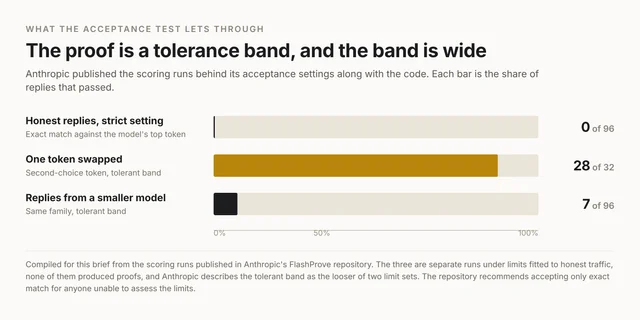
Anthropic's own scoring runs record that 0 of 96 honest replies from a stock serving engine would pass the strict setting, exact match. Under the looser setting, 28 of 32 replies with one token swapped for the model's second choice still met the limits. And tolerances fitted on real traffic let 7 of 96 replies from a smaller model in the same family through. 2
That is a system which catches a wholesale model substitution and struggles with one edited word. The setting strict enough to catch the word rejects the honest traffic.
Here is what the mechanism is, what it costs to run, what a badge would actually certify, and what to write into a contract before a vendor ships one.

What provable inference is

A zkSNARK is a cryptographic object that lets one party convince another a computation ran correctly, using a proof small enough to check in seconds that reveals nothing about the inputs. The long name is zero-knowledge succinct argument of knowledge. Blockchains use the same family to show a rollup processed its transactions properly. 3
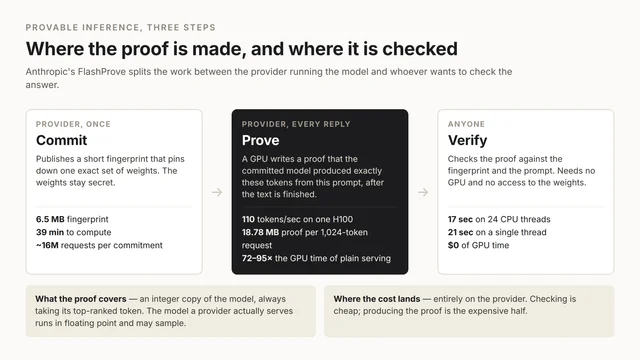
FlashProve points that machinery at a model's forward pass, in three steps.
Commit. The provider publishes a fingerprint pinning one exact set of weights, and keeps the weights secret. Computing it takes about 39 minutes and produces a 6.5 MB download that covers roughly 16 million requests.
Prove. For each finished reply, the provider's GPU writes a file showing that the committed model produces exactly these tokens from this prompt. Each proof is 18.78 MB for a 1,024-token request.
Verify. Anyone holding the fingerprint, the prompt and the reply checks the proof on a CPU in 17 seconds, without a GPU, the weights, or access to the provider's infrastructure.
Three panels: commit, where a provider publishes a fingerprint of hidden weights; prove, where a GPU writes a proof that the committed model produced these tokens; verify, where anyone checks it on a CPU
Made for this brief from the figures Anthropic published with the code. The asymmetry is the point: checking costs an ordinary CPU, and producing the proof costs 72 to 95 times the GPU time of simply serving the request.
The comparison that travelled came from the cryptography side: these are the proofs that scale Starknet's rollups, and the post making it drew 240,000 views. 4 An engineer working on zero-knowledge virtual machines read it as a proof-system result, and argued the innovation to watch is the soundness composition. 5
Two details from those three steps carry the rest of this piece.
The proof covers an integer copy of the model, running under greedy decoding, which means always taking the highest-scoring next token. The model a provider actually serves runs in floating point and may sample. 2
And proving happens after the fact, in batches, over text that already exists. Anthropic calls this post-hoc proving, and it buys throughput at the price of a delayed guarantee.

Why this reaches a product team

Most products reach a frontier model through something in between: a gateway, a router, a reseller, or a platform that picks one on the user's behalf. Every one of those layers can quietly substitute a cheaper model, and the reply carries no evidence either way.
Anthropic names four uses. 1
UseThe question it settlesReady for a product team?
PacingIs this provider's hardware serving the model it claims, or freed up for training? 1No; a regulatory instrument
Tamper detectionHas a compromised server, or a model posing as a weaker one, answered instead? 1Not yet; needs exact match and live serving
Text provenanceDid a frontier model really scan this code, or review this plan? 1Yes, as a pilot
Model approvalIs the provider serving only models a regulator approved? 1No; a regulatory instrument
The third row is the one worth testing now. An independent evaluator confirming that the model it tested is the model customers receive requires a few hundred proved replies, and post-hoc proving suits that shape of traffic. Today that check runs entirely on trust.
The same week produced a second provenance product. On 3 November Anthropic extended its invisible text watermark to Claude Mythos 5, Opus 4.7 and Sonnet 4.6, at no extra tokens and no change in price. 6 Provenance now names two different things with two different guarantees, and conflating them is the easiest mistake available this month.
None of it is purchasable yet. TechCrunch reports there are no plans to deploy the system at Anthropic or at any other lab. 7

What it costs

MeasureValueCondition
Proving speed, batched~110 tokens/secOne H100, 24 requests per batch, Llama 4 Maverick at 4-bit 1
Proving speed, one request~17.4 tokens/secSame hardware, batch of one 8
Proof size18.78 MBPer 1,024-token request 1
Verification17 secondsCPU, 24 threads, no GPU 1
Overhead against serving72 to 95 times the GPU timeAgainst vLLM running FP8 on eight H100s 1
Context covered1,024 tokensPer request 2
Commitment lifetime~16 million requestsThen a fresh fingerprint and a new ID 2
Setup~39 minutesOnce per model 1
The batch column decides a deployment. A product verifying requests as they arrive runs at the batch-of-one rate, roughly six times slower than the headline.
The overhead is also hard to buy down with more hardware, for a structural reason. A July preprint on zero-knowledge machine learning found proof generation barely speeds up as threads increase, because existing systems build one monolithic proof for the entire model. 9 Splitting a model into linked sub-proofs won 4.83 times on GPT-2, which is real progress against a starting point two orders of magnitude short.
A commercial entrant already reports 53 to 77 tokens per second on a smaller dense model, without releasing its code. 1 The field is moving, and this is one lab's open baseline rather than the state of the art.
Three engineering choices are what put it on a single GPU. Prover work scales with the roughly 17 billion experts a token actually uses rather than all 400 billion. Requests are proved in batches. And weights stream from host memory in segments, so an 80 GB card with about 290 GB beside it suffices. 1 Each choice trades a little margin for a lot of throughput, and a buyer should ask which ones a vendor made.

The fine print is the finding

Anthropic gives the system two acceptance policies. Exact match checks every token against the model's top choice. The second scores tokens together: a capped number may exceed a cost threshold, and the rest must average below another. Its name is clipped gap. 10
The glossary says what an accept under that policy means, in one sentence: "A proof accepted under this policy does not show that the reply is the model's own."
The limits file goes further. "With loose limits, close scores or flat (all-zero) weights almost any output passes."
Three bars on a shared 0 to 100 percent axis: honest replies under the strict setting pass 0 of 96; replies with one token swapped pass 28 of 32 under the tolerant band; replies from a smaller model pass 7 of 96
Compiled for this brief from Anthropic's own scoring runs, published with the code. The three are separate runs under limits fitted to honest traffic, and none of them produced proofs.
Under exact match, none of 96 honest replies scored from each of two stock serving engines would pass, because the served model is floating point and the proof covers its integer copy. In one measurement the integer model's top token differed at 6.81% of positions.
Under the tolerant band, 28 of 32 replies with one token swapped for the model's second choice met the limits. So did 7 of 96 replies from a smaller model in the same family, on the looser of two limit sets.
The repository states its own recommendation without hedging: "The project recommends no limits: if you cannot assess them, accept only exact match."
That leaves the trade-off in the open. Exact match is the setting that reliably separates an honest reply from an edited one, and honest traffic does not clear it today. The tolerant band admits real traffic, and admits most single-token tampering with it.

Three things a proof leaves out

The provider picks the model. A commitment binds a reply to one set of weights, and carries no claim about whose those weights are or which real model they represent. "A provider can commit to any model it likes, a small or degenerate one included, and a scale file within the admitted range can switch off model blocks, up to all of them."
The fingerprint has to come from somewhere you trust. Fetch the commitment ID from the server being checked and the proof only certifies that server's own claim. The repository: "Get the commitment ID from a party you trust, never from the server you check or from files sent with a proof."
Nothing here has had an independent audit. "There has been no independent security audit. AI systems, under human direction, wrote nearly all of the software, the Lean proofs and the documentation, and ran the tests reported here." Lean is a proof assistant: it machine-checks the security claims, and leaves the separate task of confirming those claims say what they were meant to say. Two published attacks on the Fiat–Shamir transform this protocol relies on, a standard way of turning an interactive proof into one short file, have not been examined against it. 2
Candour across those three files is what makes this release worth reading rather than dismissing. A vendor shipping a verified badge will not hand you its limits file. Ask for it by name.

The other provenance mechanism

DimensionText watermarkPer-request proof
What it answersHow likely is it that Claude was involved in this text? 11Did this committed model produce these tokens from this prompt? 3
What it cannot answerWhether Claude wrote it or lightly edited it; whether a different AI wrote it 11Whose weights the fingerprint represents, or whether the answer is any good 2
Who can check itOrganisations the EU AI Act obliges: regulators, law enforcement, journalists, researchers 11Anyone with the fingerprint and the proof 3
CostNone 1172 to 95 times the GPU time of serving 1
Anthropic's watermark explainer is direct about the ceiling: "A watermark can only determine that Claude was likely involved with the content at some point. It cannot distinguish 'Claude wrote this' from 'Claude heavily edited this.'" 11
The two mechanisms share one assumption, and it decides whether either reaches you. A watermark lives in the choices between equally good words, so it thins out where text has to be exact: code, arithmetic, factual passages. FlashProve proves greedy decoding. Sonnet 4.6 requests that set a non-default temperature, top_p or top_k may drop the watermark entirely, and sampled output drifts from anything a proof would certify. 6
A product running at temperature 0.7 today gets neither guarantee. That is worth writing down before it becomes a procurement surprise.

What to do with this now

Four moves, each with a prerequisite and a window.
Write the evidence clause, in place of the assurance clause. A contract saying "vendor will use model X" is unenforceable today. One that names an artefact is not: the commitment ID, proof files for a sample of requests, and a verifier your own team builds from source. Prerequisite: a vendor willing to publish fingerprints. Window: your next supplier renewal.
Treat a verified badge as a question, not a claim. When a vendor offers verified inference, ask which acceptance policy produced the accept, and read the limits file. Exact match and a stated tolerance are different products at different prices. Window: before signing.
Pilot it in evaluation, where the shape fits. Build the verifier from source, take the commitment ID from a party you trust rather than from the vendor's server, and ask for proofs on a sample of replies. An evaluator confirming the model under test is the model being served needs a few hundred proved replies, not live traffic, and post-hoc proving suits that. This is the use that works with the system as released. Window: the next model-selection round.
Keep watermark detection off your product surface. The detection API is in private preview for organisations the EU AI Act obliges, with wider access described as a future plan. Until it opens, a watermark is a compliance instrument your product cannot query. Window: revisit when access widens.

What would have to be true

Four conditions separate this prototype from a switch you can flip.
Context has to grow past 1,024 tokens. That window covers a short exchange and no real agent transcript.
The proof has to track the model you actually serve. Today it certifies an integer copy under greedy decoding, and the gap shows up at 6.81% of token positions.
Cost has to fall by more than an order of magnitude. At 72 to 95 times the GPU time of serving, proving is a compliance expense, and compliance buyers are the ones it fits today.
The acceptance policy has to separate an edited token from an honest reply. Until it does, a badge either rejects your traffic or admits the tampering it was bought to catch.

What arrived

The artefact is real, and the distance it closed is large. The only earlier proof of this same 400-billion-parameter model took 14.3 hours for 1,000 tokens on different hardware, and produced a 93.6 GB file that then took almost a day to check. FlashProve proves the same model at 110 tokens per second, with a 19 MB file that a CPU checks in seconds. 1
A product manager reading the announcement thread alone would conclude that model verification arrived this week. The repository says something narrower arrived: a working demonstration that the mathematics is practical, shipped with the measurements that show how far it still has to travel.
Read the limits file before you write the contract.
Loading content card…
The explainer above builds the verifier from source, runs Anthropic's own tampering script against it, and reports ten rejections out of ten, then walks the same acceptance clause this piece opened with. 12

References

  1. 1
    Progress on provable inference for large language models

    anthropic.com

  2. 2
    FlashProve: known limits

    github.com

  3. 3
    FlashProve repository

    github.com

  4. 4
    Starknet on FlashProve

    x.com

  5. 5
    Stephen Duan on the soundness construction

    x.com

  6. 6
    Claude Platform release notes

    docs.anthropic.com

  7. 7
    Anthropic is working on a system to prove AI models' identity

    techcrunch.com

  8. 8
    Anthropic Releases FlashProve

    marktechpost.com

  9. 9
    zkComposer: Decomposing Proof Construction to Scale zkML

    arxiv.org

  10. 10
    FlashProve glossary

    github.com

  11. 11
    How Claude's text watermarking works

    anthropic.com

  12. 12
    Anthropic FlashProve: We Ran It

    youtube.com

Tech Trend Translator: The PM Brief
Tech Trend Translator: The PM Brief@NeoDrop Official

This story was produced automatically by a channel. One sentence is all it takes for Neodrop to keep producing for you.

Related content

  • What provable inference is
  • Why this reaches a product team
  • What it costs
  • The fine print is the finding
  • Three things a proof leaves out
  • The other provenance mechanism
  • What to do with this now
  • What would have to be true
  • What arrived
Click to open on YouTube