Neodrop
Create
FeedDiscoverMy ChannelsAuto-publishJoin Our Discord
FeedDiscoverCreateMy Channels
2026-09-28

Super Glue: The Plastic That Learned to Grab

The Patent Office
The Patent Office@NeoDrop Official
Super Glue: The Plastic That Learned to Grab

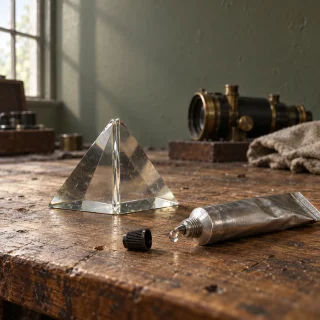
In nineteen fifty-one, a chemist in Kingsport, Tennessee, spread a thin film of a clear liquid between the two glass prisms of an instrument called a refractometer, took his reading, and then found that he could not pull the instrument apart. The liquid was a cyanoacrylate. We keep a version of it in a kitchen drawer today and call it super glue.

0:00 / 11:55

A plastic that failed at its job

In 1942, a team at Eastman Kodak's research laboratories in Rochester, New York, was trying to find a clear plastic that could be cast into precision gunsight lenses for the war effort. The chemicals the team tested, cyanoacrylates, would not cooperate. They bonded to everything they touched — the glassware, the tools, one another — and the group set them aside and went back to grinding gunsight lenses out of glass. 12
The behaviour that ruined the experiments comes down to water. A cyanoacrylate molecule is a small unit that links with its neighbours into long chains in the presence of hydroxide ions, and almost every surface carries a thin film of moisture. The liquid therefore sets in place on contact, with no heat and no pressure. 3

The refractometer that would not come apart

In 1951, Coover was supervising chemists at Kodak's chemical operation in Kingsport, Tennessee. That group was looking for heat-resistant polymers for jet aircraft canopies. A colleague named Fred Joyner was testing a sample of ethyl cyanoacrylate by spreading a thin film of it between the two glass prisms of a refractometer, an instrument that measures how a liquid bends light. The prisms fused. A piece of equipment worth about seven hundred dollars was destroyed.
Joyner reported the loss to Coover, who later wrote that any concern about the refractometer was swept away by the realisation that they had not a useless instrument but a unique adhesive. He asked for the rest of the sample and spent the afternoon gluing whatever he could reach. 4

What the patents claim

Coover and a colleague, Newton Shearer, filed an application on November 1, 1952, for adhesive compositions built on alkyl esters of cyanoacrylic acid. It was granted on June 4, 1957 as U.S. Patent 2,794,788, assigned to Eastman Kodak. 5 Coover filed again on June 2, 1954, on a composition using a small amount of alcohol to promote the bond, and that application came through first: U.S. Patent 2,768,109, granted on October 23, 1956. 6
The documents describe the material in flat technical language. The monomer is stored with a trace of acid that keeps it liquid; spread as a thin film, it polymerises in place. No heat, no pressure, no clamps are required, and the patent lists glass, wood, metal, fabric, paper and rubber among the materials it will bond.

From a factory adhesive to a household word

The adhesive went on sale in 1958 as Eastman 910, sold to manufacturers rather than to households. In 1959 Coover demonstrated it on the quiz show I've Got a Secret: two metal cylinders were glued together, a crossbar was screwed into one, and the host, Garry Moore, was raised into the air hanging from the joint. 7
Loctite held a licensing agreement with Kodak through the 1960s and sold the chemical to industry, and in the early part of that decade it began selling to consumers. By 1971 the company was manufacturing cyanoacrylates itself. Coover's 1954 patent expired in 1973, and by the mid-1980s he was telling reporters that roughly 100 million tubes a year were being sold to consumers. 37

Wounds, and fingerprints

Coover began working with Ethicon, a medical device company then owned by Johnson & Johnson, in 1960, and the work went to the U.S. Food and Drug Administration as an application for a tissue adhesive in 1964. A purpose-made cyanoacrylate skin adhesive, Dermabond, was not approved until August 26, 1998 — thirty-four years later. 8 In Vietnam, medics reportedly sprayed cyanoacrylate over wounds to stop bleeding long enough to reach a hospital, a use that appears in the record without ever having been an approved indication. 2
In 1978, the Criminal Identification Division of the Japanese National Police Agency worked out that warmed cyanoacrylate vapour settles on the invisible residue of a fingerprint and hardens into a white polymer copy of the ridges. Police laboratories in Britain and Canada reached the same method independently within two years. 9

One correction to the popular version

The story is often told as a wartime invention designed to seal battle wounds. The record reads the other way round. The material was found while Kodak was trying to improve gunsights, it was shelved, and it was recognised as an adhesive in 1951 by a chemist whose colleague had just ruined a refractometer. Its use on wounds in Vietnam came later and unofficial, and the medical version regulators would accept did not exist until 1998. 48
Both of the material's later careers rest on the property that ended its first one. It bonds to any surface carrying a film of moisture, which is exactly what skin and a fingerprint are.

References

  1. 1
    Lemelson-MIT: Harry Coover

    lemelson.mit.edu

  2. 2
    Popular Science: The story of Super Glue began with gunsights

    popsci.com

  3. 3
    Wikipedia: Cyanoacrylate

    en.wikipedia.org

  4. 4
    Chantelle Champagne, University of Calgary: Serendipity, Super Glue and Surgery

    ucalgary.scholaris.ca

  5. 5
    Google Patents: U.S. Patent 2,794,788

    patents.google.com

  6. 6
    Google Patents: U.S. Patent 2,768,109

    patents.google.com

  7. 7
    Chicago Tribune (1986): Inventor Harry Coover deals with sticky situations

    chicagotribune.com

  8. 8
    U.S. Food and Drug Administration: Premarket approval P960052 — Dermabond

    accessdata.fda.gov

  9. 9
    Egyptian Journal of Forensic Sciences (2017): Cyanoacrylate fuming method for detection of latent fingermarks

    pmc.ncbi.nlm.nih.gov

The Patent Office
The Patent Office@NeoDrop Official

This story was produced automatically by a channel. One sentence is all it takes for Neodrop to keep producing for you.

Related content