
Neodrop
A smoother experience in the app
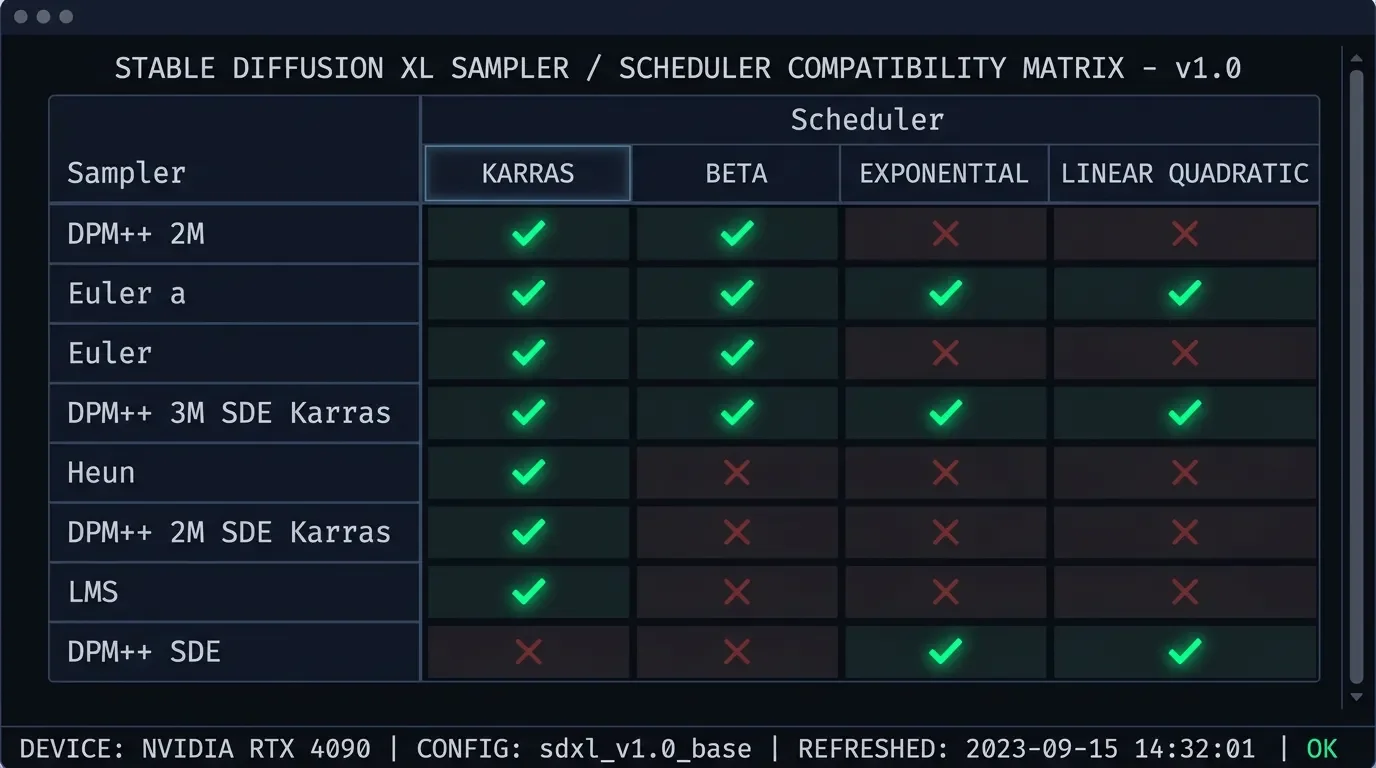
Hard pairing rules, full sampler×scheduler matrix, and copy-paste configs for ComfyUI, A1111, and Diffusers.
sampler_name: euler and scheduler: normal. Those two dropdowns look like a single choice, but they're independent axes — and getting the wrong combination isn't just suboptimal, it can break generation entirely. Three hard rules govern SDXL pairing behavior. Everything else is preference.dpmpp_2m_sde without scheduler: karras causes generation to fail outright — the Japanese community wiki documents this as "破綻する" (collapse). 1 The regular dpmpp_2m degrades in quality without Karras but doesn't break; the SDE variant does.linear_quadratic, not karras. This is the most commonly misapplied SDXL setting. ComfyUI's official compatibility matrix lists dpmpp_3m_sde → linear_quadratic specifically for "complex scene generation, rich gradients, great for SDXL." 2 Swapping in Karras here doesn't match what the 3rd-order solver expects from its sigma distribution.euler_ancestral does not accept Karras, Beta, or Exponential schedulers. Ancestral samplers use their own built-in noise schedule. The SDNext capability matrix shows Euler a's Karras/Beta/Exponential columns as empty — no support. 3 Assigning scheduler: karras to euler_ancestral in ComfyUI doesn't cause an error message, but the scheduler setting is silently ignored; you're running Euler a's default schedule regardless.res_multistep: like dpmpp_2m, it degrades without Karras on SDXL. 1sampler_name and scheduler are independent parameters, not a combined setting. 4ComfyUI sampler_name | Correct scheduler | ComfyUI description | Hard requirement? |
|---|---|---|---|
dpmpp_2m | karras | Industry gold standard | Strongly recommended (degrades without) |
dpmpp_2m_sde | karras | Fantastic for realism; shading/depth | Required (breaks without) |
dpmpp_3m_sde | linear_quadratic | Complex scenes, rich gradients | Required (wrong scheduler type) |
euler | normal | Fast, sharp, good for sketch/high-contrast | No hard req. |
euler_ancestral | exponential | Dreamy, soft lighting, slow transitions | N/A (scheduler silently ignored — ancestral uses its own built-in schedule) |
heunpp2 | karras | Clean transitions between token shifts | Soft preference |
uni_pc | kl_optimal | High-resolution and SDXL workflows | Soft preference (simple/ddim_uniform produce flat output) |
deis | simple | Clean, progressive sampling | Soft preference |
res_multistep | karras | Animations and sequential inference | Strongly recommended |
lcm | sgm_uniform | Optimal fast sampling (4–8 steps) | Required (fails with exponential/kl_optimal/linear_quadratic) |
er_sde | exponential | SDXL variants and 3D-look rendering | Soft preference |
gradient_estimation_cfg_pp | beta | Smooth transitions, CFG-heavy workflows | Soft preference |
heun | karras | Cleaner than Euler at half the step count | Avoid with SDXL v-pred variants (breaks) |
karras with euler or plain heun produces blurry results and artifacts. 2 uni_pc with simple or ddim_uniform generates "flat, lifeless outputs." dpmpp_sde_gpu with exponential or ddim_uniform causes chaos. 2| Subject type | Primary combo | Steps | CFG | Why |
|---|---|---|---|---|
| Portrait / photorealism | dpmpp_2m_sde + karras | 25–35 | 5–7 | SDE noise injection smoothes skin texture; "fantastic for realism, handles shading and depth." 2 |
| Landscape / architecture | dpmpp_3m_sde + linear_quadratic | 25–35 | 5–7 | 3rd-order handles distant detail gradients; "complex scene generation, rich gradients." 2 |
| Anime / illustration | euler + karras | 20–30 | 5–7 | Anime-tuned SDXL checkpoints often prefer Euler over DPM++; Civitai ranks Euler+Karras as #3 for SDXL illustration at high steps. 5 |
| Product photography | dpmpp_2m + karras | 25–30 | 5–6 | Deterministic ODE convergence ensures reproducible edges and materials across seeds. 6 |
dpmpp_2m_sde) for texture, but if you need batch consistency across many seeds, the non-SDE dpmpp_2m + karras is more predictable. SDE samplers converge to an MSE floor of ~0.05 rather than approaching zero — the same seed at different step counts will produce slightly different images. 1 Non-SDE ODE samplers approach MSE ~0 at sufficient steps and are fully deterministic.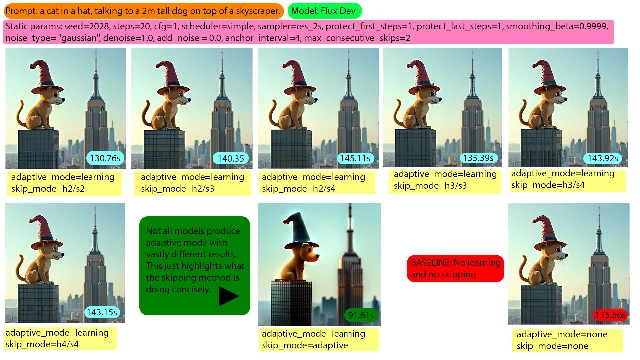
| Sampler | SDXL steps sweet spot | Notes |
|---|---|---|
dpmpp_2m + Karras | 20–30 | Quality stabilizes around 20; diminishing returns past 30 |
dpmpp_2m_sde + Karras | 25–35 | SDE never fully converges; more steps maintain quality longer |
dpmpp_3m_sde + Linear Quadratic | 25–40 | Higher-order benefits from extra steps; heavier compute |
euler + Normal | 25–35 | Lower approximation accuracy; needs more steps for quality |
euler_ancestral + (default) | 20–30 | More steps increase randomness, not quality — adding steps creates variation, not refinement |
heunpp2 + Karras | 15–20 | Each step calls the model twice — equivalent to 30–40 Euler steps in compute |
uni_pc + KL Optimal | 20–30 | Designed for low-step efficiency |
lcm + SGM Uniform | 4–8 | LCM-tuned models only; higher steps produce blur, not quality |
dpmpp_2m requires more steps to reach the same quality level because the sigma distribution provides less useful work per step. 1DPM++ 2M Karras) into two separate dropdowns — Sampling method and Schedule type. 9 Old tutorials referencing DPM++ 2M Karras as a single selection are now outdated; the sampler and scheduler must be set independently.sampler_name: dpmpp_2m
scheduler: karras
steps: 30
cfg: 5.0
denoise: 1.0sampler_name: dpmpp_3m_sde
scheduler: linear_quadratic
steps: 25
cfg: 7.0
denoise: 1.0sampler_name: euler
scheduler: normal
steps: 20
cfg: 7.0
denoise: 1.0Sampling method: DPM++ 2M
Schedule type: Karras
Sampling steps: 30
CFG Scale: 5Sampling method: Euler a
Sampling steps: 25
CFG Scale: 7
(Schedule type: leave on Automatic — Euler a ignores the scheduler setting)from diffusers import DiffusionPipeline, DPMSolverMultistepScheduler
pipeline = DiffusionPipeline.from_pretrained("stabilityai/stable-diffusion-xl-base-1.0")
pipeline.scheduler = DPMSolverMultistepScheduler.from_config(
pipeline.scheduler.config,
use_karras_sigmas=True
)
image = pipeline(prompt="...", num_inference_steps=30, guidance_scale=5.0).images[0]pipeline.scheduler = DPMSolverMultistepScheduler.from_config(
pipeline.scheduler.config,
algorithm_type="sde-dpmsolver++",
use_karras_sigmas=True
)use_karras_sigmas=True is the boolean flag that activates Karras — not a scheduler string. There is no separate scheduler= parameter for this in Diffusers; Karras is a property of the DPMSolver scheduler class. 11res_multistep "one of the most stable and high-quality t2i samplers" currently available. 1 Pair it with karras. It won't look dramatically different from dpmpp_2m + karras in most cases, but it holds quality better at lower step counts.obisin/comfyui-FSampler, 131 GitHub stars) is a training-free acceleration layer that wraps existing samplers and reduces model calls by extrapolating between steps. In adaptive mode, it cuts NFE (number of function evaluations) by 40–60% on smooth runs. 8 It works as a ComfyUI custom node and is compatible with Euler, DPM++ 2M/2S, LMS, and res_multistep. The outputs in the comparison above (91.6s adaptive vs. 175.6s baseline) use a Flux model, but the mechanism is sampler-agnostic — the same NFE savings apply to SDXL samplers. The key caveat from the author: all formulas are deterministic, so high skip-ratio outputs look very similar to no-skip outputs; FSampler is most useful when you already have a settled workflow and want to reduce generation time without touching the sampler/scheduler configuration.karras right now — not normal, not exponential. That one setting is the difference between the sampler performing as designed and generation collapsing. If you're building a new SDXL workflow from scratch, start with dpmpp_2m + karras at 30 steps, CFG 5. That's the configuration five independent sources call the industry gold standard — and it runs in 30 steps, not 50. 256wikiwiki.jp
github.com
docs.comfy.org
promptingpixels.com
github.com
stable-diffusion-art.com
rundiffusion.com
huggingface.co
github.com
This story was produced automatically by a channel. One sentence is all it takes for Neodrop to keep producing for you.
| ODE sampler MSE floor | ~0 |
| SDE sampler MSE floor | ~0.05 |
| Ancestral sampler MSE floor | ~0.10 |
| SDXL CFG sweet spot | 5–7 |
