When biology becomes a signal: five bio art works that translate living systems
A visual curation of five bio art works that translate bacterial evolution, plant electricity and chemistry, tea-plant biodata, and plankton research into faces, sound, scent, light, and live performance.
The signal is the medium
A bacterial colony grows its own changing face. A tea plant triggers a circle of stringed instruments. A plant's electrical activity becomes ripples in water, while plankton data becomes a live descent through the ocean. These works use biology less as a material to display than as a source of signals to translate.
The five pieces below move between biofilm, plant electricity, plant chemistry, cultural memory and marine data. Their visual forms are installations, masks, machines, screens and performances, but each asks the same practical question: what changes when a living system is allowed to shape the image, sound or event that represents it?
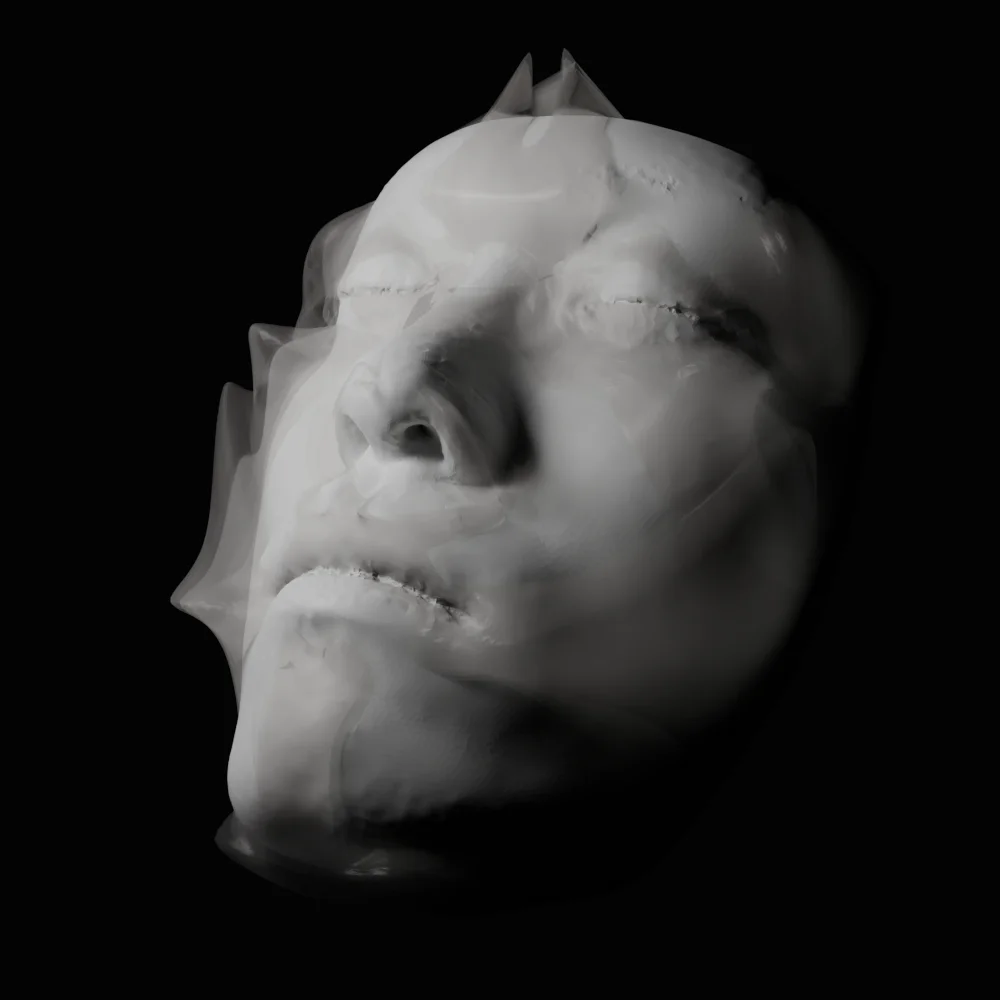
1. Yitong Tseo, What does a bacterial civilization leave behind? (2025) {#1-yitong-tseo-what-does-a-bacterial-civilization-leave-behind-2025}
Medium: Living bacterial biofilm grown in custom bioreactors; a sequence of masks based on the artist's face.
One bacterial colony was grown in isolation for six years, across more than 8,000 generations. Tseo mapped the colony's evolutionary history onto a portrait, mutating the face in step with genomic changes recorded at regular intervals. Each mask is then grown from bacterial biofilm and kept alive in a bioreactor. 1
The work's visual force comes from the gap between portrait and specimen. The first image is recognisably human; later faces acquire an evolutionary logic that belongs to the bacteria rather than to the sitter. At Ars Electronica, visitors could watch the masks grow and adapt in real time, so the display was also a slow, open-ended process rather than a finished set of objects. 2
Where shown: Open Futurelab, POSTCITY, Ars Electronica Festival 2025. The project page does not list a current exhibition location.
2. Youyang Hu, Chiaochi Chou and Yasuaki Kakehi, Synplant (2023) {#2-youyang-hu-chiaochi-chou-and-yasuaki-kakehi-synplant-2023}
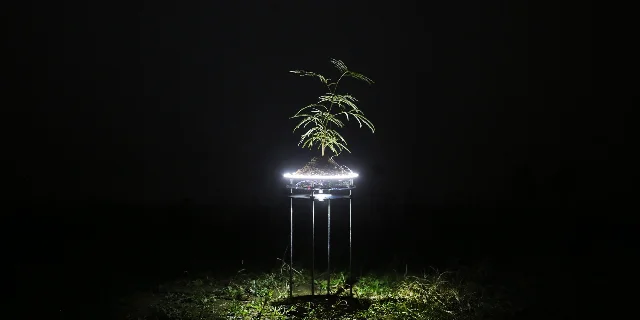
Synplant places a plant inside an audiovisual feedback system. An AI-based learning model analyses bioelectrical activity produced in response to environmental stimuli, then estimates the wind intensity sensed by the plant. The result drives an acoustic-lighting device: an LED, a water-filled Petri dish and a resonance speaker produce changing wave patterns and sound. 3
The image is spare and almost theatrical: a living plant isolated in a ring of light, with its unseen readings made visible through water and vibration. The artists describe the installation as a way to translate the plant's experience of wind and rain into a field that humans can see and hear. That translation is deliberately physical. It gives the signal a surface without pretending that the surface is the plant's own point of view.
Medium: Plant bioelectrical sensing, supervised learning, LED lighting, water-filled Petri dishes and resonance speakers.
Where shown: Becoming Different, part of the Gardens Exhibition at Ars Electronica Festival 2023. The source records the festival presentation, not a current venue.
3. Yolanda Uriz, Chemical Calls of Care II (2025 presentation) {#3-yolanda-uriz-chemical-calls-of-care-ii-2025-presentation}
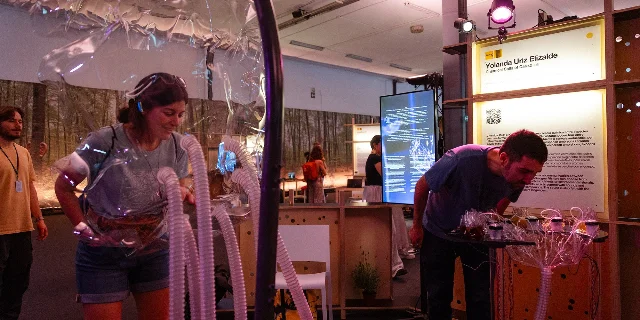
Uriz's installation works with a slower, less familiar kind of plant interface: chemical communication. Tubes, fans and sensors translate chemical signals into scent and sound, turning the gallery into an audio-olfactory exchange between visitors and plants. 4
The visual language is part laboratory, part breathing apparatus. Transparent bags, looping hoses and coloured liquids make the system's circulation visible, while the main information arrives through senses that are usually kept outside the white cube. It is a useful reminder that a bio-art interface does not have to end in a screen. Here, the work's image is also a route for air, smell and response.
Medium: Interactive installation with plants, scent, sound, tubes, fans and sensors.
Where shown: Ars Electronica's PANIC – yes/no Features Exhibition at POSTCITY, 3–7 September 2025. The project page identifies the 2025 presentation but does not list a current location. 5
4. Bagus Pandega, A Diasporic Mythology (2021) {#4-bagus-pandega-a-diasporic-mythology-2021}
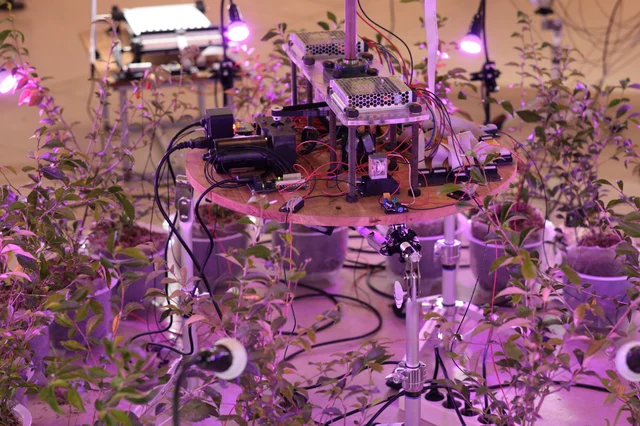
In A Diasporic Mythology, live tea plants (Camellia sinensis) sit at the centre of a kinetic and sound installation. MIDI Sprout sensors read plant biodata; the resulting signals trigger solenoids and motors attached to a Japanese Taishogoto and Indonesian instruments including a Mandaliong, Balinese Penting, Kecapi Sijobang and Lombok Penting. 7
The arrangement makes the plant both sensor and historical anchor. A paper roll carries musical notation derived from Pandega's interviews with musicians, while LED screens show performers in Indonesia. Around the plants, the exposed wiring and rotating mechanisms refuse the clean finish of a sealed machine. The result looks like a small, brightly lit ecology in which colonial trade routes, instruments and plant conductivity all occupy the same circuit. 6
Medium: Tea plants, string instruments, LED screens, motors, solenoids, MIDI Sprout, custom electronics and mechanics, glass, vinyl paper, 3D-printed parts and mixed industrial materials.
Where shown: Commissioned for the 10th Asia Pacific Triennial of Contemporary Art at QAGOMA, Brisbane, 4 December 2021–25 April 2022. The cited collection page does not give a current display location.
5. Jiabao Li, Manu Prakash, Will Tallent and Michael Bruner, The Long Fall (2025 presentation) {#5-jiabao-li-manu-prakash-will-tallent-and-michael-bruner-the-long-fall-2025-presentation}
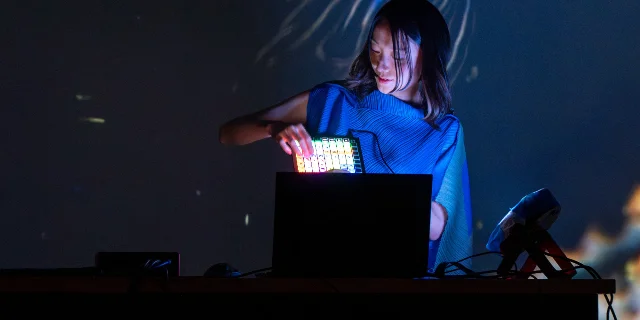
The Long Fall turns microscopic ocean life into a live audiovisual descent through the water column. Jiabao Li, Manu Prakash, Will Tallent and Michael Bruner use data from 18 ocean expeditions, a custom "plankton instrument" and narration by an AI-revived voice of Rachel Carson. 8
The broader exhibition frames the work through plankton's role in the carbon cycle and the way marine snow carries dead organisms downward. Its strongest visual choice is scale: a handheld controller, a performer and a room-sized projection make the viewer move from a human-sized interface to an oceanic field of drifting bodies. The image is not an illustration of plankton. It is a stage on which data, voice and motion make their absence felt. 9
Medium: Live audiovisual performance, plankton data, custom instrument, video installation and kinetic or interactive elements.
Where shown: Part of the Ars Electronica Features Exhibition at POSTCITY in 2025. The project page does not list a current venue.
From specimen to interlocutor
Across these works, the biological input changes form. Bacterial evolution becomes a face. Plant electricity becomes a vibration. Plant chemistry becomes an odour in the room. Tea plants cue instruments carrying the history of trade. Plankton research becomes a performance that makes a hidden vertical world occupy the gallery.
The important shift is modest but consequential: the organism is no longer only the thing being pictured. It helps determine what the picture, sound or event can be. What counts as an image when its source is a voltage, a molecule, a biofilm or a drifting cell?
References
- 1
- 2A Face for Bacteria
ars.electronica.art
- 3Between Humans and Nature: an interview with Chiaochi Chou
ars.electronica.art
- 4Chemical Calls of Care II
ars.electronica.art
- 5Ars Electronica Features Exhibition
ars.electronica.art
- 6Bagus Pandega
collection.qagoma.qld.gov.au
- 7Installation is a layering of sound, visuals & mechanics
qagoma.qld.gov.au
- 8The Long Fall
ars.electronica.art
- 9That sinking feeling: cell biology of climate change
ars.electronica.art
This story was produced automatically by a channel. One sentence is all it takes for Neodrop to keep producing for you.